October 12, 2026
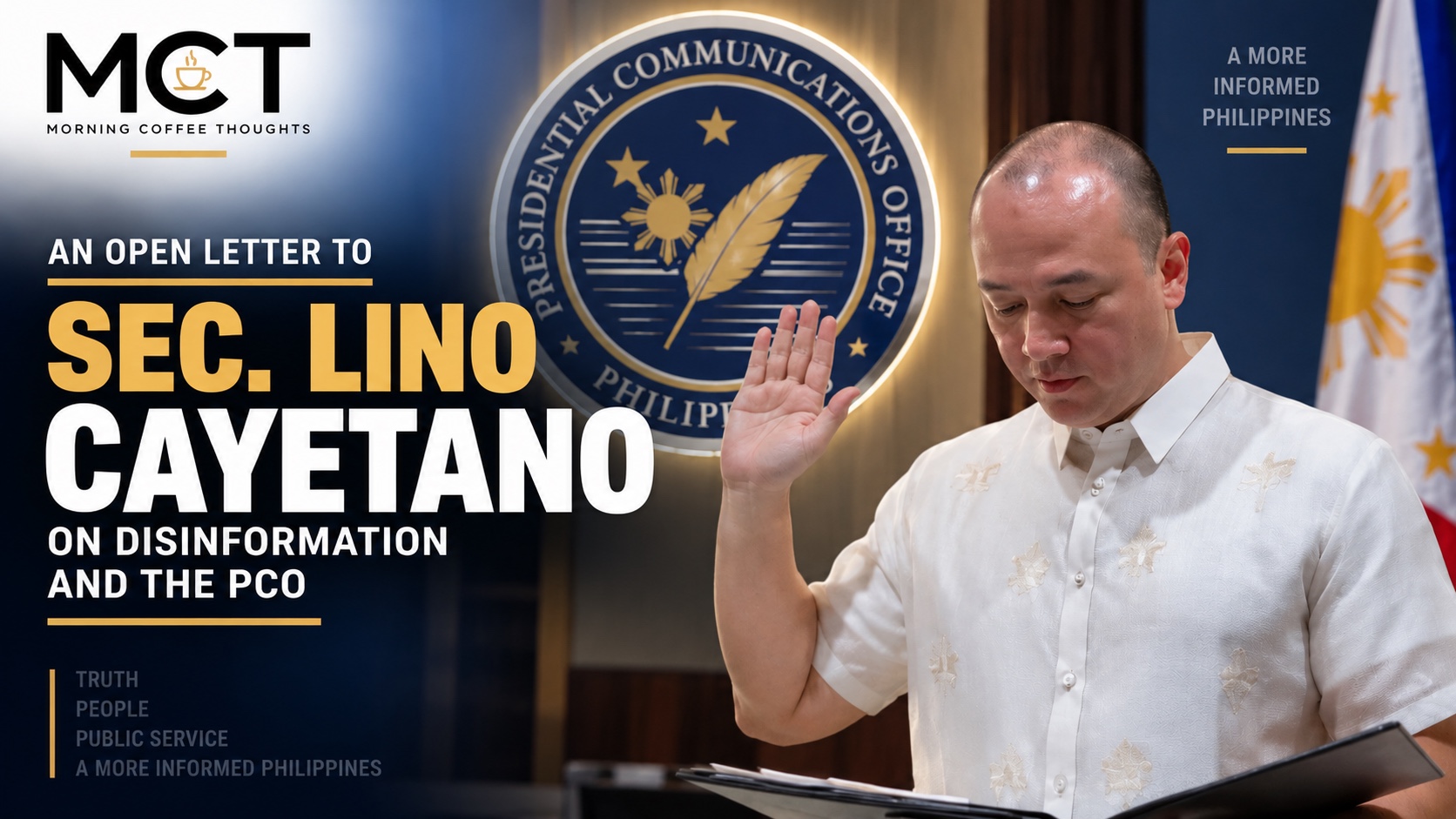
Dear Direk Lino,
First, congratulations on being named the next Secretary of the Presidential Communications Office.
Since you already follow Morning Coffee Thoughts, I thought I would write to you directly about something I have been concerned about for quite some time. I am referring to misinformation, disinformation, and the organized networks that deliberately deceive Filipinos.
I know you are familiar with the problem. We have Facebook Pages pretending to be legitimate news organizations, fabricated statements attributed to public officials, manipulated videos, AI-generated recordings, and accounts that appear to work together to influence political discussions.
Then there are the troll networks. Some are suspected of operating as organized businesses, with people allegedly paid to manage accounts, attack critics, promote political personalities, and manufacture the appearance of public support.
I have always wondered how many of these accounts represent genuine individuals expressing their opinions and how many belong to operations designed to make a particular political position appear popular.
And perhaps the most frustrating development is how easily legitimate information can now be dismissed as fake news simply because someone does not like what it says.
Direk Lino, I understand that the PCO cannot solve this problem on its own.
Under Executive Order No. 16, your office is primarily responsible for coordinating Executive Branch communications and engaging the public and media on governance. The PCO is neither a law enforcement agency nor an institution with unlimited authority to regulate what Filipinos say online.
But the PCO also has a responsibility to provide accurate government information. And through its existing programs, it has already accepted a role in addressing misinformation and disinformation.
Which brings me to something I want to share with you.
I have been disappointed with the PCO's Anti-Fake News Desk.
When it was established in March 2026, I welcomed the initiative. I thought we were finally developing an accessible government mechanism through which Filipinos could report fabricated information and seek assistance in addressing coordinated online deception.
But as I followed its activities, I began wondering whether its priorities were too closely associated with defending the incumbent administration.
There was considerable public attention given to fabricated claims concerning President Marcos, particularly those involving his health. I understand why the PCO responded. Correcting false information about the President falls within its communications responsibilities.
And I recognize that the desk has also handled other cases, including false information concerning the energy situation, fabricated government announcements, and misleading reports involving Senator Ronald dela Rosa.
So I would not be fair if I accused the desk of working exclusively for the President.
Still, I would like to know what it has accomplished for the Filipino public beyond those announced cases.
How many complaints has the desk received since its establishment? How many were investigated? How many resulted in public corrections? How many were referred to the DOJ or other investigative agencies? What happened to those referrals?
And how many of those complaints involved claims unrelated to the President or his administration?
I looked for a sufficiently detailed public accounting of these activities but could not establish the answers from the available announcements.
I hope you will consider publishing those figures.
I would also be interested in knowing how the desk decides which complaints deserve immediate attention and which ones do not.
For example, if someone publishes a fabricated statement attacking a political opponent of President Marcos, will the desk respond with the same urgency?
What if the false information originates from someone supporting the administration?
And what happens when an inaccurate statement comes from a government official?
I ask these questions because the Anti-Fake News Desk was presented as a public service. Its published objectives extend beyond defending Malacañang.
I hope your leadership can make that wider purpose visible through its actual work.
I would also encourage you to review the existing programs before introducing anything new.
The PCO already has Oplan Kontra Fake News, its partnership with nine major newspapers, the Maging Mapanuri media literacy initiative, and coordination arrangements with the DICT and DOJ.
What have these programs accomplished? Which activities produced measurable results? What needs improvement?
I would rather see an existing program become genuinely useful than another launching ceremony introducing essentially the same initiative under a different name.
One practical improvement I hope you will consider is developing the Anti-Fake News Desk into an accessible, searchable public verification service.
A Filipino who receives a suspicious government announcement through Messenger should be able to check whether it is genuine. Someone encountering a manipulated video should have somewhere to submit it for verification.
The system could issue tracking numbers for complaints, provide the status of verification requests, and maintain a searchable archive of findings and corrections.
Each published finding should explain what was checked, what evidence was used, and what conclusion the evidence supports.
Where possible, the public should be able to access the original documents.
And when new information becomes available, the findings should be updated.
I would also like to see the PCO maintain a public record of corrections involving inaccurate government announcements.
Government agencies make mistakes, too. An official statistic may be incorrect, an announcement may contain outdated information, or a public statement may misrepresent what an official document actually says.
If the PCO wants Filipinos to trust government information, acknowledging and correcting those errors should become routine.
But Direk Lino, I believe we also need to pay closer attention to the technology behind organized disinformation.
We spend so much time correcting individual fake news posts that we sometimes overlook how those posts are distributed.
What interests me are the networks of Facebook Pages, accounts, administrators, advertising arrangements, and automated systems that may be working together to deceive the public.
Meta has already demonstrated that it can investigate coordinated inauthentic behavior.
In March 2019, Facebook removed 200 Pages, groups, and accounts associated with a coordinated network in the Philippines. The company identified connections among accounts that appeared unrelated to ordinary users.
Similar investigations have been conducted involving networks operating in or targeting the Philippines.
These operations may leave technical evidence.
IP addresses, account-access histories, shared Page administrators, device information, advertising records, payment arrangements, and coordinated posting patterns can help establish relationships among accounts.
Of course, an IP address alone does not identify the individual operating an account. Several people may share the same internet connection, and technologies such as VPNs can obscure the apparent origin of online activity.
But investigators can assess different indicators together.
This is where I hope the PCO can pursue stronger technical cooperation with the DICT, Meta, Google, TikTok, independent researchers, and authorized investigative agencies.
When a deceptive network is identified, the investigation should not necessarily end with the removal of one Facebook post.
If the platform establishes that several Pages and accounts are part of the same coordinated operation violating its policies, it should assess the entire network and apply its enforcement procedures accordingly.
There should also be measures addressing attempts to recreate accounts and Pages previously removed for serious violations.
And I hope the PCO can request regular transparency reports from these platforms.
How many suspected coordinated networks targeting Filipino audiences were reported? How many were investigated? How many resulted in account or Page removals? What happened to complaints that the platforms rejected?
I understand that digital platforms cannot simply surrender private user information to the government.
Access to protected account records, including IP logs and payment information, must follow applicable laws and proper legal procedures. The PCO should coordinate with agencies authorized to conduct criminal investigations rather than attempt to acquire those powers itself.
I also want to emphasize that political anonymity is not automatically deceptive.
A Filipino using a pseudonym to criticize the government should not be treated like an operator managing hundreds of fabricated identities to misrepresent public opinion.
And no Facebook Page should be removed simply because its administrator criticizes President Marcos, Vice President Duterte, or any other public official.
The basis for platform enforcement should be documented violations of applicable policies. Criminal investigations must have a proper legal basis.
There is also the question of financing.
If an organized disinformation operation employs people to manage hundreds of deceptive accounts, purchases advertisements, and systematically distributes fabricated information, somebody may be paying for those activities.
Who finances these operations?
Are the payments coming from private political organizations, government contractors, public funds, or foreign sources?
I am not suggesting that financing political commentary is automatically illegal. But where there is evidence of fraud, unlawful use of public resources, foreign interference, or other criminal conduct, the appropriate investigative agencies should be able to follow the financial and technical evidence.
I hope your office can help establish procedures for referring such evidence to the proper authorities.
Your predecessor and the DICT already wrote to Meta in April 2026, requesting stronger measures against harmful disinformation, including coordinated inauthentic behavior.
The government requested faster reporting procedures, dedicated coordination personnel, improved detection systems, and regular transparency reporting.
I would appreciate knowing what happened after that communication.
Did Meta respond? Was an implementation plan submitted? Were any operational arrangements adopted? Have they produced measurable results?
If those arrangements already exist, perhaps the PCO could publish an account of their implementation, subject to legitimate confidentiality and security limitations.
And if cooperation has been inadequate, the public should know that, too.
I also hope you will take an interest in what Congress has already done.
The House and Senate have considered proposals addressing fake news, coordinated disinformation, troll farms, and the responsibilities of digital platforms. Senate committee hearings have also questioned representatives of Meta about manipulated content and the platform's response procedures.
There are existing legal provisions, including Article 154 of the Revised Penal Code and the Cybercrime Prevention Act, that may apply to particular offenses involving false information or online misconduct.
But these laws do not automatically make every inaccurate statement or coordinated political campaign a criminal offense.
Before supporting additional criminal penalties, I hope the PCO can work with the DOJ, DICT, legislators, independent legal experts, and digital-rights organizations to identify the actual gaps in existing law.
Which forms of deliberate deception can already be prosecuted? Which activities fall outside existing statutes? Are the difficulties caused by inadequate legislation, insufficient technical resources, or problems with implementation?
These are questions Congress could use help answering.
The PCO has an opportunity to provide technical findings and operational data from its own programs.
Any proposed legislation should also be carefully assessed for its effect on freedom of expression.
A person sharing inaccurate information in good faith should not automatically face criminal prosecution. Neither should someone expressing an unpopular opinion, publishing satire, or raising allegations against a government official.
And an allegation cannot be classified as false merely because the government denies it.
I would be particularly concerned about giving any administration broad authority to determine which political statements Filipinos are permitted to publish.
The same concern applies to government requests for social-media content removal.
There must be clear standards, documented evidence, appropriate review procedures, and safeguards against political abuse.
Another area I hope you will give attention to is public education.
You have extensive experience in television production, and you previously headed PTV. You understand how information can be presented in ways ordinary viewers can follow.
Perhaps PTV and government radio could develop regular, short programs teaching Filipinos how to recognize suspicious online content.
Show people how to verify government announcements, identify manipulated images, check the origin of viral quotations, and distinguish authentic documents from fabricated screenshots.
Explain how AI-generated audio and video can be used to impersonate public officials.
Make the programs available in Filipino and major Philippine languages. Allow schools, local governments, community organizations, and independent content creators to reproduce and distribute the educational materials.
I would also encourage the PCO to work with DepEd, CHED, and independent educational institutions to expand practical media literacy instruction.
The government should not assume that simply telling people to be careful online will change their habits.
Teach them how to verify information themselves.
I run a political blog, Direk Lino, and I regularly encounter people who accept questionable information because it supports what they already believe.
Sometimes they share it without checking. Sometimes they reject legitimate documents because the findings are unfavorable to their preferred politicians.
I have seen how difficult it can be to correct a false claim after it has circulated widely.
Even when the original post is removed, screenshots and copies can continue circulating. People may also retain the mistaken belief long after the correction has been published.
That is why I believe we need both technological intervention and sustained public education.
But I also recognize the limits of government involvement.
The PCO serves the President. That is the nature of the office.
It is expected to communicate government policies, explain the administration's decisions, and respond to inaccurate claims about presidential activities.
I have no problem with those responsibilities.
My concern arises when the same office undertakes verification activities intended to serve the wider public.
For that function to gain public trust, the methods and standards need to be transparent.
I hope you will consider inviting independent fact-checkers, researchers, journalists, legal experts, and digital-rights advocates to review the Anti-Fake News Desk's verification procedures.
They should be free to question government findings without losing access to cooperation or information.
The PCO could also publish regular performance reports.
How many complaints were received? What types of false information were reported? How many corrections were published? How many cases were referred to other agencies? What happened to those referrals?
How much public money was spent? What measurable improvements have the programs produced?
I would be interested in reading those reports, and I suspect many other Filipinos would be as well.
Direk Lino, I realize that your new position comes with considerable responsibilities.
You will be dealing with presidential communications, government announcements, public information, state media, and the daily demands of an administration that is constantly being scrutinized.
But I hope the fight against misinformation and organized disinformation receives sustained attention under your leadership.
And I hope the effort extends beyond protecting President Marcos from fabricated information.
The President has the resources of the government communications apparatus to respond to false claims about him.
Ordinary Filipinos generally do not have those resources.
Neither do teachers falsely accused online, small business owners targeted by fabricated posts, families deceived by fake government advisories, or voters exposed to manipulated election information.
They deserve reliable ways to verify information, report suspected deception, and seek assistance from the appropriate institutions.
I would like to see the PCO help develop an anti-disinformation program with transparent procedures, published standards, measurable results, and safeguards that prevent its use against legitimate political criticism.
A program that remains useful after the Marcos administration ends.
I am not expecting you or the PCO to eliminate fake news. That would be unrealistic.
But I believe the government can improve how it communicates, make verified information accessible, educate citizens, coordinate with technology companies, and help authorized investigators address organized deception when the evidence supports legal action.
And perhaps the PCO can begin by showing the public what its existing anti-disinformation programs have actually accomplished.
You are taking over an office that has already made commitments in this area. You have an opportunity to review those commitments, assess their results, and decide what needs to be improved.
I hope you will give these proposals serious consideration.
I also hope your office will be open to criticism and independent scrutiny as the programs develop. That is part of building public confidence in government institutions.
I wish you well, Direk Lino.
And I hope that under your leadership, Filipinos will eventually see the PCO's anti-disinformation efforts as a reliable public service, regardless of who occupies Malacañang.
Sincerely,
Gino
Morning Coffee Thoughts
SOURCES
- Executive Order No. 16, February 13, 2023https://lawphil.net/executive/execord/eo2023/eo_16_2023.html
- PCO, Oplan Kontra Fake News, March 4, 2026https://pco.gov.ph/news_releases/pco-all-major-newspapers-join-forces-in-oplan-kontra-fake-news/
- PCO Anti-Fake News Deskhttps://antifakenewsdesk.e.gov.ph/
- PCO, referral of energy-related disinformation to the DOJ, April 7, 2026https://pco.gov.ph/news_releases/pco-asks-doj-to-investigate-facebook-page-over-alleged-fake-energy-related-posts/
- PCO and DICT communication to Meta, April 11, 2026https://pco.gov.ph/news_releases/govt-orders-meta-platforms-inc-to-curb-all-fake-news-warns-of-legal-action/
- PCO, interagency cooperation and evidence preparation, April 13, 2026https://pco.gov.ph/news_releases/pco-readies-evidence-vs-fake-news-spreaders-as-govt-steps-up-disinformation-drive/
- Meta, coordinated inauthentic behavior in the Philippines, March 2019https://about.fb.com/news/2019/03/cib-from-the-philippines/
- Republic Act No. 10175, Cybercrime Prevention Acthttps://lawphil.net/statutes/repacts/ra2012/ra_10175_2012.html