
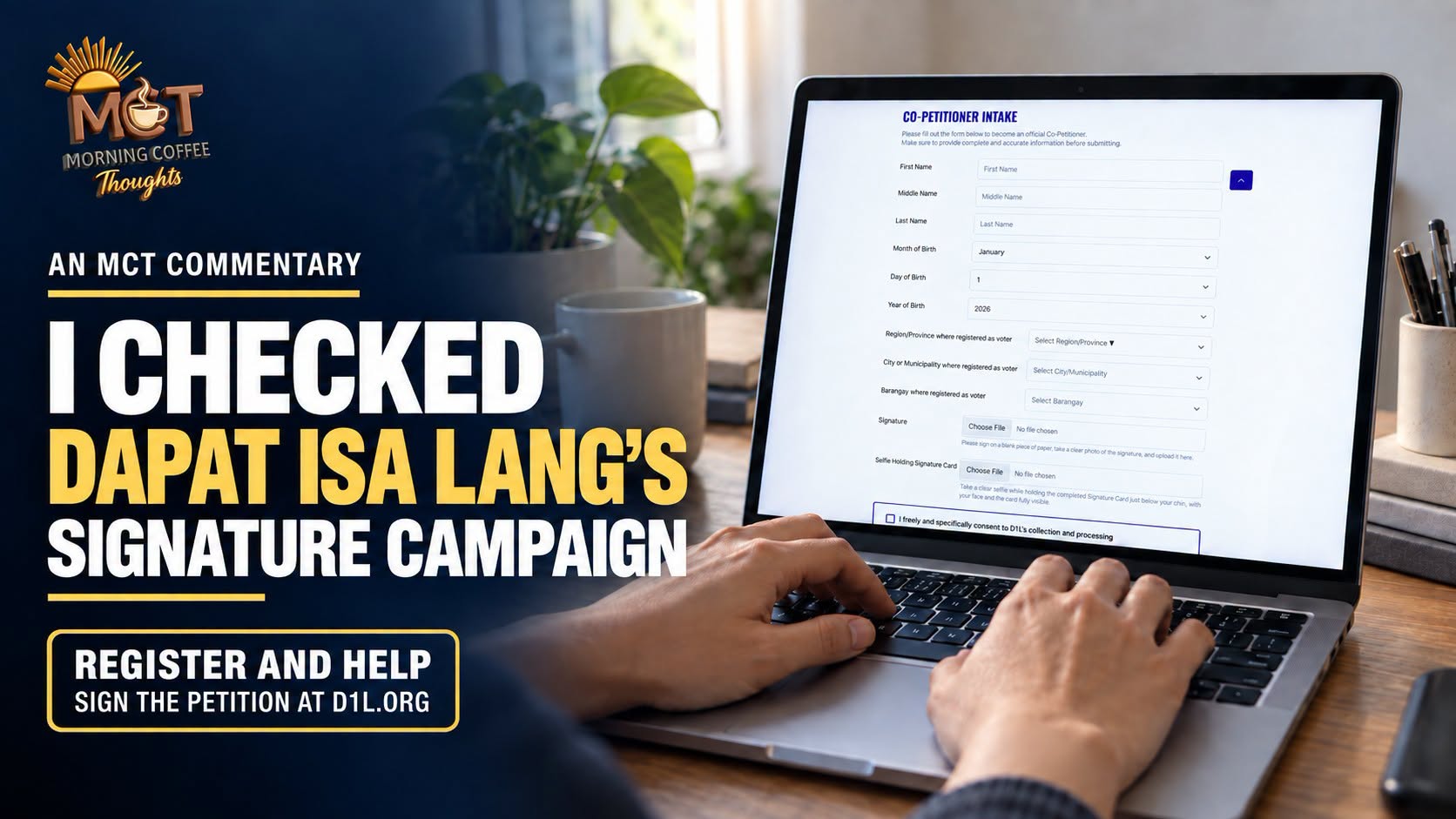
Earlier today, an MCT community member emailed me asking what I thought about the Dapat Isa Lang registration page. His concern was understandable because the page asks for personal information, a handwritten signature and a selfie.
I opened the site, went through the form, read the privacy notice and checked the rules covering a People’s Initiative. The first thing people need to know is that this is part of a signature campaign for a proposed Anti-Political Dynasty Law. When you complete the process, you are joining as a co-petitioner in that initiative.
That context explains why Dapat Isa Lang is asking for information that would look excessive on an ordinary website.
WHAT THE FORM ASKS FOR
The current D1L co-petitioner form asks for your name, date of birth and the place where you are registered to vote. It also asks for an image of your handwritten signature and a selfie while holding the completed signature card below your chin so your face and the card can both be seen.
The form does not currently ask you to upload a government ID. D1L’s privacy notice says copies of government IDs should not be collected unless there is a documented legal or operational need and the collection is proportionate to that purpose.
The selfie is part of the present process, and I understand why some people would hesitate there. A photograph of your face beside your handwritten signature is sensitive information, so anyone collecting it has to explain what it is for and how it will be protected.
D1L says the information may be used to verify identity and eligibility, detect duplicate or fraudulent submissions, preserve evidence that the person voluntarily joined the petition, process withdrawals and support verification connected with the People’s Initiative.
Once you keep the signature campaign in view, those requirements begin to make sense.
ONE SIGNATURE SHOULD REPRESENT ONE PERSON
Under Republic Act No. 6735 and COMELEC rules, a national legislative initiative needs signatures from at least 10 percent of registered voters nationwide, with at least 3 percent of registered voters represented in every legislative district.
COMELEC rules also provide for verification of the signatures and the voter-registration status of the petitioners. So when Dapat Isa Lang gathers a signature, that entry is supposed to represent an actual registered voter who voluntarily joined the petition.
That creates an obvious problem for any online collection system. A name and an email address alone leave room for repeated submissions, impersonation and organized attempts to flood the database with questionable entries.
I have already thought about the same problem for MCT. When I was working on survey and commenting features, I kept asking myself how I could prevent one person from pretending to be many people.
If one operator can submit 100 survey responses, those responses can no longer be treated as 100 Filipinos. If one person can create dozens of accounts, that person can manufacture the appearance of public support or outrage.
I considered stronger identity controls for that reason. I wanted a system where one person could not turn himself into an army simply because he knew how to create accounts or automate submissions.
Dapat Isa Lang is dealing with the same problem while gathering signatures that may eventually be presented as support from registered voters across the country. The selfie, signature image, voter location and duplicate checks all serve that verification process.
THE TROLL PROBLEM IS REAL
We already know what organized political operators can do online in the Philippines.
Meta has removed Philippine networks for coordinated inauthentic behavior. Its 2019 investigation found fake and authentic accounts being used together to distribute political content while hiding who was behind the operation.
Researchers have also documented paid cyber troops and troll operations in Philippine electoral politics. Anyone who has watched Philippine political spaces online has seen how a small group can create many accounts, repeat the same claims and flood a discussion until actual users are buried under manufactured activity.
A signature campaign has to prepare for the same kind of abuse.
Somebody could feed hundreds of fake names into the D1L system, submit the same people several times or deliberately contaminate the database with entries that cannot survive verification. Even if those entries are eventually caught, somebody still has to identify them and separate them from legitimate submissions.
Weak verification would make that easier.
If Dapat Isa Lang eventually says several million Filipinos joined the petition, I would want those numbers to correspond to actual Filipinos who chose to sign. That is the job of the verification process.
I CHECKED WHO IS BEHIND DAPAT ISA LANG
I also wanted to know who was collecting the information.
Dapat Isa Lang can be traced to identifiable people and organizations. The People’s Initiative Coalition Against Dynasty publicly launched its digital platform on September 30, 2026.
Retired Supreme Court Senior Associate Justice Antonio Carpio demonstrated the online signing process during the launch. Former COMELEC chairman and 1986 Constitutional Commission member Christian Monsod also participated. PICAD convenor Eirene Aguila and Dapat Isa Lang head Karlo Abadines have been publicly identified with the campaign.
The petition itself is published on the website. D1L’s privacy notice identifies 1SAMBAYAN CORP. as the Personal Information Controller operating the digital co-petitioner platform.
Those are the checks I would want before giving any civic website my signature and photograph. I want identifiable people, an identifiable organization, a published purpose and documents I can inspect. Dapat Isa Lang has those.
I ALSO FOUND PROBLEMS
I do not think people should stop asking questions simply because the campaign can be traced to real people and organizations.
The privacy page still has unfinished portions that D1L should fix. Some fields for the Data Protection Officer remain incomplete, and parts dealing with processors, storage and retention also appear unfinished.
That is a problem because the site is asking people to submit their date of birth, voter location, signature and photograph. A signer should be able to find the proper contact information for the person handling privacy concerns and know who may process the records, where the information is stored and how long D1L plans to retain it.
I also noticed figures on the signing page showing 1,234,567 supporting signatures and a target of 3,000,000. I would not use those numbers as evidence of how many people have signed.
The publicly discussed campaign target has been around 7.5 million signatures, while the legal threshold is based on the nationwide 10 percent and district-level 3 percent formula. The figures currently displayed on the page look like test numbers that were left there, and D1L should clean that up.
I should add that this is my reading of the site as it appears now. If D1L intends those figures or unfinished fields to mean something else, a small change to the page could easily remove the confusion.
THE COMELEC QUESTION IS STILL OPEN
There is also a legal question people should know about.
COMELEC has reopened the People’s Initiative process for national legislation. Chairman George Garcia has also said that the existing rules do not yet cover electronic signatures.
So the fact that D1L can collect signatures online does not mean COMELEC has already accepted every digitally collected signature as legally sufficient. D1L can gather co-petitioners, organize the submissions and preserve records showing who participated, while COMELEC still has to decide how electronically gathered signatures will be handled under its rules.
I HAVE DEALT WITH THE SAME PROBLEM ON MCT
After going through the site, I understand why Dapat Isa Lang built verification into the signing process. They are collecting signatures for a People’s Initiative, and every valid submission is supposed to stand for one registered voter who voluntarily joined the petition.
I have already dealt with a smaller version of the same problem while thinking about MCT surveys and comments. If I cannot control duplication, organized users can distort what the numbers appear to say.
That does not give D1L a free pass. The selfie deserves scrutiny, the handling of the data deserves scrutiny, and the unfinished privacy disclosures need to be fixed.
But I understand what the verification process is trying to protect.
If one million people signed, I want one million actual people behind those signatures. I do not want duplicate submissions, invented names or political operators inflating or contaminating the count.
That is the problem Dapat Isa Lang is trying to solve with its verification process. And if, after reading the petition and the privacy notice, you are comfortable with how that process works, then the next step is simply deciding whether you want to participate.
IF YOU WANT TO SIGN OR HELP
If you have read the petition and the privacy notice and you decide that you want to join the People’s Initiative, you can sign as a co-petitioner through the official D1L digital platform:
https://d1l.org/signthepetition
Dapat Isa Lang is also accepting people who want to volunteer and help with the campaign and signature gathering:
https://dapat.isalang.org/join/member
Read what you are signing, read how your information will be handled and decide for yourself whether you want to participate. If you do join, the point of the verification process is simple: your signature should represent you, once.
SOURCES
- Dapat Isa Lang, Official Digital Co-Petitioner Platformhttps://d1l.org/
- Dapat Isa Lang, Sign the Petitionhttps://d1l.org/signthepetition
- Dapat Isa Lang, Privacy and Data Protectionhttps://d1l.org/privacy
- Dapat Isa Langhttps://dapat.isalang.org/
- Commission on Elections, Republic Act No. 6735https://www.comelec.gov.ph/index.html?r=References%2FRelatedLaws%2FElectionLaws%2FOtherElectionLaws%2FRA6735
- Commission on Elections, Resolution No. 10650https://www.comelec.gov.ph/?r=References%2FComelecResolutions%2FOtherMatters%2Fres10650
- National Privacy Commission, Statement on Selfie Verification in SIM Card Registrationhttps://privacy.gov.ph/statement-of-privacy-commissioner-john-henry-naga-on-selfie-verification-in-sim-card-registration/
- OneNews.PH, Digital Platform Launched For Anti-Dynasty Law Initiativehttps://www.onenews.ph/articles/digital-platform-launched-for-anti-dynasty-law-initiative
- The Philippine STAR, Digital Platform Launched for Anti-Dynasty Law Initiativehttps://www.philstar.com/headlines/2026/10/01/2560155/digital-platform-launched-anti-dynasty-law-initiative
- Meta, Removing Coordinated Inauthentic Behavior From the Philippineshttps://about.fb.com/news/2019/03/cib-from-the-philippines/
- Oxford Academic, Digital Autocratization and Disinformation in Philippine Electionshttps://academic.oup.com/edited-volume/60551/chapter-abstract/523644627?utm_id=97758_v0_s00_e0_tv2_a1den1nhb2xxq8