
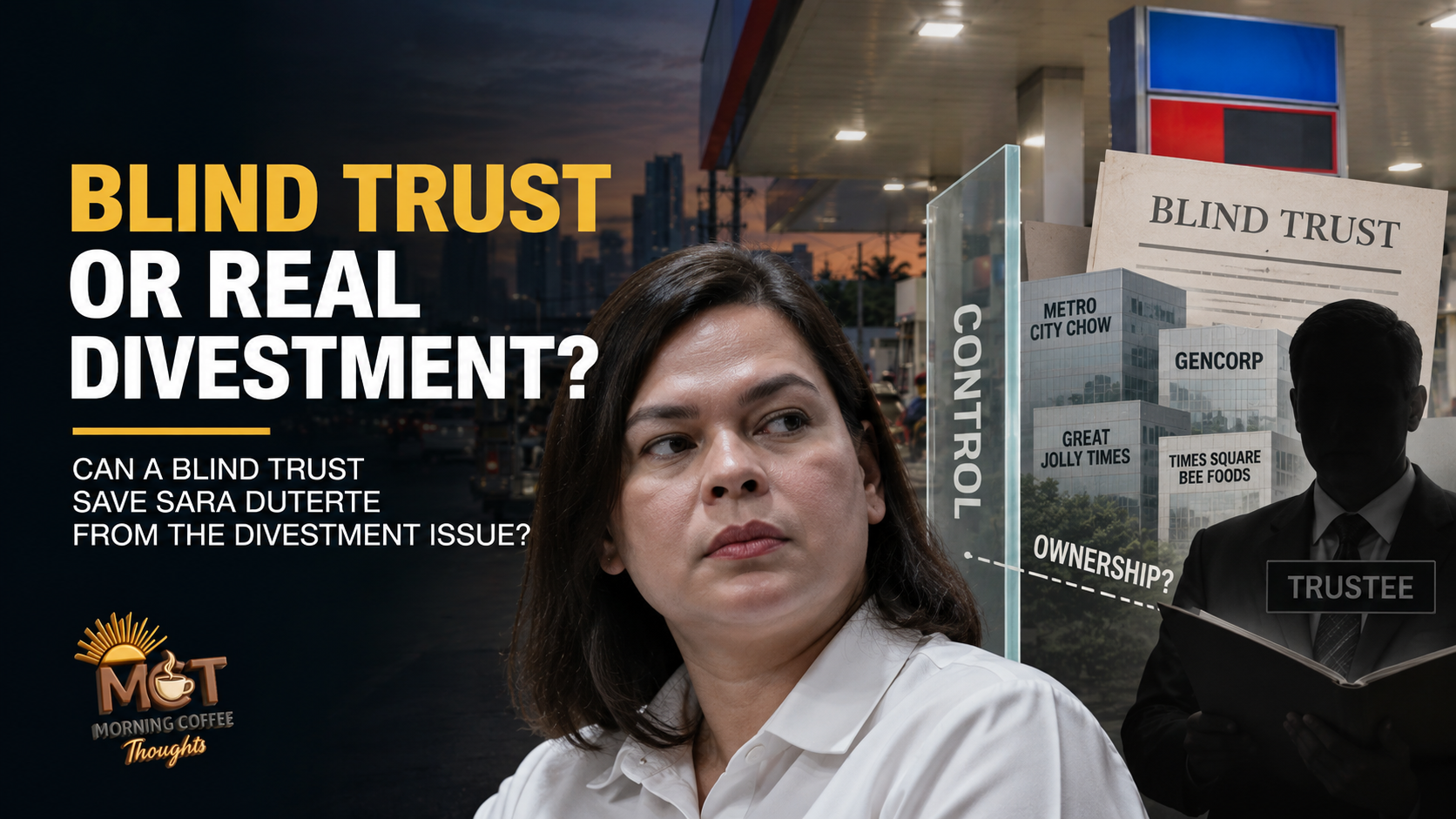
I got curious while watching Ces Oreña-Drilon interview my fellow Albayano, lawyer Howard Calleja, on One News.
Calleja was talking about Sara Duterte’s business interests and the restrictions that apply to officials occupying offices as powerful as the presidency and vice presidency. He argued that top officials should divest from businesses to avoid conflicts of interest.
While listening to them, I found myself asking a question that was not really answered by the interview.
What if Sara Duterte says she placed her business interests in a blind trust?
Would that save her from the accusation that she failed to divest after becoming Vice President?
I honestly did not know because I did not even know exactly what a blind trust was. Unlike Sara Duterte, whose 2024 Statement of Assets, Liabilities and Net Worth put her net worth at about ₱88.5 million, I do not have millions in spare change lying around that I need to figure out how to divest.
So I researched it.
WHAT IS A BLIND TRUST?
The simplest way I can explain a blind trust is this.
Imagine you own shares in several companies, but you are about to take a powerful government position. Your government decisions could affect those businesses, so people could reasonably question whether you are making decisions for the country or protecting your own money.
One way some officials deal with that problem is to hand control of their investments to an independent trustee.
The trustee manages the assets. Depending on how the trust is written, you cannot tell the trustee what to buy or sell, you do not vote the shares yourself, and you stay away from decisions involving the investments.
That is the “blind” part. You are separated from the management of the assets.
But giving somebody else control does not necessarily mean that you have stopped benefiting financially from the assets. You can stop driving the car while still owning the car.
That distinction is central to any blind-trust defense Sara Duterte might raise.
WHY A BLIND TRUST COULD HELP SARA
Article VII, Section 13 of the Constitution specifically applies to the President and Vice President, along with Cabinet members and their deputies or assistants.
It says they may not, during their tenure, directly or indirectly “participate in any business.” It separately prohibits them from having a financial interest in certain government contracts, franchises or special privileges, and says they must strictly avoid conflicts of interest.
Suppose Sara Duterte produces a real blind trust and the documents show that she handed control of her shares to an independent trustee after becoming Vice President. Suppose she could not direct the trustee, vote the shares, manage the companies or make corporate decisions.
Her lawyers could argue that she was no longer participating in those businesses even if some economic interest remained.
Something close to this distinction has already appeared during the impeachment trial. When SEC official Gerardo Del Rosario testified about Duterte’s corporate records, the questioning distinguished between what SEC records showed about ownership or board listings and what the SEC could actually prove about her personal participation in meetings or corporate decisions.
The SEC records can show that her name appeared. They do not automatically prove everything she personally did inside the company.
RA 6713 ASKS A HARDER QUESTION
Republic Act No. 6713 is the Code of Conduct and Ethical Standards for Public Officials and Employees.
Section 9 says a public official must avoid conflicts of interest. When a conflict arises, the law provides for resignation from a position in a private business enterprise and, when applicable, divestment of shareholdings or interests.
The law defines divestment as transferring title or disposing of an interest in property in a way that voluntarily, completely and actually deprives or dispossesses the official of the right or title.
Go back to our car.
You own it, but you give the keys to somebody else. That person decides where it goes, when it is used and how it is maintained.
You are no longer driving it.
But if the car still belongs to you and eventually comes back to you, did you dispose of it?
A blind trust can remove control. RA 6713 can still leave open the question of whether the official actually gave up the interest itself.
THEN I FOUND THE SENATE DELIBERATIONS
The senators who were working on what eventually became RA 6713 actually raised the blind-trust question.
During the October 13, 1987 Senate deliberations on Senate Bill No. 139, Senator Teofisto Guingona asked Senator Rene Saguisag about divestment.
Guingona raised almost exactly the situation I had been wondering about. Could an official avoid a conflict by putting property into a blind trust instead of permanently selling or transferring the assets?
He explained the idea in practical terms: custody, care and management would be placed in the trust because the official might not want to permanently sell the property while serving in government.
Saguisag, who was sponsoring the bill, pushed back against that idea. His response was that allowing someone to use a blind trust in that situation could be seen as some kind of dummy arrangement, and he pointed instead toward divestment or avoiding the conflicting transaction.
The Senate did not enact a sentence saying blind trusts are prohibited, and a sponsor’s answer during deliberations is not the same as a Supreme Court ruling.
But the exchange shows that lawmakers specifically considered the blind-trust alternative while writing the law, and the bill sponsor did not treat it as equivalent to divestment.
That creates a serious problem for any defense that tries to say a blind trust automatically satisfies RA 6713.
TWO POSSIBLE DEFENSES
Sara could theoretically argue that a blind trust proves she stopped participating in a business.
That could be relevant to Article VII, Section 13 of the Constitution.
A different argument would be that creating the blind trust itself satisfied an obligation to divest under RA 6713.
That second argument is harder because the statute speaks of completely and actually disposing of the right or title, while the Senate deliberations show that the blind-trust alternative was specifically raised and rejected by the bill sponsor as a substitute for divestment.
THE TRUST DOCUMENT WOULD HAVE TO ANSWER THE QUESTIONS
If Sara Duterte eventually invokes a blind trust, the actual trust deed would be essential.
Who was the trustee? Was that person truly independent? Could Sara remove the trustee? Could she give instructions?
Could she vote the shares indirectly? Could she receive dividends or other income? Could she reclaim the assets? Was the trust revocable? When was it created? Which businesses were included?
Those details would show what Sara actually surrendered and what economic rights she continued to possess.
They would also show whether the arrangement helps her answer the constitutional prohibition against participating in business, or whether the defense is trying to present it as actual divestment under RA 6713.
WHAT THE SEC RECORDS ACTUALLY SHOW
The current impeachment evidence gives us something concrete to compare against any future blind-trust claim.
SEC Company Registration and Monitoring Department Director Gerardo Del Rosario testified that the General Information Sheets of Metro City Chow Foods Corporation listed Sara Duterte as a member of its board from 2022 through 2025. Records presented in court also showed a 20 percent shareholding associated with her.
During cross-examination, Del Rosario acknowledged that the SEC did not have meeting minutes showing whether Duterte personally attended board or compensation committee meetings. The SEC documents establish what the company reported in its filings, but they do not by themselves show every action Duterte personally took as a director.
That distinction protects both sides from overclaiming.
The prosecution can point to corporate records showing that Duterte continued to be listed as a director and shareholder.
The defense can point out that a filing with her name on it does not, by itself, prove that she attended meetings, voted on corporate matters or exercised management authority.
If Duterte had already resigned from the board and the corporate filings were outdated, her defense should be able to produce the resignation and records showing when she left.
If the filings accurately reflected her continuing directorship, handing shares to a trustee would not automatically remove her from a corporate board.
GENCORP ADDS ANOTHER QUESTION
There is also GenCorp Industries Inc.
Sara Duterte’s 2024 SALN listed GenCorp among her business interests and financial connections and identified her as a stockholder, with the interest acquired in 2013.
But the SEC records examined during the impeachment trial did not list her name as an incorporator or stockholder in the company records presented by the SEC witness.
That does not mean GenCorp was unregistered. The discrepancy is between what Duterte declared in her SALN and what appeared in the SEC corporate records reviewed during the trial.
There could be several explanations, including an indirect interest or another ownership arrangement that does not appear under her name in the particular filings presented.
If a blind trust or some other trust arrangement eventually enters the defense, GenCorp becomes especially interesting.
Could a trust explain why Duterte declared an economic interest in GenCorp while her name did not appear directly in the SEC ownership records?
Possibly.
But that explanation would need documents.
Without them, it remains a question, not an answer.
HER SALNS HAVE TO FIT THE STORY
Sara Duterte’s SALNs list business interests and financial connections, and her 2024 SALN placed her declared net worth at ₱88,512,370.22.
Disclosure alone does not prove wrongdoing. Someone can disclose an asset precisely because transparency rules tell public officials to declare what they own or what financial connections they have.
But if Sara eventually says she had already divested a particular interest, then the SALN, the SEC records and any trust document should be capable of being read together.
If the story is that ownership was surrendered, the records should help show where it went.
If the story is that ownership remained with Sara but control went to an independent trustee, then her lawyers would have to explain why that arrangement answers the particular provision they are accused of violating.
THE PROSECUTION STILL HAS TO PROVE ITS CASE
RA 6713 does not say that every public official must sell every investment simply because he or she entered government.
Section 9 connects the divestment obligation to a conflict of interest.
So if prosecutors rely on RA 6713, they still have to show why the particular business interest created the conflict contemplated by the law and what obligation followed from it.
If they rely on Article VII, Section 13, they have to show what they believe constitutes direct or indirect participation in business.
Ownership, control, participation, directorship and financial interest are related concepts, but they do not all mean the same thing.
A blind trust could help Sara answer one accusation while doing very little against another.
THE STRONGEST VERSION OF SARA’S DEFENSE
Suppose Sara produces a trust created at the proper time.
The trustee is independent. Sara cannot direct the trustee, remove the trustee whenever she pleases, vote the shares or participate in company decisions.
Suppose she also produces documents showing she had resigned from corporate boards and stopped exercising management authority.
That could be substantial evidence against an accusation that she continued participating in private businesses while Vice President.
The remaining question would be whether she still retained a beneficial economic interest and, if so, whether that arrangement qualifies as divestment under RA 6713.
The statutory language creates difficulty for that argument.
The Senate deliberations make it harder because Guingona specifically asked whether a blind trust could be used by an official who wanted to avoid a conflict without permanently surrendering the property, and Saguisag pointed instead toward actual divestment.
The exchange does not decide Sara Duterte’s impeachment case, but it does show that this was not an issue lawmakers failed to consider.
WHAT I CAME AWAY WITH
I started this because I was watching Ces Oreña-Drilon and Howard Calleja and realized there was a financial term I did not properly understand.
Now I understand why a blind trust could become useful to Sara Duterte.
If properly created and genuinely independent, it could help her argue that she stopped controlling or participating in a business.
When the question becomes actual divestment under RA 6713, the text of the law becomes harder for her, and the legislative history does not help.
So if Sara Duterte eventually presents a blind trust as part of her defense, I would want to see more than the name of the arrangement.
Show us the deed.
Show us the date.
Show us what she surrendered.
Show us what she kept.
Then we can see what the trust actually proves.
SOURCES
- One News, WATCH: VP Sara Duterte’s Days Are Numbered Based On Evidence – Callejahttps://www.onenews.ph/articles/watch-vp-sara-duterte-s-days-are-numbered-based-on-evidence-calleja
- Supreme Court E-Library, 1987 Constitution, Article VIIhttps://elibrary.judiciary.gov.ph/thebookshelf/showdocs/45/25550
- Senate of the Philippines Legislative Reference Bureau, Republic Act No. 6713https://issuances-library.senate.gov.ph/legislative%2Bissuances/Republic%20Act%20No.%206713
- Senate of the Philippines, Plenary Deliberations on Senate Bill No. 139, October 13, 1987https://issuances-library.senate.gov.ph/sites/default/files/2022-07/Plenary%20ROS.pdf
- Lawphil, Republic Act No. 6713https://lawphil.net/statutes/repacts/ra1989/pdf/ra_6713_1989.pdf
- Philippine News Agency, SEC record: VP Duterte retained 20% stake, board seat 2022-2025https://www.pna.gov.ph/articles/1284475
- Philippine News Agency, SEC records: VP Sara remained Metro City Chow director through 2025https://www.pna.gov.ph/articles/1284560
- ABS-CBN News, Sara Duterte declares P88.5-M net worth in 2024 SALNhttps://www.abs-cbn.com/news/nation/2025/11/19/sara-duterte-declares-p88-5-m-net-worth-marks-nearly-p17-m-increase-during-her-vp-tenure-1516
- ABS-CBN News, Sara Duterte SALNs from 2019 to 2024 had no declared cash on hand, bank depositshttps://www.abs-cbn.com/news/nation/2026/4/22/ombudsman-sara-duterte-saln-house-panel-impeachment-1050