
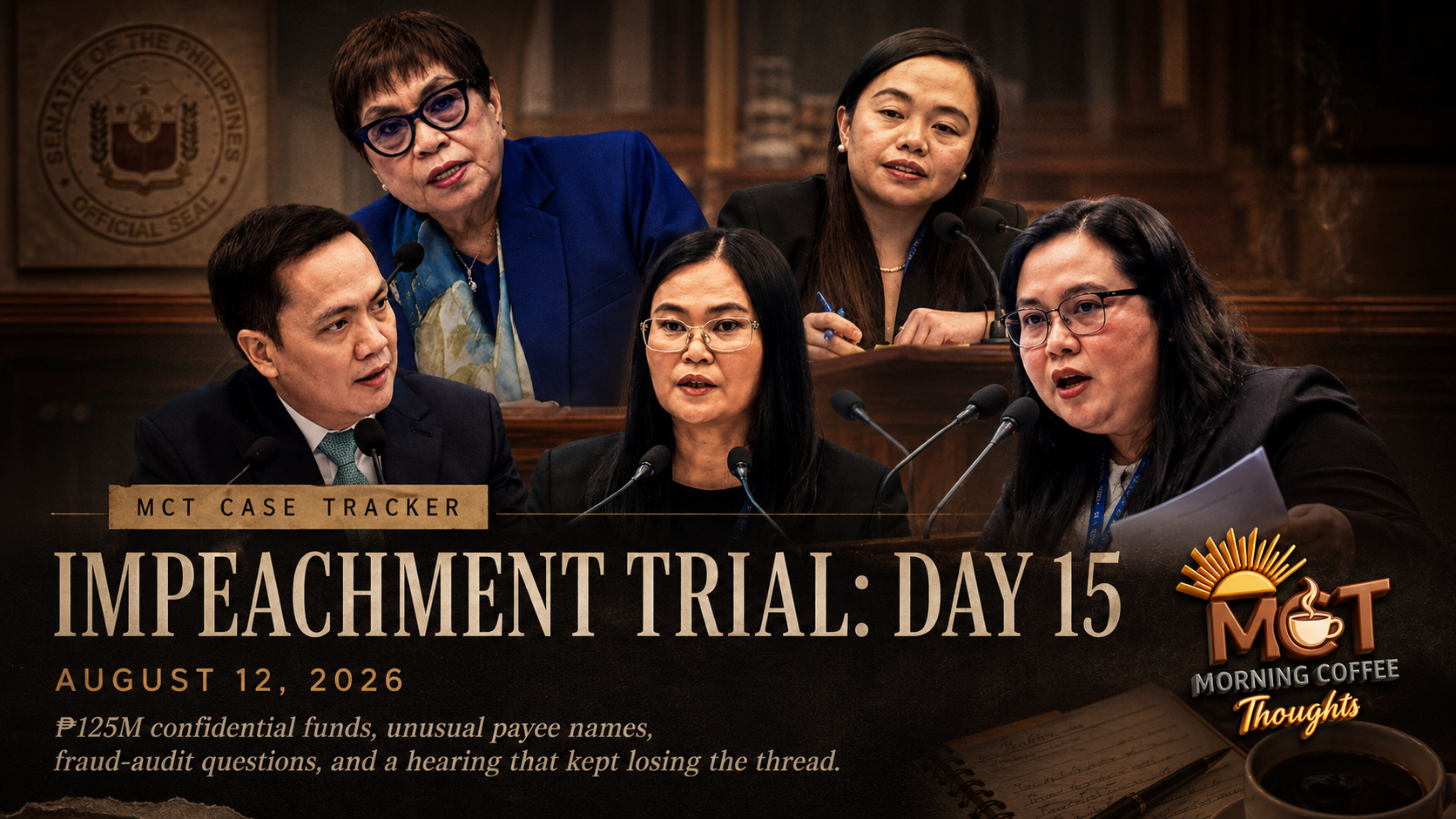
ARTICLE I: ALLEGED MISUSE AND MISAPPROPRIATION OF CONFIDENTIAL FUNDS
Proceeding: Senate sitting as an impeachment court
Respondent: Vice President Sara Duterte
Presiding officer: Sen. Francis “Chiz” Escudero
Article under consideration: Article I, involving the alleged misuse and misappropriation of ₱612.5 million in confidential funds of the Office of the Vice President and the Department of Education
Witness: Xylene Mae Del Campo of the Commission on Audit’s Intelligence and Confidential Funds Audit Office
Stage of testimony: Continued cross-examination by the defense, followed by questions from senator-judges
A NOTE ON THIS TRACKER
This is a reconstruction of the August 12 hearing from reports by Philippine news organizations, official government material and the applicable rules of evidence. It is not an official transcript of the impeachment court.
The account separates testimony from arguments made by lawyers. It also separates evidence from courtroom exchanges that affected the hearing but did not prove or disprove any allegation under Article I.
I. WHERE THE CASE STOOD AT THE START OF DAY 15
The impeachment court remained on Article I, which covers the alleged misuse and misappropriation of ₱612.5 million in confidential funds. Official House material and contemporaneous reports describe the amount as ₱500 million in OVP confidential funds and ₱112.5 million in DepEd confidential funds.
Part of the prosecution’s case concerns alleged defects in the liquidation documents submitted for those expenses. House investigators previously questioned acknowledgment receipts carrying names that they said could not be matched with Philippine Statistics Authority civil-registry records.
Those allegations still have to be proved in the impeachment trial. A failed PSA search may raise a serious question about a payee’s identity, but it does not by itself establish who received the money, whether the listed person never existed or whether the transaction was fraudulent.
Most of Day 15 was devoted to the defense cross-examination of COA auditor Xylene Mae Del Campo. The questioning repeatedly returned to three subjects: COA’s audit process, the activities that may legally be charged to confidential funds and the acknowledgment receipts used to support the expenses.
II. THE ₱125-MILLION OVP CONFIDENTIAL-FUND EXPENDITURE
One of the central portions of Del Campo’s testimony concerned ₱125 million in OVP confidential funds made available for the period from December 21 to 31, 2022.
During questioning, Del Campo confirmed that the documents available to COA at the relevant stage were insufficient for the auditors to determine whether the ₱125 million had been personally used or properly used for authorized purposes. COA therefore requested additional supporting documents.
Her answer did not establish that Duterte personally took the money. It established a narrower point: the records then available to the auditors were not enough to verify the expenditure.
For an ordinary taxpayer, the difference is straightforward. Missing or inadequate records are a serious accountability problem because public money must be traceable. They are not, on their own, proof of personal theft. The remaining evidence must show where the money went, who received it and whether the expenditure was authorized.
UNUSED FUNDS AND RETURN TO THE TREASURY
Del Campo also confirmed the rule that confidential funds left unused after the authorized period must be returned to the Treasury.
That statement explains the rule. It does not establish that a particular amount from the ₱125 million remained unused. The unresolved factual questions are whether any money remained at the end of the authorized period, how much remained and whether it was returned.
III. WHAT MAY BE PAID FOR WITH CONFIDENTIAL FUNDS
The defense questioned Del Campo about Joint Circular No. 2015-01, which governs the entitlement, release, use, reporting and audit of confidential and intelligence funds. The questioning included surveillance and information-gathering activities that may fall within confidential operations.
Two issues must be examined separately:
1. Whether the stated activity is legally chargeable to confidential funds.
2. Whether the records prove that the particular activity took place and that the money was spent for it.
An activity may fall within an authorized category while the expense supporting it remains inadequately documented. Conversely, incomplete documents do not allow the court to assume, without more evidence, that no operation occurred. The trial must examine the rules and the proof for each questioned transaction.
IV. THE DOCUMENTS USED DURING CROSS-EXAMINATION
Defense counsel Kristine Ferrer and private prosecutor Lorna Kapunan clashed over documents used while Del Campo was being questioned. The dispute concerned whether particular documents could properly be shown to or identified through that witness.
The fact that a document has been marked or previously presented does not necessarily mean that every witness can authenticate it or testify about its contents. That depends on the witness’s knowledge and the purpose for which the document is being offered.
This was a procedural dispute over how evidence could be introduced and tested. The argument itself did not prove that the contents of the disputed documents were true or false.
V. ACKNOWLEDGMENT RECEIPTS AND QUESTIONED PAYEE NAMES
The cross-examination again dealt with names appearing on acknowledgment receipts connected to confidential-fund expenses. The prosecution has relied on records involving Mary Grace Piattos and other listed recipients that investigators said could not be matched with PSA civil-registry records.
Ferrer challenged the suggestion that an unusual or humorous-sounding name was enough to establish that the person was fictitious. Kapunan objected, arguing that the prosecution’s position was based on documents and PSA searches rather than the sound of the names alone. Escudero allowed the defense to continue questioning Del Campo.
The exchange exposed the correct evidentiary question. A strange name proves nothing by itself. The court must examine the acknowledgment receipt, the PSA search, signatures, supporting records and any evidence connecting the name or alias to a real recipient and a real confidential operation.
For the public, this is where the issue leaves political entertainment and returns to accountability. The question is whether government records can identify who received public money and demonstrate the authorized purpose for which it was spent.
VI. LEADING AND MISLEADING QUESTIONS
One widely shared exchange began when Kapunan objected that a question was misleading. She said misleading questions were not allowed. Ferrer responded that they were allowed.
Rule 132, Section 10 of the Rules of Evidence distinguishes the two forms of questioning:
- A leading question suggests the answer the examining lawyer wants. Leading questions are generally permitted during cross-examination.
- A misleading question assumes as true a fact that the witness has not testified to, or a fact contrary to the witness’s testimony. Misleading questions are not allowed.
The Supreme Court Benchbook makes the same distinction. The rule concerns the proper examination of a witness. It does not decide whether any allegation under Article I is true.
VII. THE ARGUMENT OVER “YES” OR “NO” ANSWERS
Another dispute arose when Ferrer pressed for a yes-or-no answer while Del Campo sought to explain her response. Kapunan objected and later said that the witness had already answered. Escudero directed Ferrer to modify or reformulate the question.
Cross-examination permits firm questioning, but the presiding officer retains authority to stop questions that are misleading, vague, repetitive or argumentative. A lawyer may test a witness’s answer. The lawyer cannot force a categorical answer when the form of the question would make that answer incomplete or misleading.
The episode showed Escudero exercising control over the examination. It did not add evidence about the use of confidential funds.
VIII. THE FERRER-KAPUNAN CONFRONTATION
The disagreement became personal when Kapunan said she was preventing herself from giving Ferrer “a spanking.” Escudero intervened and referred to a possible generational divide. Ferrer later asked the court to stop side comments directed at counsel. Reports said Kapunan withdrew the remark.
The confrontation consumed time and disrupted the cross-examination. It had no evidentiary value under Article I. Neither the remark nor the lawyers’ reactions proved anything about the questioned transactions.
IX. BAM AQUINO’S QUESTION ABOUT A POSSIBLE FRAUD AUDIT
Sen. Bam Aquino asked Del Campo whether COA could conduct a fraud investigation or fraud audit into the unusual names or aliases in the confidential-fund records.
Del Campo said no fraud audit had yet been conducted because the issue was still being studied. She also confirmed that COA could conduct one if necessary.
The testimony therefore did not establish that COA had found fraud. It also did not clear the transactions. It established only that this particular type of audit had not yet been completed and remained possible.
If COA conducts a fraud audit, the resulting report could give the public a more complete answer about the identities, documents and transactions under question. Until then, “fraud” remains an allegation rather than a COA finding arising from such an audit.
X. ROBIN PADILLA’S SECURITY LINE OF QUESTIONING
Sen. Robin Padilla questioned Del Campo in the context of alleged communist or terrorist infiltration involving alternative schools and Lumad schools in Davao, where Duterte previously served as mayor.
The reports reviewed for this tracker did not preserve enough of Del Campo’s complete answer to support a reliable conclusion from that exchange. Padilla’s questions may be recorded as part of the hearing, but they cannot be presented as confirmation or rejection by COA of his security argument.
XI. THE SOCIAL-MEDIA POST RAISED BY THE DEFENSE
Prosecution lawyer Amando Virgil Ligutan posted during the hearing that misleading questions are not allowed even on cross-examination. Defense lead counsel Sheila Sison later raised the post before the court and argued that it was improper under Rule XVIII of the impeachment rules.
The safe conclusion is limited: Sison made the objection and cited Rule XVIII. Unless the impeachment court rules on it, the tracker should not state as fact that Ligutan violated the rule.
The legal proposition in Ligutan’s post is separately supported by Rule 132, Section 10. The dispute over his public comment remains separate from the evidence concerning the confidential funds.
XII. WHAT DAY 15 ADDED TO THE RECORD
Day 15 added or clarified the following points:
1. COA did not have enough documentation at the relevant audit stage to determine whether the ₱125-million expenditure had been personally or properly used, so it requested additional records.
2. Confidential funds left unused after the authorized period must be returned to the Treasury, although Day 15 did not establish that any particular amount remained unused.
3. The defense challenged the treatment of unusual names and aliases on acknowledgment receipts.
4. The prosecution maintained that its concern rested on documents and PSA searches, not merely on names sounding unusual.
5. COA had not yet conducted the fraud audit discussed by Aquino, although Del Campo said one could be conducted if necessary.
6. The parties continued to dispute what counts as a confidential activity and whether the claimed activities were adequately documented.
7. The parties also disputed which documents Del Campo could properly identify or address during cross-examination.
XIII. WHAT DAY 15 DID NOT ESTABLISH
The testimony and exchanges on August 12 did not, by themselves, establish that:
- Duterte personally pocketed the ₱125 million.
- All of the ₱125 million was improperly spent.
- Any specific amount remained unused and should have been returned.
- Every listed recipient without a PSA match was fictitious.
- An unusual name was proof that its bearer did not exist.
- COA had completed a fraud audit and found fraud.
- Every claimed surveillance or information-gathering activity was legitimate.
- Every claimed operation was illegitimate.
- Ligutan violated Rule XVIII.
- Article I had been resolved.
XIV. QUESTIONS THAT REMAIN OPEN
The ₱125-million fund
1. What documents did the OVP originally submit to account for the expenditure?
2. What additional records did COA request?
3. Which requested records were later submitted?
4. Was COA eventually able to trace the full amount?
5. Did any amount remain unused, and was it returned to the Treasury?
Acknowledgment receipts
1. What evidence identifies each questioned recipient beyond the name on the receipt?
2. Which names produced no match in the PSA search?
3. If aliases or operational names were used, what underlying records connect them to real recipients or assets?
4. Who prepared and signed the receipts?
5. What do the handwriting, signatures and related documents show?
Claimed confidential operations
1. What operations did the OVP say it funded?
2. Which activities are permitted under Joint Circular No. 2015-01?
3. What proof was required for each expense, and what proof was submitted?
4. Which expenses were accepted, suspended, questioned or disallowed by COA, and on what grounds?
Audit status
1. What did the regular confidential-funds audit conclude?
2. Were any findings changed on review or appeal?
3. Has COA ordered or begun a fraud audit?
4. If it does, what transactions and periods will it cover?
These questions return the case to the public-accountability issue: where the money went, what it paid for and whether the records can prove both.
XV. BOTTOM LINE
Day 15 showed that COA had been unable, from the documents available at the relevant stage, to verify whether the ₱125-million OVP confidential-fund expenditure was properly used. The defense continued to challenge COA’s audit approach, the treatment of questioned payee names and the documentary basis of the prosecution’s case.
The hearing also produced arguments between counsel that drew public attention but did not prove the allegations. Article I remained unresolved. The next useful evidence will be the additional records requested by COA, testimony explaining the questioned receipts and any later audit findings capable of tracing the money to identified recipients and authorized operations.
SOURCES
- House of Representatives, Press and Public Affairs Bureau: official material on the questioned confidential-fund records.https://www.congress.gov.ph/media/press-releases/9964
- Philippine News Agency: reporting on the impeachment proceedings and confidential-fund allegations.https://www.pna.gov.ph/articles/1280577
- The Philippine Star: reporting on the COA witnesses and Article I.https://www.philstar.com/headlines/2026/07/29/2545596/coa-auditors-summoned-sara-duterte-trial/amp/
- ABS-CBN News publisher-post mirror: August 12 hearing report on Del Campo’s testimony concerning the ₱125 million.https://www.reddit.com/r/pinoy/comments/1vm7u85/coa_auditor_p125m_sara_duterte_confidential_funds/
- INQUIRER.net publisher-post mirror: August 12 report on the questioned payee names.https://www.reddit.com/r/pinoy/comments/1vm5xp8/ferrer_kapunan_spar_over_fictitious_payee_names/
- Malaya Business Insight publisher-post mirror: August 12 report on the document dispute.https://www.reddit.com/r/newsPH/comments/1vm2ng3/defense_prosecution_clash_over_documents_during/
- Manila Bulletin/Balita publisher-post mirror: August 12 reports on the Ferrer-Kapunan exchanges and the Ligutan post.https://www.reddit.com/r/newsPH/comments/1vm8flb/atty_sheila_sison_binanatan_social_media_post_ni/
- Supreme Court E-Library, Revised Rules on Evidence, Rule 132, Section 10https://elibrary.judiciary.gov.ph/thebookshelf/showdocs/11/370
- Supreme Court of the Philippines, Benchbook for Trial Court Judgeshttps://elibrary.judiciary.gov.ph/thebookshelf/showdocs/44/50146