
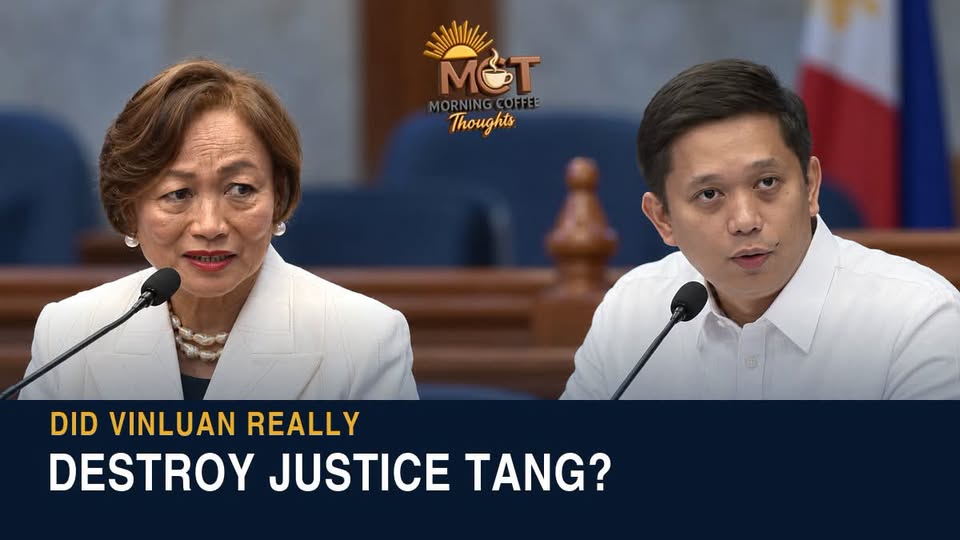
Supporters of Vice President Sara Duterte quickly declared Atty. Mark Vinluan’s cross-examination of retired Sandiganbayan Presiding Justice Amparo Cabotaje-Tang a demolition. In pro-Duterte circles, the verdict was that Vinluan had exposed or even “destroyed” the prosecution’s witness.
The short clips were convincing. Vinluan asked Tang whether she had personal knowledge of Duterte’s bank accounts, income, liabilities, properties, business interests and Statements of Assets, Liabilities and Net Worth. Tang repeatedly answered that she did not. Viewed without context, it looked devastating. Why would the prosecution present a witness who knew almost nothing about Duterte’s finances?
I watched the complete examination because I wanted to know whether the celebration matched what actually happened.
I am not a lawyer, so I will not pretend to grade Vinluan according to techniques taught in law school. I can only look at what he tried to establish, what Tang admitted and whether those admissions defeated the purpose of her testimony.
What I saw was a cross-examination that accomplished two useful things. Vinluan clearly limited what Tang could prove, and he raised an important warning about confusing the total movement of money with actual wealth. He did not establish that Tang was politically biased, prove that her explanation of the law was wrong or disprove any financial allegation against Duterte.
WHY TANG WAS THERE
The prosecution did not present Tang as Duterte’s banker, accountant, business partner or financial investigator. She had not personally audited Duterte, traced the source of specific deposits or authenticated the SALNs involved in Article II. She was called to explain the legal principles surrounding unexplained wealth, SALN disclosure, conflicts of interest and the restrictions imposed on high government officials. Other witnesses and financial records were expected to provide the facts specific to Duterte.
In ordinary language, Tang was there to explain the rules that could later be applied to the evidence. That purpose was discussed before she testified. Senate President Francis Escudero also made clear that Tang’s opinions would not bind the senator-judges or decide the case.
The defense still had a legitimate reason to challenge her appearance. A former Sandiganbayan presiding justice carries an impressive title, especially when the subject is alleged unexplained wealth. Viewers might assume that she had personally examined Duterte’s finances and already found something suspicious. Vinluan needed to make sure that no one confused Tang’s legal explanation with proof against Duterte.
WHAT VINLUAN ACCOMPLISHED
Vinluan’s clearest achievement was separating Tang’s knowledge of anti-graft law from the actual financial accusations against Duterte. Through a series of direct questions, he established that Tang could not personally tell the impeachment court how much Duterte lawfully earned, what she owned, how much she owed or where particular deposits came from. Tang could not say from firsthand knowledge that Duterte had accumulated unexplained wealth.
That was useful because it placed a clear boundary around her testimony. Her former judicial position could not honestly be presented as direct evidence that Duterte had done anything wrong.
But Tang had not claimed to possess firsthand knowledge of Duterte’s finances. The prosecution had already explained that the financial records would be presented through other witnesses. Vinluan confirmed that the person explaining the rules was not the person presenting the records. Once Tang admitted that, the point was already clear. I understood it early in the cross-examination.
By the time Vinluan had moved through Duterte’s SALNs, income, liabilities, properties, accounts, companies, transactions and her husband’s income, I was no longer learning anything new from the repeated answers. Tang did not know those facts personally. The court understood it too, and Escudero eventually directed Vinluan to move on from that line of questioning.
THE ₱6.7-BILLION QUESTION
The more interesting part of Vinluan’s cross-examination involved the large transaction figure connected to Article II. A reported aggregate of ₱6.7 billion in transactions does not automatically mean that Duterte owned, earned or accumulated ₱6.7 billion. Transaction totals can include deposits, withdrawals and transfers between accounts. The same money can appear several times as it moves.
Vinluan used a hypothetical example involving a deposit, interest and withholding tax to show how one original amount could produce several recorded entries. This exposed the danger of presenting a huge transaction total as though it represented a person’s actual wealth.
This was the part of his cross-examination that I found genuinely useful. Unlike the repeated questions about Tang’s personal knowledge, this challenged how ordinary viewers might understand the financial figures themselves.
But Vinluan demonstrated only how double-counting could happen. He did not prove that the ₱6.7-billion figure was actually calculated that way. That can only be determined by examining the records. The impeachment court will have to know which entries were deposits, withdrawals or transfers, who owned or controlled the accounts, where the money came from and whether the same funds were counted repeatedly.
Until then, the ₱6.7-billion figure should not be treated as self-explanatory. It is a figure that requires examination, not a verdict by itself.
A CROSS-EXAMINATION FOR TWO AUDIENCES
The repeated questions about Tang’s lack of personal knowledge may have added little inside the courtroom, but they worked very well outside it. Every additional “No” created another short exchange that could be clipped and shared without the explanation of why Tang had been called.
Vinluan was questioning a witness before the senator-judges while also speaking to the public. That does not necessarily mean the repetition was accidental or incompetent. An impeachment trial is both a legal proceeding and a national political event watched by millions of Filipinos. As courtroom questioning, the repetition produced less and less new information. As political communication, it was highly effective.
The defense had accused the prosecution of using Tang to condition the public by placing a respected former anti-graft justice on the witness stand before presenting the financial documents. That concern was understandable because her title gave her statements immediate authority.
Vinluan then used the same witness to push the public in the opposite direction. Tang became a sounding board for the defense’s position that Article II may involve misunderstood transaction figures, innocent SALN errors, assumptions and political hostility.
The prosecution used Tang to introduce the language of public accountability. The defense used her answers to create doubt before the financial records were fully examined.
THE ATTACK ON HER EXPERTISE
Vinluan challenged the prosecution’s description of Tang as a legal expert. Tang acknowledged that she did not possess a government certificate or special statutory title declaring her one, and she declined to proclaim herself an expert. That exchange reduced the authority created by the label. Tang’s years in the judiciary did not make every statement she gave automatically correct.
But the absence of a special certificate did not erase her experience. From my readings under the Rules on Evidence, expertise may come from knowledge, education, training, skill or experience. Tang spent years handling cases in the Sandiganbayan. Vinluan reminded the court that she was not infallible, but he did not identify a Supreme Court ruling that clearly disproved the central explanation she had given.
He also brought up Tang’s unsuccessful applications to the Supreme Court. But failing to become a Supreme Court justice does not prove that a lawyer lacks extensive knowledge of anti-graft law.
THE SEARCH FOR POLITICAL BIAS
Vinluan asked whether Tang was anti-Duterte, a Kakampink, affiliated with Akbayan, personally close to prosecutor Chel Diokno or resentful over her unsuccessful Supreme Court applications. He also asked whether she had been promised anything or hoped to receive an ambassadorial appointment.
Looking for possible bias is a legitimate part of cross-examination. Political affiliations, personal relationships and expected rewards could affect how a witness’s testimony should be received.
But the questions produced denials rather than proof. Tang denied the political affiliations and personal motives attributed to her. The defense did not publicly present a document, statement, organizational record or contradictory testimony establishing those suggested connections.
When Vinluan asked whether she had been promised anything in exchange for testifying, Tang gave one of the hearing’s most memorable answers: “My testimony is not for sale.”
Vinluan had every right to investigate possible bias. But asking whether Tang was biased did not prove that she was, and the questioning gave her an opportunity to present herself as independent.
THE MORE USEFUL SALN ADMISSIONS
The cross-examination became more valuable when Vinluan asked how SALN discrepancies should be interpreted. Tang acknowledged that an omission or discrepancy does not automatically establish unexplained wealth. The surrounding circumstances must be examined before deciding whether an inaccurate or missing entry resulted from an honest mistake or intentional concealment. She also agreed that good faith cannot simply be ignored.
Those were useful admissions for Duterte. A missing SALN entry does not automatically prove corruption, and a discrepancy cannot explain itself. The amount involved, the frequency of the errors, the official forms used, the transactions surrounding them and the explanation offered by the official must all be examined. A single honest mistake is not the same as a repeated effort to hide property or money.
This gives the defense an opening if discrepancies are eventually proven. Its value will depend on whether Duterte can provide credible explanations supported by records.
THE PROCEDURAL ARGUMENTS
Vinluan also invoked constitutional protections, the prosecution’s burden and Duterte’s opportunity to confront the information used against her during the House proceedings. These are legitimate concerns because impeachment cannot become an excuse to remove an elected official through unsupported accusations. Duterte must know the charges against her and receive a meaningful opportunity to answer them.
But impeachment is not identical to an ordinary criminal trial. It is a special constitutional proceeding conducted by the Senate, while any criminal liability must still be pursued separately before the courts. The House stage also does not necessarily operate like a completed trial.
Supreme Court decisions recognize due-process protections in impeachment, but the opportunity to respond can occur through pleadings and other procedures instead of live cross-examination of every person consulted during the investigation. The sensible question is whether Duterte received enough information and a genuine opportunity to answer the accusations. Importing every criminal-court procedure into impeachment would oversimplify how the constitutional process works.
DID VINLUAN DESTROY TANG?
No, at least not according to what I understand “destroying a witness” to mean.
He did not expose a lie, force Tang to withdraw her legal explanation or confront her with a controlling decision that proved her interpretation was false. He did not establish that she was politically connected to Duterte’s opponents or had been promised a reward.
What Vinluan did was narrower, but still valuable. He prevented Tang’s title from being mistaken for direct proof against Duterte. He obtained useful admissions about good faith and SALN discrepancies, and he warned the public that a huge aggregate transaction figure is not automatically the same as actual wealth.
He also gave Duterte’s supporters a series of powerful clips. Those clips succeeded because they presented Tang as though she had been called to prove Duterte’s financial misconduct from personal knowledge. She had not.
The questions that could decide Article II remain unanswered. What do the bank and ownership records show? How were the transaction totals calculated? Who owned or controlled the accounts? Where did the money come from? What appeared in the SALNs, and how will Duterte explain any proven discrepancy?
Tang’s lack of personal knowledge cannot answer those questions for the prosecution. Vinluan’s cross-examination cannot answer them for the defense.
Vinluan showed that the witness explaining the map had not personally travelled the route. His supporters celebrated as though he had proven the map was wrong.
He did not.
SOURCES
- UNTV News and Rescue, Full Day 24 impeachment trial broadcasthttps://www.youtube.com/watch?v=S4ucrT8aiEY
- GMA News, Senate impeachment court allows Cabotaje-Tang to testify as expert witnesshttps://www.gmanetwork.com/news/topstories/nation/1002274/senate-impeachment-court-allows-cabotaje-tang-to-testify-as-expert-witness/story/
- GMA News, Sara Duterte’s defense asks Cabotaje-Tang about political alignmenthttps://www.gmanetwork.com/news/topstories/nation/1002319/sara-duterte-s-defense-to-cabotaje-tang-are-you-anti-duterte-a-kakampink/story/
- Inquirer.net, Vinluan questions Tang’s political alignmenthttps://newsinfo.inquirer.net/2304781/vinluan-questions-tangs-political-alignment-are-you-anti-duterte
- ABS-CBN News, Ex-Sandiganbayan judge tells VP Sara lawyer: My testimony is not for salehttps://www.abs-cbn.com/news/nation/2026/9/14/ex-sandiganbayan-judge-tells-vp-sara-lawyer-my-testimony-is-not-for-sale-1514
- Journal News, Impeachment court allows Cabotaje-Tang to lay out Article II wealth testhttps://journalnews.com.ph/impeachment-court-allows-cabotaje-tang-to-lay-out-article-ii-wealth-test/
- Journal News, Repeated SALN omissions may signal concealment, dishonestyhttps://journalnews.com.ph/repeated-saln-omissions-may-signal-concealment-dishonesty-cabotaje-tang/
- SunStar, Prosecution presents surprise witness in Sara Duterte impeachment trialhttps://www.sunstar.com.ph/manila/prosecution-presents-surprise-witness-on-sara-duterte-impeachment-trial
- PhilSTAR Life, Analysis of Duterte impeachment trial Day 24https://philstarlife.com/news-and-views/413810-analysis-duterte-impeachment-trial-day-24
- Philstar.com, AMLC confirms ₱6.7-billion bank transactions involving VP and associated personshttps://www.philstar.com/headlines/2026/09/14/2556063/amlc-confirm-p67-billion-bank-transactions-vp-mans
- Supreme Court, Duterte v. House of Representativeshttps://lawphil.net/judjuris/juri2025/jul2025/gr_278353_2025.html
- Supreme Court, Gutierrez v. House Committee on Justicehttps://lawphil.net/judjuris/juri2011/feb2011/gr_193459_2011.html
- 1987 Constitution of the Philippineshttps://lawphil.net/consti/cons1987.html
- Republic Act No. 6713, Code of Conduct and Ethical Standards for Public Officials and Employeeshttps://lawphil.net/statutes/repacts/ra1989/ra_6713_1989.html
- Supreme Court, 2019 Amendments to the Revised Rules on Evidencehttps://lawphil.net/courts/rules/am_19-08-15-sc_2019.html
- Articles of Impeachment against Vice President Sara Dutertehttps://media.philstar.com/editorial/documents/articles-of-impeachment-sara-duterte-2026.pdf