
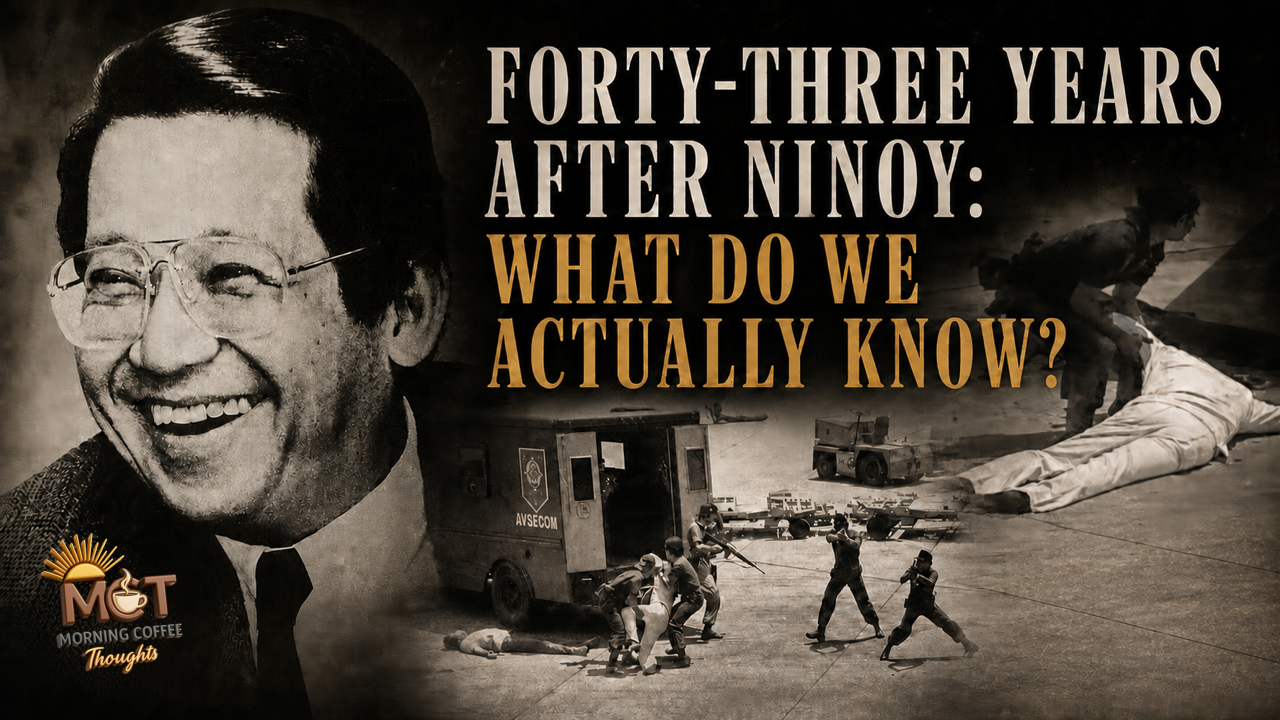
Every August 21, one sentence returns with the commemorations: forty-three years later, we still do not know who killed Ninoy Aquino.
I used to accept some version of that too. But when I went back through the court decisions, the investigations, contemporary accounts and Ninoy's own words, I found that the sentence is not quite right. The assassination of Benigno Aquino Jr. is not an entirely unsolved murder. Parts of it were solved in court. Other parts were contested, deliberately obscured or never proved.
The unresolved question is narrower, and perhaps more disturbing: who ultimately ordered it?
I am not trying to solve that question here. I have no new witness, secret document or evidence that somehow escaped everyone for forty-three years. What I wanted to do was something simpler: go back to the record and separate what we actually know from what we have repeated for so long that we now assume it must be true.
And to understand what happened on August 21, it helps to begin with the man who decided to come home.
THE MAN BEFORE AUGUST 21
For many Filipinos, Ninoy Aquino is inseparable from the final images of his life: the white clothes, the airport tarmac, the funeral, the yellow ribbons and eventually the events that led to EDSA.
That is understandable. His assassination became one of the defining moments of modern Philippine history, and the courage it took to return home despite repeated warnings of what could happen to him became central to how generations came to remember him.
But before August 21, 1983, Benigno Aquino Jr. had already lived an extraordinary political life.
He entered public life remarkably young, first gaining national attention as a journalist before moving into politics. He became mayor of Concepcion in his twenties, then vice governor, governor and, at 34, one of the youngest senators in Philippine history. By the years before martial law, he had become one of Ferdinand Marcos' most formidable political opponents and was widely regarded as a possible future presidential contender.
He was also unmistakably a politician. He came from a prominent political family, understood the power of media, knew how to command public attention and possessed enormous political ambition. None of those things are revelations meant to diminish him. They are simply part of who he was.
And perhaps that is precisely what makes his later choices more significant.
Ninoy had known power, competed for it and understood how Philippine politics worked. Then came martial law, arrest, military trial, years of imprisonment, a hunger strike, exile and finally the decision to return to a country where he knew his life could be in danger.
The interesting question is not whether Ninoy Aquino had always been the national hero Filipinos later remembered. It is how the politician became the man who boarded that final flight home.
WHY DID HE COME HOME?
This is another part of the story that has been simplified over time.
The popular version is that Ninoy returned to confront Marcos, fully expecting to die, almost as though everything after he boarded the plane had already been written.
He certainly understood that he could be killed. His final interviews show a man acutely aware of the danger, talking openly about the possibility that something could happen within minutes of arriving.
But expecting that death was possible is different from returning because you intended to die.
His own undelivered statement says he was returning to join the struggle to restore rights and freedoms through nonviolence. He wrote, "I seek no confrontation." He warned against both dictatorship and revolutionary violence and argued that the country's political problems could not simply be suppressed by force.
There was also a more complicated political calculation behind his return.
According to Cory Aquino's account shortly after his death, Ninoy believed Marcos was physically weakening and that the Philippines was becoming dangerously polarized. If Marcos suddenly died without an orderly political transition, Ninoy feared the resulting power vacuum could produce an even worse crisis.
Remarkably, Ninoy apparently hoped to talk to Marcos. He believed there was still a possibility, however remote, that Marcos himself could preside over a peaceful restoration of democracy because Marcos still controlled the military and the machinery of government.
That is quite different from the image of Ninoy returning simply to ignite a revolution.
The irony is difficult to miss. He appears to have returned partly because he feared where the country was heading if a peaceful political transition became impossible. His assassination then helped accelerate precisely the political explosion he hoped the Philippines could avoid.
There is another detail that complicates the familiar martyr story, but in a very human way. In a June 1983 letter to Antonio Cuenco, Ninoy discussed reorganizing the opposition and preparing it for the restoration of democracy. He then wrote that after democracy returned, he intended to retire, describing himself as physically and financially exhausted and speaking of leaving a functioning political organization to younger leaders.
Would he really have retired? Nobody can know. Politicians change their minds. But the letter tells us something important about the man who was coming home: Ninoy was still making plans for a life after Marcos.
THE LAST JOURNEY HOME
Getting back to Manila was itself an operation.
The Marcos government did not make Ninoy's return easy, so his journey took him through several countries and involved unusual travel arrangements. Among them was a Philippine travel document issued under the name "Marcial Bonifacio," an alias that has since become part of the lore surrounding his return.
He traveled through the United States and Asia, meeting political contacts and explaining why he had decided to return. Journalists accompanied him on the final leg aboard China Airlines Flight 811 from Taipei to Manila.
We know what happened next largely because those journalists were there.
Ninoy knew the danger as the aircraft approached Manila. He spoke about the possibility of being arrested immediately and about the possibility that something worse could happen. He had been warned that he might be assassinated.
Yet when Flight 811 landed, he got up and went with the military personnel waiting for him.
He never reached the terminal.
TWO BODIES ON THE TARMAC
The photographs have become so familiar that our eyes automatically go to one body.
Ninoy Aquino lies dead, but another man is lying there too.
His name was Rolando Galman.
The government explanation after the assassination was simple: Galman was a communist hitman who had managed to infiltrate one of the country's most heavily secured airports, shot Aquino and was immediately killed by security personnel.
What is striking is how quickly that explanation appeared. Within roughly three hours of the assassination, military investigators were already reporting that Aquino had been killed by a communist-hired gunman. A reenactment supporting the military version followed and was repeatedly shown on television.
The explanation did not survive investigation.
The Agrava Board rejected the claim that Galman had killed Aquino. Even though the board later split over how extensive the conspiracy was and which senior officers were involved, its findings destroyed the central premise of the original government account.
The later criminal trial went further. The Sandiganbayan convicted military personnel for the murders of both Ninoy Aquino and Rolando Galman.
The man presented to the country as the assassin eventually became, in the final judicial account, the second murder victim.
WAS NINOY STILL ALIVE ON THE TARMAC?
There is another detail in the photographs from August 21 that has received surprisingly little attention.
In 2013, VERA Files revisited a photograph originally published by TIME shortly after the assassination. Ninoy appears to be lying on the tarmac with both feet raised slightly above the ground. A reader who brought the photograph to VERA Files' attention argued that the position suggested Aquino may still have been alive at that moment, noting that later photographs showed his feet flat on the pavement.
The photograph alone cannot prove that Ninoy consciously moved or lifted his feet. A still image gives us a position, not necessarily an action, and there are other possible explanations for how his body ended up that way.
But another detail makes the question worth examining.
During the autopsy, Dr. Juanito Billote, who represented the Aquino family, observed hemorrhaging around a depressed fracture near the top of Ninoy's skull. According to the Sandiganbayan decision, Billote said the injury could have resulted from a severe blow by a blunt object.
That raises another question, but not necessarily the one conspiracy theories might suggest.
Pathologist Dr. Raquel Fortun, when VERA Files later asked her about the injury, cautioned against concluding that somebody deliberately struck Aquino after the shooting. There were other possible explanations. His head could have hit the pavement as his body fell or was handled, or the injury could have occurred while he was being moved and placed inside the vehicle.
In other words, the photograph is not proof that Ninoy remained conscious after being shot, and the skull injury is not proof that somebody deliberately struck him afterward.
But taken together, they leave a small and unsettling part of August 21 without a definitive answer: was Ninoy already dead in those first photographs on the tarmac, or was he still dying?
The available evidence does not allow us to say. What it does show is that even some of the most familiar images from that day contain details that were never completely explained.
WHO WAS ROLANDO GALMAN?
We should resist the temptation to correct one myth by creating another.
Galman was not a spotless civilian who happened to wander onto the tarmac. Contemporary records describe a man with a criminal background, firearms cases and connections to people in the military. There were legitimate questions about who he was and what he had been involved in.
But the government's description of him as the communist assassin who killed Aquino was another question entirely.
His lawyer said he knew of no subversion or New People's Army case against him. Military officers acknowledged knowing Galman. His son later positively identified Air Force Col. Arturo Custodio as one of the men who had come for his father on August 17, four days before the assassination.
Custodio acknowledged knowing Galman but denied going to the Galman house that day. He said he had last seen him the previous month.
Those competing accounts were part of a much larger mess surrounding Galman's final days.
Some members of his family and people close to him were subsequently reported missing or allegedly taken away by armed men. The surviving contemporary reports are not always consistent about dates and circumstances, which is precisely why we should be careful about turning every disappearance into one tidy conspiracy story.
There is already enough without embellishment.
Galman had military contacts. There was testimony that military men came for him shortly before August 21. He appeared inside an extremely secure airport operation. He was killed immediately after Aquino. The courts eventually concluded that Galman was one of the victims of the conspiracy rather than Aquino's assassin.
How did Rolando Galman get there?
THE PEOPLE WHO SAW IT HAPPEN
Another part of this history tends to disappear behind the famous names: the witnesses.
Passengers and airport personnel saw pieces of what happened. Their accounts did not always arrive immediately, and some people later described fear, intimidation or pressure.
One of the most important was Rebecca Quijano, a passenger on Aquino's flight. She eventually testified that she saw a uniformed man behind Aquino and then heard the shot.
Her explanation for not speaking earlier was fear.
In the later investigation into the handling of the case, Quijano described armed men allegedly looking for her, harassment of her family and attempts to induce her not to testify. Those were her allegations, and they should be presented as such. But they were not considered in isolation: the commission investigating the original proceedings found a broader pattern of efforts to suppress, discourage or influence witnesses whose testimony contradicted the government's version.
Imagine witnessing the assassination of the government's most famous political opponent while the same government controls the military, the investigation, the prosecution machinery and much of the information people receive about the case.
Fear becomes part of the evidence problem, and that problem began almost immediately.
BEFORE THERE WAS AGRAVA
Most Filipinos who remember the investigation remember the Agrava Board.
It was not the first attempt.
Only days after the assassination, Marcos created an investigative commission headed by then Chief Justice Enrique Fernando. The order establishing it even addressed the obvious concern: the investigation had to avoid the appearance of a whitewash.
That itself tells us how deep the credibility problem already was.
The Fernando commission quickly failed to gain public confidence and was dissolved. It was replaced by the independent fact-finding board headed by Corazon Agrava.
Creating an investigating body was easy. Convincing people that the government accused of involvement in the crime could credibly investigate itself was something else.
THE AGRAVA BOARD DID NOT PRODUCE ONE SIMPLE ANSWER
We often talk about "the Agrava report" as though there was one conclusion.
There were actually two.
Corazon Agrava submitted one report. The four other members submitted a majority report.
They agreed on the central point that destroyed the official story: Galman was not the man who assassinated Aquino, and military personnel were involved in the killing.
Where they differed was how far the conspiracy reached.
The majority implicated Armed Forces Chief Gen. Fabian Ver and several senior officers. Agrava's own report limited the conspiracy and did not include Ver in the same way.
That difference is important because political memory often turns an investigative finding into a criminal conviction.
Ver was among those prosecuted in the first Sandiganbayan case and was acquitted with the other accused in 1985. That acquittal, however, did not survive: when the Supreme Court later declared the entire proceeding a sham and void from the beginning, the acquittals were nullified with it.
By the time a valid retrial proceeded, Ver had already left the Philippines with Marcos after EDSA. The Sandiganbayan expressly noted that it had not acquired jurisdiction over him in the retrial.
So it would be incorrect to say Ver was convicted as the mastermind. It would also be incorrect to say he was never involved in any legal proceeding over the case.
Again, what we know depends on what kind of finding we are talking about.
An allegation is not an investigative conclusion. An investigative conclusion is not automatically a judicial finding. And a judicial finding against one person cannot simply be extended to somebody who was never validly tried to judgment.
That discipline becomes especially important when we reach Ferdinand Marcos.
THE TRIAL THAT WASN'T REALLY A TRIAL
This may be the most disturbing part of the entire story.
After the Agrava investigation, the accused military officers and men were prosecuted before the Sandiganbayan.
On December 2, 1985, all of them were acquitted.
For anyone looking at the case at that moment, it appeared finished. The constitutional protection against double jeopardy generally prevents the government from simply trying an acquitted defendant again because it dislikes the result.
Then Marcos fell.
After EDSA, Deputy Tanodbayan Manuel Herrera disclosed something extraordinary: there had been a meeting in Malacañang on January 10, 1985 involving Marcos, officials responsible for the prosecution and Sandiganbayan Presiding Justice Manuel Pamaran while the Aquino-Galman case was being prepared.
The Supreme Court did not simply accept Herrera's account at face value. It appointed a three-member commission headed by retired Justice Conrado Vasquez to receive evidence and investigate the allegations.
What that inquiry uncovered eventually became part of the basis for one of the most extraordinary Supreme Court decisions in Philippine legal history.
The Court concluded that the original Aquino-Galman proceeding had been manipulated to produce a predetermined acquittal. Its decision described the case using language that would sound excessive if it came from a political blogger.
The Court called it a "sham trial," a "mock trial" and the "non-trial of the century."
Even more remarkable was the legal strategy described in the record. An acquittal could trigger double jeopardy and potentially protect the accused from prosecution later, including after Marcos was no longer in office.
The Supreme Court concluded that what had occurred was not a genuine trial at all. Because the proceeding was void from the beginning, the accused could be prosecuted again without violating double jeopardy.
This was no longer merely a story about the manipulation of evidence. It was about the attempted manipulation of the judicial system itself.
WHAT THE SECOND TRIAL ACTUALLY ESTABLISHED
The retrial finally produced something the first proceeding did not: convictions.
In 1990, the Sandiganbayan convicted 16 military personnel of the murders of both Benigno Aquino Jr. and Rolando Galman.
The court identified CIC Rogelio Moreno as the man who fired the shot that killed Aquino. Fifteen others were held criminally liable as co-conspirators.
That point is worth emphasizing because later retellings sometimes create uncertainty about whether another convicted man, Pablo Martinez, was also judicially identified as the shooter. The final Sandiganbayan finding affirmed in the later Supreme Court proceedings identified Moreno as the gunman. Martinez was convicted as part of the conspiracy.
The convictions became final.
Years afterward, some of the convicted men attempted to reopen the case using a forensic theory arguing that Aquino had actually been shot on the tarmac rather than while descending the service stairs. The Supreme Court rejected the attempt, ruling that the evidence being offered did not justify another trial.
So when someone says, "Nobody ever found out who killed Ninoy," we should be more precise.
A Philippine court identified the gunman, found a military conspiracy and convicted sixteen men of murdering both Aquino and Galman. Those are not theories. Those are judicial findings.
WHAT HAPPENED TO THE 16 MEN?
There is another part of the story that tends to disappear once the convictions are mentioned.
The sentences were not the end.
Over the following years, some of the convicted men died in prison while others received executive clemency or had their sentences commuted. Pablo Martinez was released in 2007. Two more convicted men were released in February 2009, and the remaining surviving prisoners followed the next month after President Gloria Macapagal-Arroyo commuted their sentences.
By March 2009, every surviving man convicted in the Aquino-Galman murders was out of prison. Three of the sixteen had died in custody.
Whether one agrees with those releases is a separate question from whether they were legally possible. But historically, it completes an important part of the story.
The people whom the courts found responsible for carrying out the murders were eventually convicted. The surviving convicts eventually walked free, while the person who ultimately ordered the operation was never judicially identified.
SO WHAT REMAINS UNSOLVED?
This is where the story reaches the wall.
The convictions tell us who carried out the assassination operation.
They do not conclusively tell us who stood at the very beginning of the chain of command.
The retrial record contains references to orders being passed down. Moreno's defense was that he was following orders. Other parts of the evidence pointed toward officers coordinating the operation.
But the final judgment never produced the name Filipinos have been asking for since 1983.
Who ultimately gave the order?
Suspicion has always reached upward-to senior military officers, to Fabian Ver, and inevitably to Ferdinand Marcos and people surrounding him.
Suspicion, however powerful, is not a conviction.
The Sandiganbayan itself acknowledged the public suspicion surrounding Ferdinand Marcos, Imelda Marcos and Fabian Ver. Yet Ferdinand and Imelda were never indicted in the murder case because, as the court explained, no witness had come forward to accuse them and the evidence presented did not establish the prima facie case necessary to prosecute them for ordering the assassination.
That does not erase every historical suspicion.
It tells us where the judicial evidence stops.
And there is a particularly uncomfortable fact sitting beside that evidentiary gap: the Supreme Court separately found that Ferdinand Marcos intervened in the handling of the first Aquino-Galman trial and that the proceeding had been manipulated to obtain acquittals.
That is an established judicial finding.
But even that does not logically prove that Marcos ordered the killing itself. Interfering with or manipulating the prosecution of a crime is not automatically proof that the same person ordered the original crime.
We cannot fill the missing link simply because history makes us suspicious.
If this article is about separating what we know from what we inherited, then we have to apply that rule even when the uncertainty is frustrating.
THE ASSASSINATION DID NOT CREATE THE ECONOMIC CRISIS
Another familiar version of the story is that Ninoy's death destroyed the Philippine economy.
The record is more complicated.
By August 1983, the economy was already in serious trouble. The country carried heavy external debt. International interest rates had risen. Government finances were under pressure. Banks were vulnerable, reserves were deteriorating and foreign creditors were increasingly nervous about continuing to lend.
The bomb was already there, and Aquino's assassination helped light the fuse.
The World Bank later described the sequence very directly: the assassination "hastened the slide of the economy into recession." Political uncertainty intensified capital flight, commercial lenders became increasingly unwilling to roll over short-term credit or extend new money, and the country's external-debt crisis burst into the open.
So August 21 should not be treated as the origin of the economic collapse. It was an accelerant.
The assassination also changed who was willing to oppose Marcos. Political protest was no longer confined to traditional opposition groups and activists. Members of the middle class and business community increasingly entered the streets as political stability, economic confidence and the credibility of the government deteriorated together.
The country was already sick. Ninoy's death made it much harder to pretend otherwise.
THE BODY THE GOVERNMENT COULD NOT CENSOR
Then there was the body.
After Ninoy's remains were brought home, his mother Aurora made an extraordinary decision. She did not want the injuries cosmetically concealed. She wanted people to see what had been done to her son.
The blood remained visible, the wound remained visible, and the dead politician became physical evidence of what had happened.
That decision took on greater power because of the information environment surrounding the assassination. The Marcos government still exercised enormous influence over television and the mainstream press. Journalists trying to cover August 21 and its aftermath operated under restrictions that younger Filipinos accustomed to social media may find difficult to imagine.
But photographs escaped.
Photographers at the airport captured what happened. Images circulated internationally. Alternative publications and the so-called mosquito press published material that the larger establishment press initially handled cautiously or inadequately.
Eugenia Apostol's special editions documenting Ninoy's death, wake and enormous funeral became part of that alternative information system.
The government could issue explanations, but it could not make the photographs disappear.
There is something almost primitive about the political power of an image in that environment. Before hashtags, livestreams and viral video, Filipinos saw a dead man's blood and were forced to reconcile what they could see with what they were being told.
Aurora Aquino understood that before most people did.
THEN THE POLITICIAN BECAME "NINOY"
The assassination did not end the argument over Benigno Aquino Jr.
It transformed him.
The senator, political opponent, prisoner, exile and man who knowingly returned to danger gradually became something larger: Ninoy, the martyr whose death became inseparable from the movement that eventually ended the Marcos dictatorship.
That transformation was understandable. He had returned despite threats, was taken into military custody and was shot within minutes of arriving home. His funeral became one of the largest political demonstrations the Philippines had ever seen. His widow later became the opposition candidate against Marcos. His death became inseparable from the chain of events that ended the dictatorship.
But national symbols inevitably simplify the people behind them.
As the years passed, some admirers remembered primarily the courage and sacrifice. Later critics sometimes moved in the opposite direction, rediscovering his political ambition, family background or tactical skill and presenting those characteristics as though they somehow cancelled what happened afterward.
They do not.
Finding out that Ninoy Aquino belonged to a political dynasty does not disprove his opposition to dictatorship. Knowing that he once wanted to become president does not erase years of imprisonment. Recognizing that he understood publicity does not make his decision to return in 1983 less dangerous.
Likewise, believing that his assassination was a crime of enormous historical consequence does not require pretending that every claim made about him afterward was true.
We should be capable of remembering a historical figure in full. History should be able to survive that.
FORTY-THREE YEARS LATER, WHAT DO WE ACTUALLY KNOW?
We know that Benigno Aquino Jr. returned voluntarily to the Philippines on August 21, 1983 despite knowing he faced arrest and possible assassination.
We know that he was taken from China Airlines Flight 811 by military personnel and was killed before reaching the terminal, and we know Rolando Galman died on the same tarmac.
We know the official claim that Galman assassinated Aquino did not survive the Agrava investigation or the later criminal trial. We know the Agrava Board concluded that military personnel were involved, although its members disagreed over how extensive the conspiracy was.
We know the first prosecution ended in acquittals. We know the Supreme Court later concluded that the proceeding had been manipulated under Ferdinand Marcos and declared it void.
We know a second trial convicted 16 military men of murdering both Aquino and Galman, and we know the court identified Rogelio Moreno as Aquino's gunman.
We know those convictions became final, and we know that by 2009 every surviving convict had eventually been released while three had died in custody.
What we still do not have is a final Philippine judgment identifying and convicting the person who ultimately ordered the assassination.
That last question remains, but describing the entire murder as unsolved accidentally erases the enormous amount of work done by witnesses, investigators, prosecutors and courts who did manage to establish substantial parts of what happened. It also lets the real mystery hide inside a much larger one.
The question is no longer simply, "Who killed Ninoy?"
The question history still has not answered is: Who told them to do it?
Maybe that is why August 21 continues to disturb us forty-three years later. After investigations, frightened witnesses, competing reports, a sham trial, a revolution, a second trial, convictions, clemency and decades of argument, the trail still stops just before the place Filipinos most want it to reach.
And somewhere along the way, we also stopped talking as much about the living man who stepped onto Flight 811 and began talking primarily about the symbol created after he died.
Perhaps remembering Ninoy Aquino properly does not require making him flawless.
It simply requires being honest about the man, the murder, what the historical record has established, and what it still cannot tell us.
SOURCES
- [Supreme Court of the Philippines / Lawphil - Galman v. Sandiganbayan, G.R. Nos. L-72670-71, September 12, 1986](https://lawphil.net/judjuris/juri1986/sep1986/gr_l-72670_1986.html)
- [Supreme Court of the Philippines / Lawphil - Aquino-Galman case proceedings and later review](https://lawphil.net/judjuris/juri2005/mar2005/gr_96027_2005.html)
- [Supreme Court of the Philippines / Lawphil - Administrative Order No. 469, August 24, 1983](https://lawphil.net/executive/ao/ao1983/ao_469_1983.html)
- [Supreme Court of the Philippines / Lawphil - Later Aquino-Galman proceedings and Agrava findings](https://lawphil.net/judjuris/juri2010/dec2010/gr_192935_2010.html)
- [Sandiganbayan - Decision in the Aquino-Galman murder case, September 28, 1990](https://kahimyang.com/resources/books/Sandiganbayan-Decision-on-Aquino-Assasination.pdf)
- [GMA News - Ninoy Aquino's undelivered August 21, 1983 arrival statement](https://www.gmanetwork.com/news/topstories/nation/199074/i-am-prepared-for-the-worst-ninoy-aquino-s-undelivered-arrival-statement-august-21-1983/story/)
- [TIME - Interview and reporting on Aquino's decision to return and his view of Marcos](https://time.com/archive/6860017/he-would-be-lonely-without-me-benigno-aquino-and-marcos/)
- [Christian Science Monitor - Corazon Aquino on Ninoy's reasons for returning, August 31, 1983](https://www.csmonitor.com/1983/0831/083137.html)
- [Cebu Daily News - Antonio Cuenco's copy of Ninoy Aquino's June 27, 1983 letter](https://cebudailynews.wordpress.com/2012/08/21/a-personal-letter-from-ninoy-aquino-in-june-83-shows-how-he-wanted-to-retire/)
- [United Press International - Testimony and background concerning Rolando Galman](https://www.upi.com/Archives/1984/03/27/A-lawyer-hired-by-Rolando-Galman-the-alleged-assassin/8688449211600/)
- [United Press International - Col. Arturo Custodio, Rolando Galman and testimony concerning Galman's final days](https://www.upi.com/Archives/1983/11/09/A-Philippine-Air-Force-colonel-today-admitted-he-had/9199437202000/)
- [United Press International - Reports concerning Galman's family and associates](https://www.upi.com/Archives/1984/03/27/Mystery-shrouds-alleged-Assassin-of-Benigno-Aquino/2677449211600/)
- [United Press International - Aurora Aquino and the viewing of Ninoy's body, August 22, 1983](https://www.upi.com/Archives/1983/08/22/A-long-line-of-mourners-formed-at-the-home/4473430372800/)
- [VERA Files - Luz Rimban, “Forgotten details from an old story,” September 22, 2013](https://verafiles.org/articles/forgotten-details-from-an-old-story)
- [Philippine Center for Investigative Journalism - Journalists, censorship and coverage of Ninoy's assassination and funeral](https://old.pcij.org/stories/a-million-came-for-ninoy-as-reporters-battled-censors/)
- [Philippine Center for Investigative Journalism - Eugenia Apostol and the alternative press during the Marcos period](https://old.pcij.org/stories/eugenia-apostol/)
- [World Bank - The Philippines in the 1980s: economic crisis and reforms](https://documents.worldbank.org/curated/en/876031468915271942/pdf/The-Philippines-in-the-1980s-a-review-of-national-and-urban-level-economic-reforms.pdf)
- [International Monetary Fund - Historical analysis of the Philippine financial crisis](https://www.imf.org/external/pubs/ft/history/2001/ch13.pdf)
- [Library of Congress - Philippines: A Country Study, historical discussion of Benigno Aquino Jr., Marcos and the opposition](https://tile.loc.gov/storage-services/master/frd/frdcstdy/ph/philippinescount00dola_0/philippinescount00dola_0.pdf)
- [The Philippine Star - “2 Ninoy killers freed,” February 7, 2009](https://www.philstar.com/headlines/2009/02/07/437768/2-ninoy-killers-freed)
- [GMA News - “Ninoy Aquino's consul ‘bittersweet’ about ‘little’ place in history,” August 21, 2014](https://www.gmanetwork.com/news/topstories/nation/375762/ninoy-aquino-s-consul-bittersweet-about-little-place-in-history/story/)
- [The Philippine Star - “GMA pardons soldier in Aquino-Galman slay,” November 23, 2007](https://www.philstar.com/headlines/2007/11/23/29189/gma-pardons-soldier-aquino-galman-slay)
- [The Philippine Star - “10 Aquino-Galman convicts released,” March 5, 2009](https://www.philstar.com/headlines/2009/03/05/445332/10-aquino-galman-convicts-released)