
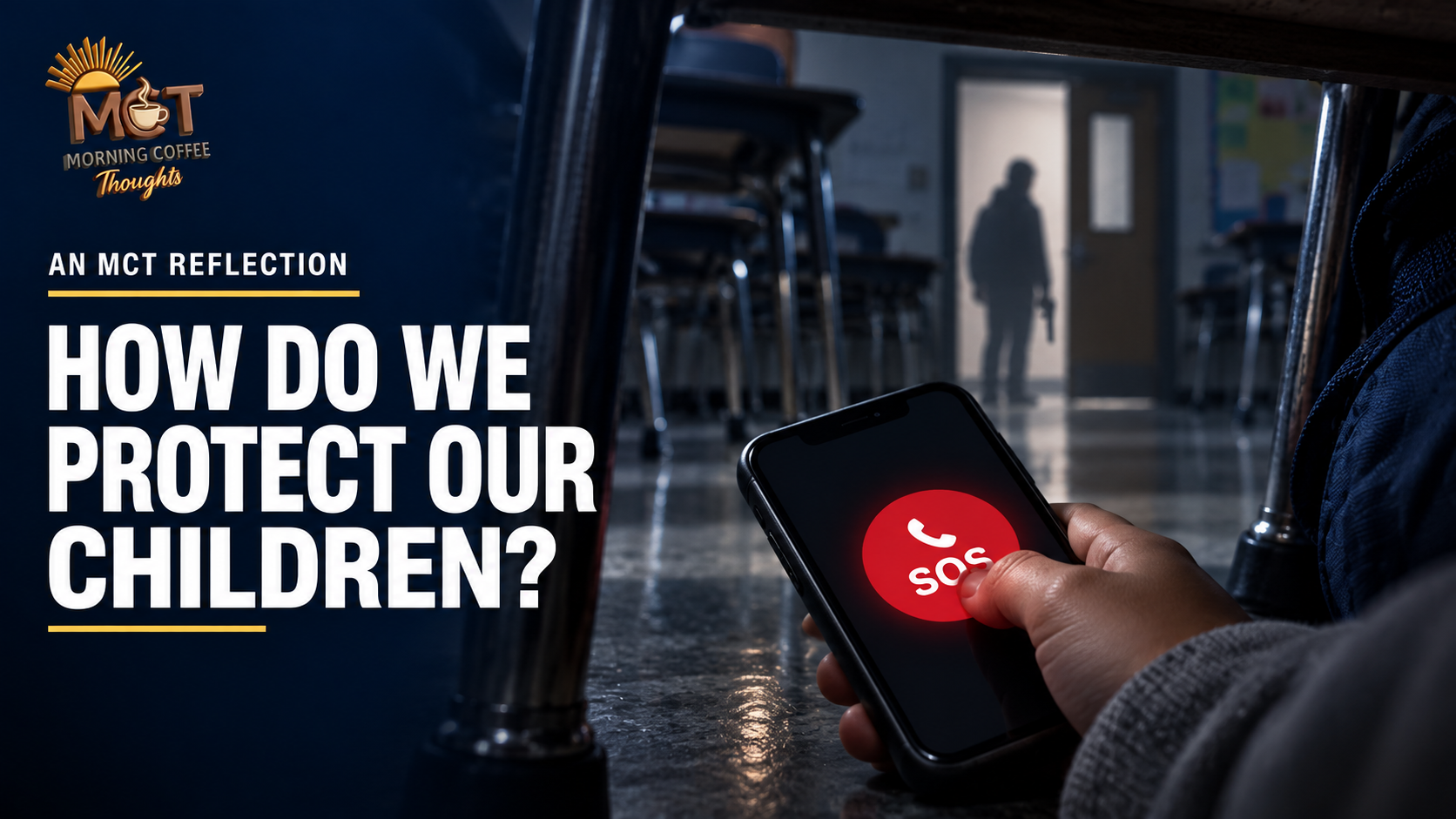
I have been reading too many stories about children getting hurt lately. Maybe that comes with what I do. I read reports, compare versions, check what authorities actually said and try to understand what happened before I write anything.
Usually, there comes a point when the research ends. You understand enough of the story to write it, put the facts in order and eventually move on. Some stories refuse to stay on the screen.
When children are shot inside schools, I stop looking at casualty figures as numbers in a report. I start imagining parents waiting outside a gate, children hiding somewhere inside a building, teachers trying to keep students calm and families waiting for a phone call they never imagined receiving. At that point, I stop reading as a blogger and start reading as a father.
How do we protect our children?
THREE SCHOOLS
In June, three students were killed in a shooting at San Jose National High School in Tacloban City. Twenty others were injured.
In August, another shooting happened at the junior high school campus of Ateneo de Zamboanga University. A student was killed, the student identified by authorities as the shooter also died, another student was wounded and other students were attended to for panic, anxiety and minor injuries.
Then came Banga National High School in South Cotabato in September. Two students were killed, the student identified by authorities as the shooter also died and several others were wounded.
Three fatal school shootings happened in less than three months. I am not saying that three incidents prove the Philippines has a national epidemic of school shootings because I do not have the data to make that claim. But I am a parent, and three schools are already three too many for me to ignore.
There are still things being investigated in the Banga case. Authorities say the firearm belonged to the student’s father and are looking into how he was able to access it. Investigators are also examining the student’s online activity and other circumstances surrounding what happened.
There have already been statements and speculation about what may have influenced him, but an investigation is still an investigation. I do not want to turn something authorities are still trying to understand into a neat explanation simply because people want one immediately. Sometimes we have to be comfortable admitting that we do not know yet.
WHAT DO YOU DO IF IT IS YOUR CHILD?
We spend years teaching our children how to stay safe. Look both ways before crossing the street. Do not go with strangers. Tell me where you are going. Message me when you arrive.
We ask whether they have eaten, whether they got home and whether somebody is with them. We worry when they are late, even if they are only a few minutes late, because that is what parents do. Then we send them to school.
School is supposed to be one of those places where a parent can breathe a little easier. You leave your child there because there are teachers, administrators, guards and other adults whose responsibilities include keeping children safe.
Now imagine receiving a message saying there is a gunman inside your child’s school. I do not know what I would do, and that scares me more than I care to admit.
I would probably want to call immediately, but what if my child’s phone rings while she is hiding? I would probably want to drive straight to the school, but what if hundreds of parents do the same thing and emergency vehicles cannot get through? Maybe I would just sit there staring at my phone, waiting for somebody to tell me whether my child is safe.
Parents like to believe that when something happens to our children, we will know what to do. We imagine ourselves rushing in, making decisions and protecting them somehow. But there are dangers we simply cannot physically stand between our children and, and that is very difficult for a parent to accept.
SCHOOL SECURITY IS ONLY ONE PART OF IT
After every school shooting, people talk about guards, gates, bag inspections and metal detectors. Of course those things matter, but the danger can begin long before someone walks through a school gate with a weapon.
In some cases, it begins at home with access to a firearm. Another child may have seen something disturbing but did not know whom to tell. Different people may have noticed separate warning signs without anybody seeing the whole picture.
Sometimes a child needed help long before anybody realized how serious things had become. There is no perfect checklist that tells us who will become violent, and we should be careful about treating every angry, isolated or troubled child as a future criminal.
Children should know that when they see something frightening, hear a threat or believe somebody may hurt themselves or someone else, there is an adult who will listen and take them seriously. Parents, teachers and schools also need to know what to do with that information when it arrives.
Protection cannot start only after somebody pulls a trigger.
AND THEN WE TURN IT INTO CONTENT
This is the part that makes me angry. Something terrible happens and almost immediately, social media gets to work.
Videos appear before families even understand what happened. Screenshots begin circulating, people repeat rumors because somebody else posted them first and others speculate about motives while investigators are still collecting evidence.
A frightened child running out of a school becomes a video people replay. A grieving family becomes something strangers discuss, while a blurry cellphone recording becomes something somebody uploads because people will click on it. I find that disgusting.
There is obviously a need for information during an emergency. Parents need to know what is happening, communities need accurate updates and journalists need to report. But there is a difference between informing people and feeding them trauma.
After the Zamboanga shooting, the Kapisanan ng mga Brodkaster ng Pilipinas reminded journalists, content creators and social media users to protect the dignity and identities of minors. After the Banga shooting, government agencies again asked people not to circulate graphic material and unverified information.
Think about what that means. Children had just experienced something horrifying, families were trying to understand what happened and adults still had to be reminded not to turn their suffering into content.
Maybe part of the problem is that we have built an internet where attention has value. Attention can mean reach, reach can mean followers and followers can eventually mean money. Tragedy attracts attention, and that creates a terrible incentive.
I am not accusing every person who shares a video of trying to earn money from it. Some people share because they are shocked, some believe they are helping spread information and others simply do not stop to think about what they are doing.
But we have to ask what we are contributing when we repost the same frightening footage for the twentieth time. Did people need to see it? Did the public learn anything useful from it? Was a child identifiable, and did the family have any say in how far that image traveled?
We may simply be adding another link to a chain that turns somebody else’s worst day into something people can watch.
There is also research suggesting that we should be careful about the way mass violence is covered. Researchers have examined possible imitation, short-term clustering and the effect of giving perpetrators enormous amounts of attention.
Much of that research comes from the United States, so I am not going to pretend it proves what is happening in the Philippines. It does not. But it gives us another reason to be careful about how we talk about perpetrators and how much attention we give them.
We do not need to make shooters famous to explain what happened. We do not need to repeat every disturbing thing associated with them or replay their images until everyone knows their faces better than the names of the children who died. We can refuse to give them the audience they may have wanted.
WHO IS LOOKING AT THE WHOLE PROBLEM?
The frustrating part is that we already have people and institutions responsible for different parts of child safety. Schools have responsibilities, DepEd has child-protection rules, child-welfare agencies exist, police investigate crimes, professional broadcasters have standards, social media platforms have their own policies and Congress can investigate and write laws.
I cannot honestly say that nobody is watching. What I see is fragmentation.
The school sees what happens inside the campus. Police see the criminal investigation, child-welfare agencies look at the protection of minors and platforms decide what content stays up or gets removed. Journalists have professional standards that an ordinary person running a large Facebook page may not have.
Meanwhile, the child moves through all of these spaces at once. A child can go from a classroom to a group chat, a gaming platform, TikTok and Facebook within the same afternoon. Something seen online can become a conversation in school, while something that happens in school can be uploaded within minutes.
In the sources I reviewed, I did not find one clearly identified national mechanism looking at the entire problem together. We keep having separate conversations about things happening to the same children. We talk about school security in one place, mental health somewhere else, guns in another conversation and social media and misinformation somewhere else again.
The child does not experience these things in separate government departments. To the child, it is one life.
WHY I AM MENTIONING AGAP SOS
I hesitated to include AGAP SOS in this reflection because I do not want a tragedy involving children to become an opportunity to promote something I am building. I am mentioning it because this article is partly about what helplessness does to a parent and how I have tried to respond to that feeling.
AGAP SOS is one small response. It is still being developed, and I am not presenting it as a solution to school violence.
An app cannot stop a bullet.
It cannot replace good parenting, secure somebody else’s gun or take the place of a teacher who notices something wrong. It cannot replace a counselor, the police or a school that has prepared properly for an emergency. It cannot guarantee that somebody will be rescued.
The idea started with a smaller question. If somebody I love is in danger, how quickly can that person tell the people they trust, “I need help. This is where I am”?
The basic idea is one action that can alert trusted people and temporarily share the person’s location during an emergency. Possibilities involving schools, organizations or formal emergency services would have to be built, tested and agreed upon before I would ever claim they work.
I keep imagining a frightened child somewhere inside a building. Maybe the child cannot speak, there is no time to search through contacts or all he or she can manage is one action on a phone. Can we at least make that action useful and make sure somebody who cares knows something is wrong?
AGAP SOS is a very small response to a much larger problem. I am including it here because building it is one of the ways I have tried to do something with the helplessness I feel as a parent, not because I believe I have solved school violence.
WHAT DO WE OWE THEM?
I still do not know the complete answer to the question that started this reflection. Parents have responsibilities, but schools, gun owners, government agencies, technology companies and social media platforms have responsibilities too. So do those of us who post things online.
Maybe protecting children also means learning when not to post something. It can mean refusing to share a video simply because it is shocking, waiting for facts instead of racing to be first and remembering that a frightened child in a video is someone’s son or daughter before that child is content.
I keep thinking about the ordinary things children bring to school: a notebook, a pen, a water bottle, a phone and maybe lunch prepared by somebody at home. They leave in the morning and their parents expect them back later. It is such an ordinary expectation that we barely think about it until one day a parent waits and the child does not come home.
I cannot read these stories anymore without imagining that possibility. I cannot stand outside every classroom, secure every firearm, watch every corner of the internet or know what every troubled child is thinking. I wish I could protect my child from everything, as every parent does, but love does not give us that power.
What we do have is responsibility. Adults decide how guns are stored, run schools, build platforms, create algorithms, write laws, produce news, upload videos and moderate communities. Adults decide whether a child’s tragedy becomes information or entertainment, and children live with the consequences of those decisions.
The question is therefore bigger than how we protect them from the next shooting. What do we owe our children before anything happens, when they tell us something is wrong, when they are frightened and when tragedy has already happened?
But I know we cannot keep asking children to live with the consequences of things adults refuse to fix.
SOURCES
- GMA Newshttps://www.gmanetwork.com/news/topstories/regions/992425/what-we-know-so-far-day-2-of-tacloban-school-shooting/story/
- GMA Newshttps://www.gmanetwork.com/news/topstories/nation/992963/tacloban-shooting-victims-deped/story/
- GMA Newshttps://www.gmanetwork.com/news/topstories/regions/993401/timeline-tacloban-city-school-shooting-incident/story/
- Associated Presshttps://apnews.com/article/022bd9892d858b1bc5e9ed741e0d7222
- GMA Regional TVhttps://www.gmanetwork.com/regionaltv/news/115210/suspect-in-adzu-shooting-among-2-killed-1-other-hurt/story/
- Associated Presshttps://apnews.com/article/fe3aa5d6d1f3dd2ca614d68bb373d604
- GMA Newshttps://www.gmanetwork.com/news/topstories/regions/1002852/students-reported-dead-in-banga-national-high-school-shooting/story/
- Associated Presshttps://apnews.com/article/0fb2a2443f64829985e0aab1368d2ee8
- GMA Newshttps://www.gmanetwork.com/news/topstories/regions/1002925/shooter-at-banga-national-high-school-was-into-deep-dark-web-dilg/story/
- GMA Newshttps://www.gmanetwork.com/news/topstories/nation/1002863/avoid-sharing-videos-unverified-info-on-banga-school-shooting-dict-warns/story/
- Kapisanan ng mga Brodkaster ng Pilipinashttps://kbp.org.ph/article/statement-on-responsible-reporting-and-legal-compliance-regarding-the-school-shooting-incident-in-zamboanga-city
- Kapisanan ng mga Brodkaster ng Pilipinashttps://kbp.org.ph/downloads/broadcast-code
- Department of Social Welfare and Developmenthttps://www.dswd.gov.ph/dswd-cwc-launch-media-guide-to-protect-children-in-news-coverage/
- PLOS ONEhttps://journals.plos.org/plosone/article?id=10.1371/journal.pone.0117259
- PubMedhttps://pubmed.ncbi.nlm.nih.gov/26135941/
- PLOS ONEhttps://journals.plos.org/plosone/article?id=10.1371/journal.pone.0196863
- Department of Educationhttps://www.deped.gov.ph/wp-content/uploads/OM-OSEC-2025-003.pdf