
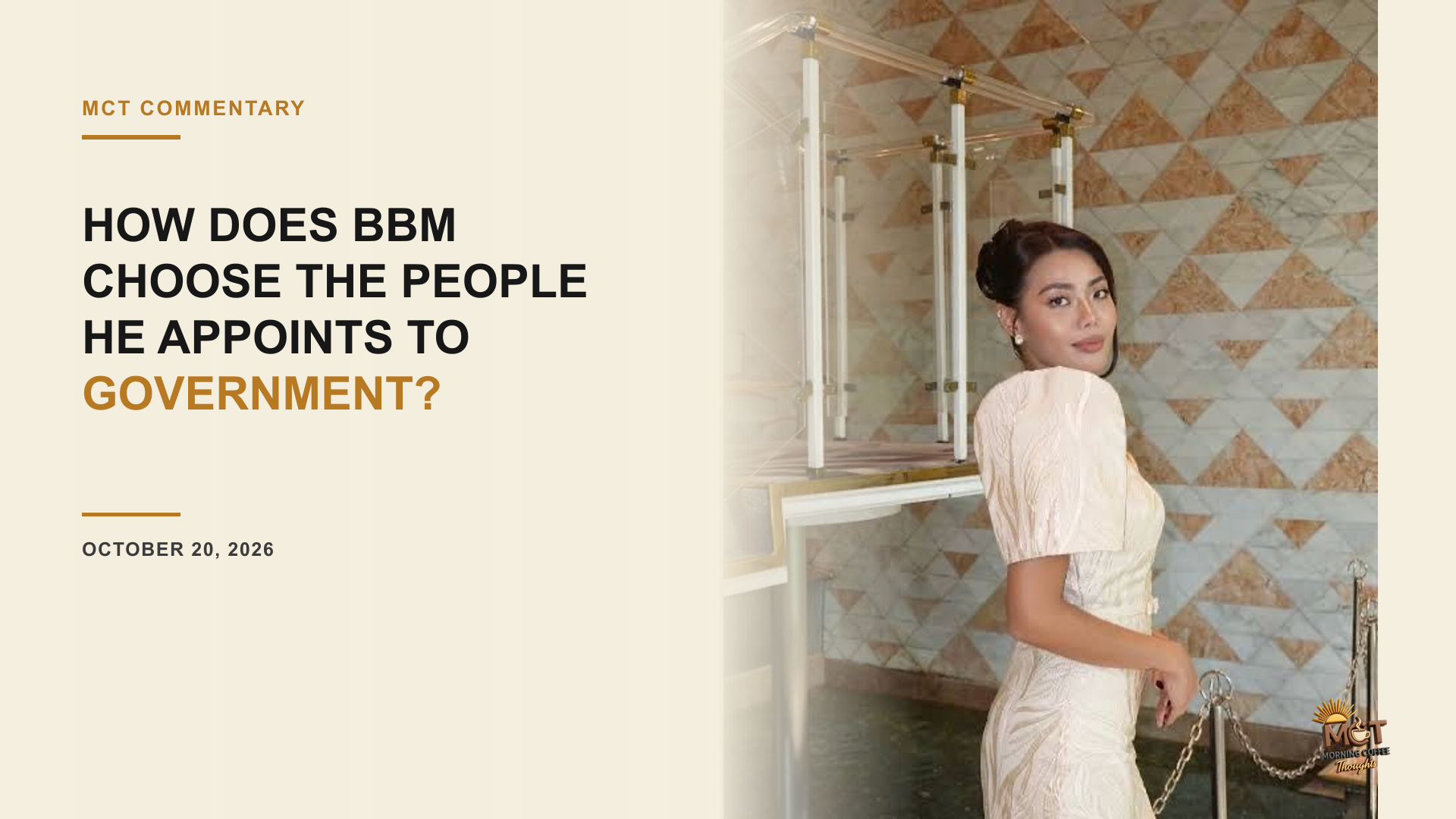
The appointment of Zofia Canlas to the Presidential Commission for the Urban Poor, or PCUP, raised my eyebrows. I looked at the appointment, looked at the person, and wondered how the two fit together.
What makes her tick? What does she know about the urban poor? What has she done for them? And what convinced President Ferdinand Marcos Jr. that she was the right person for the job?
THE QUESTION BEHIND THE APPOINTMENT
I do not have anything against her age, financial background, or trips abroad. Being young or wealthy does not make someone unqualified for public service. But when you appoint someone to a commission dealing with poverty, demolition, relocation, and families struggling to survive, surely it is reasonable to ask what qualifies that person for the position.
Canlas graduated from De La Salle University in 2024 with a Biology degree, major in Medical Biology. She was also the first nominee of the Batang Quiapo party-list in the 2025 elections. Her photographs from trips abroad drew attention, particularly because she has been appointed to a commission concerned with the urban poor.
Personally, I could not care less where she spends her vacations. I am more interested in what she knows and what she can do.
Malacañang defended the appointment on October 20, saying she had served as chief of staff to the PCUP chairperson and was familiar with the commission’s work.
All right. What exactly did she do there? How long did she serve? What did she accomplish?
There are Filipinos who have spent years working with urban poor communities, helping families threatened by demolition, dealing with housing problems, and fighting government bureaucracy on behalf of people who can barely afford their next meal.
Were any of them considered? And if so, what made Canlas the better choice?
I would welcome information about her actual work at PCUP. If she has a record of accomplishments that qualifies her for the position, the Palace should have no difficulty presenting it.
But her appointment got me thinking about BBM’s other choices.
REMEMBER LARRY GADON?
On June 26, 2023, Marcos appointed him Presidential Adviser for Poverty Alleviation.
Two days later, the Supreme Court announced that it had unanimously disbarred Gadon over his abusive and offensive remarks against journalist Raissa Robles.
The disbarment ruling came after the appointment, but Gadon’s earlier disciplinary problems were already public. The Supreme Court had suspended him before.
Then, in May 2024, the Court found him guilty of gross misconduct again in a separate matter. He was fined ₱150,000.
Of all the people BBM could have appointed to advise him on poverty alleviation, he chose Larry Gadon.
I still find that decision difficult to comprehend.
The Palace cited Gadon’s legal background and management experience. Fine. But what did those qualifications have to do with poverty alleviation? What had Gadon accomplished in that field?
And what about his disciplinary record?
We are talking about someone whose conduct had already attracted serious sanctions from the Supreme Court. His behavior was hardly a secret.
Yet BBM apparently believed he was an appropriate choice to advise him on poverty.
Now we have Canlas, another appointment involving poverty, although to a different office and under very different circumstances. I am not comparing her character with Gadon’s. I am questioning what the president considers relevant when choosing people for these positions.
The Philippines has no shortage of people who have devoted years to helping poor communities. I find it strange that appointments involving poverty can leave us with so little public information about the appointees’ actual work in that field.
NICOLAS TORRE III
I also remember Nicolas Torre III.
In May 2025, Marcos chose Torre to lead the Philippine National Police. The Palace praised his qualifications and said the appointment was based on merit.
Torre was an experienced police officer with an extensive law-enforcement career.
By August, he was out.
The dispute involved the reassignment of senior police officials. The National Police Commission, or NAPOLCOM, reversed those assignments. Marcos later said he had spoken to Torre repeatedly about complying with the commission’s directive. Torre still resisted, and the president removed him.
I understand the president’s position. Civilian authority over the police must be respected, and a PNP chief cannot simply disregard lawful directives.
But here is what caught my attention.
After removing Torre, Malacañang confirmed that Marcos had offered him another government position.
So BBM chose him to lead the PNP, removed him after roughly three months because of a serious disagreement over official authority, and still considered him suitable for another government job.
I am not questioning Torre’s entire career. He had years of police experience, and the disagreement does not erase that.
But what was BBM’s reasoning?
If Torre’s refusal to comply with NAPOLCOM was serious enough to cost him the PNP leadership, what convinced Marcos that another government position was appropriate?
Perhaps Torre was simply considered unsuitable for that particular assignment. If so, I would have liked to hear a fuller explanation.
It makes me wonder how the president decides who deserves to remain in government after losing a position under controversial circumstances.
THE CABINET RESET
I had similar questions in May 2025 when Marcos ordered Cabinet secretaries and other senior officials to submit courtesy resignations following the midterm elections.
The Palace described it as a government reset.
I supported the idea of reviewing Cabinet performance. We should be doing that regularly, and officials who are not delivering should be replaced.
But why did it take the midterm elections for BBM to announce such a sweeping review? What had he been doing before then?
Among those retained was Budget Secretary Amenah Pangandaman.
Six months later, her resignation was accepted amid the flood-control controversy. In videos, then-resigned Ako Bicol representative Zaldy Co alleged that Marcos, through Pangandaman, ordered ₱100 billion in 2025-budget project insertions. Malacañang denied the allegation and called his account inconsistent. The allegation and denial do not establish wrongdoing by Pangandaman.
The Palace said her departure was intended to prevent any appearance that she could influence the investigation.
What interested me was the earlier Cabinet review.
What exactly had BBM evaluated?
Were department heads assessed for actual performance, financial management, internal controls, and their ability to detect irregularities? Or was the review primarily about whether officials were delivering the president’s programs?
I am not assuming that the later allegations were known during the May review. But considering how publicly the administration promoted that exercise, I think it is fair to ask what standards were applied and what conclusions were reached.
Marcos even spoke about conducting quarterly performance evaluations.
I would be interested in seeing what those reviews produced.
We keep hearing that the president is evaluating his people. It would be useful to know how those evaluations affect his decisions.
THE FOUR-WEEK HEALTH SECRETARY
And then there was Dr. Jose “Brix” Pujalte Jr.
Marcos appointed him Health Secretary on July 13, 2026. Twenty-eight days later, he resigned.
Pujalte had decades of experience in public healthcare and previously headed the Philippine Orthopedic Center. His professional qualifications were substantial.
Malacañang cited health reasons for his departure.
During his brief tenure, a casino complaint and a complaint involving the alleged freezing of tuberculosis-commodity procurement had surfaced. Pujalte denied deliberately delaying the procurement, saying the process was under review. Neither complaint establishes misconduct, and the records cited here do not prove either one caused his resignation.
Still, four weeks?
We are talking about the Department of Health, which oversees public hospitals, disease prevention, national health programs, and services millions of Filipinos depend on.
Was there anything that could reasonably have been identified before Pujalte was appointed? Were his health circumstances or any existing complaints reviewed?
Perhaps his resignation resulted from circumstances nobody could have anticipated. That possibility should be acknowledged.
But I would like to know what happened because a Cabinet appointment lasting just 28 days is hardly ordinary.
WHO CHECKS THE RECOMMENDATIONS?
Looking at these decisions, I keep wondering about the people around BBM.
The president has Cabinet officials, advisers, agency heads, and other people who presumably help him evaluate candidates. Recommendations must pass through several hands before appointments reach his desk.
Does anyone question those recommendations?
Does anyone tell BBM that someone he trusts might be a poor choice for a particular job?
I ask because we have seen how political appointments work in this country. Political loyalty, personal relationships, and recommendations from influential people have long played roles in government appointments.
I am not claiming that those considerations explain Canlas’s appointment. We do not know who recommended her or what convinced Marcos to approve it.
But I am curious how much weight the president gives to those relationships compared with a person’s actual ability to do the job.
Being loyal to a president does not make someone qualified to run an agency. Having impressive credentials does not automatically mean someone can manage a government department. And having the confidence of the appointing authority tells us very little about whether an official can deliver results.
We have an unfortunate habit of accepting appointments because the president supposedly knows what he is doing.
Then, when something goes wrong, the administration announces a resignation, removal, or replacement, and we are expected to move on.
I do not think we should.
If an official turns out to be unsuitable, we have every reason to ask how that person got the job.
If someone is removed from one position and offered another, we can question the reasoning.
And if the president announces performance reviews, the public should be able to see some evidence of how those reviews influence his decisions.
CONFIDENCE IS EASY TO DECLARE
I am aware that even carefully chosen officials can disappoint. A person can have an excellent record and still make bad decisions. Health problems can arise unexpectedly. Disagreements can develop between capable people. Allegations can surface years after an appointment.
None of that automatically proves the president made a bad choice.
But I am having difficulty understanding the consistency of BBM’s judgment.
With Gadon, there was already a documented history of professional misconduct before the appointment. With Torre, a dispute over authority ended his PNP leadership after roughly three months, yet the president still offered him another government position. Pangandaman was retained during a Cabinet review but left months later amid serious allegations she denied. Pujalte’s tenure as Health Secretary lasted four weeks.
These incidents deserve to be judged on their individual facts. Yet they also give us reason to examine how BBM makes appointments and assesses the people he has chosen.
And that brings me to something I think we have tolerated for far too long.
Government positions are treated almost casually whenever a new appointee is announced.
We hear that someone is experienced, capable, dedicated, and trusted by the president. Malacañang releases a statement, the appointment becomes official, and everyone is expected to accept it.
But these people are being placed in charge of public money, government programs, and decisions affecting millions of Filipinos.
Some of them will influence how entire departments operate. Others will deal directly with communities that depend on government assistance.
Surely, we should demand something more than the president’s assurance that he made the right choice.
I started questioning Canlas’s appointment because I could not immediately see how her background fit the responsibilities of the PCUP.
I am open to being proven wrong about her. If she has the experience and ability to perform well, I hope she demonstrates it.
The urban poor deserve competent people working on their behalf, regardless of those people’s age or financial circumstances.
But the responsibility for choosing the right people begins with the president.
BBM has every right to appoint officials within the limits of the law. He also has the power to replace them when circumstances call for it.
What he cannot reasonably expect is for Filipinos to accept those decisions without asking questions.
I do not expect a president to get every appointment right. I expect him to make decisions carefully, listen to competent advisers, and recognize when his judgment has been wrong.
And when the public questions an appointment, I expect more than the usual Palace assurance that the president has confidence in the person.
Confidence is easy to declare.
What interests me is what that confidence is based on.
Because the next time an official disappoints, resigns under controversy, or gets removed from office, we will undoubtedly criticize that person.
I think we should also be asking about the judgment of the man who put that official there.
And right now, that man is Ferdinand Marcos Jr.
SOURCES
- Philippine News Agency, October 20, 2026 — Palace defense of Zofia Canlas’s PCUP appointmenthttps://www.pna.gov.ph/article/palace-cites-dedication-familiarity-with-pcup-work-in-defending-zofia-canlas-appointment
- Commission on Elections — Batang Quiapo party-list nomination documents, 2024https://www.comelec.gov.ph/php-tpls-attachments/2025NLE/COC_2025NLE/COC_Partylist162/29.%20BATANG%20QUIAPO.pdf
- Presidential Communications Office, June 26, 2023 — Appointment of Larry Gadonhttps://pco.gov.ph/news_releases/pbbm-appoints-atty-larry-gadon-as-presidential-adviser-for-poverty-alleviation/
- Supreme Court, June 28, 2023 — Gadon’s disbarmenthttps://sc.judiciary.gov.ph/court-unanimously-disbars-atty-lorenzo-larry-gadon-for-misogynistic-sexist-abusive-and-repeated-intemperate-language/
- Supreme Court, May 23, 2024 — Gadon found guilty of gross misconduct againhttps://sc.judiciary.gov.ph/sc-finds-gadon-guilty-of-gross-misconduct-anew/
- Presidential Communications Office, May 29, 2025 — Torre’s appointmenthttps://pco.gov.ph/news_releases/new-pnp-chief-torres-appointment-based-on-merit-professionalism/
- Presidential Communications Office, August 27, 2025 — Torre’s removal and offer of another government posthttps://pco.gov.ph/news_releases/pbbms-decision-to-relieve-gen-torre-is-in-the-nations-best-interest/
- Philippine News Agency, September 9, 2025 — Marcos explains Torre’s removalhttps://www.pna.gov.ph/articles/1258353
- Philippine News Agency, May 22, 2025 — Cabinet courtesy resignationshttps://www.pna.gov.ph/articles/1250590
- Philippine News Agency, June 13, 2025 — Quarterly Cabinet performance reviewshttps://www.pna.gov.ph/articles/1252094
- Philippine News Agency, November 15, 2025 — Palace response to Zaldy Co’s ₱100-billion insertion allegationhttps://www.pna.gov.ph/articles/1263368
- Presidential Communications Office, November 17, 2025 — Pangandaman resignation acceptedhttps://pco.gov.ph/news_releases/president-marcos-accepts-resignations-of-es-bersamin-and-dbm-secretary-pangandaman/
- Philippine News Agency, July 13, 2026 — Appointment of Jose Pujalte Jr.https://www.pna.gov.ph/index.php/articles/1279300
- Philippine News Agency, August 10, 2026 — Pujalte’s resignationhttps://www.pna.gov.ph/articles/1281487
- Philippine Star, August 6, 2026 — Complaint over alleged TB-procurement freezehttps://www.philstar.com/headlines/2026/08/06/2547435/health-advocates-file-complaint-vs-new-doh-chief-over-tuberculosis-drug-freeze/amp/
Photograph supplied by the author. The separately supplied MCT logo remains Morning Coffee Thoughts artwork; no endorsement is implied.