
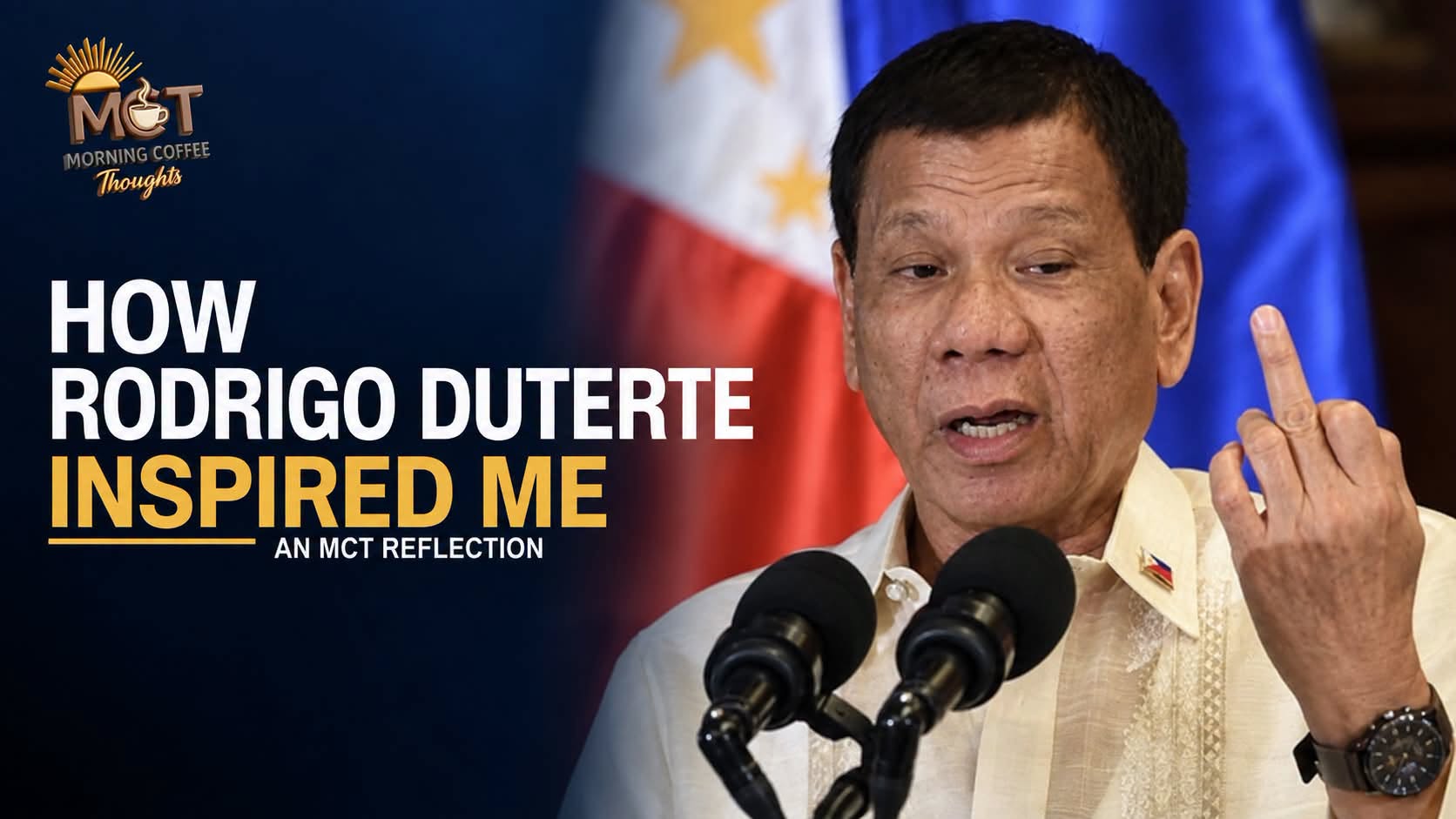
Rodrigo Duterte inspired me. I mean that sincerely.
His presidency changed the way I look at government and eventually changed the way I write about politics.
Before Duterte, I followed politics, had opinions and argued about issues like many Filipinos did.
During his years in office, I started asking a question much more often: how do I know this is true?
HE MADE ME PAY ATTENTION
Listen again to what Duterte said when he became President in 2016.
In his inaugural address, he spoke about corruption, criminality, illegal drugs and the erosion of public trust in government. He said he knew the limits of presidential power and described his adherence to due process and the rule of law as “uncompromising.”
He also said he abhorred secrecy and wanted transparency in government contracts, projects and business transactions.
Those were good things to hear from a new president.
A few weeks later, he signed Executive Order No. 2, which operationalized Freedom of Information across offices under the executive branch. It gave the public a formal way to ask government for records that could be released under the order.
I liked the idea behind it.
If government belongs to the people, then citizens should be able to look at what government is doing.
I did not realize then how much that idea would eventually affect me.
HE MADE ME LOOK FOR THE PAPER TRAIL
Duterte talked frequently about corruption.
He built part of his political identity around the idea that corrupt public officials should fear the President and that government should stop tolerating corruption.
So I started paying more attention to corruption.
Eventually, though, I wanted more than accusations and speeches. If someone supposedly stole government money, I wanted to know how much, where it came from, which project was involved, who approved it and what records supported the accusation.
I started looking for contracts.
Then budgets.
Then Commission on Audit reports, court decisions, procurement documents, legislative records and transcripts.
Sometimes I would read a news report and then spend much longer looking for the document the report was based on. I discovered that the original document could be more interesting than the article written about it.
It could also change the story.
A statement that sounded damning in a headline could look different when I read the entire transcript.
An allegation repeated hundreds of times online could become much weaker once I tried to find the document supposedly supporting it.
The opposite happened too.
Sometimes a few dry pages buried inside an audit report told a much more troubling story than anything circulating on Facebook.
That habit became part of Morning Coffee Thoughts.
A politician says something. I check.
Someone throws an accusation. I look for the record.
A government agency publishes a number. I want to know what was counted and how.
HE MADE ME THINK ABOUT POWER
Duterte’s public image was different from the presidents who came before him.
He was blunt, aggressive and often angry. He threatened criminals, insulted critics and projected himself as somebody willing to act while other politicians talked.
I understood why people liked it.
The Philippines had spent decades dealing with corruption, crime, slow government services and politicians who could talk beautifully without fixing much. A leader who appeared impatient with all of that was bound to attract people who were tired of waiting.
Watching Duterte govern made me pay closer attention to something I had not studied seriously enough before: the limits placed on government power.
I started reading more about due process, constitutional rights, the role of courts, congressional oversight and independent institutions. I began paying attention to procedures that can look irritating when people want government to act immediately.
There is a reason power is surrounded by rules.
Government can investigate you. It can arrest you. It can prosecute you. It can take away your liberty and, under certain circumstances, use force against you.
Once I understood government that way, I stopped treating aggression as proof of competence.
A president could dominate the political conversation and still make bad decisions. A leader could frighten opponents without fixing the weaknesses inside the institutions he controlled.
The image of strength became less interesting to me than the work of governing.
THEN CAME THE DRUG WAR
This part changed things much more deeply.
The Duterte government’s final Real Numbers data recorded 6,252 drug suspects killed during anti-drug operations from July 2016 through May 31, 2022.
The United Nations Human Rights Office reported a higher number in 2020 using broader official government data. It said at least 8,663 people had been killed in connection with the anti-drug campaign by that point, while human rights organizations produced still higher estimates.
Those figures do not count exactly the same thing, so I learned not to throw them around as though one number automatically disproved another.
But every credible count led to the same place.
Thousands of people were dead.
Numbers became people once I started asking questions.
Who was killed?
What were they accused of?
What evidence existed?
Were they armed?
Who investigated the killings?
What happened when the police version of events was challenged?
How many deaths resulted in prosecution?
How many families ever received an answer?
Due process became much easier for me to understand after that.
Police officers can be wrong. Witnesses can lie. Evidence can be planted. Informants can have their own motives, and a person accused of a crime can turn out to be innocent.
Death does not give government a chance to correct its mistake afterward.
The legal battle over Duterte’s drug war has now moved far beyond political argument. On April 23, 2026, the International Criminal Court confirmed three counts of crimes against humanity involving murder and attempted murder and committed Duterte to trial after finding substantial grounds to believe he was criminally responsible for the alleged crimes.
He has not been convicted. His trial is scheduled to begin on November 30, 2026.
I can strongly condemn what I saw during the drug war and still write those last two sentences.
If evidence and due process mean anything to me, I cannot throw them away because the accused happens to be Rodrigo Duterte.
HE MADE ME READ PAST THE HEADLINE
Duterte also spent years fighting with journalists and news organizations.
Rappler became one of his most visible targets. In 2018, his administration barred Rappler reporters from covering presidential events inside Malacañang after Duterte had accused the organization of publishing fake news and his spokesperson said the President had lost trust in it.
I did not respond by deciding that Rappler must therefore always be right.
I started checking.
When a news report quoted a court ruling, I tried to find the ruling. When someone cited COA, I looked for the audit report.
When politicians accused journalists of lying, I wanted to see what the journalists actually published.
When journalists accused politicians of wrongdoing, I wanted to see the evidence behind the report.
That eventually became one of the most important habits in the way I work.
I do not want Rodrigo Duterte deciding what I should believe.
I do not want Rappler deciding it either.
Or ABS-CBN.
Or GMA.
Or the Inquirer.
Or the Manila Times.
Or some Facebook page with a million followers.
Give me the information. Give me the document when one exists. I will read as much as I can and make up my own mind.
THEN I HAD TO TURN THE SAME STANDARD AROUND
There was an uncomfortable consequence to all of this.
It became easy for me to investigate Rodrigo Duterte because I increasingly disagreed with him.
The real test came when the person under scrutiny was somebody I liked.
If I demanded proof before accepting an accusation against Duterte, I had to demand proof when someone accused a politician I supported.
If I insisted on due process for someone whose politics I shared, then due process could not disappear when the accused was someone I disliked.
If a document contradicted the argument I wanted to write, the argument had to change.
There are times when research ruins a very good post.
I have learned to live with that.
Political loyalty is dangerous once it begins deciding which facts we accept. The moment I start lowering the standard for someone because I happen to like that person, everything I claim to believe about accountability becomes meaningless.
That realization changed Morning Coffee Thoughts more than my position on any single politician.
I became much less interested in belonging to a political camp.
People I agree with can be wrong.
People I dislike can be right.
A politician I defend today may deserve criticism tomorrow.
And when I make a mistake, the evidence does not become less true simply because correcting myself is embarrassing.
SO YES, RODRIGO DUTERTE INSPIRED ME
Now I can say exactly what I mean.
The Duterte administration’s poor governance inspired me.
Watching that administration pushed me to understand government more seriously because I did not want anger to be the only thing I had.
I wanted to know why things were happening.
I wanted records.
I wanted laws.
I wanted numbers I could trace.
I wanted to understand how public money moved, how government contracts worked, how accusations became cases, what courts actually decided and what happened after politicians stopped talking about an issue.
The Duterte years taught me how easily aggression can be mistaken for leadership and how easily confidence can hide incompetence.
They showed me how political loyalty can make people defend conduct they would condemn immediately if someone from the other side did exactly the same thing.
The drug war showed me what can happen when government begins treating due process as something that gets in the way and when human beings are reduced to statistics in a political argument.
His battles with critics showed me why I should never allow a politician to choose which sources I am permitted to believe.
And his constant talk about corruption made me understand that shouting about corruption and finding it are two completely different jobs.
That is why I research.
That is why I read documents that most people will never bother opening.
That is why an allegation is never enough for me simply because I want it to be true.
That is why I have become suspicious of political heroes.
Rodrigo Duterte inspired me to become a more investigative political writer because I watched what I considered poor governance and realized that simply being angry about it accomplished nothing.
I needed to understand it.
And once I started understanding how government actually works, I also began understanding how easily citizens can be fooled when we stop checking.
That may be the strongest influence Rodrigo Duterte ever had on me.
He made me pay attention.
Then he gave me more than enough reasons to keep looking.
SOURCES
- Presidential Communications Office, President Rodrigo Roa Duterte’s Inaugural Address, June 30, 2016https://pco.gov.ph/june-30-2016-president-rodrigo-roa-dutertes-inaugural-address/
- LawPhil, Executive Order No. 2, Series of 2016https://lawphil.net/executive/execord/eo2016/eo_2_2016.html
- Philippine News Agency, Real Numbers data on the anti-drug campaignhttps://www.pna.gov.ph/articles/1181087
- UN Human Rights Office, Report on the Situation of Human Rights in the Philippineshttps://bangkok.ohchr.org/reports/ohchr-report-situation-human-rights-philippines
- International Criminal Court, Philippines situation and Rodrigo Duterte casehttps://www.icc-cpi.int/philippines
- Reuters, ICC confirms former Philippine President Rodrigo Duterte will stand trial, April 23, 2026https://www.reuters.com/world/asia-pacific/icc-confirms-trial-against-former-philippine-president-duterte-2026-04-23/
- Reuters, ICC sets Rodrigo Duterte trial date for November 30, 2026https://www.reuters.com/world/asia-pacific/icc-sets-trial-date-philippines-duterte-over-alleged-crimes-against-humanity-2026-05-27/
- Reuters, Rodrigo Duterte appears before ICC judges, September 2026https://www.reuters.com/world/asia-pacific/former-philippines-leader-duterte-due-icc-courtroom-assess-if-fit-murder-trial-2026-09-15/
- Committee to Protect Journalists, Philippines bans Rappler reporters from presidential palacehttps://cpj.org/2018/02/philippines-bans-rappler-reporters-from-presidenti/