
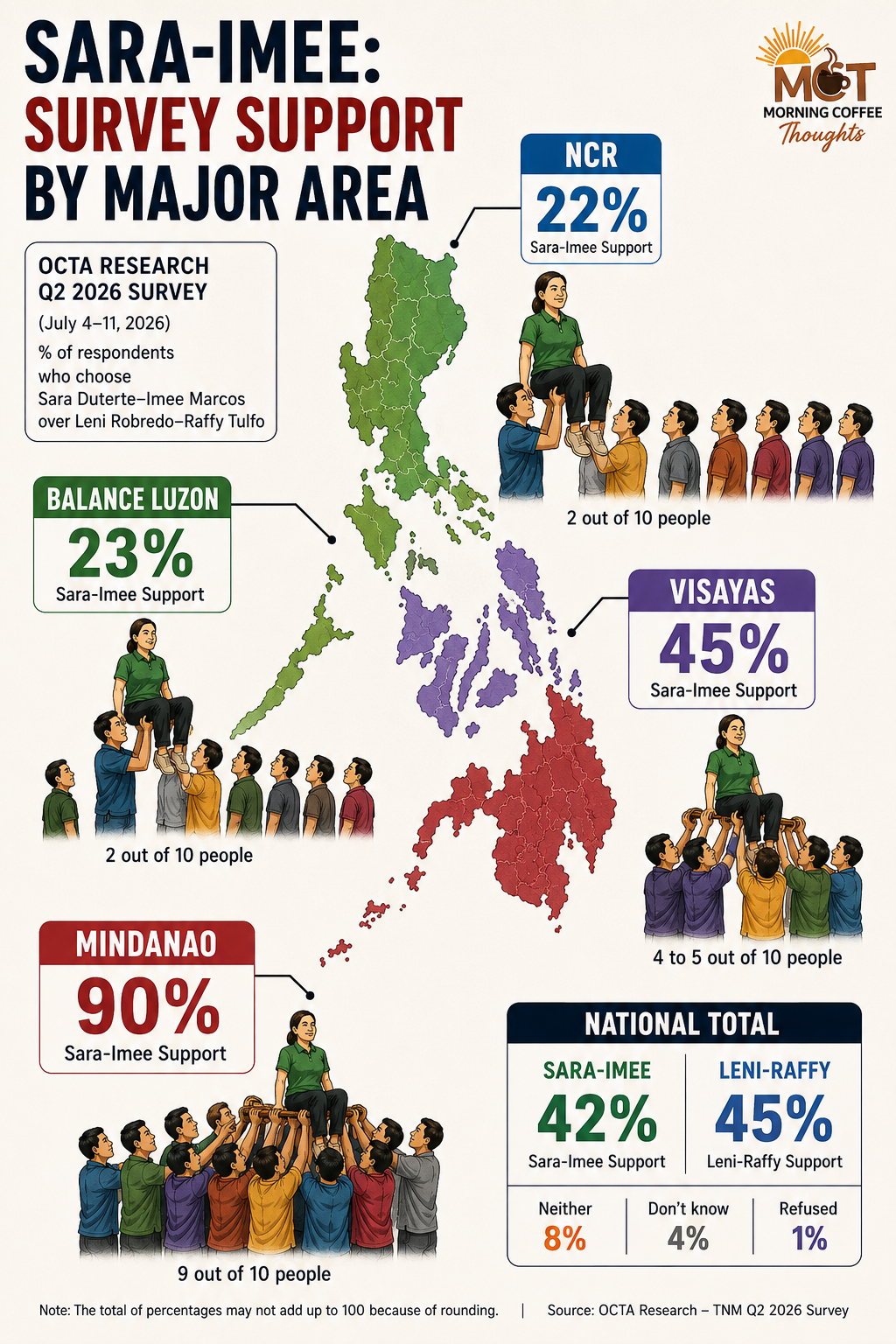
OCTA Research sent me this survey this morning. I read the details, went through the tables, and realized merong mas interesting na kuwento dito kaysa sa 45% versus 42% na malamang unang mapapansin ng marami.
I also wanted to spend time on this because marami sa atin ang naniniwala na surveys are made to manipulate people. I understand where that suspicion comes from. Political surveys are constantly used by politicians, supporters, influencers, and social media pages to create an impression that their candidate is winning, collapsing, unstoppable, finished, or whatever version helps their side.
But I've been looking at surveys for some time now, and I don't feel manipulated simply because somebody conducted one. Mas madali akong ma-manipulate kung hanggang headline lang ako, or kung makakita ako ng graphic sa Facebook, react agad, share agad, tapos hindi ko na titingnan kung kailan ginawa ang survey, ilan ang respondents, ano mismo ang tanong, ano ang margin of error, at ano ang nasa ibang tables.
That's generally how I approach surveys, and frankly, almost anything political. I question first, read further, check what the headline leaves out, then decide what I think.
And in this OCTA survey, the number that made me stop was not 45 or 42.
Ninety percent.
Ganoon kataas ang Sara Duterte-Imee Marcos tandem sa Mindanao. Siyam sa bawat sampung respondents doon ang pumili sa kanila, while Leni Robredo-Raffy Tulfo got only 5%.
Pero hindi rin naman bago sa akin na malakas si Sara sa Mindanao. I've seen this pattern repeatedly in previous surveys. Given na iyon. Kapag Mindanao ang tinitingnan mo, expected nang napakalakas ng Sara-led tandem.
If you stop there, madaling mabuo ang impression na unbeatable siya. Tingnan mo naman, 90%.
Pero Mindanao alone cannot tell us what the national race looks like. Isang malaking bahagi iyon ng bansa, pero hindi iyon ang buong electorate.
And that is exactly why I kept reading.
HINDI NATIONAL DOMINANCE ANG 90% SA MINDANAO
The survey was conducted from July 4 to 11, 2026 among 1,200 respondents nationwide. OCTA gives the national survey a ±3% margin of error, while the estimates for NCR, Balance Luzon, Visayas, and Mindanao each have a ±6% margin.
The hypothetical choice was between two tandems: Leni Robredo-Raffy Tulfo and Sara Duterte-Imee Marcos.
Nationally, Leni-Raffy got 45%. Sara-Imee got 42%. Eight percent chose neither tandem, 4% said they did not know, and 1% refused to answer.
OCTA itself describes the race as a statistical dead heat.
So what does the margin of error mean for people like us who are just trying to read the survey correctly?
Simple lang.
If OCTA says 45% for Leni-Raffy and 42% for Sara-Imee, that does not mean we should automatically think, “Okay, lamang ng three points ang Leni-Raffy.”
The survey is based on 1,200 respondents, not every Filipino voter. So there is always some allowance for the possibility that the real nationwide numbers are a little higher or a little lower than what appeared in the sample.
That is what the margin of error is telling us.
Parang kumuha ka ng maliit na scoop from a big pot of soup. The scoop gives you a good idea of the taste, pero hindi ibig sabihin na every single spoonful in the pot will taste exactly the same.
So when the gap is only three points, and the uncertainty around the comparison is large enough that either tandem could actually be ahead, the sensible conclusion is: close ang laban.
I don't need to spend my time arguing whether 45 is really ahead of 42.
Mas useful sa akin ang susunod na tanong.
Saan nanggagaling ang support ng bawat tandem?
Because once you look at that, ibang picture na ang makikita mo.
Sa National Capital Region, 56% ang Leni-Raffy at 22% ang Sara-Imee.
Sa Balance Luzon, 61% versus 23%.
Sa Visayas, 45-45.
Then you get to Mindanao.
Five percent ang Leni-Raffy.
Ninety percent ang Sara-Imee.
That is a huge regional divide. It also tells us that the two tandems are arriving at almost the same national number through very different parts of the country.
Kayang manatiling competitive ng Leni-Raffy nationally kahit halos wala sila sa Mindanao because they are doing very well in NCR and Balance Luzon, while they are tied with Sara-Imee in the Visayas.
Sara-Imee has the reverse situation. Their Mindanao number is enormous, but their numbers in NCR and Balance Luzon are much lower.
So when somebody tells me, “Malakas si Sara,” I now have a follow-up question.
Saan?
Because if we're talking about Mindanao, yes, overwhelmingly strong.
If we're talking about the whole Philippines, the numbers are telling us something very different.
MALAKAS SA MINDANAO, PERO HINDI SAPAT ANG MINDANAO LANG
I recently had this conversation with my mother-in-law when she visited from the United States. Napunta kami sa politics, and at one point sinabi niya sa akin, basically, malakas si Sara.
Hindi naman ako nagtaka. In fact, that conversation reminded me how powerful that impression has become.
Kapag paulit-ulit mong nakikita ang loyal supporters, social media posts, political rallies, and huge Mindanao numbers, madaling makabuo ng picture na nationally untouchable na rin si Sara.
Because I had been following the surveys, I tried to explain the other side of it. Oo, sobrang lakas ng Sara-led tandem sa Mindanao. Pero kapag tiningnan mo ang national results, NCR, Balance Luzon, at Visayas, mas complicated ang picture.
I went into the details with her. I don't know exactly what she thought afterward, and that's fine.
But that conversation reminded me of another problem when we talk about political surveys.
For many of us, survey data is no longer the first thing we consult once we have already decided who we like, who we dislike, or who we consider our political idol. Minsan nauuna na ang conclusion.
“Malakas si Sara.”
“Panalo na iyan.”
“Wala nang chance ang kabila.”
Then every new piece of information gets processed through a conclusion we already made.
And that's where I think we can actually allow ourselves to be manipulated. We don't have to be fooled by the survey itself. Sometimes all it takes is somebody showing us one favorable number, one graphic, or one headline and knowing that we probably won't read anything beyond it.
That's why I prefer reading the report itself.
Question the survey. Question the methodology. Question the people interpreting it. Check whether the question was fair and whether the numbers actually support what somebody is claiming.
Pero basahin muna natin.
If I'm going to reject a survey, I want to know first what I am rejecting.
NINETY PERCENT SOUNDS HUGE BECAUSE IT IS HUGE
I don't want to minimize that Mindanao number just because it complicates the discussion.
Ninety percent is enormous. A political tandem would be thrilled to have that kind of support anywhere, and Sara-Imee's Mindanao base is obviously one of the biggest advantages visible in this poll.
But think about what being at 90% also means.
Halos nasa iyo na lahat.
The closer you get to 100%, the fewer additional voters remain available in that same place.
Meanwhile, Sara-Imee has 22% in NCR and 23% in Balance Luzon. Those numbers leave much more room for possible growth.
So if I'm watching the next survey, hindi ang pag-akyat nila from 90% to 91% or 92% in Mindanao ang pinaka-aabangan ko.
I want to know what happens outside Mindanao.
Can 22% in NCR become substantially higher?
Can 23% in Balance Luzon grow?
Can they build an advantage in the Visayas?
Because Mindanao alone cannot make the national numbers say something they don't.
A presidential election is decided by votes from across the Philippines. Dominating one part of the country gives you a powerful base, but you still need enough votes from everywhere else.
And the Q1-to-Q2 comparison gives us one clue about where Sara-Imee may be finding more support outside Mindanao.
TINGNAN ANG VISAYAS
OCTA also compared the latest results with its Q1 2026 survey.
Noong Q1, Leni-Raffy had 61% in NCR against Sara-Imee's 23%. In Q2, that became 56% versus 22%.
In Balance Luzon, Leni-Raffy went from 57% to 61%. Sara-Imee stayed at 23%.
In Mindanao, Leni-Raffy stayed at 5%, while Sara-Imee went from an already overwhelming 86% to 90%.
Then there is the Visayas.
Q1 had Leni-Raffy at 48% and Sara-Imee at 40%.
Q2 has them tied at 45%.
That is the movement I want to watch.
Sara-Imee gained another four points in Mindanao, where they were already at 86%. In the Visayas, they went from 40% to 45% while Leni-Raffy went from 48% to 45%.
An eight-point numerical gap disappeared.
Pero dito ulit papasok ang margin of error.
The Visayas estimate has a ±6% margin of error. So even that 45-45 should not be treated as if we have discovered the permanent political position of the entire Visayas.
One survey gives us a picture. The next survey helps us see whether what looked like movement was actually something that continued.
So I won't say the Visayas has permanently moved toward Sara-Imee, and I definitely won't say the Visayas will decide 2028.
What I can say is that Q2 shows Sara-Imee doing better there than they did in Q1.
If that happens again, then I'll pay much closer attention.
THE CLASS NUMBERS ADD ANOTHER PIECE
The socioeconomic numbers are also interesting.
Among Class E respondents, Sara-Imee leads 53% to 33%.
Among Class D, Leni-Raffy leads 48% to 41%.
Among Class ABC, Leni-Raffy leads 41% to 37%.
Madaling gumawa agad ng political theory mula diyan. Poor voters support this candidate. Better-off voters prefer another.
Pero hindi ganoon kalinis ang ibang tables.
Among respondents with college or postgraduate education, Sara-Imee actually leads 40% to 36%.
Among respondents with no formal education or elementary schooling, Leni-Raffy leads 46% to 40%.
Vocational respondents prefer Leni-Raffy 54% to 30%.
So I don't think the data allows us to reduce this into a simple story about rich voters versus poor voters, or educated voters versus less-educated voters.
What we know is that Sara-Imee has a strong Class E advantage in this survey.
Why?
OCTA did not answer that here.
And I would rather leave that question open than invent a reason that happens to fit my politics.
PATI ANG AGE NUMBERS, ANG WEIRD
The age numbers are one of the most curious parts of the entire report.
Among 18-to-24-year-olds, Leni-Raffy leads 52% to 32%.
Sara-Imee then leads among 25-34 at 50% to 33%, among 35-44 at 50% to 35%, and among 45-54 at 48% to 43%.
The direction changes again among older respondents.
Leni-Raffy leads 48% to 40% among those aged 55-64, 60% to 29% among 65-74, and 76% to 23% among respondents aged 75 and above.
Ang weird.
And ang dali sanang gawan ng magandang explanation.
Young voters think one way. Working-age Filipinos care about another set of issues. Older people remember certain periods in history.
But OCTA did not ask why respondents chose those tandems in this release.
So I don't know.
The pattern is interesting. I want to understand it better. But I won't pretend the table tells me something it doesn't.
TANDEM POLL ITO
There's another reason I want to be careful with the phrase “malakas si Sara.”
This survey did not ask respondents to choose between Leni Robredo and Sara Duterte alone.
They were given tandems.
Leni Robredo-Raffy Tulfo.
Sara Duterte-Imee Marcos.
So I cannot separate Sara Duterte's support from Imee Marcos's effect on the tandem. I also cannot tell how much of Leni-Raffy's 45% comes from Robredo and how much comes from Tulfo.
Different running mates could produce different numbers. Different political alliances could change the picture, and an actual 2028 campaign could change it again.
So the accurate description is that Sara-Imee has 90% support in Mindanao in this hypothetical matchup.
I would not automatically turn that into “Sara Duterte has 90% of Mindanao” under every possible 2028 scenario.
Wala pang final candidates. Wala pang final tandems. Almost two years remain before the election.
The survey gives us a snapshot from July 2026.
That's already useful. We don't have to make it say more than it does.
THE BIGGER STORY STARTED BEFORE Q2
This is also why I don't want the article to become an argument over three percentage points.
OCTA says earlier rounds of this same hypothetical matchup had Duterte-Marcos ahead of Robredo-Tulfo by roughly 15 to 25 percentage points.
Then came Q1 2026.
Robredo-Tulfo: 44%.
Duterte-Marcos: 40%.
Now Q2 gives us 45% versus 42%.
The Q1-to-Q2 national movement is small. OCTA itself treats the two surveys as basically showing a stable national race.
The much bigger change happened over a longer period.
A pairing that OCTA says once held a 15-to-25-point numerical advantage is now in a statistical dead heat.
And here's the part I find especially interesting: Duterte-Marcos did not lose Mindanao while that happened.
They had 86% there in Q1.
Now they have 90%.
Their strongest territory became even stronger, while their old national advantage disappeared.
So if somebody wants to convince me that Sara's enormous Mindanao numbers alone prove she is nationally unbeatable, I have a problem with that conclusion.
The national data doesn't support it.
AND THEN THERE'S SOCIAL MEDIA
This is where social media can badly distort our perception.
If your feed is filled with Sara supporters, fan pages, political influencers, viral clips, and people repeatedly telling you that she is unbeatable, the sheer volume can start feeling like evidence.
Sometimes political campaigns and networks also use astroturfing. That's when organized or manufactured activity is made to look like spontaneous grassroots support.
But I cannot use this OCTA survey to tell you how much of Sara Duterte's online support is organic, coordinated, paid, or artificially amplified.
The survey did not measure that.
So I won't make that accusation from these numbers.
What I can say is that social media visibility and national voter preference are two different things.
A politician can look enormous inside your feed while the national numbers show a much more complicated picture.
That is one reason I find surveys useful.
They give me something outside my own Facebook feed, my own political circle, and my own assumptions to check against.
SO, MALAKAS BA SI SARA?
My answer after reading this survey would be: yes, but I immediately want to know where.
If you mean Mindanao, the Sara-Imee tandem is overwhelmingly strong.
If you mean nationally, OCTA has them at 42%, statistically tied with Leni-Raffy at 45%.
Those are very different descriptions of political strength.
If somebody takes the 90% Mindanao number and uses it to prove that Sara is already nationally unbeatable, then they're asking that number to prove something it cannot prove.
Mindanao alone cannot tell us who becomes president. The whole country votes.
And that is what I want to watch from here.
I already know what Sara-Imee looks like in Mindanao. We've seen that pattern repeatedly.
What I want to see in the next surveys is what happens in NCR, Balance Luzon, and the Visayas.
If those numbers start rising substantially and the pattern holds across several surveys, then I would have much stronger evidence that the tandem is expanding its national support.
If Mindanao remains overwhelmingly theirs while the rest of the map continues to look like this, then 90% will remain an astonishing number.
It just won't mean what some people think it means.
SOURCES
- OCTA Research, Q2 2026 Tugon ng Masa Survey: Hypothetical 2028 Presidential and Vice-Presidential Tandem Match-Up Results: Robredo-Tulfo vs. Duterte-Marcos, https://www.octaresearch.com
- OCTA Research, Q1 2026 TNM Survey, https://www.facebook.com/OCTAResearch/photos/octa-q1-2026-tnm-survey-robredotulfo-leads-dutertemarcos-in-hypothetical-2028-ta/1468199825326948/
- Philippine Daily Inquirer, OCTA Q1 2026 hypothetical presidential and vice-presidential tandem results, https://newsinfo.inquirer.net/2227746/octa-on-hypothetical-presidential-and-vice-presidential-tandems-for-the-2028-elections