
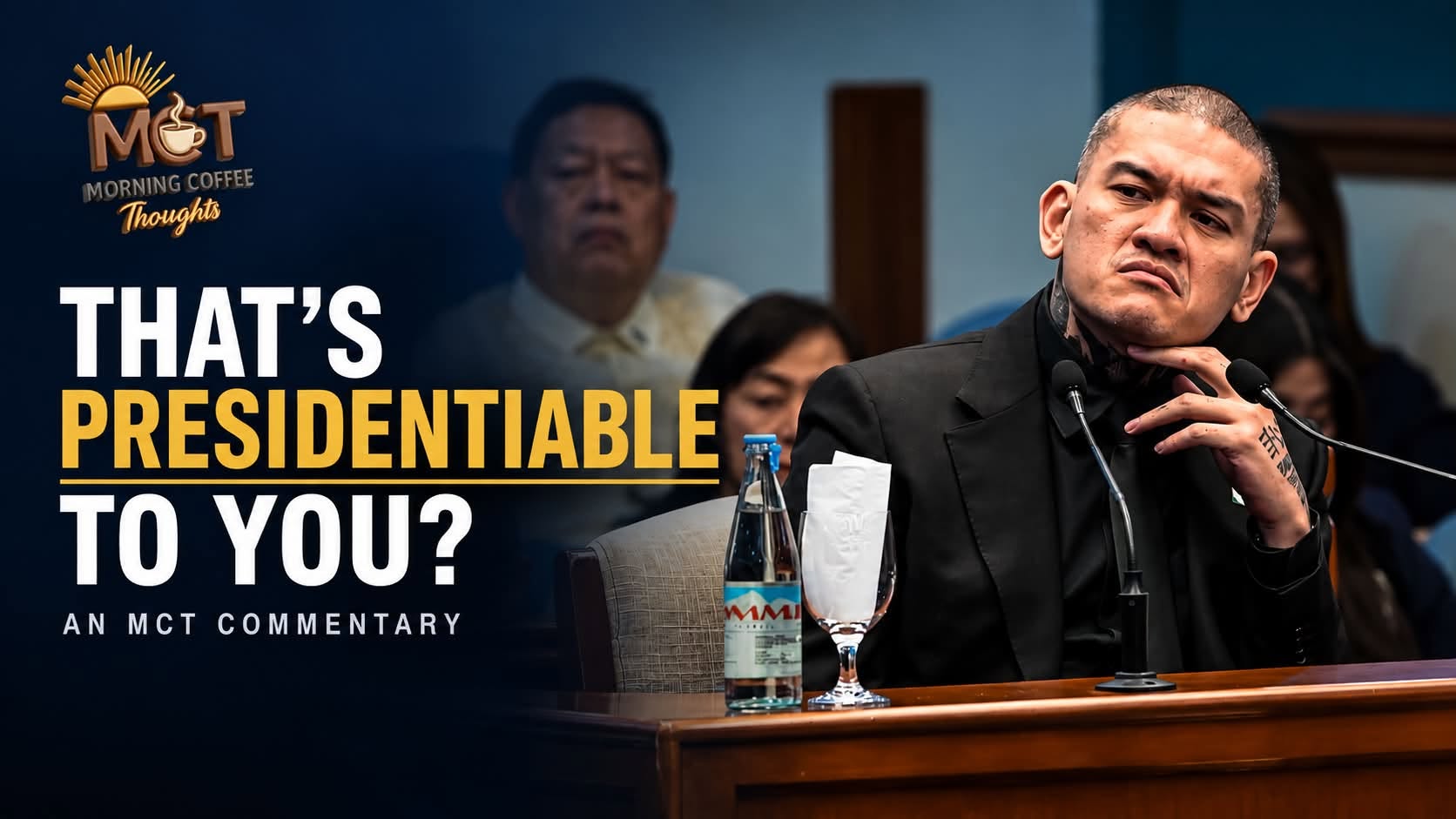
I saw Baste Duterte appear before the Senate impeachment court dressed entirely in black.
My first thought was: who died?
But apparently, in some circles, the all-black look and the gangster posture read as power.
His appearance drew “mafia boss” comparisons online, while some reactions praised him as confident or stylish. At the same time, politicians had already been discussing Baste as a possible fallback for 2028 if Sara Duterte could not run.
Those are two separate developments, but once they start getting mixed together, I have a question: what exactly are we using as evidence that somebody is presidential material?
I have zero hate for Baste Duterte. I do not know him personally, and I am not interested in his haircut, tattoos or clothes.
I am interested in what he actually showed Filipinos once he was placed under sustained questioning.
A PLATFORM FOR WHAT?
Baste appeared on September 29 as a prosecution witness in the impeachment trial of his sister, Vice President Sara Duterte. The impeachment court declared him a hostile witness, which allowed prosecutors to use leading questions. That ruling did not amount to a finding that he had committed wrongdoing.
Much of the questioning dealt with contracts between the Davao City government and GenCorp Industries Inc.
Sara Duterte listed GenCorp as a business interest in her 2024 and 2025 Statements of Assets, Liabilities and Net Worth. SEC records presented during the trial, however, did not list her as an incorporator, director or stockholder of GenCorp. The impeachment court has heard both sets of records, and that discrepancy remains something the senator-judges have to weigh.
Baste testified that he did not know about his sister’s declared interest in GenCorp when the city dealt with the company. He said he would not have allowed the contracts had he known.
He also confirmed that he had delegated authority to Assistant City Administrator Tristan Dwight Domingo to sign contracts on his behalf. Asked about accountability, Baste said it still stopped with him.
Now we are talking about something useful.
How much did the mayor know about contracts entered into by his own city government? How much did he personally review? What did he delegate, and what responsibility remained with him?
Those questions tell us far more about a politician than whether he looked intimidating in black.
WHAT EXACTLY IMPRESSED PEOPLE?
This is where I have trouble following the excitement around the appearance.
If somebody thought Baste looked good, okay. Clothes are clothes. Somebody can look stylish without that having anything to do with public office.
But once appearance starts bleeding into talk about presidential potential, the standard changes.
What did the September 29 hearing actually test?
It tested parts of Baste’s knowledge of Davao City procurement. It showed how he answered questions about GenCorp. It gave Filipinos a chance to hear him discuss delegated authority and responsibility.
It did not test his understanding of monetary policy, national taxation, agriculture, education, healthcare, energy, defense, foreign relations or the West Philippine Sea.
That does not prove he lacks knowledge in those areas. It simply means the hearing gave us no basis for reaching that conclusion either way.
So if somebody watched him walk into the Senate in black and immediately saw a future president, I would like to know what information produced that conclusion.
THE “SOMETHING IS WRONG WITH YOU” LINE
My first reaction was harsher: if that was enough to impress you, something is wrong with you.
But that sentence is too broad unless I explain exactly what I mean.
The useful criticism is not about somebody’s intelligence, education or sanity. Supporting Baste Duterte does not prove any of those things about a person.
The question is the standard being applied.
An intimidating appearance does not tell us how somebody handles a national budget. Swagger does not tell us whether somebody understands food security or foreign policy. A famous surname gives us family history, not a complete assessment of the person carrying it.
Those are very different kinds of information.
That is the part I want people to think about.
THE MAFIA BOSS THING
Then there is the “mafia boss” comparison.
The phrase circulated online after Baste’s appearance, along with comparisons to action characters and AI-generated drama figures. Some reactions treated the all-black look positively.
I understand the pop-culture reference. The image is supposed to communicate control, intimidation and somebody who cannot easily be pushed around.
But what does any of that tell us about governing?
That is where the comparison stops being useful.
Someone can project toughness and still leave unanswered questions about administrative skill. Someone can have commanding body language without having demonstrated a national policy program.
If the discussion is about fashion or presence, then call it fashion or presence.
If the discussion is about the presidency, then I want information about governing.
HAVEN’T YOU LEARNED FROM RODRIGO DUTERTE’S POLITICS?
This is also why the celebration of the “mafia boss” image bothers me.
We have already seen what happens when political toughness becomes a product.
Rodrigo Duterte built much of his political appeal around being the tough guy who spoke differently from traditional politicians.
Academic studies of his political style describe the deliberate use of coarse language, belligerence, anti-elite rhetoric and the image of a leader willing to ignore the usual restraints of politics to get things done.
That style was not accidental. It was part of the political persona that helped distinguish him from the people he portrayed as weak, elitist or unwilling to act. And you are falling for it. Again.
Filipinos already know where one of the biggest expressions of that politics ended up.
His drug war produced at least 6,248 officially acknowledged deaths by the end of his administration, while human-rights organizations have given much higher estimates.
Rodrigo Duterte is now in ICC custody, and in April 2026 the International Criminal Court confirmed three counts of crimes against humanity involving murder and attempted murder and committed him to trial. That is not a conviction. Not yet, at least. His trial is scheduled to begin on November 30, 2026.
So when I see people admiring another Duterte because he looks intimidating, I cannot pretend we have never seen this kind of politics before.
That is the lesson I would rather discuss.
Did the swagger produce better institutions? Did fear make government more accountable? Did coarse language solve corruption? Did presenting a president as somebody who should be feared make the country better governed?
Those questions cannot be answered with a photograph of Baste wearing black.
And perhaps that is exactly what bothers me about the “mafia boss” praise. We have already had six years of a Duterte presidency in which toughness, profanity and hostility toward critics became part of the political brand. Now, four years later, some Filipinos seem ready to be impressed all over again by the image of another Duterte looking dangerous.
If Baste Duterte has something better to offer, then show us that.
Show us the governing record. Show us the judgment. Show us what he understands about the country beyond Davao City.
The black clothes can stay in the photograph.
The presidency demands much more than the performance of toughness.
BASTE DOES HAVE A RECORD
Baste Duterte should also be judged on more than one hearing.
He has served in Davao City government for years. He became vice mayor in 2019 and mayor in 2022. After winning the vice mayoralty in 2025, he later became mayor through succession when Rodrigo Duterte could not assume office. Baste formally took his oath as mayor in January 2026.
Davao City also recorded strong economic growth during his earlier mayoral term.
According to the Philippine Statistics Authority, the city economy grew 7.5 percent in 2023 and 7.9 percent in 2024. Davao City posted the fastest growth in Davao Region in both years.
Those numbers belong in any fair assessment of his record.
They also cannot simply be credited entirely to one mayor. A city economy reflects businesses, workers, consumers, investment, national policy, local policy and conditions inherited from previous years.
So the more useful research goes deeper.
Which programs did Baste initiate? What changed because of his decisions? How did Davao perform in areas directly affected by city government? What weaknesses appeared during his administration, and how did he respond?
Those are questions that can actually tell Filipinos something about the executive record of Sebastian Duterte.
IS HE REALLY PLAN B?
The possibility of Baste becoming a fallback candidate for 2028 did not begin with memes.
In April, ACT Teachers Rep. Antonio Tinio publicly called Baste the Duterte camp’s “Plan B” after Baste became president of PDP-Laban. Tinio is an opposition politician, so his claim by itself does not prove that the Duterte camp had decided anything.
Then Mike Defensor, a Duterte ally, discussed the same scenario and said Baste could be fielded if Sara Duterte were prevented from running. Defensor said, “Ikakandidato namin ’to.”
That is enough to say the possibility has been discussed seriously inside Philippine politics.
It is not enough to say Baste has already been formally selected as the Duterte family’s presidential replacement.
That distinction should stay intact.
If the Plan B discussion grows, then Baste should receive the same scrutiny any possible national candidate should receive. His Davao record belongs in that scrutiny, along with his positions on national issues and his performance when questioned about decisions made under his authority.
That is far more useful than trying to infer presidential ability from an outfit.
WHAT ARE WE ACTUALLY LOOKING FOR?
This goes beyond Baste Duterte.
Many Filipinos have children or grandchildren who will live with the consequences of the political choices made over the next several elections.
So what information should people demand before treating somebody as presidential material?
A local record deserves attention. Policy positions deserve attention. Decisions made in office, use of public money, acceptance of responsibility and the ability to explain government actions are all things voters can inspect.
Public image is information too, but it answers a different question.
It tells us how somebody presents himself.
It does not tell us how he would run the Philippines.
Baste Duterte now has greater national visibility. He is Davao City mayor, he has taken a larger role in PDP-Laban, and his name has entered public discussion about 2028.
That gives Filipinos plenty of reason to keep watching him.
But if the discussion reaches the presidency, the questions should get harder, not easier.
Ask about Davao.
Ask about GenCorp.
Ask what he knew as mayor and what he delegated.
Ask what he believes about the economy, agriculture, education, national security, China and the West Philippine Sea.
Ask what he would actually do with presidential power.
Then judge the answers.
Because whatever somebody thought of Baste Duterte’s all-black appearance, the presidency requires an assessment much larger than an image from one morning at the Senate.
And that is the question I would rather leave with readers:
What exactly should make somebody presidentiable?
SOURCES
- Philippine News Agencyhttps://www.pna.gov.ph/index.php/articles/1285035
- GMA News Onlinehttps://www.gmanetwork.com/news/topstories/nation/1004077/baste-duterte-declared-as-hostile-witness-by-impeachment-court/story/
- GMA News Onlinehttps://www.gmanetwork.com/news/topstories/nation/1004191/sara-duterte-impeachment-trial-day-31-baste-duterte-defends-p33m-gencorp-contracts/story/
- GMA News Onlinehttps://www.gmanetwork.com/news/topstories/nation/1004093/baste-duterte-at-impeachment-trial-i-ll-know-irregularity-if-there-s-any-in-gov-t-contracts/story/
- Philippine News Agencyhttps://www.pna.gov.ph/articles/1284560
- Philstar.comhttps://www.philstar.com/headlines/2026/09/22/2558100/firm-vp-saras-saln-won-millions-davao-city-contracts-
- Philstar.comhttps://www.philstar.com/headlines/2026/09/30/2559954/baste-i-would-have-blocked-gencorp-deals
- Philippine Statistics Authorityhttps://rsso11.psa.gov.ph/content/services-based-activities-drive-davao-citys-75-percent-economic-growth-2023
- Philippine Statistics Authorityhttps://psa.gov.ph/content/davao-city-emerges-fastest-growing-economy-davao-region-faster-regional-growth-rate-2024
- GMA News Onlinehttps://www.gmanetwork.com/news/topstories/nation/983673/tinio-baste-is-dutertes-039-plan-b-for-2028-presidential-elections/story/
- Politikohttps://politiko.com.ph/2026/04/14/pag-si-vp-sara-na-disqualify-baste-duterte-will-run-for-president-mike-defensor/politiko-lokal/
- GMA Regional TVhttps://www.gmanetwork.com/regionaltv/news/112564/baste-rigo-take-oath-as-mayor-vice-mayor-of-davao-city/story/
- Working Draft, Impeachment Trial of Vice President Sara Dutertehttps://tordecilla.github.io/duterte-impeachment-working-draft/sessions/31/
- PhilNewshttps://philnews.ph/2026/09/29/baste-duterte-all-black-outfit-steals-attention-during-impeachment-trial/