
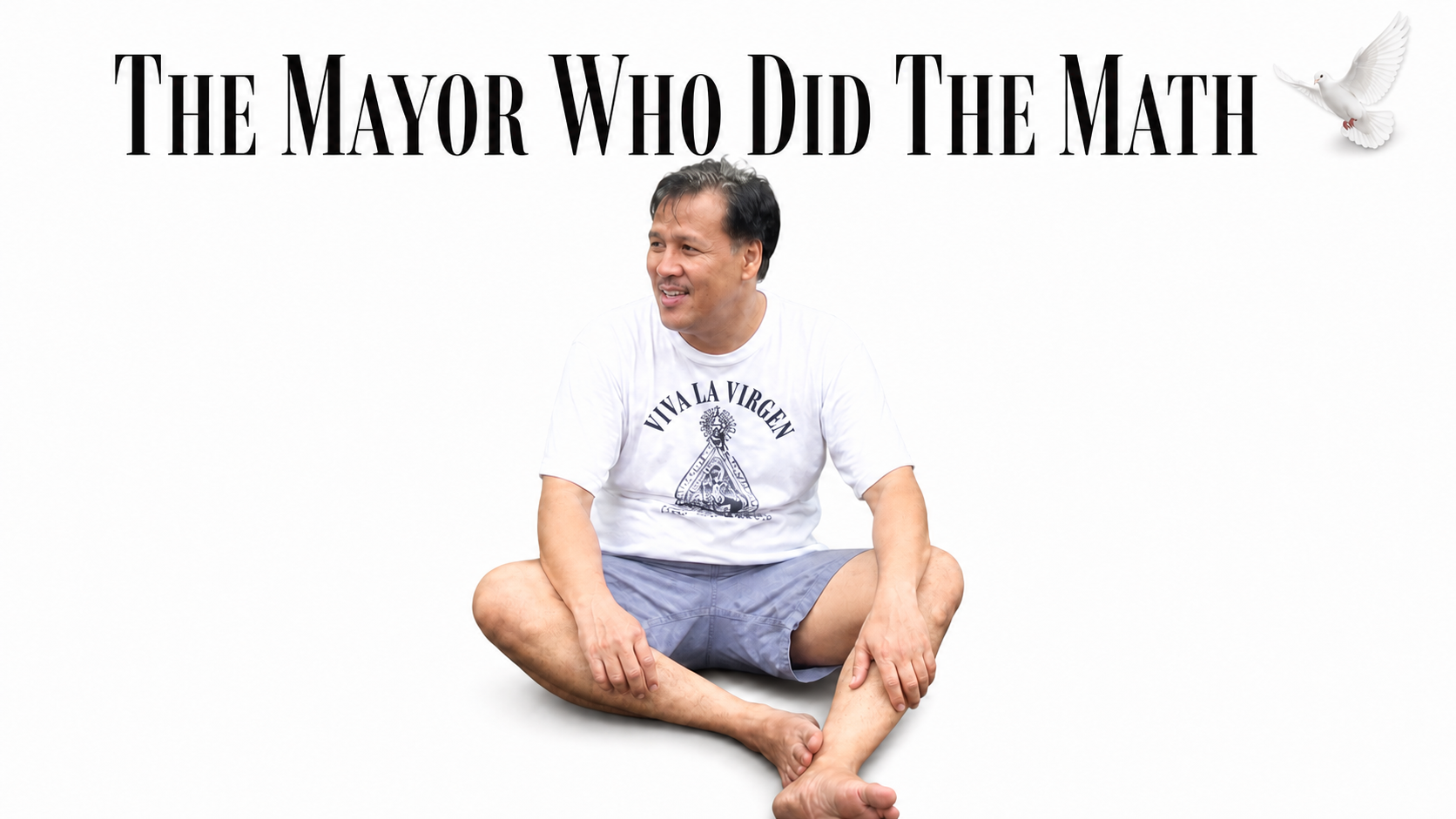
Fourteen years ago today, Jesse Robredo died when the small plane carrying him home to Naga crashed into the sea off Masbate.
For many Filipinos, the image that survived him is easy to recognize. Jesse Robredo in simple clothes, often in tsinelas, walking around Naga without the usual distance between a politician and the people around him.
That image became part of how we understood him, and for good reason. It showed a kind of humility that felt unusual in Philippine politics.
I remember that man in tsinelas very well.
In 1995, I was working as a radio jock at one of the FM stations in Naga. Jesse Robredo was still mayor then, and one day there he was in front of me wearing a sando, shorts and tsinelas.
Since he was already there, I greeted him. “Marhay na aga tabi, Mayor Jess.”
He smiled, looked me in the eye and offered his hand. I shook it and he replied, “Marhay na aga man,” then went on his way.
That was it. I was a radio jock who happened to greet the mayor, and the mayor greeted me back.
So when people talk about Jesse Robredo as the man in tsinelas, I know exactly what they mean. I saw him that way myself in 1995, long before the slippers became one of the images Filipinos would associate most strongly with him.
There was much more to Jesse Robredo than that image.
The sandals showed something real about him. They showed how simply he carried himself and how comfortable he seemed around ordinary people.
When I started reading more closely about what he actually did as mayor, and later as secretary of the Department of the Interior and Local Government, I found another side of his legacy that deserves just as much attention.
We remember the man in tsinelas very well. If we want to pay homage to his legacy, we should also remember what the man in those tsinelas actually built.
A YOUNG MAYOR IN A CITY THAT NEEDED FIXING
Robredo was 29 when he was elected mayor of Naga in 1988. He studied mechanical engineering and industrial management engineering at De La Salle University, then later earned a Master of Business Administration from the University of the Philippines.
Before politics, he worked in the private sector. His return to Bicol was not originally part of a long political plan.
He came home in 1986 to work for the Bicol River Basin Development Program after an invitation from his uncle, then Camarines Sur governor Luis Villafuerte. Two years later, he ran for mayor and won.
The city he inherited was struggling financially. Patronage had a strong hold on local politics, and vice operators had political influence.
A Princeton University case study also says his first campaign relied partly on the support of gambling operators and describes that support as something Robredo viewed as a “necessary evil.”
I think that detail is worth knowing because it shows the political environment he entered. He did not begin his career in some unusually clean corner of Philippine politics. He entered a system Filipinos would recognize.
What he did after winning tells us much more.
Inside City Hall, his administration pushed merit-based hiring and promotion. He also moved against gambling and other vice operations that had become tied to local politics.
The Ramon Magsaysay Award Foundation later credited his administration with improving the city's finances and professionalizing local government. Those decisions may sound ordinary, but they changed how City Hall worked.
Hiring and promoting people based more on merit gives politicians less room to use government jobs as favors. Better financial management also gives citizens a clearer idea of where public money goes.
Neither reform produces a dramatic photograph. Both can affect people long after an election is over.
WHEN CITIZENS COULD TELL THE MAYOR NO
One of the most revealing parts of Robredo's years in Naga came in 1995, the same year I happened to meet him in my very ordinary way.
That year, Naga passed its Empowerment Ordinance and formally recognized the Naga City People's Council. Organized civic groups were given a regular place in discussions involving city policies, programs and public spending.
There is an episode from those years that deserves to be remembered as much as the tsinelas.
Robredo favored a plan to build a golf course in Naga. The Naga City People's Council opposed the project because of environmental concerns, and the groups argued against it until the proposal was abandoned.
I like that story because it tells us something a photograph cannot. Robredo helped create a system that citizens later used to oppose a project he wanted.
Supporting citizen participation is easy when citizens agree with you. The harder test comes when the people given access use it to challenge your own decision.
The golf course was not built.
For me, that says a great deal about Robredo's approach to government. He allowed room for disagreement, and the mechanism still worked when the disagreement was with him.
TELL PEOPLE HOW GOVERNMENT IS SUPPOSED TO WORK
Naga also introduced a Citizen's Charter that explained government services in plain terms. Residents could see which office handled a transaction, what requirements were needed and how long the process was expected to take.
The city distributed thousands of copies to households. Anyone who has dealt with government offices knows how useful that kind of information can be.
Without it, a person can spend hours moving from one window to another, only to be told that another document is needed or that the person responsible is unavailable. Clear rules make citizens less dependent on favors, fixers and connections.
Naga also began making budgets, procurement information and other government records easier for the public to inspect. This happened years before online disclosure became common in Philippine government.
None of these steps magically removes corruption. A public document can still contain questionable spending, and a posted budget does not mean every peso was well spent.
But a citizen cannot question what he or she cannot see.
Once the numbers are available, somebody can ask why a project costs that much, why one supplier keeps winning contracts, why spending suddenly increased, or why an office failed to deliver what the budget promised.
That kind of access can look boring until the day you need it.
THE NAGA IDEA GOES NATIONAL
Robredo became secretary of the Department of the Interior and Local Government in 2010 under President Benigno Aquino III.
His job was suddenly much bigger than Naga. The department dealt with local governments across the country, each with its own political culture, local alliances and ways of doing business.
One of the policies pushed during Robredo's time was the Full Disclosure Policy. Local governments were required to make key financial documents public, including budgets, procurement information and statements showing how public money was being used.
A DILG accomplishment report for 2011 said 1,551 of the country's 1,713 local government units had complied with the policy. The department also used the Seal of Good Housekeeping to assess local governments on financial management and other basic standards.
There was also money attached to good performance.
Local governments that met the requirements could qualify for grants through the Performance Challenge Fund. In 2011, 351 local governments received grants under the program.
I find that approach more useful than another speech about honesty. Government officials have heard countless reminders to be transparent and responsible, but Robredo's department connected those expectations to the way national support was given to local governments.
The reforms did not end corruption in local government. We know that from what we still see in the news today.
Still, requiring local governments to disclose records gives citizens, journalists, auditors and watchdog groups something they can examine. A town or city may still make a questionable decision, but leaving a paper trail makes that decision easier to discover and harder to deny.
THE SANDALS WERE PART OF THE STORY
Jesse Robredo received the Ramon Magsaysay Award for Government Service in 2000. The award recognized the reforms in Naga and his work in giving citizens a greater role in local government.
Yet the image many Filipinos remember first is the simpler one.
The tsinelas.
I understand why. When I remember my brief encounter with him in 1995, I do not remember a mayor surrounded by people announcing that the mayor had arrived.
I remember a man in a sando, shorts and slippers who looked me in the eye, shook my hand, returned my greeting and continued on his way. There was something genuine in that simplicity.
Government reforms are harder to remember than a human moment like that.
There is no iconic photograph of a merit-based promotion rule. Nobody puts a procurement record on a commemorative poster, and a Citizen's Charter will never create the same emotional reaction as a picture of a Cabinet secretary among ordinary people.
That is why I think the other side of his legacy deserves more attention.
Humility is admirable. In government, it becomes even more valuable when citizens also have rules that tell them what to expect, records they can inspect and a place where they can question decisions.
A good mayor eventually leaves office. The institutions created during his time have a chance to keep serving people long afterward.
WHAT HAPPENS AFTER THE MAN IS GONE?
The Naga City People's Council continued beyond Robredo's years as mayor, although keeping it active was not always easy.
A Princeton case study later found that participation had weakened, some committee seats reserved for the People's Council were unfilled, and the council had problems finding money independent of City Hall and outside donors.
I think that belongs in the story because creating an institution is only part of the job. People still have to use it, defend it and keep it alive after the politician who helped create it is gone.
Other parts of Robredo's work also survived him. The Full Disclosure Policy continued under later administrations, and the good-governance seal that began during his time at the DILG was later expanded into the Seal of Good Local Governance and eventually written into law.
That does not mean every program still works exactly as intended. A disclosure requirement can become another document officials upload because they are required to, and citizen participation can become ceremonial when people stop using the space given to them.
So remembering Robredo also gives us a reason to look at the government we have now.
Can citizens still see where public money goes? Can people question local decisions without first knowing somebody at City Hall?
Are procurement records easy to find? Are government services clear enough that ordinary citizens know what to expect, and do local officials accept scrutiny even when it becomes uncomfortable?
Those questions belong to the present.
Fourteen years after his death, I can still picture that brief encounter in Naga. A mayor in a sando, shorts and tsinelas, a smile, a handshake, “Marhay na aga man,” and then he went on his way.
I am glad Filipinos remember that Jesse Robredo. I remember him that way too.
If we truly want to honor what he left behind, we should remember the less visible part as well. The rules, the records, the room he tried to create for citizens inside government, and the belief that people should be able to question those in power without depending entirely on the goodness of the person occupying the office.
The sandals showed us Jesse Robredo.
What he built helps explain why, fourteen years later, we still remember the man who wore them.
SOURCES
- Ramon Magsaysay Award Foundation,https://rmaward.asia/rmawardees/robredo-jesse-manalastas/
- Princeton University Innovations for Successful Societies,https://successfulsocieties.princeton.edu/interviews/jesse-robredo
- Princeton University Innovations for Successful Societies,https://successfulsocieties.princeton.edu/document/3165
- Naga City Ordinance No. 95-092,https://www2.naga.gov.ph/wp-content/uploads/2021/06/ord1995-092.pdf
- Galing Pook Foundation,https://www.galingpook.org/what-we-do/awards/awardees/people-empowerment-program-of-naga-city/
- Philippine Center for Investigative Journalism via GMA News,https://www.gmanetwork.com/news/topstories/specialreports/40365/pcij-people-power-reforms-thrive-in-naga-city/story/
- Department of the Interior and Local Government Region IX,https://region9.dilg.gov.ph/90-percent-of-lgus-are-practicing-transparency-robredo/
- Department of the Interior and Local Government Region V,https://region5.dilg.gov.ph/camarinessur/the-seal-of-good-housekeeping-project-measuring-the-fundamentals-of-good-governance-in-the-local-government-units/
- World Bank,https://www.worldbank.org/en/news/speech/2012/08/24/philippines-a-tribute-to-dilg-secretary-jesse-robredo0
- City Government of Naga,https://www2.naga.gov.ph/hon-jesse-m-robredo/
- Republic Act No. 11292, Senate of the Philippines Legislative Reference Bureau,https://issuances-library.senate.gov.ph/legislative-issuance/republic-act-no-11292