
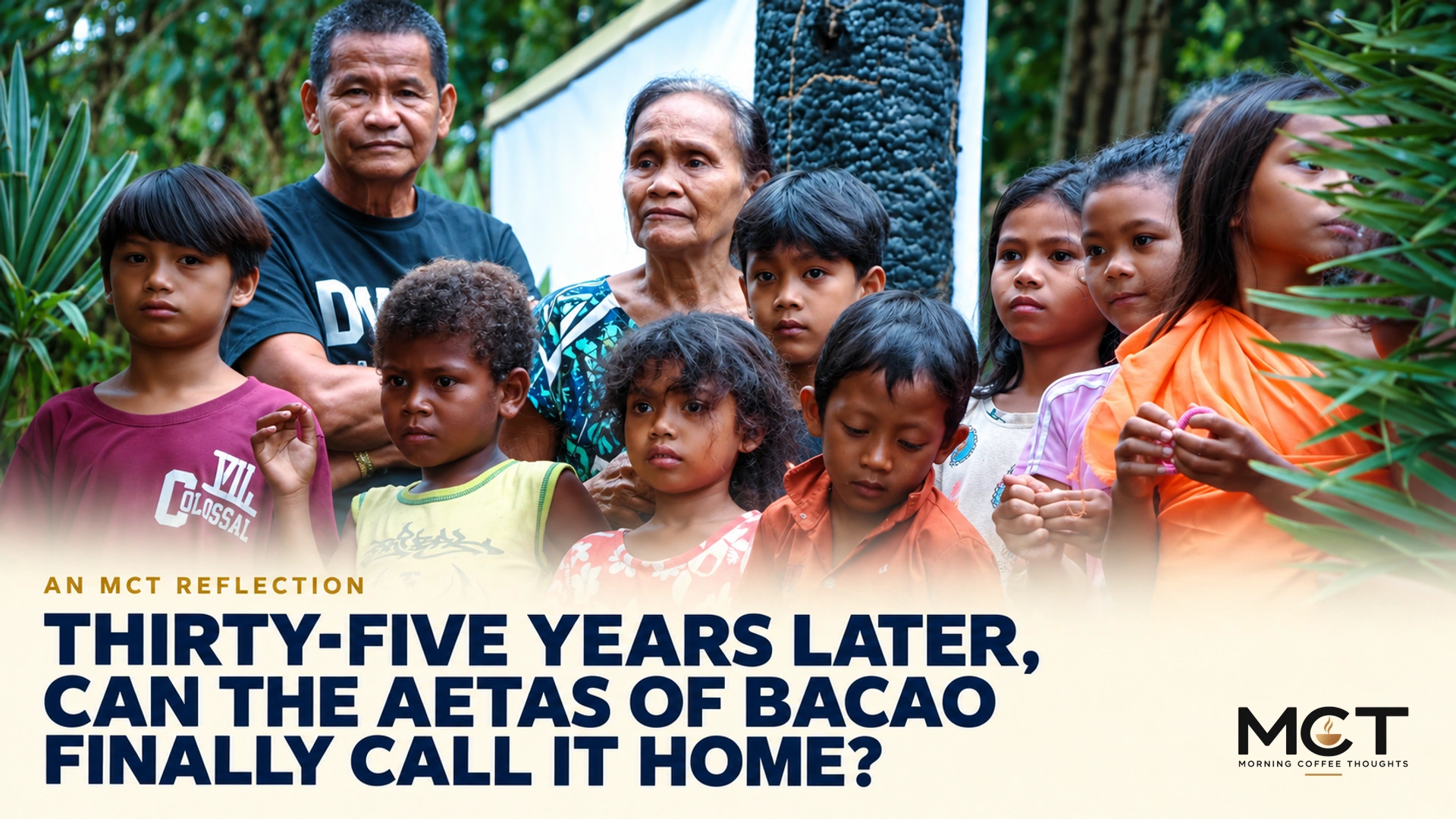
I was recently invited to attend the National Indigenous Peoples Sunday celebration held on October 11 in Sitio Bacao, Palayan City, Nueva Ecija. Unfortunately, I wasn't feeling well and couldn't attend. I would have loved to be there because helping our Katutubo communities and bringing attention to their concerns has always been part of what Morning Coffee Thoughts stands for.
The celebration was organized by the Catholic Bishops' Conference of the Philippines, through its Episcopal Commission on Indigenous Peoples (CBCP-ECIP), in partnership with the Diocese of Cabanatuan. It brought together Indigenous communities, Church leaders, and representatives of organizations and government institutions involved in Indigenous Peoples' concerns.
I appreciate the invitation, and I regret missing the opportunity to meet the community and hear directly from them. Fortunately, I was given a copy of the history of Sitio Bacao, along with information about the gathering. I decided to read the documents and research the community's history.
What I discovered was something I knew very little about, despite living in nearby Cabanatuan City.
Some of the Aeta families displaced by the eruption of Mount Pinatubo in 1991 were resettled in Palayan City, where they established homes, cultivated farms, raised families, and participated in environmental rehabilitation projects.
Thirty-five years later, however, some residents are still asking the government to recognize their rights over the places where they live and the agricultural areas that provide their livelihoods.
And I think their situation deserves our attention.
THE FAMILIES WHO CAME AFTER PINATUBO
In June 1991, Mount Pinatubo erupted, devastating communities across Central Luzon and displacing thousands of people, including Aeta families whose lives were closely connected to the surrounding mountains and forests.
Many lost their homes and access to their traditional sources of food and income. Some eventually relocated to Barangay Doña Josefa in Palayan City, Nueva Ecija, where resettlement communities had been established.
One of those communities was Sitio Bacao, located within the Fort Magsaysay Military Reservation.
A July 2018 special report by journalist Anselmo Roque documented how approximately 1,900 Aeta individuals agreed to relocate to Barangay Doña Josefa during the latter part of 1991. The report identified Sitio Bacao as an area selected for the development of an Aeta resettlement community.
What makes this history particularly interesting is the involvement of the Philippine Army and the Diocese of Cabanatuan.
According to Roque's reporting, then Brigadier General Orlando Soriano, commander of the Army's 7th Infantry Division, and then Bishop Sofio Balce entered into a memorandum of agreement involving approximately 1,000 hectares intended for community development.
Fr. Apollo de Guzman, who headed the diocese's Tribal Filipino Apostolate, helped organize the resettlement and guide the families as they adjusted to their new surroundings.
The agreement is an important part of the community's history. It indicates that the resettlement involved cooperation between military and Church authorities, rather than families independently occupying an area without any organized arrangement.
The precise terms of that agreement are important in assessing the residents' present concerns, particularly because the property remains within a military reservation.
For the families who arrived in 1991, however, the immediate concern was finding a way to survive in an unfamiliar place.
A DIFFICULT BEGINNING
The community history shared with me describes Bacao as an area that was largely covered with cogon grass and talahib before the arrival of the displaced families. There were few established farms, and the surroundings differed considerably from the areas around Pinatubo where many residents had previously lived.
The Aetas were accustomed to an environment where forest resources and traditional agricultural practices supported their daily needs. In Bacao, they had to learn how to cultivate unfamiliar surroundings while dealing with the difficulties of displacement.
Some families eventually returned to Zambales because they could not adjust to the conditions in their new community.
In Roque's 2018 report, Aeta resident Lolita Soria recalled how difficult the early years had been. She described how families struggled with the absence of familiar crops and forest resources, leading many to return to their former communities.
Those who remained gradually developed agricultural activities and established new livelihoods.
They planted rice, corn, sweet potatoes, taro, vegetables, and other crops. Some raised livestock, while others worked as agricultural laborers. Over time, families built homes and raised children who would grow up knowing Bacao as their community.
The Diocese of Cabanatuan continued assisting the residents, initially through Fr. Apollo de Guzman and later through Fr. Jacinto "Chito" Beltran.
Their involvement included livelihood assistance, agricultural development, and environmental rehabilitation projects intended to improve the surrounding area.
One of the community's achievements was its participation in reforestation activities.
In 2015, Bacao Ecological System and Technologies Inc., or BESTI, was established to support environmental and livelihood programs. Historical reporting describes cooperation with the Department of Environment and Natural Resources, with Aeta residents participating in tree planting and forest protection.
By December 2018, Fr. de Guzman was reporting that approximately 800 hectares were being cared for through the reforestation initiative. Some residents worked as Bantay-Gubat, helping protect growing trees while earning income from environmental activities.
The community history also describes the planting of narra, molave, and other tree species, along with continued efforts to develop agricultural livelihoods.
These accomplishments were reported in 2018, and the present condition of the entire project area would need a separate assessment. Nevertheless, the historical accounts show how residents participated in developing and caring for the surroundings where they had been resettled.
These families had already experienced displacement caused by a natural disaster. Rebuilding their lives meant developing new skills, adapting to a different environment, and finding sources of income that could support their children.
They spent years doing exactly that, with assistance from the Church and participating government agencies. Yet the community history also describes problems that have apparently remained unresolved.
THE CONCERNS OF THE BACAO RESIDENTS
Toward the latter part of the document shared with me, the discussion turns to the residents' concerns about their homes and agricultural areas.
The document alleges that military activities have affected areas previously used by residents for farming. It also claims that banana plants were destroyed, resulting in the loss of crops that families depended upon for daily expenses and their children's education.
Another complaint concerns housing. According to the community account, some homes provided through government assistance have deteriorated, but residents say restrictions associated with the military reservation have prevented repairs.
These are serious allegations that deserve a response from the military authorities responsible for the area.
The document does not identify the dates of the alleged incidents, the military units involved, or the particular agreements governing the affected property. I have also not found independent records establishing that the alleged actions violated the residents' legal rights.
It would therefore be premature to accuse the military of unlawfully destroying crops or preventing repairs without establishing the circumstances.
However, the residents' concerns deserve to be investigated, particularly because they involve families whose history in the area goes back more than three decades.
Near the end of the community history, the residents make this appeal:
"Kayat po sana mai Award na samin ng pamahalaan ang lupang kinatitirikan ng bahay at lupang sinasaka."
They are asking the government to award them the residential and agricultural areas on which their lives depend.
That request raises a question about the original resettlement arrangement and the present legal status of the community.
The Army and the Diocese of Cabanatuan participated in establishing Bacao as a resettlement community after the Pinatubo eruption. Residents later participated in agricultural and environmental programs supported by government institutions.
What rights were granted to those families, and what arrangements govern their continued occupancy today?
The answers should be found in the original memorandum of agreement, any subsequent agreements, and the records of the government agencies responsible for the reservation and resettlement.
THE QUESTION OF LEGAL RIGHTS
Republic Act No. 8371, or the Indigenous Peoples' Rights Act of 1997, provides legal protections for Indigenous Cultural Communities and Indigenous Peoples.
Section 7(d) addresses communities displaced by natural catastrophes. It recognizes their right to return to their ancestral territories under appropriate conditions and provides for security of tenure in resettlement areas when the statutory conditions are satisfied.
The provision is relevant to the circumstances surrounding the Bacao Aetas, who relocated after the Pinatubo eruption. However, applying it to their present situation requires an assessment of the original resettlement agreement, the circumstances affecting their former ancestral territories, and the legal status of the military reservation.
The law does not automatically transfer ownership of government resettlement property to the Indigenous families occupying it.
Section 56 also recognizes and respects property rights already existing or vested when the Indigenous Peoples' Rights Act took effect.
The National Commission on Indigenous Peoples has an important role in assessing the rights and remedies that may be available to the Bacao residents. The Department of National Defense and Philippine Army also have responsibilities concerning the military reservation and the agreements governing its use.
A proper assessment would need to identify the areas occupied by the community, the authority under which those areas were allocated, and any restrictions imposed on agricultural or residential activities.
It should also establish whether the residents have applied for formal recognition of their rights and what action the responsible agencies have taken.
These questions concern actual legal arrangements, and their resolution should be based on the relevant documents and applicable law.
AN OLD PROPOSAL FOR PERMANENT SECURITY
Another detail from the July 2018 reporting deserves attention.
Fr. Apollo de Guzman discussed the possibility of the Aeta residents eventually owning their resettlement area through a presidential proclamation.
The report indicates that such an arrangement was being contemplated, although it does not establish that a formal proclamation was eventually issued.
There is a historical precedent for the release of portions of Fort Magsaysay from military reservation status.
In March 1991, President Corazon Aquino issued Proclamation No. 709, excluding designated portions of Barangay Militar in Palayan City from the Fort Magsaysay Military Reservation and opening those areas for disposition under applicable laws.
That proclamation concerned Barangay Militar, while Sitio Bacao is in Barangay Doña Josefa. It also preceded the Pinatubo eruption.
It therefore cannot be treated as a proclamation granting rights to the Bacao Aetas. What it demonstrates is that portions of the military reservation have previously been released through presidential action.
Whether a comparable arrangement would be legally appropriate for Bacao depends on the property's current classification, its military use, existing agreements, and the circumstances of the community.
There is also Executive Order No. 5, issued in March 2001, which addressed the transfer of administrative responsibilities for designated upland Pinatubo resettlement communities to the appropriate local government units.
The available records do not establish that Bacao was covered by that order.
These government actions provide useful historical context, but they do not resolve the residents' present legal position.
The central issue remains the agreement under which Bacao was established and whether any later government action granted the community permanent rights to its residential and agricultural areas.
THE CHURCH'S ROLE CONTINUES
The National Indigenous Peoples Sunday celebration on October 11 brought renewed attention to Indigenous communities, including the Aetas of Bacao.
The gathering carried the theme "Journeying with Indigenous Peoples: Honoring God's Creation and Rights of Nature."
The celebration emphasized the protection of Indigenous Peoples' rights, cultures, ancestral territories, and the environment.
Ahead of the event, CBCP-ECIP executive secretary Tony Abuso called on the government to recognize and protect Indigenous communities' rights to their ancestral domains.
In an October 8 report published by the Archdiocese of Manila's communications office, Abuso discussed the situation of approximately 120 Aeta families living in Bacao.
He acknowledged that returning to Pampanga would be difficult for families who had spent decades developing their lives in Palayan City.
His observation reflects the reality of long-term displacement.
A family that moved to Bacao in 1991 may now include children and grandchildren who have lived their entire lives there. For them, their connection to the community comes from decades of residence, livelihood, and family history.
The Church's continuing involvement is especially relevant because the Diocese of Cabanatuan participated in the original resettlement arrangement.
During the October 11 celebration, Cabanatuan Bishop Prudencio Andaya encouraged Indigenous residents to remain courageous in asserting their dignity and rights.
According to Radio Veritas, the bishop assured the participants that the Church would continue listening to their concerns and accompanying them in their efforts.
I appreciate that commitment, particularly given the diocese's long history of assisting the Bacao community.
The celebration also provided an opportunity for Indigenous representatives and participating institutions to discuss concerns affecting their communities.
The available public reports, however, do not provide a complete account of the discussions or identify any final agreement concerning the Bacao residents' property rights.
What happens after the celebration will be important, particularly if the community's complaints are formally raised with the government agencies responsible for addressing them.
WHAT SHOULD HAPPEN NOW?
The Bacao community's history involves several institutions with different responsibilities.
The Philippine Army and Department of National Defense are responsible for the military reservation and the activities conducted within it. The Diocese of Cabanatuan participated in establishing the resettlement community and may possess historical records relating to the original agreement.
The National Commission on Indigenous Peoples is responsible for administering and implementing programs concerning Indigenous Peoples' rights under existing law. Local government institutions and agencies involved in the original Pinatubo resettlement programs may also possess relevant documents.
There is enough institutional history to begin establishing the present legal position of the Bacao residents.
The original memorandum of agreement would be an appropriate starting point, together with any amendments, property records, and documents identifying the areas allocated for residence, agriculture, and environmental activities.
The community's complaints about damaged crops and housing restrictions also deserve a proper assessment.
The military should be given the opportunity to explain the activities involved, the applicable restrictions, and whether affected residents received appropriate assistance.
The residents, meanwhile, should have access to information explaining their occupancy rights and any procedures available for resolving disputes.
If certain agricultural areas are reserved for military activities, the boundaries and restrictions should be clear to the people whose livelihoods may be affected.
If housing repairs are restricted, the responsible authorities should explain the legal basis and identify what arrangements are available for families living in deteriorating homes.
And if permanent recognition of residential or agricultural use is legally possible, the government should explain what procedures would be necessary to pursue it.
The original resettlement effort involved cooperation between the Army and the Church. Any attempt to resolve the present concerns would benefit from the participation of those institutions, the appropriate government agencies, and the community itself.
THIRTY-FIVE YEARS LATER
There is something about the history of Sitio Bacao that deserves attention beyond the annual celebration of Indigenous Peoples' Sunday.
The Aetas who arrived there in 1991 had already experienced the destruction and displacement caused by Mount Pinatubo. They had to adapt to unfamiliar surroundings and develop new sources of livelihood.
Some families eventually returned to their former communities. Others remained, cultivated farms, raised children, and participated in efforts to improve their environment.
Over the years, the community received assistance from religious organizations and government institutions. Its residents also contributed their own labor to agricultural and environmental programs.
That history deserves recognition, but the residents' appeal concerning their homes and agricultural areas also deserves serious attention.
Their document describes concerns about the security of their residence, restrictions affecting housing repairs, and the reported loss of crops associated with military activities.
Those complaints have not been independently established as violations of law, and the military's explanation is necessary before conclusions can be reached.
Still, government officials should be able to determine what rights the community holds and what arrangements are available to address its concerns.
I believe there is a responsibility to provide those answers, particularly because the community's resettlement was organized with the participation of public institutions.
The Aetas of Bacao should not have to rely indefinitely on uncertainty about the terms governing their homes and livelihoods.
If legal limitations prevent the transfer of property, those limitations should be explained. If existing laws or agreements provide a path toward greater tenure security, the residents should be informed of their options and assisted through the appropriate process.
The government must also consider the practical consequences of its decisions for families who have spent decades developing their livelihoods in the area.
A PERSONAL NOTE
I genuinely regret being unable to attend the October 11 celebration. It would have been an opportunity to meet the residents, listen to their experiences, and better understand the community's concerns.
I am grateful to the people who extended the invitation and shared the history of Sitio Bacao with me. The documents encouraged me to learn about a community whose experiences I had previously known very little about, despite living nearby.
I also appreciate the work of the Catholic Church, particularly the Diocese of Cabanatuan and CBCP-ECIP, in bringing attention to Indigenous communities and supporting their rights.
The history of Bacao shows how religious organizations, public institutions, and residents themselves participated in helping families rebuild after the Pinatubo eruption.
Today, the community is asking for answers concerning the place where those efforts began.
I hope the October 11 gathering helps bring those questions before the government offices capable of resolving them.
Morning Coffee Thoughts has consistently called for accountability, transparency, and responsible governance. Those principles apply just as much to the concerns of Indigenous communities as they do to the political controversies that dominate public discussion.
The people of Bacao deserve to understand the legal status of their homes and farms, and the government institutions involved in their resettlement should be able to explain the arrangements governing their continued residence.
Thirty-five years have passed since these families began rebuilding their lives after Mount Pinatubo. I hope the next chapter of their history includes something they have been asking for in their own words: lasting security over the place they call home.
SOURCES
- Punto Central Luzon, July 12, 2018https://punto.com.ph/special-report-back-to-eden-greening-in-ecija-by-the-resettled-aetas/
- Punto Central Luzon, July 17, 2018https://punto.com.ph/special-report-back-to-eden-greening-in-ecija-by-the-resettled-aetas-3/
- Punto Central Luzon, December 12, 2018https://punto.com.ph/retired-priest-bats-for-tribes-as-aides-for-refo-projects/
- Republic Act No. 8371, Indigenous Peoples' Rights Act of 1997https://lawphil.net/statutes/repacts/ra1997/ra_8371_1997.html
- Proclamation No. 709, March 26, 1991https://lawphil.net/executive/proc/proc1991/proc_709_1991.html
- Executive Order No. 5, March 5, 2001https://elibrary.judiciary.gov.ph/thebookshelf/showdocs/10/41475
- Archdiocese of Manila, October 8, 2026https://rcam.veritasph.net/cbcp-ecip-calls-on-government-to-recognize-ancestral-domain-of-indigenous-peoples/
- Radio Veritas, October 9, 2026https://www.veritasph.net/national-indigenous-peoples-sunday-gugunitain-ng-cbcp-ecip-sa-piling-ng-mga-ayta-at-dumagat/
- Radio Veritas, October 12, 2026https://www.veritasph.net/mga-katutubo-hinimok-ni-bishop-andaya-na-maging-matatag/
- Radio Veritas, October 12, 2026https://www.veritasph.net/mamamayang-pilipino-hinimok-na-makialam-sa-kalagayan-ng-mga-katutubo/