
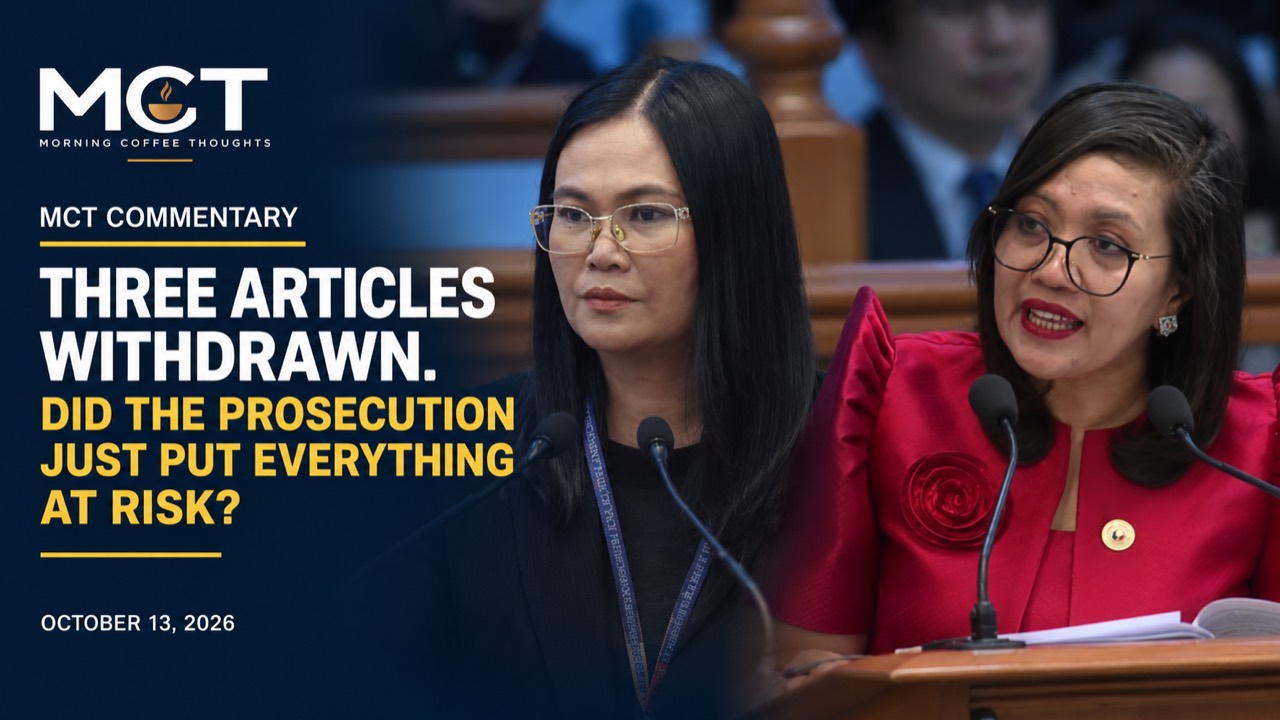
I was having coffee when I learned that the House prosecution had withdrawn three of the four impeachment articles against Vice President Sara Duterte. My immediate reaction was surprise, followed by a question: Are they putting all their eggs in one basket?
After weeks of hearings, the prosecution has withdrawn Article I on the alleged misuse of confidential funds, Article III on alleged bribery, and Article IV on alleged grave threats. Only Article II remains, involving unexplained wealth, incomplete asset declarations, and business interests.
Lead prosecutor Rep. Gerville Luistro believes the evidence under Article II is enough to remove Duterte from office. She even described the decision as going all in. That is a lot of confidence when the defense has not yet presented its full case.
I can see the practical reason for the decision. But what happens if the prosecution is wrong? Has it thought that through? And does the Senate impeachment court share its confidence, or did the senator-judges accept the withdrawal for entirely different reasons?
THE PROSECUTION'S GAMBLE
Under the Constitution, a conviction on one impeachment article is enough, as long as it gets the Senate votes needed. The prosecution does not have to win on all four articles to remove Duterte from office.
Luistro explained that Article II could stand on its own. She cited the financial evidence, the length of the proceedings, public impatience, and the Senate's approaching budget deliberations. Continuing with the other articles could mean calling dozens more witnesses and spending weeks presenting testimony that prosecutors believe they no longer need.
But Luistro also said that all four articles were equally strong. If that is what the prosecution believes, why abandon three?
Maybe the prosecutors believe they already have enough evidence under Article II to win, and that continuing with the other charges would add little. That is possible. But I would like to hear how they reached that decision. The national budget matters, but impeachment is also a duty under the Constitution. A crowded schedule alone would be a poor reason to drop serious accusations.
Look at the financial evidence Alexander Cabrera presented. His analysis put the alleged unexplained wealth involving Duterte and her husband, Manases Carpio, at about ₱817.87 million. A higher estimate of about ₱1.5 billion has also come up during the trial.
Those are serious amounts. But we need to understand what went into them: personal assets, company transactions, shares in businesses, and what the law says must be declared. The prosecution has to show which amounts can rightly be linked to Duterte. It also has to prove that what she allegedly did is a ground for impeachment.
Money received by a company is not automatically money received by Duterte herself. And a mismatch between financial records and declared assets does not, by itself, prove a violation of the Constitution. The prosecution has to show how the records prove that she failed to meet her legal duties.
During cross-examination, the defense questioned whether Cabrera had complete records and why certain assets and transactions were linked to Duterte or her husband. If the defense shows that large amounts should not have been included, the Senate will have to decide whether what is left is enough. Even if most of Cabrera's figures hold up, the senator-judges still have to decide whether they prove a ground for conviction under the Constitution.
And if Article II fails, there is no other article left for conviction in this trial.
The prosecution may have thought all of this through. I just want to know why it is willing to take that risk before hearing the defense's full answer.
DOES THE SENATE AGREE?
The Senate impeachment court accepted the prosecution's withdrawal after an informal caucus among the senator-judges. I found myself wondering what was said during that meeting.
Did some senators say they were confident in Article II? Were they worried about the coming budget debates? Or did they simply accept that prosecutors can ask to withdraw charges, as long as the court agrees?
The public record does not tell us what each senator-judge decided during that meeting. Accepting the withdrawal does not mean they think Article II has been proven. They were deciding whether to allow the withdrawal, not whether the remaining allegations were true.
Alan Peter Cayetano questioned the decision to withdraw articles after evidence had already been presented, particularly when the prosecution continued describing all four as strong. Pia Cayetano was surprised and wanted the defense to have time to think about its options after the change.
Those objections were about how the trial would proceed. They do not tell us what either senator thinks of the financial evidence.
I have followed the questioning about the Anti-Money Laundering Council, bank records, tax information, and Cabrera's analysis. Some senator-judges asked for clearer explanations of the transactions. Others questioned whether the records were reliable or had been read correctly. But questions are not votes. The same question can mean different things depending on what a senator is trying to find out.
Did the prosecution take those exchanges as a sign that it should focus on Article II? If so, I would like to know why. Otherwise, this seems to be a decision based mainly on how the prosecution itself sees the evidence.
The senator-judges have not heard the full defense yet. Agreeing to the withdrawal is not the same as agreeing with the prosecution's case.
BAM AQUINO HAD A POINT
Today's controversy reminded me of a proposal Senator Bam Aquino made in July. He suggested that the impeachment court hear evidence article by article, allowing the prosecution to present its case on a particular charge and the defense to respond before moving to the next.
I actually agreed with that proposal. It made sense to hear the accusation, the supporting evidence, and the defense's answer while the testimony and documents about that article were still fresh.
The prosecution supported the proposal. In its July 27 manifestation, it said it preferred taking turns, but the defense objected. On July 29, Senate President Sherwin Gatchalian confirmed that Duterte's lawyers had submitted a letter rejecting the arrangement.
The defense raised concerns about fairness, due process, and changing rules already agreed on during pretrial. Those were fair concerns. Under the original setup, the prosecution would finish its whole case first. Duterte's lawyers could then look at all the accusations before giving their answer.
Escudero kept that setup.
Now look at what happened on October 13. After weeks of hearings, the prosecution withdrew three articles, and the defense complained that it would no longer have a chance to answer accusations already introduced before the Senate.
There is an irony here. The defense had opposed an arrangement that might have allowed it to answer each article before the prosecution moved to another. Luistro pointed that out during today's proceedings, arguing that alternating presentations could have prevented some of the complications Sison was raising.
Of course, Aquino's proposal might not have stopped the withdrawal. The prosecution could still have asked to drop charges, and the Senate would still have had to decide what that meant under the law. The defense would also have lost the chance to hear the prosecution's entire case before presenting its own.
But the way a trial is run matters. Today's dispute shows one of the risks of the setup they chose.
Aquino deserves credit for suggesting another way when he did. Given the problem the defense now faces, I wonder whether it still thinks rejecting his proposal was the right call.
SHEILA SISON, SARA'S PRESS CONFERENCES, AND THE FAIRNESS ARGUMENT
I had to laugh during the exchange between defense lead counsel Sheila Sison and Luistro.
Sison objected to the suggestion that Duterte could answer the withdrawn allegations through other platforms, including Facebook. Her argument was that the prosecution had spent weeks presenting accusations before the Senate, only to withdraw the articles before the defense could formally answer them.
I understood the concern, but I also wondered what exactly Sison was protesting when it came to Duterte's ability to speak publicly. Sara Duterte has hardly been silent throughout this controversy. She has repeatedly given press conferences, commented on the allegations, questioned the prosecution's evidence, and offered her own explanations outside the courtroom.
I sometimes wonder whether those public statements make her lawyers' work harder. They have to prepare her defense while she keeps talking about the case, sometimes raising more questions they may later have to answer. And really, paano mo pa sisiraan ang taong siya mismo ang sumisira sa sarili niya?
Then Luistro responded by referring to Duterte's own practice of addressing impeachment-related allegations during press conferences rather than personally appearing before the impeachment court. I laughed because that was exactly what I had been thinking while listening to Sison.
Still, Sison had a real point about the trial. A press conference cannot replace presenting evidence before the Senate. Documents become part of the official record, witnesses can be questioned, and the senator-judges decide which evidence they can use.
The prosecution had those chances while presenting the articles it later withdrew. The defense says Duterte should also get a chance to answer accusations already on the record, especially after so many people have heard them.
Escudero relaxed Rule 18 for the withdrawn articles. That rule limits public comments on an ongoing impeachment trial. His ruling would let both sides discuss those allegations outside the Senate. But the defense pointed to another problem: a separate court order limiting public statements about the grave-threats case.
That is a real complication. Relaxing the Senate's rule does not automatically cancel another court's order.
What I found unnecessary was the suggestion that asking Duterte to respond publicly was somehow asking her to do something unusual. She has been doing that throughout this controversy. Sison's stronger point was about letting her answer the allegations inside the impeachment court.
And that brings me to the repeated appeals to fairness from the defense and some senator-judges.
Alan Peter Cayetano warned against rushing the proceedings, while Pia Cayetano wanted the defense to have enough time to think about its options. Alan Peter also spoke about the example the Senate would set for future generations on justice and democracy.
I agree that the trial should be fair. But I found the repeated speeches about fairness irritating.
I have serious criticisms of the Duterte camp's record on accountability and due process. When I hear those principles used to defend Duterte, I wonder whether her camp has shown the same concern for political opponents and ordinary Filipinos.
But Duterte's constitutional protections do not depend on whether she or her political allies have always respected those principles. The Senate must treat her fairly, and I would expect the same treatment for any other public official facing impeachment.
That does not let politicians off the hook when we ask whether they apply the same standards to everyone.
On July 15, Alan Peter Cayetano suggested that both sides explain witness withdrawals at press conferences or other public forums, instead of giving long explanations inside the impeachment court. He worried that those explanations could bring claims into the courtroom without witness testimony or a chance to question them.
The impeachment court adopted his proposal.
Today, Cayetano is questioning the withdrawal of impeachment articles after evidence has already been presented. Withdrawing witnesses and withdrawing articles carry different legal consequences, so his positions are not necessarily inconsistent.
But what does he think the Senate should do now? Keep hearing evidence on articles it will no longer decide? Let the defense give a limited answer to testimony already on the record? And how would either choice affect the rest of the trial?
I would rather hear senator-judges answer those questions than give another general speech about fairness. The question now is how to make the trial fair after the withdrawal.
WHAT HAPPENS TO THE WITHDRAWN ARTICLES?
What happens to the allegations in the withdrawn articles? Impeachment is not the only way they can be taken up under the law.
The grave-threats case is already before Quezon City Regional Trial Court Branch 98. The Department of Justice filed three counts of grave threats against Duterte concerning her remarks about President Ferdinand Marcos Jr., First Lady Liza Araneta-Marcos, and former Speaker Martin Romualdez. Her scheduled arraignment on October 9 was postponed because of pending legal issues.
That criminal case remains separate from impeachment. Withdrawing Article IV does not automatically end the case before the regular court.
Other offices may also be able to look into the confidential-funds allegations. The Commission on Audit has issued findings on confidential spending. The Ombudsman and other authorities can examine allegations of misuse of public money under the laws they enforce.
But an audit disallowance, an investigation, a complaint, and a criminal case already in court are not the same thing. I have not confirmed that the confidential-funds allegations under Article I have already led to a criminal case filed in court.
The same caution applies to the procurement-related bribery allegations under Article III. If there is evidence to support a criminal case, the proper authorities can examine it separately from impeachment.
These cases do different jobs. Impeachment is about removal from public office and possible disqualification. A criminal trial decides whether someone is guilty of a crime and can lead to punishment under the law.
Did the prosecution think about these other legal routes when it dropped the three articles? If it did, the public should hear that explanation. But taking allegations to a criminal court does not, by itself, answer whether the official should be removed from office.
There are also consequences within impeachment itself. Under Escudero's October 13 ruling, Articles I and IV were withdrawn with prejudice for impeachment purposes during Duterte's current term. Article III was treated differently because the prosecution withdrew it before presenting evidence on that charge.
So the House has accepted limits on whether it can bring those accusations back through impeachment. It should explain why.
WHAT THE HOUSE AND SENATE STILL OWE THE COUNTRY
The House used its power under the Constitution to start impeachment proceedings and sent four articles to the Senate. They carried serious accusations about public funds, financial disclosures, bribery, and threats against senior public officials.
After weeks of presenting witnesses and documents, House prosecutors have decided to continue with just one article. Who made that decision? And did the House formally look at what dropping the others would mean under the law?
Did they review the evidence together? Did the House give the prosecutors permission to withdraw the articles through the proper process? Did they think through what withdrawing Articles I and IV with prejudice would mean?
Luistro has pointed to the strength of Article II, how long the trial has taken, and the Senate's other work. Those reasons are worth hearing. But the House still needs to explain why dropping three articles makes sense if, as the prosecution said, all four were strong.
The Senate, meanwhile, must now decide Article II. The prosecution's formal offer of evidence is due October 23, after which the defense can submit objections. The presentation of defense evidence is scheduled to begin November 9.
I want to see how Duterte's lawyers answer the financial allegations. If Cabrera's figures are wrong, show us where and bring the records to back that up. If transactions were wrongly linked to Duterte or her husband, explain why. If assets were properly declared, or the law did not make her give up certain business interests, show the documents and the law.
It is the prosecution's job to prove the impeachment charges. Duterte does not have to prove her innocence. Her lawyers can challenge the prosecution's findings with witnesses, documents, and legal arguments.
The senator-judges then have to decide whether the evidence proves a ground for conviction under the Constitution. A huge amount of money is not a substitute for that proof. And finding an error in part of the computation does not automatically answer every allegation under Article II.
The Senate also has to be careful with evidence from the withdrawn articles. Keeping it in the official record is one thing. Using it to decide Article II needs a sound legal basis. The defense must have a chance to challenge any evidence used against Duterte.
And when the Senate votes, I expect the senator-judges to explain what they made of the evidence and why they voted that way.
The prosecution chose to go all in on Article II. The public deserves to know why.
I understand the practical reason for focusing on one charge. But what mattered most in that decision: confidence in the financial evidence, how the prosecutors read the senator-judges' reactions, or pressure to finish sooner?
The defense has not finished presenting its case. And the senator-judges have not clearly told the public that they share the prosecution's confidence.
So here is my question for the House prosecutors: Why are you so sure Article II can carry the whole case when you have not heard the defense's full evidence and the senator-judges have not said they agree with you?
I think Filipinos deserve an answer.
SOURCES
- House of Representatives, October 13, 2026https://www.congress.gov.ph/media/press-releases/10322
- GMA News, October 13, 2026https://www.gmanetwork.com/news/topstories/nation/1005740/prosecution-drops-3-articles-retains-article-ii-in-sara-duterte-impeachment-trial/story/
- GMA News, October 13, 2026https://www.gmanetwork.com/news/topstories/nation/1005756/senate-court-allows-prosecution-to-drop-3-impeachment-articles-vs-sara-duterte/story/
- Philippine Star, October 13, 2026https://www.philstar.com/headlines/2026/10/13/2562940/impeach-court-grants-prosecution-bid-drop-3-4-charges-vs-vp-sara/
- DZRH, October 13, 2026https://www.dzrh.com.ph/post/duterte-defense-slams-prosecutions-suggestion-to-use-other-platforms-to-present-evidence-it-is-unacceptable
- GMA News, July 29, 2026https://www.gmanetwork.com/news/topstories/content/996588/chiz-rules-prosecution-should-finish-presenting-evidence-before-defense/story/
- Philippine Daily Inquirer, July 28, 2026https://newsinfo.inquirer.net/2272798/prosecutors-want-dutertes-defense-to-show-evidence-after-each-article
- Philippine Daily Inquirer, July 29, 2026https://newsinfo.inquirer.net/2273214/sara-dutertes-camp-nixes-impeachment-trial-flow-change
- Philippine News Agency, July 29, 2026https://www.pna.gov.ph/articles/1280577
- Senator Alan Peter Cayetano, July 15, 2026https://alanpetercayetano.com/media-kit/cayetano-urges-prosecutors-to-explain-witness-withdrawals-outside-impeachment-court/
- Senator Alan Peter Cayetano, October 13, 2026https://alanpetercayetano.com/press/cayetano-rushed-trial-could-mislead-next-generations-view-of-justice/
- Philippine Star, October 9, 2026https://www.philstar.com/headlines/2026/10/09/2562027/qc-court-postpones-sara-dutertes-grave-threats-arraignment-anew/
- Official Gazette, 1987 Philippine Constitutionhttps://officialgazette.gov.ph/constitutions/1987-constitution/