
We keep talking about treason whenever a politician seems more interested in defending another country than protecting the Philippines. People get angry, demand action, and ask why nobody is filing a case.
Then we run into the law. Treason is tied to wartime. However strongly people feel about someone’s behavior, anger cannot supply the proof and conditions needed for a treason conviction.
So here is a proposal: keep the existing wartime treason law, then ask whether Congress should add a crime for Filipinos who deliberately help a foreign government seriously harm this country during peacetime.
The difficulty is deciding what that addition should cover. “Mas kinakampihan niya ang ibang bansa” may be enough to explain why we distrust a politician. It cannot be enough to send someone to prison.
WHO ARE THEY WORKING FOR?
A Philippine official should be able to explain how a decision benefits Filipinos. If we are being asked to accept a concession, support an agreement, or give something up, what do we get in return?
It becomes irritating when an official seems to have an explanation ready for everything a foreign government does, while our own people are expected to keep adjusting. Apparently, we should always understand the other country. Who is supposed to understand us?
That deserves criticism. But even a position I find offensive could come from an honest belief that cooperation or restraint would serve the Philippines better. Countries can share interests. Agreeing with another government does not automatically mean someone is secretly working for it.
A private arrangement would be a different question.
Take an invented example. An official supports an agreement with a foreign government. Later, records show that the official privately agreed to give that government unauthorized access to a sensitive Philippine facility and used public authority to make it happen.
Or suppose someone knowingly arranges foreign campaign funding in exchange for a promise to interfere with Philippine defense decisions. There could be several people involved, including people outside government.
What would our laws already punish in those situations? Would they reach everyone who knowingly helped? That is where the proposal needs an answer.
WE ALREADY HAVE LAWS AGAINST SOME OF THIS
The research turned up something that should temper any claim that nothing can be done before war.
Article 117 of the Revised Penal Code covers certain forms of espionage. Commonwealth Act No. 616 also punishes acts involving defense information, including certain disclosures during peacetime. It contains provisions against deliberately damaging defense facilities or equipment and deliberately making defense material defective.
So leaking defense information or sabotaging equipment cannot simply be offered as examples of acts that go unpunished until war begins.
There are other laws concerning official secrets, corruption, foreign election contributions, and people acting for foreign principals. Computer offenses have their own law. Suspicious government purchases also have to be checked against procurement and anti-graft laws.
The sources are below for anyone who would like to read them. Each law has conditions that prosecutors must prove, so none should be treated as an automatic answer to every accusation involving another country.
Their existence does put a responsibility on anyone proposing peacetime treason, including me. We have to ask what serious assistance still escapes those laws and why.
If an act is already punishable, why was nobody charged? Perhaps the evidence was insufficient. Perhaps investigators failed to do their jobs, or someone refused to act. Passing another law will not automatically solve those problems.
Congress is already working on espionage reform too. Its records list House Bill 9642, the proposed New Espionage Act, as approved by the House on September 17, 2026 and received by the Senate on September 21. House approval does not make it law.
Any peacetime treason proposal should be compared with that bill. Otherwise, we might be demanding something without checking whether the changes already being considered would address it.
LOOK BEYOND THE SPEECHES
This is the part that concerns me more than whether a politician sounded sufficiently patriotic in an interview.
Someone can give a stirring speech about defending the Philippines and quietly help a foreign government afterward. Another person can express a view we dislike without having any secret arrangement at all.
The records should tell us more than the performance. Who asked for assistance? What did the person know, and what did they do? Investigators would have to connect those acts to the alleged operation against the Philippines.
Money needs context too. A payment from abroad could come from a lawful transaction. It could also be evidence of a harmful arrangement. Its purpose has to be proved, rather than assumed from where it came from.
And someone could volunteer assistance without being paid. The absence of a bank transfer would not make the assistance harmless.
The same care applies to meetings with diplomats, overseas travel, and friendships. Filipinos have lawful reasons to deal with foreigners. A photograph with someone is a poor substitute for evidence of what actually happened.
WHAT ABOUT DELIBERATELY DOING NOTHING?
Suppose an official has a clear legal duty to send an urgent defense warning. The official has the means and authority to send it but deliberately withholds it to help a foreign operation.
That is another invented example Congress should work through. What law would apply? If existing laws leave something uncovered, how would an addition deal with it?
There would have to be proof of the duty, the ability to act, and the deliberate decision to withhold action for that purpose. An official without equipment, authority, or reliable information could be unable to respond for entirely different reasons.
Refusing to condemn another government in an interview is also far removed from deliberately withholding a warning the law obliges someone to send. Public silence alone should not become a shortcut to a criminal charge.
WOULD WE TRUST OUR OPPONENTS WITH THIS LAW?
I would have to ask myself that before supporting a bill.
Would the wording still seem fair if politicians I distrusted controlled the government? Could they use it against me for criticizing an alliance or opposing an agreement?
“Putting another country first” is too vague to be the wording of a crime. A law would have to state what acts it punishes, what the accused must have known and intended, and how those acts were connected to serious harm or danger to the Philippines.
Filipinos should remain free to support negotiations with China, oppose American military access, question defense spending, and criticize foreign policy. Those views can face forceful arguments without becoming grounds for arrest.
The same standard should apply whichever foreign government benefits. There should be no special allowance for helping a country favored by the administration in power.
The Constitution’s protections would still apply. A new crime could cover only acts committed after the law takes effect, and a conviction would need proof beyond reasonable doubt.
The existing wartime treason law also has a special rule: conviction calls for two witnesses to the same overt act or a confession in open court. This proposal would leave that provision intact. Congress would have to work through the evidence rules for a separate peacetime crime while respecting the Supreme Court’s power to set court rules.
That work belongs in the drafting and public hearings. The public should be able to follow the argument without having to take anyone’s word that the bill is safe from abuse.
SO, SHOULD CONGRESS ADD IT?
The proposal is worth putting to Congress, with the questions attached.
Keep wartime treason. Explain what the other laws already cover and what the pending espionage reforms would change. If serious acts of deliberate assistance would still escape punishment, show us those gaps and explain whether a peacetime treason provision is the best way to close them.
This article has not proved that a particular act escapes every applicable Philippine law. That has to be settled before the proposed addition becomes law.
What prompted the question, though, is easy enough to understand. Filipinos see politicians defending foreign interests and ask whose side they are on. Sometimes the answer may be a policy judgment we dislike. If evidence shows a deliberate arrangement to harm the Philippines, there should be a lawful way to act.
We should not have to wait for war to ask whether our laws are ready for that.
SOURCES
- Revised Penal Code, including Articles 114–117. Read with later amendments.https://lawphil.net/statutes/acts/act1930/act_3815_1930b.html
- Supreme Court, Estrada v. Sandiganbayan, February 26, 2002. Discussion of the elements of conspiracy to commit treason.https://lawphil.net/judjuris/juri2002/feb2002/gr_148965_2002.html
- Commonwealth Act No. 616, particularly Sections 2(a), 13, and 14.https://lawphil.net/statutes/comacts/ca1941/ca_616_1941.html
- Republic Act No. 10951, Sections 3, 44, and 47, amending Articles 114, 226, and 229 of the Revised Penal Code.https://lawphil.net/statutes/repacts/ra2017/ra_10951_2017.html
- Republic Act No. 6713, Code of Conduct and Ethical Standards for Public Officials and Employees.https://lawphil.net/statutes/repacts/ra1989/ra_6713_1989.html
- Republic Act No. 3019, Anti-Graft and Corrupt Practices Act.https://lawphil.net/statutes/repacts/ra1960/ra_3019_1960.html
- Batas Pambansa Blg. 881, Omnibus Election Code, Sections 95–96.https://lawphil.net/statutes/bataspam/bp1985/bp_881_1985.html
- Batas Pambansa Blg. 39, Foreign Agents Act of 1979.https://lawphil.net/statutes/bataspam/bp1979/bp_39_1979.html
- Republic Act No. 10175, Cybercrime Prevention Act of 2012.https://lawphil.net/statutes/repacts/ra2012/ra_10175_2012.html
- Republic Act No. 12009, New Government Procurement Act.https://lawphil.net/statutes/repacts/ra2024/ra_12009_2024.html
- House of Representatives, Twentieth Congress, legislative record for House Bill 9642. Status checked October 18, 2026.https://congress.gov.ph/index.php/legis/results?congress=20&oth_nos=HB09642&qrytype=N&signif=NL
- Philippine Information Agency, carrying the Presidential Communications Office report on the proposed New Espionage Act, September 23, 2026.https://pia.gov.ph/news/pbbm-open-to-anti-espionage-law-amendments-palace
- 1987 Constitution, particularly Articles III, VI, and VIII.https://lawphil.net/consti/cons1987.html
- Supreme Court, 2019 Amendments to the Revised Rules on Evidence, Rule 133, Section 2.https://lawphil.net/courts/rules/pdf/am_19-08-15-sc_2019.pdf
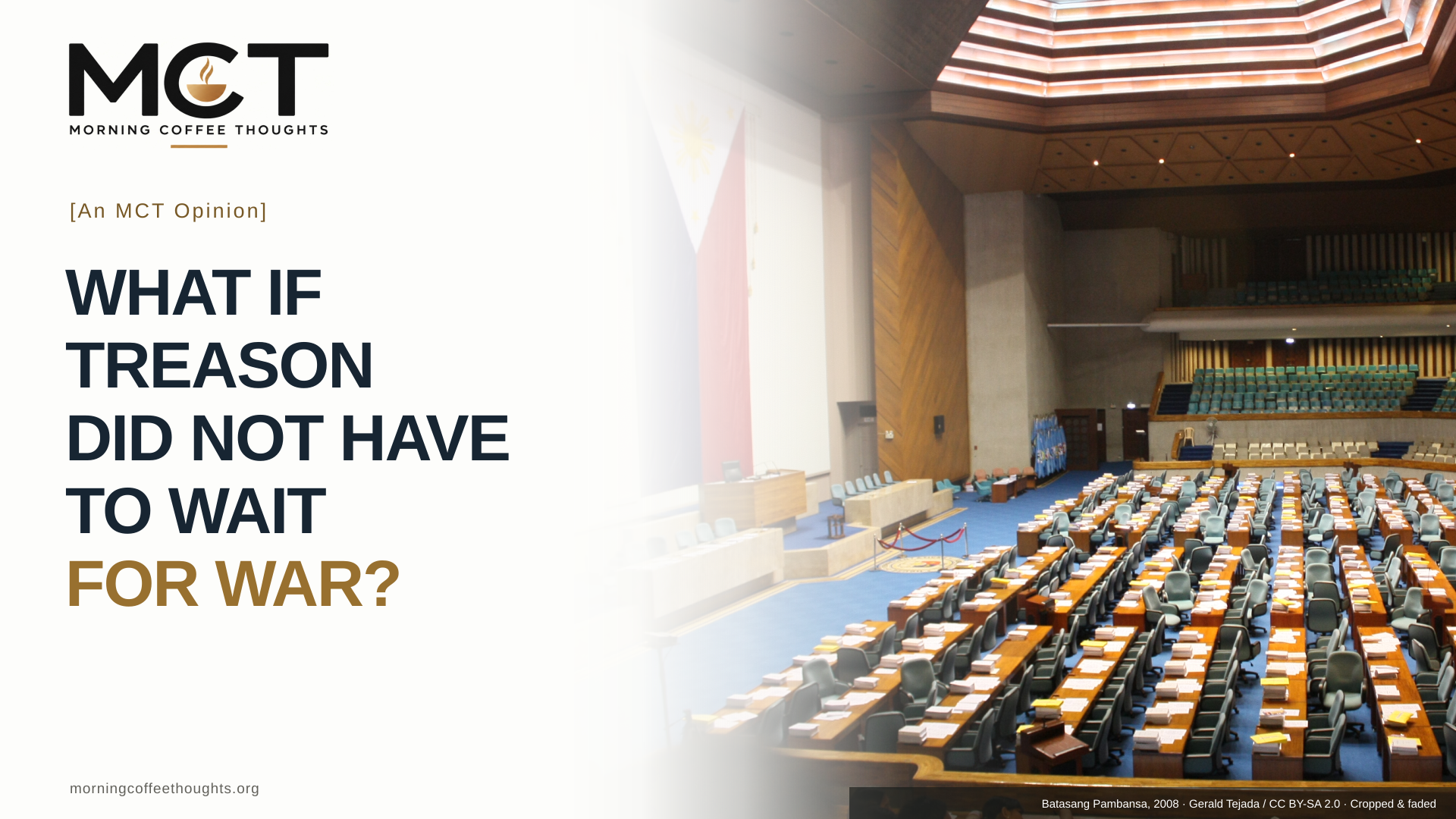
Archival illustrative photograph: “Batasan (2891409318)” by Gerald Tejada, September 18, 2008. Source: https://commons.wikimedia.org/wiki/File:Batasan_(2891409318).jpg . License: https://creativecommons.org/licenses/by-sa/2.0/ . Changes: scaled, cropped and faded, with editorial headline added. Adapted photographic artwork is supplied under CC BY-SA 2.0. The separately supplied MCT logo remains its owner’s artwork; no photographer endorsement is implied.