
Corrupt Kami, Ano Ngayon? How the Philippine Political Machine Turns Outrage Into Resignation
The Philippine political machine doesn't just steal — it makes you accept the theft, normalize it, and eventually stop fighting it. Through coordinated disinformation, manufactured consensus, and decades of engineered helplessness, corruption has been turned into a spectator sport where the audience forgets it holds the remote. But the ground is shifting, the people are waking up, and the Philippine political machine may have finally overplayed its hand.
14 min read
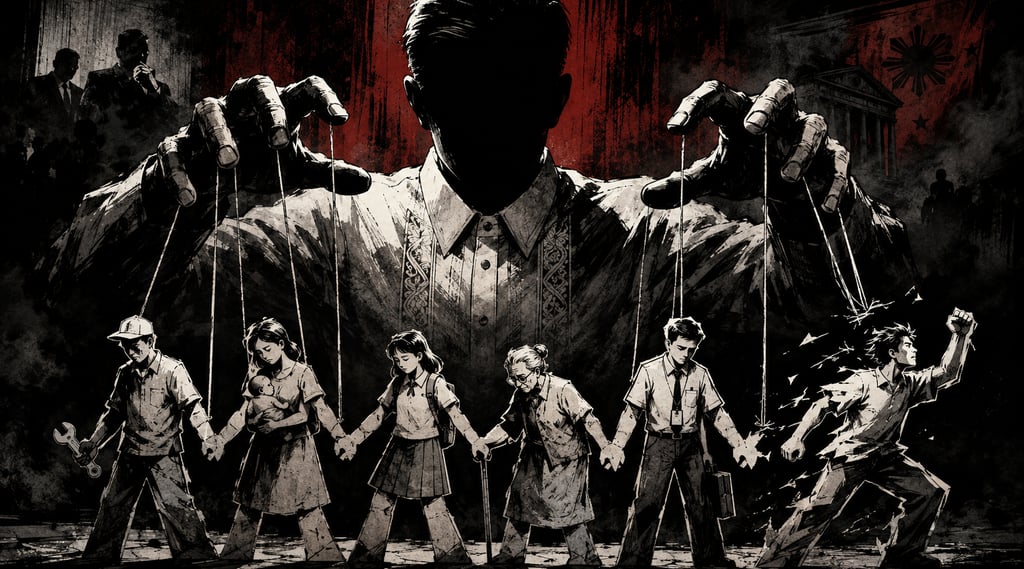
People keep saying it. "Kung may utak lang sila." If only they used their brains. As if the problem is that Filipinos are stupid.
That framing has always bothered me. Because I've watched reasonably intelligent people — teachers, engineers, nurses, people with college degrees and healthy skepticism — get duped. Not because they stopped thinking. But because what they were up against had nothing to do with intelligence alone.
Understanding Philippine politics demands something more than common sense. And that's not an insult. It's the honest starting point.
THE MACHINE YOU DON'T SEE
When we talk about political manipulation in the Philippines, we tend to picture a troll typing in a dark room. One person, one fake account, one lie.
The reality is far more organized.
Researchers studying the 2022 elections found that influence operations function as a form of political brokerage. They don't just spread lies. They build relationships, manufacture credibility, and operate as part of a larger campaign ecosystem. The mechanisms are specific: infrastructural capacity, reputation manipulation, relationship-building at scale, and obscured accountability.
That last one matters most. Obscured accountability means nobody can trace it back.
By mid-2022, Meta had removed 15,000 accounts for inauthentic behavior in the Philippines. Twitter suspended hundreds more. These weren't random trolls. They were coordinated operations running alongside legitimate campaigns, filling gaps that official messaging couldn't cover.
To the ordinary Facebook user scrolling through their feed, none of that coordination was visible. What they saw was a lot of people saying the same thing.
That looks like consensus. That looks like truth.
This is not a problem that common sense can solve. Because common sense tells you to trust what many people believe. Manipulation is engineered precisely to exploit that reflex. Your own instincts become the entry point.
DISINFORMATION DOESN'T LOOK LIKE A LIE
UP communication scholars draw a clear line between misinformation — which is accidental — and disinformation, which is deliberately orchestrated, professionally funded, and politically planned.
The Philippines has been described as "patient zero" of global debates on digital manipulation and democracy. The Duterte administration institutionalized disinformation as a governing tool. That same infrastructure later helped rehabilitate the Marcos family name across social media, paving the way for a 2022 landslide.
Marcos Jr. won not just by spending on ads. His team used micro-influencers, celebrities, fake accounts, bots, and coordinated hashtags. They created false accusations against opponents while framing him as a victim of injustice. The narrative felt organic because it was designed to.
Disinformation in the Philippines now follows a specific design cycle. It attaches itself to moments of political tension and sustains itself across weeks. By the time fact-checkers catch up, the emotional impression has already settled.
The lie doesn't need to be believed forever. It only needs to last long enough.
IT COMES FROM EVERYWHERE, ALL AT ONCE
This is where the manipulation becomes genuinely difficult to resist — not because any single piece of it is overwhelming, but because it comes from every direction at once.
It's vote buying on election day, pervasive especially among poor communities. It's political dynasties mobilizing patronage networks built over decades. It's media ownership concentrated among families with political interests. It's an electoral system without runoffs, where a candidate can win with 39% of the vote — with the majority having rejected them — and still hold full executive power.
The Lowy Institute describes Philippine elections as personality-driven and promoted by non-ideological parties, where voters choose who governs them but not how. Parties here are not ideological organizations. They're loyalty machines formed around individuals.
At every level — national media, local governments, social media, election mechanics — the system amplifies certain narratives and buries others.
And most of it looks normal because it has always looked this way.
That's the real trap. When manipulation is the baseline, it stops registering as manipulation. It becomes the weather.
CORRUPTION BECAME THE DEFAULT
There's a phrase that captures something painful about this: lahat naman magnanakaw.
Everybody steals. It has become shorthand for a worldview, not just a complaint.
A report tracking the normalization of corruption in the Philippines traces it across every administration since Marcos Sr. Under Aquino, pork barrel was democratized. Under Ramos and beyond, corruption dispersed across agencies, local governments, and the bureaucracy. Each administration promised reform. Each one repeated the cycle. The Philippines scored 33 out of 100 in the 2024 Corruption Perceptions Index, significantly below the global average.
The rationalizations are the same across administrations. The names change.
A 2025 flood control investigation uncovered more than 400 ghost projects, with sitting and former senators and legislators implicated. Billions lost. The reaction from most Filipinos? A tired shrug.
Corrupt sila. Ano ngayon?
That shrug is not stupidity. It's the product of decades of watching accountability fail. Of watching scandals get buried, commissions go nowhere, and the same families reappear on the ballot wearing different colors. The Ombudsman's own research found that 85% of Filipinos believed corruption was rampant in government — as far back as the year 2000.
Twenty-five years ago.
WHAT LOOKS LIKE APATHY IS SOMETHING ELSE
When people don't vote, or vote for the familiar trapo, or accept ₱500 on election day, the easy analysis is that they gave up. Walang pakialam.
But what's actually happening has a name: learned helplessness.
It describes what happens when people experience repeated failure until they stop trying — not because they don't care, but because they've been conditioned by experience that their efforts don't change outcomes. Whoever wins, the rice is still expensive. Whoever wins, the red tape gets longer. The roads still flood.
Vote buying works because it delivers immediate, tangible change. Cash in hand. Systemic reform doesn't feel like anything yet. Politicians know this. They offer housing, scholarships, subsidized rice. It doesn't matter if it's feasible. What matters is that it's real right now, and the alternative is abstract.
There's also the collective action problem. Voting feels meaningless when you experience yourself as an individual and not part of a collective. One vote disappears into a sea of 57 million.
The 2025 midterms had the highest turnout ever for a Philippine midterm election. So people are still showing up. But showing up without a collective strategy doesn't break the pattern. It just feeds it.
And here's what we never say plainly enough: the feeling that one vote won't matter is not irrational. It is the logical conclusion of watching manipulated outcomes for decades. The people who feel powerless are not wrong about the system. They are wrong only about what can change it.
THE CHALLENGE EMBEDDED IN THE THEFT
There's a more brazen element to this that deserves naming directly.
Corrupt officials in the Philippines have moved past hiding. Some operate openly. The "corrupt kami, ano ngayon?" posture is real. It's visible in the way scandals get absorbed, in the way implicated politicians run again and win, in the way ghost projects cycle through the same contractors under different administrations.
Freedom House's 2025 assessment of the Philippines notes that rule of law remains haphazard and heavily favors the elite. There's no real fear of accountability. The Plunder Law exists. The Sandiganbayan exists. The Commission on Audit exists. All of it exists. And yet the conviction rate for high-profile corruption cases remains historically low.
When impunity becomes the expected outcome, corruption loses its stigma. When losing an election doesn't result in consequences for those who stole, the message sent to the public is clear: go ahead, try to vote us out. We'll be back.
This is the challenge embedded in the theft. The system is designed to absorb outrage without consequence.
Knowing this doesn't make it easier. But it reframes the problem. The question is not why Filipinos tolerate corruption. The question is: what does it take to make impunity costly enough that it stops?
THE SHARED GRIEVANCE NOBODY TALKS ABOUT
Here's where I want to slow down. Because this is the part most political writing skips.
There's a tendency to split the conversation into two camps: the educated voter who makes principled choices, and the masa voter who accepts ₱500 and votes for the name they recognize. The educated voter is frustrated with the masa voter. The masa voter has no idea the educated voter exists. And both of them feel, in their own way, that their vote doesn't matter.
That's the common ground. Not civic duty. Not policy literacy. The shared feeling of being played.
The educated voter who followed every senate hearing, read every COA report, and voted with full information — and still watched their candidate lose to someone under investigation — knows that feeling. The market vendor who traded their vote for cash because the alternative was another election cycle of nothing — they know that feeling too.
Both of them are right that something is broken. They just don't know they're looking at the same thing.
The manipulation is designed to keep those two observations from ever meeting. And so the first step — before civic education, before media literacy, before any organized campaign — is building the bridge between those two experiences. Acknowledging that the system failed both of them. That neither group is the enemy of the other. That the ₱500 voter and the opinion column reader are both operating inside a system that was designed to make them feel alone.
Bakit? Because alone, neither of them is a threat to anyone.
VOTER EDUCATION: THE SYSTEM THAT NEVER REALLY EXISTED
So if common sense fails, and the manipulation is professional and funded and coordinated — what does it take to build genuine resistance?
Not what we currently call voter education.
COMELEC's voter information drive ahead of the 2025 elections ran two months — December 2024 to January 2025. COMELEC's chairman admitted that wasn't enough to reach the whole country. He ended up asking candidates and political parties to supplement the effort. The institution responsible for voter education was asking the people running for office to do it for them. Think about that for a moment.
In schools, the picture is just as thin. The K-12 curriculum's main civic education subject covers only eight hours in senior high school. If students don't take the Humanities and Social Sciences strand, that's their last formal exposure to civic education. Many schools have no co-curricular activities to reinforce even what little is taught. The curriculum leans more toward culture and society than toward actual political citizenship.
Eight hours. Once. In senior high school.
The current system treats voter education as a pre-election logistical reminder. It tells people how to shade a ballot. It doesn't build the capacity to think critically about who to vote for, why, or what the systemic consequences are. It treats citizens as recipients of information, not people who need to develop political judgment over years.
That's not voter education. That's voter orientation.
And it solves the wrong problem.
THE GAP NOBODY IS WILLING TO NAME
The deeper problem is this: there is no sustained, institutionalized program for building political literacy in the Philippines.
What exists are campaigns that spike before elections and disappear after. They treat political awareness as a seasonal event. But the manipulation doesn't stop after election day. The disinformation campaigns don't pause. The patronage networks don't rest. Political literacy needs to be built the same way — continuously, over years, embedded in communities, not dropped from above every three years.
There's also a design problem. The materials and campaigns that exist are built for people who are already politically engaged. The framing, the language, the platforms — they reach people who are already paying attention. The voter who accepted ₱500 is not scrolling through COMELEC's Facebook page. The voter who has never trusted a government institution is not going to be moved by an infographic from that same government institution.
Media literacy faces the same gap. Understanding that disinformation is coordinated, funded, and professional — understanding how it works at the structural level — is knowledge that exists mostly in academic papers and journalism written for people who already read academic papers and journalism. It hasn't moved into the barangay. It hasn't moved into the market. It hasn't moved into the household.
The people most targeted by disinformation are the least equipped to recognize it. That is not an accident.
WHAT ACTUALLY WORKS — AND WHY IT'S HARD
The evidence is not ambiguous. One-way broadcast does not work. Two-way conversation does.
A J-PAL study on deliberative political campaigns in the Philippines found that town hall meetings — actual dialogue between candidates and voters — meaningfully increased community engagement. Not rallies. Not political ads. Conversations where voters could ask questions, push back, and hear platforms explained directly.
The Friedrich Naumann Foundation's voter education model before the 2025 elections used the same principle: train community members to become voter educators in their own barangays. Peer-to-peer, not top-down. Because people trust people they know. A coordinated influence operation exploits that exact same trust — which means the antidote has to operate at the same level.
This is what effective voter education looks like. Not a pamphlet. Not a government campaign. A neighbor, trained and equipped, having a real conversation with another neighbor about what's on the ballot and why it matters.
The problem is that this model is slow, expensive, and difficult to scale. It requires political will to fund over years, not just months. It requires civil society organizations with real reach, not just social media presence. It requires the kind of sustained institutional support that the Philippines has never consistently provided for civic education.
And it requires something even harder: the willingness to educate people in ways that might make them harder to manipulate — including by the people funding the education.
That last part is why it keeps not happening.
THE ADVOCATES ARE FIGHTING. IT'S NOT ENOUGH.
There are Filipinos doing this work right now.
Pro-good governance bloggers, fact-checkers, civic advocates — they exist, they are active, and God bless them for it. Their effort has real effect. Some of the public awakening we're seeing right now is partly their doing, years of patient documentation finally finding an audience that is ready to receive it.
But they are overwhelmed. And the model they're working in is structurally disadvantaged.
The good governance side is reactive. It responds to the lie after it spreads. It shows up after the narrative has already settled, after the emotional impression is done. Each week brings a new scandal, a new coordinated attack, a new false claim to debunk — and there are only so many people willing to do that work without pay, without rest, without institutional backing.
The other side has an army. The good governance side has heroes.
An army is coordinated. It uses the same talking points, the same timing, the same amplification. Heroes fight their own battles, build their own audiences, respond to their own feeds. Each one doing important work. None of it adding up to a unified front.
That's the gap. Not effort. Architecture.
A Richter scale does not move from a hundred people pushing in different directions. It moves when force is concentrated, sustained, and pointed at the same fault line.
THE GROUND IS ALREADY MOVING
Here's what changes the picture.
The awakening isn't coming. It's already happening — and the other side is accelerating it themselves.
Sara Duterte's numbers are slipping. Octa Research's Tugon ng Masa surveys are showing it. Not because of a blogger campaign. Because of her own attitude, her own behavior, her own statements in the face of the cases she is confronting. Alan Peter Cayetano, Imee Marcos, Rodante Marcoleta, and the rest of the DDS cohort — they are each, in their own way, shooting themselves in the foot. Publicly. Repeatedly. In front of a population that is watching more closely than they expected.
The irony is almost too clean. The same people who built their power on controlling the narrative are being undone by their own actions inside it.
This matters. It means the work of building political awareness is not starting from zero. It's starting from a country that is already awake in ways it wasn't before. Record midterm turnout. A 2025 senate result that surprised the machinery. The Leni movement mobilized fifteen million votes in 2022 against a machinery that had everything, the money, the trolls, the dynasties, and the Marcos name." These were not accidents. They were organized. They were built on months of sustained community work, peer conversations, people deciding that collective movement was worth trying even when individual effort felt pointless.
Evil may win a battle. That's true and it's worth saying plainly. But a population that is awake, aware, and increasingly active is a fundamentally different electorate than the one the current power structure built itself on.
The conditions for a real movement are forming. Not because someone planned them. Because the other side keeps handing them over.
WHAT THE MOVEMENT NEEDS TO BE
What's missing is not anger. There's enough anger.
What's missing is a unified movement — not a political party, not a single charismatic leader — but a shared covenant around values that different bloggers, communities, organizations, and ordinary citizens can point to together. Good governance. Honesty. Integrity. Performance. Accountability. All of it in the name of a better Philippines.
Something that converts the scattered energy of individual awakening into sustained, collective pressure. Something that gives the educated voter and the masa voter a common language. Something that exists between elections, not just during them.
The pro-good governance community is close to this. The civic organizations are close to this. What they haven't done yet is agree on the architecture. A shared message. A shared call to action. A shared standard against which every candidate, every official, every public statement can be measured and held.
That is the missing piece. And no blog, including this one, can build it alone.
What a blog can do is name it clearly enough that the people with the capacity to build it understand what they're being asked to do.
WHAT A BLOGGER CAN AND CANNOT DO
Let me be honest about something.
This piece will not fix anything.
No piece of writing will. "Vote wisely" is useless advice against a professional disinformation operation. Telling people to think critically doesn't help if the conditions for critical thinking were never built. Sharing a well-researched article reaches the people who already read well-researched articles.
The honest role of writing in this context is narrower. It can give people a better map of the terrain. It can name things accurately — the manipulation is professional and funded, the apathy is learned and rational, the gap in civic education is structural and intentional. It can refuse the comfortable lie that the problem is stupidity, and hold open the harder truth that the system was designed to make smart people fail.
That's something. Not enough. But something.
The rest — the actual work of building political literacy at the barangay level, of peer education, of sustained civic institutions, of collective action — that work doesn't happen on a blog. It happens in communities, over years, by people who refuse to accept that the only options are resignation or outrage.
A blog can point toward that work. It can describe the terrain. It can name what's missing.
What it can't do is replace the decision each person has to make about whether to be part of it.
Piliin mo. That's still on you.
SOURCES
East Asia Forum – The disinformation paradox gripping the Philippines, https://eastasiaforum.org/2025/06/28/the-disinformation-paradox-gripping-the-philippines/
Wikipedia – Corruption in the Philippines, https://en.wikipedia.org/wiki/Corruption_in_the_Philippines
Friedrich Naumann Foundation – Fake Accounts, Bots, and Trolls, https://www.freiheit.org/southeast-and-east-asia/fake-accounts-bots-and-trolls-how-social-media-influences-philippines
International Journal of Communication – Influence Operations as Brokerage: 2022 Philippine Elections, https://ijoc.org/index.php/ijoc/article/view/23553
Internews – Nexus of Manipulation: Anatomy of Influence Operations in the Philippines, https://internews.org/resource/nexus-of-manipulation-anatomy-of-influence-operations-in-the-philippines/
UP Manila – The Problem with Fake News, https://up.edu.ph/the-problem-with-fake-news-up-experts-speak-on-the-impact-of-disinformation-on-politics-society-and-democracy/
Fulcrum – Influence Operations in the Philippines: New Frontiers of Online Manipulation, https://fulcrum.sg/influence-operations-in-the-philippines-new-frontiers-of-online-manipulation/
Lowy Institute – Philippine Elections and the Politics Behind It, https://www.lowyinstitute.org/the-interpreter/philippine-elections-politics-behind-it
Asian Century PH – The Normalization of Corruption in the Philippines, https://asiancenturyph.com/2025/10/12/the-normalization-of-corruption-in-the-philippines/
Inquirer Opinion – The Normalization of Corruption, https://opinion.inquirer.net/74408/the-normalization-of-corruption
PRIF Blog – Deja Vu: The Flood of Corruption Engulfs the Philippines Again, https://blog.prif.org/2025/10/15/deja-vu-the-flood-of-corruption-engulfs-the-philippines-again/
Office of the Ombudsman – Political Culture of Corruption in Government, https://www.ombudsman.gov.ph/UNDP4/wp-content/uploads/2012/12/Chap2_PolCulture.pdf
Archium Ateneo – An Empirical Analysis of Vote Buying Among the Poor, https://archium.ateneo.edu/asog-pubs/52/
Inquirer Opinion – Election Helplessness, https://opinion.inquirer.net/183057/election-helplessness
Niskanen Center – Voting as a Collective Action Problem, https://www.niskanencenter.org/voting-as-a-collective-action-problem/
Asia Society – A Look at the 2025 Philippine Midterm Elections, https://asiasociety.org/policy-institute/look-2025-philippine-midterm-elections
Wikipedia – 2025 Philippine General Election, https://en.wikipedia.org/wiki/2025_Philippine_general_election
Freedom House – Philippines Election Watch 2025, https://freedomhouse.org/country/philippines/election-watch/2025
Assorted Edge – Disinformation in the Philippines No Longer Looks Like Isolated Fake Posts, https://www.facebook.com/assortedge/posts/disinformation-in-the-philippines-no-longer-looks-like-isolated-fake-posts-or-kn/13980
Philippine News Agency – Battling Disinformation in the Age of Social Media, https://www.pna.gov.ph/opinion/pieces/1039-battling-disinformation-in-the-age-of-social-media
PIDS – Making Voter Education a Pillar of Democracy in the Philippines, https://serp-p.pids.gov.ph/publication/public/view?slug=making-voter-education-a-pillar-of-democracy-in-the-philippines
PIDS – Civic Education in the Philippines Must Be Improved, https://www.pids.gov.ph/details/news/press-releases/civic-education-in-the-philippines-must-be-improved-dlsu-professor
Inquirer Opinion – Civic Education and the Filipino Voter, https://opinion.inquirer.net/140270/civic-education-and-the-filipino-voter
Friedrich Naumann Foundation – CLD Prepares Trainers for Voter Education and Vote Protection Ahead of 2025 Philippine Elections, https://www.freiheit.org/philippines/cld-prepares-trainers-voter-education-and-vote-protection-ahead-2025-philippine
Inquirer – Comelec Asks Political Parties and Bets to Add Voter Education in Campaign, https://www.inquirer.net/419219/comelec-asks-pol-parties-bets-add-voter-education-in-campaign/
J-PAL – Impact of Deliberative Political Campaigns on Voter Behavior in the Philippines, https://www.povertyactionlab.org/evaluation/impact-deliberative-political-campaigns-voter-behavior-philippines
Rosa Luxemburg Stiftung – Civic Education in the Philippines, https://rosaluxmanila.org/wp-content/uploads/2024/01/Civic-Education-in-The-Philippines.pdf
If this piece made you think and you believe MCT should keep doing this work, please consider sending a donation via GCash: 0969 314 4839, under An***** B. Just enough to help keep the research tools and monthly subscriptions running. Every bit makes the next piece possible.
Contact us
subscribe to morning coffee thoughts today!
inquiry@morningcoffeethoughts.org
© 2024. All rights reserved.
If Morning Coffee Thoughts adds value to your day, you can support it with a monthly subscription.
You can also send your donation via Gcash: 0969 314 4839.