
Every Single Line on Your Electric Bill — and Why You're Paying for Things That Have Nothing to Do With Your Electricity
Your electricity bill isn't just one charge—it's a maze of pass-throughs, subsidies, and decades-old debts you're forced to pay every month. This breaks down every line on your bill: generation, transmission, systems loss, NPC stranded debts, and the new renewable energy charges nobody asked for. If you've ever wondered why your electricity bill keeps rising and where all that money actually goes, this is what you need to read.
12 min read
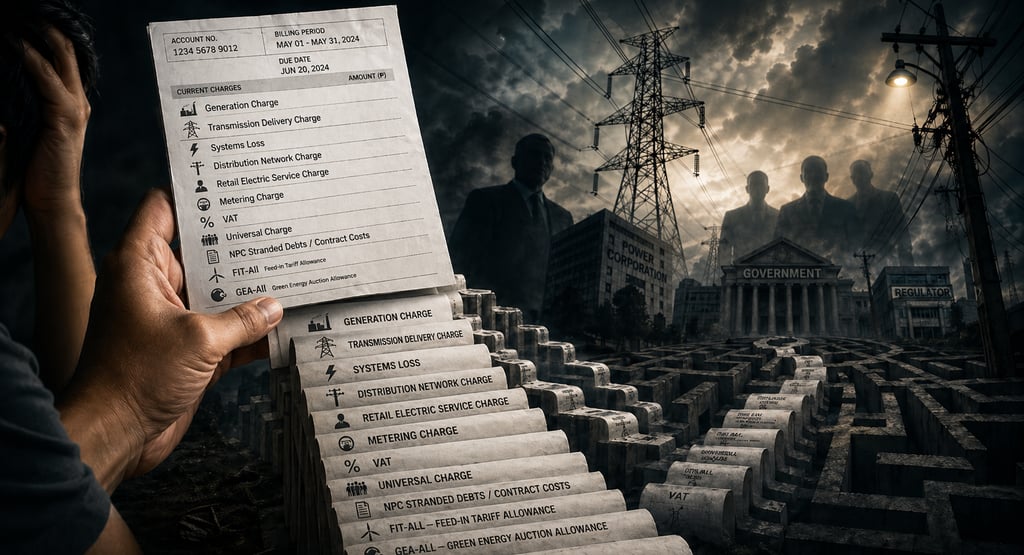

I open my electric bill and the first thing I see is the total. Then the dread.
But this month I actually looked at the lines below that number. And I saw something worse than the price. A list of charges I don't understand, didn't agree to, and can't escape.
Generation charge. Transmission delivery charge. Systems loss. Distribution network charge. Retail electric service charge. Metering charge. Then the VAT on all of it. Then universal charges. Then NPC stranded debts. Then FIT-All. Then GEA-All.
I'm not paying for one thing. I'm paying for a system that decided, a long time ago, that I would fund every failure, every loss, every bad decision, and every subsidy — and pretend it's all just the cost of keeping the lights on.
So I did what I probably should have done years ago. I went line by line. Because if I'm paying for it, I deserve to know what the hell it is.
What "Pass-Through" Actually Means
Before I get into the individual charges, I need to understand what "pass-through" means because it shows up everywhere.
A pass-through charge means the utility doesn't set the price and doesn't profit from it. They collect the money from me, then remit it to whoever actually provides that service — generation companies, NGCP, government funds.
The generation charge is a pass-through. The transmission charge is a pass-through. Systems loss, universal charges, FIT-All, GEA-All — all pass-through.
My utility says: "We're just the middleman. We don't control these costs."
Which sounds reasonable until I realize that means nobody I can directly complain to has any incentive to lower these charges. The power generator sets the price. NGCP sets the transmission rate. The ERC approves everything. My utility just collects and forwards the bill.
And because these are pass-throughs, they fluctuate every month. Generation costs go up when fuel prices rise or when demand spikes and utilities have to buy expensive electricity from the spot market. Transmission goes up when NGCP's ancillary service costs increase. I don't get advance notice. I just see the number change on my bill.
Pass-through means the risk of price increases gets transferred entirely to me.
The Big One: Generation Charge
This is the largest chunk — roughly 55% to 64% depending on the month. It's what my electric cooperative pays power producers for the actual electricity they generate.
Who gets this money? Independent Power Producers like First Gen Corporation and San Miguel Energy, companies with Power Supply Agreements, renewable energy producers, and the Wholesale Electricity Spot Market.
The generation charge moves every month because it's a pass-through. When fuel prices go up, I pay more. When demand surges during summer and utilities have to buy power from the spot market at peak rates, I pay more. When a major power plant goes offline and supply tightens, I pay more.
The utility doesn't generate the power. It just buys it on my behalf and passes the cost directly to me.
I'm not buying power from my electric cooperative. I'm buying it from private companies through my electric cooperative. And the price changes every single month based on factors I have zero control over.
Transmission Delivery Charge
This is what I pay the National Grid Corporation of the Philippines for transmitting electricity from the power plants — often located in remote provinces — to my local distribution system using high-voltage transmission lines.
NGCP is a private consortium owned by Monte Oro Grid Resources Corp. led by Henry Sy Jr., Calaca High Power Corporation led by Robert Coyiuto Jr., and State Grid Corporation of China with a 40% stake.
China owns 40% of the company that controls the national power grid.
NGCP claims it charges around 3.57% to 3.60% of the total bill. But the transmission charge fluctuates wildly because NGCP passes through "ancillary service charges".
Ancillary services are the costs of keeping the grid stable — frequency regulation, voltage support, reserves for sudden outages. NGCP contracts with power plants to provide these services, then passes the cost to consumers.
In January 2025, transmission hit P1.3504 per kWh. By May 2025, it dropped to P1.0904 after NGCP announced a 28% reduction. By March 2026, it spiked again due to a 70% increase in ancillary charges.
The rate can swing 30% to 70% month to month. I have no warning. I just get the bill.
Sen. Risa Hontiveros revealed in 2023 that NGCP passed on P8.7 billion in janitorial and security expenses to consumers from 2009 to 2022 — while also making massive dividend payouts to shareholders.
I paid for their janitors. They kept the profits.
System Loss
This is the charge for electricity that never made it to my home.
System loss is the power lost during transmission and distribution. There are two kinds:
Technical losses: Resistance in wires, heat dissipation, transformer losses — basic physics. You can't push electricity through thousands of kilometers of cable without losing some of it.
Non-technical losses: Illegal connections, meter tampering, pilferage, billing errors, unmetered connections.
The law allows distribution utilities to recover up to 8.5% of delivered electricity as "systems loss" and charge consumers for it. Meralco's cap is 6.5%, and it claims to be below that. Electric cooperatives often have higher caps.
But here's the part that makes my blood boil: I'm paying for electricity lost because of problems the utility failed to fix. Stolen power from illegal connections they didn't disconnect. Faulty meters they didn't replace. Old transformers they didn't upgrade.
The law doesn't distinguish between technical and non-technical losses in what they can charge me. So I pay for both. The physics I can't control and the operational failures they should have fixed.
Rep. Lani Mercado-Revilla filed House Bill 6976 in December 2025 to stop private utilities from recovering systems loss entirely. Under her bill, only electric cooperatives would be allowed to pass on verified technical losses — capped at 5%, with no VAT.
Her words: "For decades, Filipino households have been paying for electricity they never consumed and losses they did not cause."
The bill is pending. It's been pending for years in various forms. Sen. Win Gatchalian filed a similar bill in 2017 to reduce the cap from 8.5% to 5% — it could have saved consumers P0.66 per kWh.
Nothing happened.
Distribution Network Charge
This is the only charge that actually goes to my electric cooperative for its core business: building, operating, and maintaining the local distribution network that brings power from the transmission grid to my house.
This includes the poles, wires, transformers, substations, and all the infrastructure needed to deliver electricity to my meter.
Unlike the pass-through charges, this one is set by the Energy Regulatory Commission based on the utility's approved revenue requirement. It's supposed to cover their capital expenses, operating costs, maintenance, and a reasonable return on investment.
Distribution accounts for roughly 12% of the total bill. So out of every peso I pay, only 12 centavos stays with the local utility for actual distribution work. The rest gets remitted to generation companies, NGCP, and government funds.
This charge doesn't change monthly like generation and transmission. It stays fixed until the ERC approves a new rate.
Retail Electric Service Charge
This is the cost of rendering customer service — billing, collection, customer assistance, call centers, branch operations, and other associated services.
Also called the "supply charge" on older bills.
It's a fixed monthly fee based on customer classification, not how much electricity I consume. Whether I use 50 kWh or 500 kWh, this charge stays the same.
The utility sets this based on their approved customer service costs divided by their total number of customers.
Metering Charge
This covers the cost of reading my meter, operating and maintaining metering facilities and associated equipment, and other costs related to providing metering service.
Another fixed monthly fee.
Between the retail electric service charge and the metering charge, I'm paying the utility just for existing as a customer — regardless of how much power I actually use.
For customers who consume very little electricity — maybe they're away for most of the month — these fixed charges can end up being a significant percentage of the total bill.
Value Added Tax
VAT is imposed separately on almost everything: generation charge, transmission charge, system loss, distribution charge — which includes distribution plus supply plus metering — and even subsidies.
Here's how it works: First, they compute the local franchise tax on the sum of generation, transmission, system loss, distribution, supply, metering, and subsidies. Then they apply the 12% VAT on top of that sum and on the franchise tax itself.
I'm being taxed on the franchise tax.
VAT alone eats up 12% on most of the bill components. For a typical 200 kWh household consuming power at P14.35 per kWh in April 2026, that's over P500 going straight to government coffers.
The VAT moves every month too, because it's a percentage of charges that are mostly pass-throughs. When generation and transmission go up, VAT goes up automatically.
Universal Charge
This is a "non-bypassable" charge imposed on all electricity consumers to recover the following:
Stranded debts of the National Power Corporation
Stranded contract costs of NPC and distribution utilities
Missionary electrification in unserved and underserved areas
Equalization of taxes and royalties on indigenous energy sources
Environmental charges for watershed rehabilitation
Cross-subsidy removal
It all sounds noble until I realized what "stranded debts" actually means.
The universal charge is also a pass-through. It gets collected by utilities, then remitted to various agencies and funds. The rates are set by the ERC based on what these programs need to collect each year.
NPC Stranded Debts
This is the killer.
NPC stranded debts refer to unpaid financial obligations of the National Power Corporation that were not liquidated by the proceeds from privatization of NPC's assets under EPIRA.
NPC stranded contract costs refer to the excess of the contracted cost of electricity under eligible IPP contracts over the actual selling price of that electricity in the market.
Translation: NPC signed bad deals with private power producers in the 1990s — contracts where the government agreed to buy electricity at inflated prices. These were called "take-or-pay" contracts: the government had to pay even if they didn't need the power.
When EPIRA privatized the power industry in 2001, those debts and obligations didn't disappear. They got transferred to the Power Sector Assets and Liabilities Management Corporation.
And PSALM said: the consumers will pay for it.
Since 2001, Filipino electricity consumers have paid over P1.479 trillion toward PSALM's financial obligations through the universal charge. As of end-2011, PSALM still owed P915.19 billion. By 2018, Sen. Sherwin Gatchalian said consumers were paying P0.2203 per kWh just for NPC stranded debts and contract costs. That's P44 a month for a 200 kWh household — the equivalent of about 1 kilogram of rice.
PSALM projected that from 2020 to 2026, consumers would need to pay an accumulated universal charge of P0.5593 per kWh to pay off the remaining debt of P466.2 billion.
That's this year. I'm still paying for it.
Gatchalian proposed using the P207 billion Malampaya Fund to pay off the stranded debts and contract costs so consumers wouldn't have to. The government said no.
So I keep paying. For contracts signed before I was born. For debts incurred by a government corporation that no longer operates power plants.
This is a pass-through I never consented to, for debts I never incurred, from deals I had no say in.
FIT-All and GEA-All: The Renewable Energy Charges I Didn't Ask For
Starting January 2026, the Energy Regulatory Commission approved two new charges on the bill. Both are pass-throughs.
FIT-All — Feed-in Tariff Allowance
This is a uniform charge imposed on all on-grid consumers to pay for electricity generated by "eligible renewable energy sources" like solar, wind, biomass, and small-scale hydroelectric plants.
Here's how it works: renewable energy producers sell their power at a guaranteed "feed-in tariff" rate that's higher than market rates, to encourage investment in renewable energy. The difference between what they get paid and what the market would normally pay gets collected from all consumers through FIT-All.
The money goes to TransCo, which then pays renewable energy producers under the feed-in tariff system.
The rate dropped slightly from P0.2073 per kWh in 2025 to P0.2011 in 2026. For a 200 kWh household, that's about P40 a month.
I'm subsidizing renewable energy producers whether or not any of that renewable energy is actually flowing to my house.
GEA-All — Green Energy Auction Allowance
This is a brand-new charge introduced in January 2026 to fund renewable energy projects awarded through the Green Energy Auction Program. Same concept as FIT-All, different program.
The ERC approved it. Distribution utilities, NGCP, and retail electricity suppliers are required to collect it and remit all proceeds to the GEA-All Fund by the 15th day of the month following the billing cycle.
The rate is P0.0371 per kWh. For a 200 kWh household, that's another P7.42 a month.
Together, I'm paying nearly P50 a month for renewable energy I may or may not be consuming — because the charge applies to everyone on the grid, regardless of where the actual electricity came from.
There's a legal question hanging over GEA-All. A Manila Bulletin op-ed published April 26, 2026 argued that the charge has no solid statutory basis under EPIRA or the Renewable Energy Act. The FIT system was designed for "emerging RE technologies" — not mature ones like large-scale geothermal and hydro. But the ERC approved it anyway.
And I'm paying it anyway. Another pass-through I can't refuse.
Why Hasn't the Government Stopped Any of This?
Because stopping it would require:
Rewriting or repealing EPIRA — the 2001 law that unbundled and privatized the entire power industry.
Nationalizing assets now owned by powerful private interests — IPPs, NGCP, distribution utilities.
Absorbing NPC's stranded debts into the national budget instead of passing them to consumers.
Capping or eliminating charges that fund missionary electrification, renewable energy subsidies, and senior citizen discounts
The government knows exactly what it would take to fix this — and has chosen, repeatedly, not to do it.
The Energy Regulatory Commission is supposed to be the watchdog. But the ERC hasn't reviewed the systems loss cap since 2008 — 18 years ago. It approved over P31 billion in new Meralco charges starting March 2026 while calling itself "consumer-first."
Bills have been filed. Sen. Gatchalian's 2017 bill to reduce the systems loss cap from 8.5% to 5%. Rep. Lani Mercado's 2025 bill to end systems loss charges for private utilities entirely. Proposals to use the Malampaya Fund to pay off NPC stranded debts.
All pending. All ignored.
The government isn't fixing this because the system was designed this way. EPIRA promised competition and lower prices. What it delivered was a set of private monopolies — generation companies that don't compete in franchise areas, a single transmission operator with a 25-year concession, distribution utilities with exclusive service territories.
And every time something goes wrong — a bad contract, a stranded debt, a systems loss, a renewable energy subsidy — the cost gets passed to me.
The bill says "pass-through charges." What it really means is: I pay for everything, and nobody I can complain to has any power to lower the price.
The Bottom Line
My generation charge goes to private power producers. It's a pass-through that moves every month.
My transmission charge goes to NGCP — 40% owned by China's State Grid Corporation. It's a pass-through that can swing 30% to 70% based on ancillary service costs.
My system loss charge pays for electricity that never reached me, lost because of problems the utility didn't fix. It's a recoverable charge capped by law, but the cap hasn't been reviewed in 18 years.
My distribution charge, supply charge, and metering charge go to my electric cooperative for actual service. These are the only charges that stay fixed month to month.
My VAT goes to the government. It moves every month because it's calculated on top of all the pass-throughs.
My universal charge and NPC stranded debt charge pay for the mistakes of a government corporation that stopped generating power over 20 years ago. Both are pass-throughs.
My FIT-All and GEA-All pay for renewable energy projects I may never benefit from, under legal authority that's questionable at best. Both are pass-throughs.
Add it all up and I'm not paying for electricity. I'm paying for a system that decided, line by line, that I would carry the cost of every failure, every loss, every debt, and every subsidy — and pretend it's all just the price of turning on the lights.
Walang choice. Walang accountability. Walang review.
Just a bill. Every month. With lines I'm not supposed to question too loudly.
Sources
Meralco, Breakdown of Charges, https://www.meralco.com.ph/residential/billing-payment/understanding-your-bill/breakdown-charges
GMA News, What each charge in the Meralco bill mean for customers, https://www.gmanetwork.com/news/topstories/nation/985542/explainer-what-each-charge-in-the-meralco-bill-mean-for-customers/story/
Meralco, Higher Residential Rates April 2026, https://company.meralco.com.ph/news-and-advisories/higher-residential-rates-april-2026
NGCP Corporate Profile, https://www.ngcp.ph/profile
NGCP Transmission Rate May 2025, https://www.gmanetwork.com/news/money/companies/946125/ngcp-slashes-transmission-rate-by-43-centavos-in-may-2025/story/
Philippine Star, NGCP Transmission Rate January 2025, https://www.philstar.com/business/2025/02/13/2421140/ngcp-transmission-rates-increase-january-ancillary-service-hike
Sen. Risa Hontiveros on NGCP pass-on charges 2023, https://newsinfo.inquirer.net/1839983/risa-hits-questionable-pass-on-charges-of-ngcp
SolarNRG, The Truth Behind Meralco System Loss Charges, https://solarnrg.ph/blog/the-truth-behind-meralco-system-loss-charges-and-why-youre-paying-for-it/
Philippine Power Insights, Understanding Meralco's Systems Loss Charge, https://philippinepowerinsights.wordpress.com/2014/12/10/understanding-meralcos-systems-loss-charge/
Manila Bulletin, House bill seeks to end 30 years of unfair system loss recovery charges, https://mb.com.ph/2025/12/28/house-bill-seeks-to-end-30-years-of-unfair-system-loss-recovery-charges
Win Gatchalian, Lower system loss cap championed for consumer electricity savings 2017, https://wingatchalian.com/news/gatchalian-champions-lower-system-loss-cap-for-consumer-electricity-savings/
Diskurso.ph, Extra charges in electric bills explained, https://www.diskurso.ph/news/2026/04/25/extra-charges-in-the-meralco-bill-explained-fair-system-support-or-hidden-burden-on-consumers
DivinaLaw, The curious case of Murang Kuryente, https://www.divinalaw.com/dose-of-law/the-curious-case-of-murang-kuryente/
Matuwid.org, Consumers may pay for NPC's stranded debts and contract costs, https://matuwid.org/consumers-may-pay-for-npcs-stranded-debts-contract-costs/
GMA News, FDC blames PSALM for nearly P1T in power sector debts, https://www.gmanetwork.com/news/money/personalfinance/247448/fdc-blames-psalm-for-nearly-p1t-in-power-sector-debts/story/
Jur.ph, Allocation of Malampaya Funds to Cut Power Rates, https://jur.ph/law/summary/reducing-electricity-rates-malampaya-share
Energy Regulatory Commission, TransCo Gets ERC Nod to Set 2026 FIT-All, https://www.facebook.com/ERCgovPH/posts/transco-gets-erc-nod-to-set-2026-feed-in-tariff-allowance-fit-all-12-december-20/1170576483594614/
Power Philippines, ERC approves 2026 FIT-All reduction to PHP 0.2011/kWh, https://powerphilippines.com/erc-approves-2026-fit-all-reduction-to-php-0-2011-kwh-introduces-green-energy-charge/
Inquirer Business, Consumers to pay extra for renewable energy, https://business.inquirer.net/564081/consumers-to-pay-extra-for-renewable-energy
Philippine Star, New RE charges hit power bills in 2026, https://www.philstar.com/business/2025/12/14/2494006/new-re-charges-hit-power-bills-2026
Manila Bulletin, No solid legal basis for GEA-All charge in electric bills, https://mb.com.ph/2026/04/27/no-solid-legal-basis-for-gea-all-charge-in-electric-bills
Meralco, About your Meter, https://www.meralco.com.ph/residential/billing-payment/understanding-your-bill/about-your-meter
Jur.ph, ERC Rules Governing Collection of Universal Charge, https://jur.ph/law/facts/rules-governing-collection-universal-charge
ERC, Consumer-first: ERC powers up a 2026 overhaul, https://tribune.net.ph/2025/12/31/consumer-first-erc-powers-up-a-2026-overhaul
SGA.net.ph, ERC-Approved Meralco Charges March 2026, https://sga.net.ph/erc-approved-meralco-charges-march-2026-metro-manila-homeowners/
IBON Foundation, Ten Years of EPIRA, https://www.ibon.org/ten-years-of-epira-a-decade-of-increasing-private-power-monopoly/
IBON Foundation, EPIRA: Failed Promise of Affordable Electricity, https://www.ibon.org/epira-failed-promise-of-affordable-electricity/
ADB, Electric Power Industry Reform Act of 2001, https://lpr.adb.org/resource/electric-power-industry-reform-act-2001-philippines
GMA News, Pass-through charges collected from consumers are mandated by law says Meralco, https://www.gmanetwork.com/news/money/companies/985369/pass-through-charges-collected-from-consumers-are-mandated-by-law-says-meralco
Contact us
subscribe to morning coffee thoughts today!
inquiry@morningcoffeethoughts.org
© 2024. All rights reserved.
If Morning Coffee Thoughts adds value to your day, you can support it with a monthly subscription.
You can also send your donation via Gcash: 0969 314 4839.