
LATEST COMMENTARY
FIVE THINGS TO KNOW
MCT READER PULSE · MCT-PULSE-2026-017
MCT READER SURVEY
Gaano ka nagtitiwala na tama ang ginagawa ng Kongreso sa budget ng bayan?
This is an informal survey of people who choose to participate. It is not a scientific or nationally representative sample.
ABOUT AI WORMS AND THE SMART GADGETS IN OUR HOMES
A TV box is supposed to let you watch television. A security camera is supposed to help you watch your home.
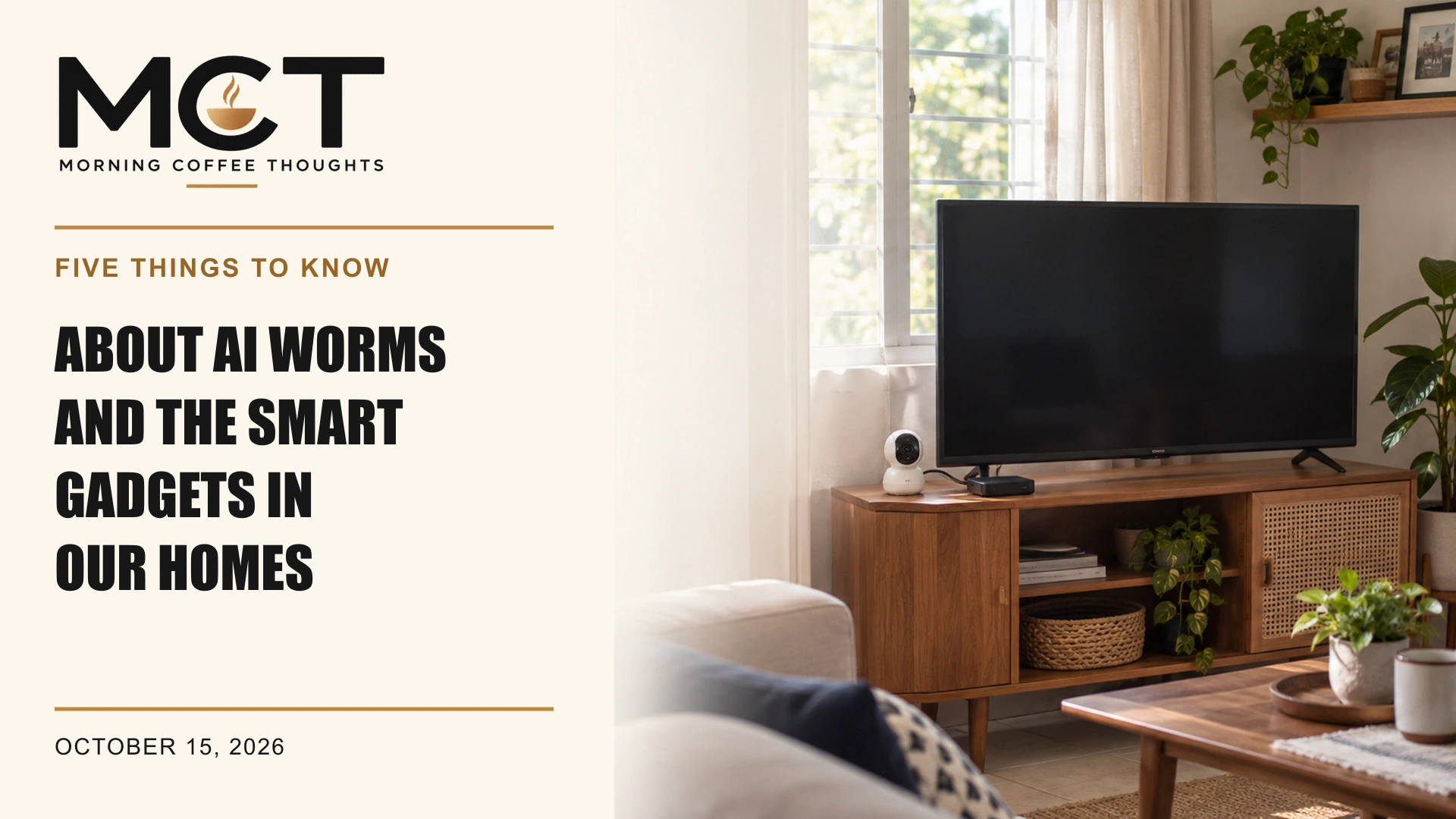
The thought that someone could turn those devices into tools for spreading malicious software is unsettling. New research on “AI worms” makes that concern worth understanding.
But before we start looking suspiciously at every gadget in the house, we need to separate what researchers have shown from what they think could happen next.
1
AN AI WORM IS MALICIOUS SOFTWARE, NOT A GADGET THAT SUDDENLY BECOMES SELF-AWARE
A computer worm spreads copies of itself between machines. An AI-powered version can use a model to help work out how to attack the next target, rather than depend entirely on instructions written in advance.
University of Toronto researchers demonstrated an adaptive worm inside an isolated laboratory network. It used AI to adjust its attacks to different targets and used computing power from compromised machines to help it spread. This was controlled research, not evidence that the same worm was loose in people’s homes. [University of Toronto](https://www.utoronto.ca/news/u-t-researchers-demonstrate-ai-worm-could-target-any-online-device)
WHAT TO WATCH
The concern is not that your appliance develops a mind of its own. It is that an attacker could make software better at finding its way around unfamiliar machines.
2
THE NEW EXPERIMENT DID NOT SHOW A FINISHED WORM SPREADING THROUGH REAL HOMES
In research published October 12, Anthropic ran an AI model across 15 inexpensive Android TV boxes.
It separately tested replication in a contained, simulated Android network. That test deliberately made entry easy: the devices exposed a debugging connection without authentication. The stronger model’s own processing also ran on a separate server.
Those details matter. Running a model on TV boxes and testing replication under simplified conditions are not the same as showing a fully independent worm spreading between household gadgets.
WHAT TO WATCH
Anthropic said it did not yet have a complete rogue replicator. Its suggestion that smaller models could gain the necessary ability within months is a forecast, not a confirmed outbreak. [Anthropic’s research](https://www.anthropic.com/research/self-replicating-ai)
3
YOUR DEVICE WOULD NOT NEED AN “AI” LABEL TO BE USEFUL TO AN ATTACKER
Anthropic’s concern is that compromised devices could share the work of running a model. One appliance would not necessarily have to run the whole thing.
That could make a scattered collection of devices harder to shut down through one central point. But the researchers also expect this kind of spread to be slow on weak hardware. [Anthropic’s research](https://www.anthropic.com/research/self-replicating-ai)
WHAT TO WATCH
The useful question is therefore not simply, “Does my gadget have AI?”
It is, “Who can access it, and is anyone still fixing its security problems?”
4
THE SECURITY PROBLEMS ARE ALREADY FAMILIAR
Weak passwords, missed updates and abandoned products already put smart devices at risk. The UK’s National Cyber Security Centre warns that compromised gadgets can expose private information or be used in attacks. [NCSC guidance](https://www.ncsc.gov.uk/guidance/smart-devices-in-the-home)
A camera makes the consequences easy to understand. Someone who gains access may be able to watch its video. You do not need an AI worm for that to become a serious problem. [NCSC camera guidance](https://www.ncsc.gov.uk/guidance/smart-security-cameras-using-them-safely-in-your-home)
For buyers, this means the price and feature list are not the whole story. A cheap device is less of a bargain if nobody can tell you how long it will receive security fixes.
WHAT TO WATCH
Manufacturers should make that answer easy to find before a customer pays.
5
YOU CAN TAKE USEFUL STEPS WITHOUT WAITING FOR AN AI-WORM OUTBREAK
Start with the devices you already own:
Change default passwords and use strong, separate passwords.
Turn on automatic security updates where available.
Enable two-step verification for the device account if offered.
Switch off remote access if you do not use it.
Check when the manufacturer will stop providing security updates.
These are established precautions, not special cures for AI malware. [NCSC guidance](https://www.ncsc.gov.uk/guidance/smart-devices-in-the-home)
CISA also advises considering a separate network for connected household devices. That can help keep them apart from computers holding personal or work information. [CISA’s connected-device guidance](https://www.cisa.gov/sites/default/files/publications/NCSAM_InternetofThings_2020.pdf)
WHAT TO WATCH
If you suspect a device has been taken over, follow the manufacturer’s recovery instructions. Do not assume an ordinary restart has solved it.
BOTTOM LINE
There is a real security question here. There is not enough evidence in these experiments to tell readers that AI worms are already taking over their homes.
For now, the sensible response is to check the gadgets we have, keep them updated, and ask harder questions about the ones we buy.
We should not have to become cybersecurity experts just to use a television. But manufacturers should not get to sell us an internet-connected device and then leave its security to us.
GOOGLE PREFERRED SOURCES
FOLLOW MCT ON GOOGLE
Google’s Preferred Sources feature lets you choose publications you want Google to prioritize for you. Select “Add to Preferred Sources” to make MCT easier to find in Top Stories and other eligible Google results. This does not subscribe you to email.