
LATEST COMMENTARY
FIVE THINGS TO KNOW
MCT READER PULSE · MCT-PULSE-2026-017
MCT READER SURVEY
Gaano ka nagtitiwala na tama ang ginagawa ng Kongreso sa budget ng bayan?
This is an informal survey of people who choose to participate. It is not a scientific or nationally representative sample.
ABOUT COMPENSATION FOR WORK-RELATED HEAT ILLNESS
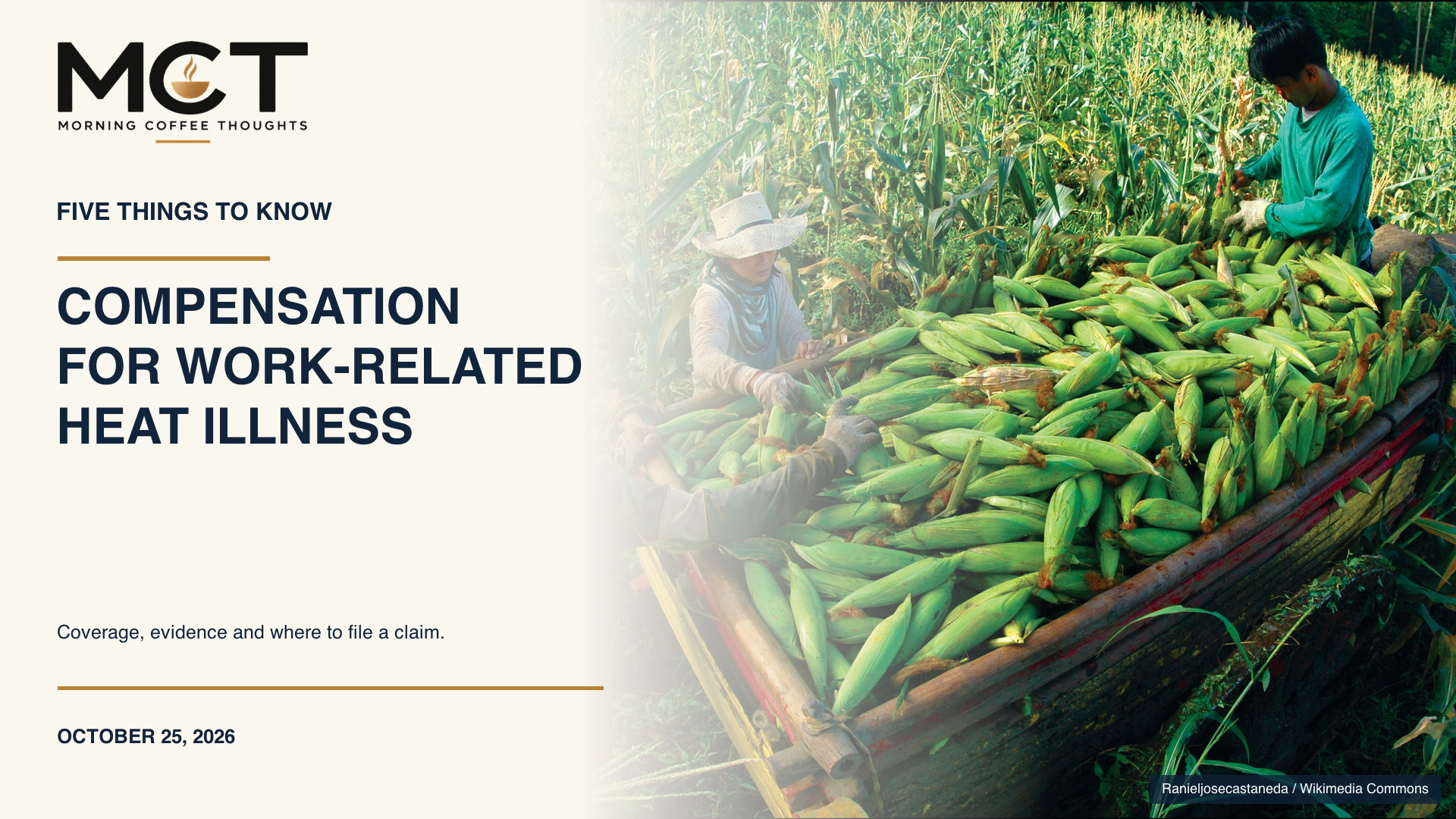
If someone becomes ill while working in extreme heat, the problem can continue after the shift ends: medical bills, missed work and uncertainty about where to ask for help. The Department of Labor and Employment (DOLE) announced guidelines on October 23 for heat-illness claims under the existing Employees' Compensation Program (ECP).
Reporting cutoff: October 25, 2026, 5:02 PM Philippine time.
1
THIS IS AN EXISTING PROGRAM FOR WORK-RELATED ILLNESS AND INJURY
The ECP provides benefits for covered work-related sickness, injury or death. The Social Security System (SSS) describes a package that can include income benefits, medical services and rehabilitation, subject to the applicable conditions. Coverage also includes eligible self-employed SSS members. Employees' Compensation, shortened to EC in agency forms and guidance, refers to the compensation provided under this program. SSS program guide
DOLE says its heat advisory applies to ECP-covered workers under SSS and the Government Service Insurance System (GSIS) whose jobs expose them, or may reasonably expose them, to excessive heat. That includes indoor and outdoor work. DOLE announcement
2
A CLAIM NEEDS MEDICAL AND WORKPLACE EVIDENCE
Heat stroke, heat cramps and heat exhaustion are already listed under EC occupational-disease rules. Occupational-disease list
The Employees’ Compensation Commission (ECC) says claims for listed diseases must meet the conditions in those rules. For illnesses outside the list, evidence must show that working conditions increased the risk of contracting them. ECC guidance
Medical records identify the illness. Records of the job and workplace conditions help explain its connection to work. Both are part of assessing whether an individual claim qualifies.
3
KEEP A RECORD OF THE WORK AND THE CONDITIONS
DOLE says assessment may consider the tasks performed, workplace conditions, the duration and intensity of heat exposure, protective clothing and preventive measures.
It also identifies records such as work schedules, workplace temperature measurements, workload and rest arrangements, safety records and witness statements as possible supporting evidence. DOLE announcement
Keep medical records and a clear account of when and where the illness occurred, the job being done and whom you informed. Save available work schedules, temperature readings and other workplace records. Heat-index information from the Philippine Atmospheric, Geophysical and Astronomical Services Administration (PAGASA) can support the account of environmental conditions, but does not by itself prove what happened to an individual worker.
4
CHECK THE FILING ROUTE FOR YOUR MEMBERSHIP AND CLAIM
SSS says employers submit EC sickness notifications for employed members through their SSS web accounts. For employed members' EC sickness claims, SSS lists an employer accident or sickness report, the relevant logbook entry and supporting medical documents when needed. Self-employed and separated members should check the SSS guidance for their own filing category. SSS EC filing guidance
Public-sector employees covered under the ECP through GSIS file their EC claims with GSIS. ECC guidance Working for a government office does not by itself identify the filing route: job-order and contract-of-service workers may instead be covered through SSS as self-employed members. ECC explanation
Contact the agency as soon as possible to check which notification steps, documents and filing or appeal deadlines apply to your claim. Keep a copy of what you submit and any acknowledgment you receive.
5
ASK FOR HELP IF THE EMPLOYER'S LOGBOOK IS MISSING
Maintaining the EC logbook is the employer's responsibility. ECC says its absence should not deprive a worker of benefits under the program. A claim should still be evaluated using the supporting evidence available. ECC logbook reminder
Ask the agency handling your claim for help if the employer's records are incomplete. If a claim is denied, ECC's guidance describes requesting reconsideration through SSS or GSIS and appealing to ECC if the denial is maintained. ECC guidance
KEEP IN MIND
Get medical attention when needed and keep copies of medical and work records. Ask the relevant SSS or GSIS office about the steps and deadlines for your claim. ECC can also help with filing concerns and appeals.
GOOGLE PREFERRED SOURCES
FOLLOW MCT ON GOOGLE
Google’s Preferred Sources feature lets you choose publications you want Google to prioritize for you. Select “Add to Preferred Sources” to make MCT easier to find in Top Stories and other eligible Google results. This does not subscribe you to email.