
LATEST COMMENTARY
FIVE THINGS TO KNOW
MCT READER PULSE · MCT-PULSE-2026-017
MCT READER SURVEY
Gaano ka nagtitiwala na tama ang ginagawa ng Kongreso sa budget ng bayan?
This is an informal survey of people who choose to participate. It is not a scientific or nationally representative sample.
ABOUT HARRY ROQUE’S DISPUTED ASYLUM STATUS
Remulla announced a denial, then said he was still confirming it. Without an official Austrian decision, Roque’s asylum status remains disputed.
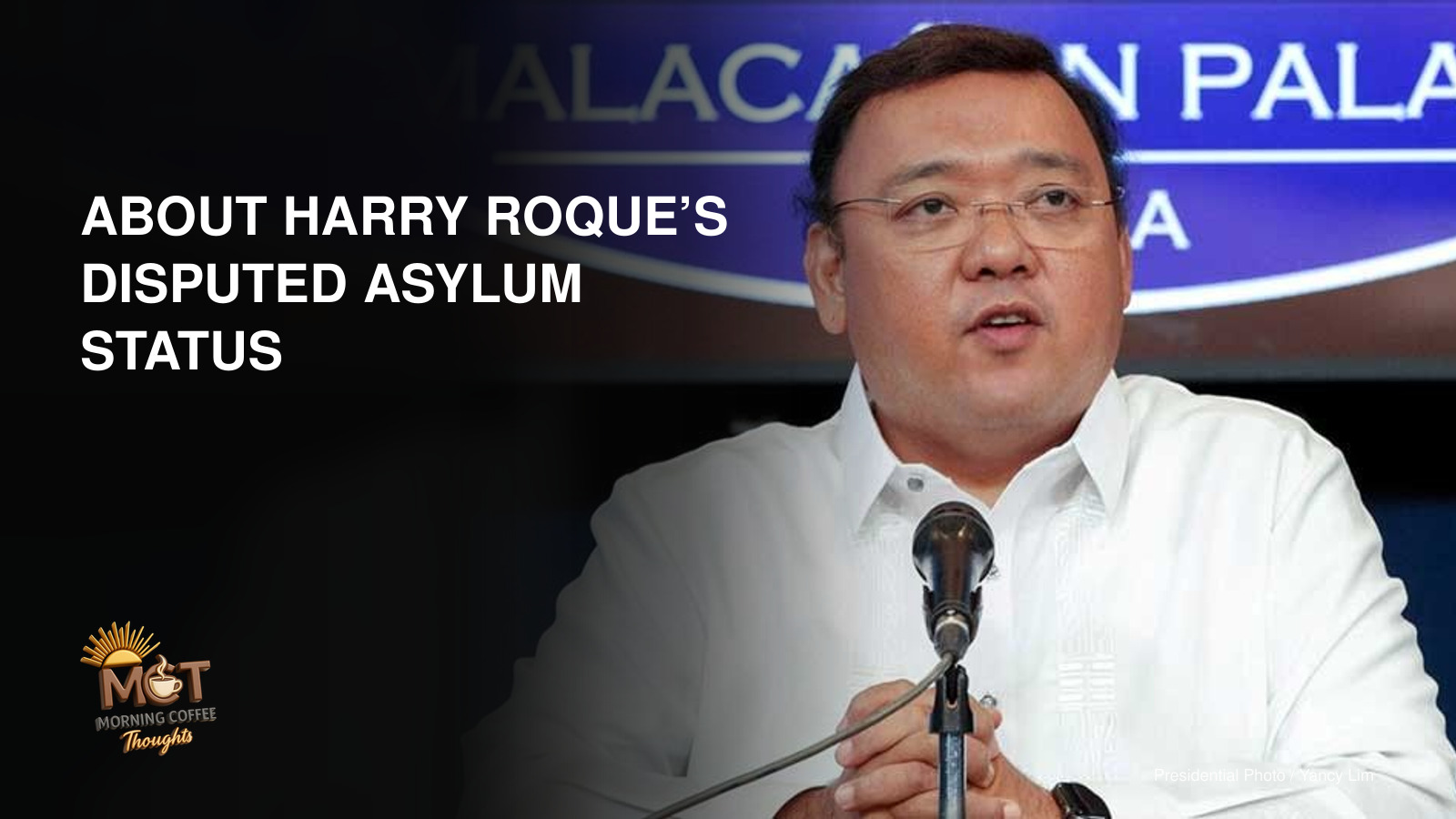
Interior Secretary Jonvic Remulla announced that Harry Roque’s asylum application in Austria had been denied. But when reporters asked whether that information had been verified, Remulla said he was still confirming it.
Roque called the claim false. He said his application had been submitted for resolution and that he was still waiting for the official decision of the Austrian authorities.
That leaves one fact in the middle of the noise: no Austrian decision has been made public or independently verified. Roque remains wanted in the Philippines in a human-trafficking case, but an arrest warrant, an asylum ruling and an Interpol notice are different legal steps. Here are the five things that matter.
1
REMULLA SAID “DENIED,” THEN SAID HE WAS STILL CONFIRMING IT
Remulla told reporters that Roque’s asylum request had been denied because the usual processing period had already passed. The statement immediately travelled as a settled development: asylum denied, return to the Philippines next.
But the certainty did not last. After Roque denied the announcement, Remulla described five months as the usual processing time and said he was still working to confirm the status. That is a major qualification. A usual timeline is not an official ruling, and a statement that is still being checked cannot establish what Austria has decided.
Roque’s denial is not proof that the application remains pending either. He is an interested party defending his own position. The reliable evidence would be a written decision from Austria’s Federal Office for Immigration and Asylum, a court record from any appeal, or a confirmation that can be independently authenticated. None has been produced publicly.
WHAT TO WATCH
An official Austrian document or confirmation identifying the decision, its date, whether it concerns admissibility or the merits, and whether Roque has filed an appeal.
2
AUSTRIA BECAME INVOLVED BECAUSE OF THE VISA ISSUE
Roque first sought asylum in the Netherlands. Dutch authorities later told him to pursue the claim in Austria, which was reported to have issued the Schengen visa he used to enter Europe. That shift was tied to the Dublin system, which determines which participating European country is responsible for examining an asylum claim.
Under the Dublin rules cited in reports on his case, the country that issued a valid visa could be responsible for the application. The point of the system is to assign one country to examine the claim, not to let an applicant choose repeatedly among European states. That helps explain why the Netherlands did not simply decide the substance of Roque’s request.
Being sent to Austria did not mean Austria had approved him as a refugee. It meant Austria was being treated as the country responsible for processing the application. Responsibility for hearing a case and a decision granting protection are two very different things.
WHAT TO WATCH
Whether Austria confirms that it accepted responsibility for Roque’s application, when the Austrian proceeding formally began, and whether the eventual decision addresses the substance of his asylum claim or only a procedural issue.
3
FIVE OR SIX MONTHS WITHOUT A PUBLIC RESULT IS NOT AUTOMATIC DENIAL
Remulla tied his announcement to the time that had passed. But no official rule has been produced showing that an Austrian asylum application automatically becomes denied when five or six months expires.
Austria’s asylum authority issues decisions in writing. An applicant can challenge a negative decision before the Federal Administrative Court. Delays may matter, and time limits can affect particular parts of an asylum proceeding, but the passage of an estimated or usual processing period is not a substitute for the decision itself.
These three stages carry different legal consequences. If a first decision has been issued but is under appeal, Roque may accurately say the fight is not over while the government may accurately say he lost at one stage. Without the document, the public cannot know which description, if either, is complete.
WHAT TO WATCH
The exact procedural status: pending before the asylum authority, denied at first instance and appealed, or finally denied after the available review process; and the dates attached to each step.
4
ASYLUM ASKS A DIFFERENT QUESTION FROM A CRIMINAL TRIAL
Asylum is meant for a person who can show a well-founded fear of persecution because of race, religion, nationality, membership in a particular social group or political opinion. Roque says the human-trafficking case against him is political persecution. Philippine authorities say he must return and answer the case.
The Austrian authority must assess the protection claim for itself. A Philippine arrest warrant does not equal a conviction, and a criminal accusation alone does not automatically defeat asylum. But asylum is not a shield that automatically erases a criminal case either. International refugee law contains exclusion rules for certain serious conduct, and the authority may examine the evidence and the real purpose of the prosecution.
That is why neither side can settle the asylum question through a press conference. Austria has to decide whether Roque faces persecution for a protected reason or legitimate prosecution for an alleged offense, including whether any exclusion rule applies. The Philippine criminal court, separately, must decide the case under Philippine law if Roque is brought before it.
WHAT TO WATCH
Austria’s treatment of Roque’s political-persecution claim, the Philippine case records submitted in response, and whether any exclusion ground is raised and supported by evidence.
5
EVEN A FINAL DENIAL WOULD NOT PUT HIM ON A PLANE IMMEDIATELY
A confirmed negative decision would be important, but it would not by itself arrest Roque or deliver him to Philippine custody. The effect would depend on whether the decision is final, whether an appeal or another legal remedy remains, and what Austrian authorities do under their own immigration law.
The Philippine warrant is a domestic court order. An Interpol Red Notice, if issued, would be a request to law-enforcement agencies to locate and provisionally arrest a person for possible extradition or similar action; it is not an international arrest warrant. Remulla said he would move once a Red Notice is issued. He did not announce that one already exists. The absence of Roque’s name from Interpol’s public website would not prove that no restricted notice exists, because most Red Notices are visible only to law enforcement.
Return to the Philippines would still require lawful coordination with Austria. Removal under immigration law, provisional arrest, extradition and voluntary return are possible routes, but they are not interchangeable. Each has its own authority, documents and opportunity for legal challenge.
WHAT TO WATCH
A verified final asylum ruling, any Austrian removal or surrender proceeding, an official Philippine or Interpol update on the Red Notice request, and the specific legal route authorities use to seek Roque’s return.
BOTTOM LINE
The public does not yet have reliable proof that Austria denied Harry Roque’s asylum request. Remulla announced a denial, then acknowledged that he was still confirming the information; Roque says the application remains unresolved. Until an Austrian decision is produced and authenticated, the honest description is disputed. If a denial is eventually confirmed, it would weaken Roque’s ability to remain in Austria. Even then, an appeal, an Interpol process, lawful cross-border coordination and the criminal trial in which the Philippine allegations must be proved would remain separate steps.
GOOGLE PREFERRED SOURCES
FOLLOW MCT ON GOOGLE
Google’s Preferred Sources feature lets you choose publications you want Google to prioritize for you. Select “Add to Preferred Sources” to make MCT easier to find in Top Stories and other eligible Google results. This does not subscribe you to email.