
LATEST COMMENTARY
FIVE THINGS TO KNOW
MCT READER PULSE · MCT-PULSE-2026-017
MCT READER SURVEY
Gaano ka nagtitiwala na tama ang ginagawa ng Kongreso sa budget ng bayan?
This is an informal survey of people who choose to participate. It is not a scientific or nationally representative sample.
FIVE THINGS ABOUT CIVIL FORFEITURE
A court order taking money away from its holder can sound like a criminal verdict. It is not necessarily one.
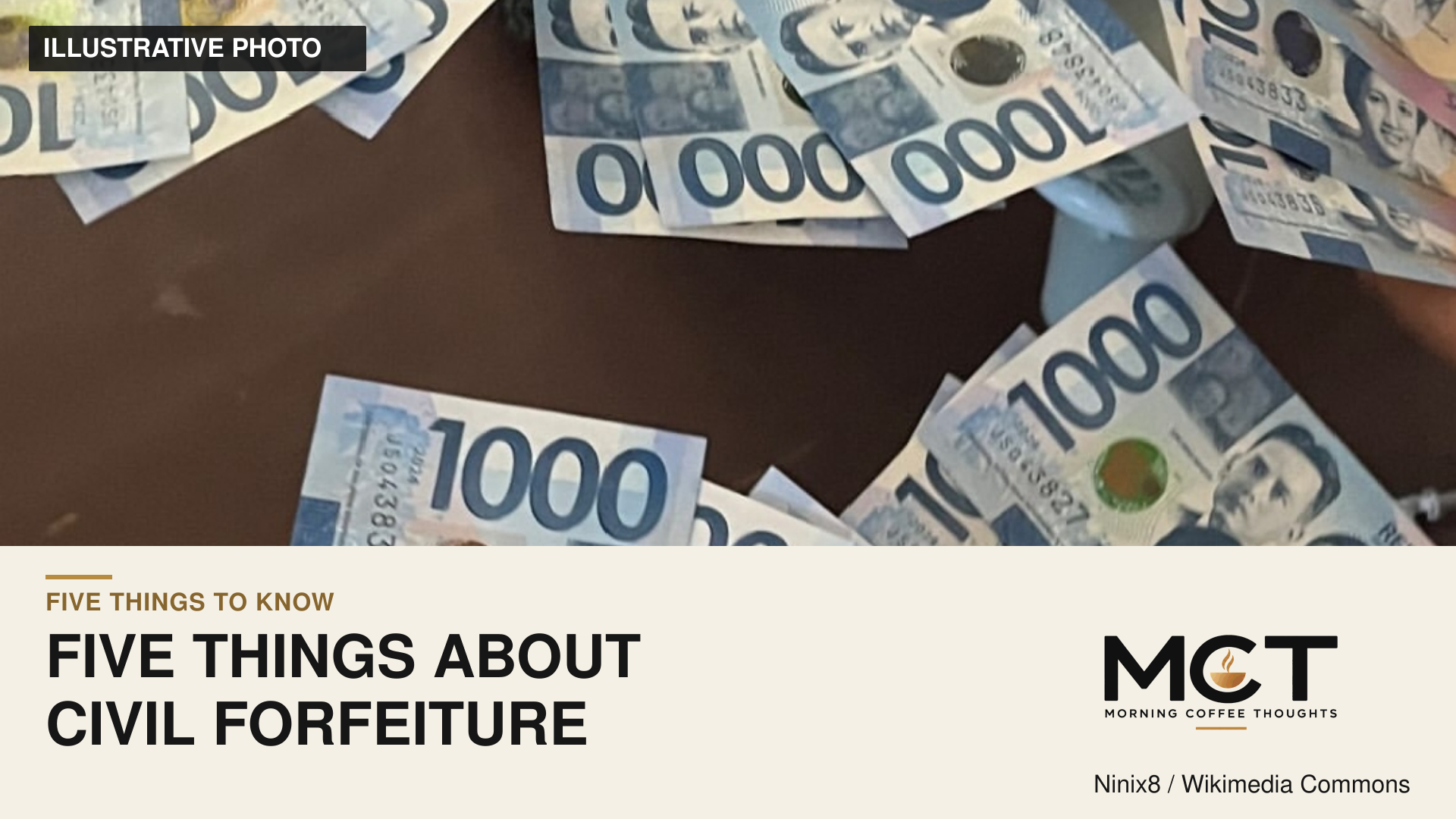
On October 29, the Anti-Money Laundering Council announced an October 9 Batangas court decision ordering the forfeiture of ₱3.12 million linked, according to the agency, to an alleged bribery attempt. The AMLC also made an important qualification: the decision was not yet final and remained subject to appeal.
Here are five distinctions that help make sense of that announcement and civil forfeiture under the Anti-Money Laundering Act.
1
THE CASE IS ABOUT THE PROPERTY
Civil forfeiture asks a court to take property connected to unlawful activity or money laundering. The law covers more than cash: it can apply to monetary instruments and other property within the law’s scope.
That does not mean officials can simply label someone’s money suspicious and keep it. A civil forfeiture case has to go through court proceedings. The question is whether the legal grounds for forfeiting the property have been established.
2
KEEPING ASSETS IN PLACE IS NOT THE SAME AS FORFEITING THEM
A freeze order or an asset preservation order can prevent assets from being moved while the legal process continues. That temporary restraint should not be reported as though the government has already won ownership of the assets.
In Republic v. Ng, the Supreme Court explained the distinction between preserving property while a case is pending and deciding whether it should ultimately be forfeited. Seeing the word “frozen” in a report is therefore not enough to conclude that there has been a final forfeiture judgment.
3
A CIVIL CASE STILL REQUIRES PROOF
The applicable civil standard is preponderance of evidence: the evidence supporting forfeiture must carry greater weight than the evidence against it. It is not the criminal standard of proof beyond reasonable doubt.
That difference does not make an allegation proof. The court must still examine the evidence and decide whether the requirements for forfeiture have been met. The Supreme Court discussed this standard in Republic v. Ng. That general rule does not tell us what evidence the Batangas court considered; the AMLC announcement did not include the full decision.
4
A CRIMINAL CASE IS A SEPARATE QUESTION
In Republic v. Glasgow Credit and Collection Services, the Supreme Court explained that civil forfeiture can proceed independently of a criminal prosecution. A prior criminal charge or conviction is not required before the civil forfeiture case can be brought or resolved.
The distinction works both ways. The absence of a criminal conviction does not by itself prevent civil forfeiture. But a civil forfeiture order also should not be presented as a criminal conviction. Any report about criminal charges, guilt or punishment needs its own supporting record.
5
AN ORDER MAY STILL BE CHALLENGED
A decision and a final decision are not interchangeable. The AMLC’s October 29 release expressly said the October 9 ruling remained subject to appeal and had not yet become final. It did not establish that an appeal had actually been filed.
The release did not identify the people involved or provide the court’s full decision. We should not fill those gaps by guessing identities, treating the money as already available for public spending, or assuming that a criminal case has ended. The accurate update is narrower: the court ordered forfeiture, and the AMLC said that order was still appealable.
The practical lesson is simple: ask what the court ordered, what evidence and legal process the report describes, and whether the decision is final. Those questions keep accountability reporting accurate without weakening it.
SOURCES
- AMLC, October 29, 2026 announcement concerning the October 9 Batangas RTC decisionhttps://www.amlc.gov.ph/news-and-announcements/100-amlc-secures-forfeiture-of-illicit-funds-linked-to-corruption
- AMLC, full original releasehttps://www.amlc.gov.ph/storage/v1/object/public/news/news/images/29_october_2026_press_release_forfeiturejpg_1793250221929.png
- Supreme Court, Republic v. Glasgow Credit and Collection Services, G.R. No. 170281, January 18, 2008https://lawphil.net/judjuris/juri2008/jan2008/gr_170281_2008.html
- Supreme Court, Republic v. Ng, G.R. No. 239047, June 16, 2021https://elibrary.judiciary.gov.ph/thebookshelf/showdocs/1/67646
- AMLC, 2018 implementing rules, as amended in January 2021, Rule 12https://www.amlc.gov.ph/images/PDFs/2018%20IRR%20%282021%20JAN%20AMENDMENT%29.pdf
GOOGLE PREFERRED SOURCES
FOLLOW MCT ON GOOGLE
Google’s Preferred Sources feature lets you choose publications you want Google to prioritize for you. Select “Add to Preferred Sources” to make MCT easier to find in Top Stories and other eligible Google results. This does not subscribe you to email.