
LATEST COMMENTARY
FIVE THINGS TO KNOW
MCT READER PULSE · MCT-PULSE-2026-017
MCT READER SURVEY
Gaano ka nagtitiwala na tama ang ginagawa ng Kongreso sa budget ng bayan?
This is an informal survey of people who choose to participate. It is not a scientific or nationally representative sample.
FIVE THINGS ABOUT OMBUDSMAN PREVENTIVE SUSPENSION
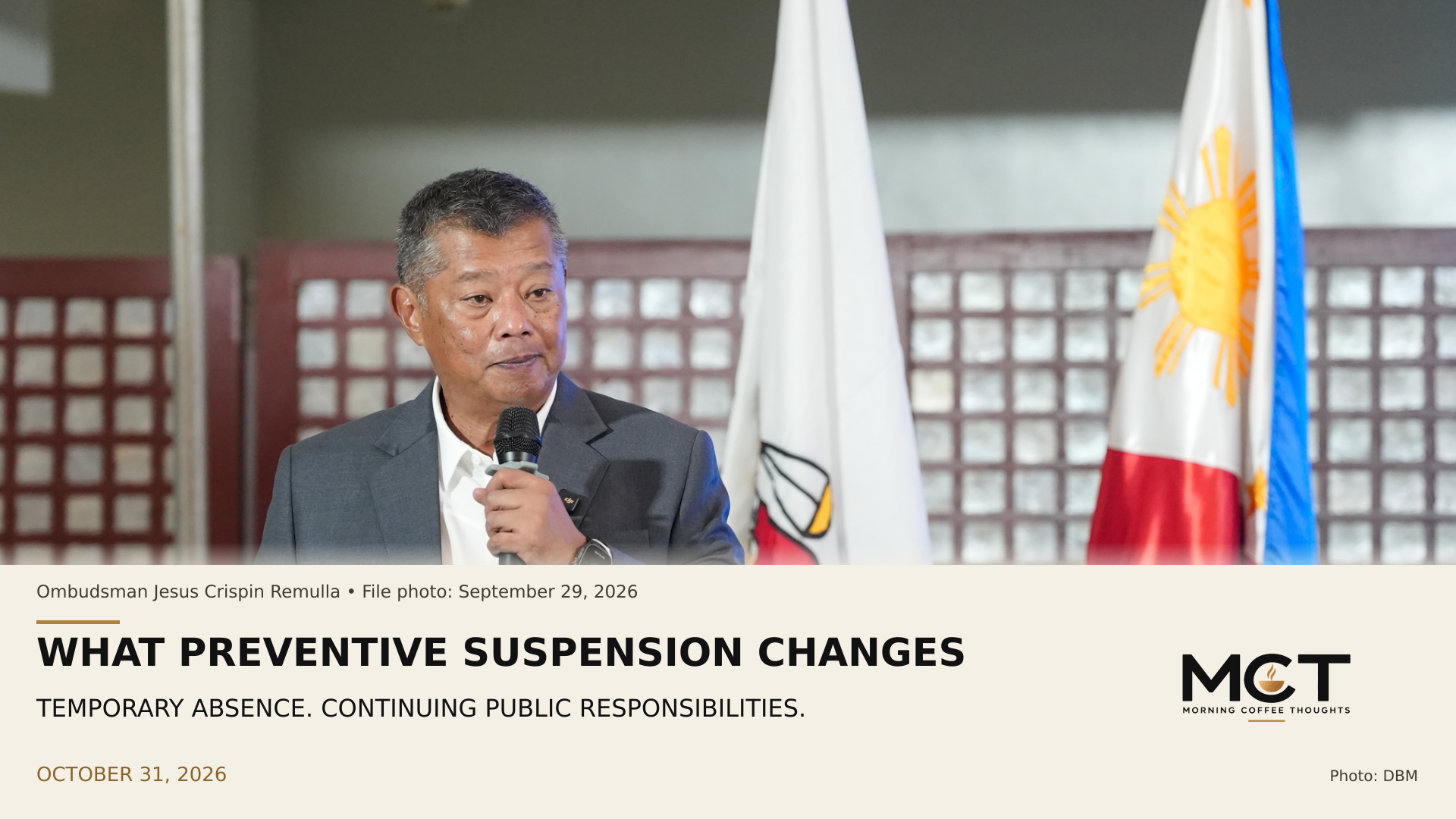
An official under preventive suspension temporarily stops doing the job, but the office still has work to do. Barangay services and public projects need someone responsible for them while the investigation continues and the case remains undecided.
The Ombudsman has ordered the preventive suspension of five public-works engineers in Bulacan and two officials of Barangay Quirino 3B in Quezon City. The barangay officials have sought reconsideration. In their October 30 statement, they denied that projects were ghosts and said most audit disallowances, covering spending rejected by the Commission on Audit, had been lifted or resolved. Those are their assertions, not independently verified audit outcomes.
1
HAS THE OFFICIAL BEEN FOUND GUILTY OR REMOVED?
A preventive suspension temporarily keeps an official from performing the duties of the office while an administrative investigation into official conduct proceeds. It does not, by itself, dismiss the person from government service or prove criminal guilt.
The Supreme Court has explained that the measure can protect records and witnesses from interference. An official may have access to documents or authority over people whose accounts investigators need. Restricting that access gives the investigation room to proceed.
The immediate decision concerns whether the official should keep exercising the office’s powers during the investigation. Before imposing a final administrative penalty, the office must still decide whether the official is liable for misconduct. Criminal guilt is decided in a separate criminal proceeding. A suspension order therefore cannot answer the question of what wrongdoing has been proved.
2
WHAT JUSTIFIES THE ORDER, AND HOW LONG CAN IT LAST?
Under Section 24 of the Ombudsman Act, the Ombudsman or deputy must judge the evidence of guilt strong. At least one further condition must apply: the charge involves specified misconduct, including dishonesty or grave misconduct; it could warrant removal; or remaining in office could interfere with the case.
The law allows suspension without pay until the case ends, subject to a six-month maximum. Delay caused by the respondent's fault, negligence or petition is excluded from that count. For anyone asking when the official returns, six months is not a ready-made answer. It is a limit, not the length of every order, and excluded delays affect the count. The announcement date alone cannot tell readers when a particular suspension ends.
Returning to work does not automatically mean the official will receive the pay withheld during suspension. In its 2017 Purisima decision, the Supreme Court upheld an Ombudsman preventive suspension and denied back salaries for that period. Whether back salaries are due depends on the legal basis and the ruling in the particular case.
3
CAN THE OFFICIAL CHALLENGE IT?
Yes, but an official’s request and the authority’s response must be tracked separately. A motion asks for the order to be reconsidered; a ruling tells residents whether that request succeeded. In Gobenciong, the Supreme Court held that filing a motion for reconsideration does not automatically stop the immediate implementation of an Ombudsman preventive suspension order. The Quirino 3B officials' statement says they filed their motion on October 30; there is no verified ruling in the records reviewed here lifting the suspension.
Judicial review is also possible. The Supreme Court has identified a petition before the Court of Appeals under Rule 65 as the route for challenging an Ombudsman preventive suspension on jurisdictional or grave-abuse grounds. In plain language, the challenge concerns whether the authority was exercised unlawfully, rather than serving as an ordinary appeal from a final decision on guilt.
Filing that court petition does not itself stop the proceedings. A restraining order or injunction, a court order stopping the challenged action, must be verified separately. Nor does issuance before a counter-affidavit, the official's sworn written answer, automatically mean due process was violated: the Supreme Court has allowed that sequence for this preliminary measure. Whether a particular order is valid still depends on its legal grounds and record.
4
WHO HANDLES THE PUBLIC OFFICE MEANWHILE?
For a suspended punong barangay, or barangay chair, the Local Government Code sets out a temporary arrangement. The highest-ranking barangay council member exercises the chief executive's powers and duties. The authority to appoint, suspend or dismiss employees is restricted unless the temporary incapacity exceeds 30 working days.
For residents, this is where the suspension affects the running of the barangay: another council member can perform the chair’s duties, subject to those limits. The law identifies the temporary arrangement, but no verified implementation record reviewed here identifies who has actually assumed those duties in Quirino 3B.
A barangay treasurer and a public-works engineer hold different jobs. The rule for a suspended barangay chair does not settle who takes over either of those roles. Residents need the relevant office’s actual arrangements to know who is handling the work; one suspension announcement does not mean one replacement process applies to everyone named.
5
WHAT DECISION STILL HAS TO COME?
The Ombudsman must still decide the administrative case on the alleged misconduct. If there is also a criminal complaint, its progress must be checked separately. A complaint before investigators is not automatically a criminal charge filed in court.
The Ombudsman's administrative suspension power must also be distinguished from a court's power to suspend an accused official in a criminal case. Different laws govern those actions. The administrative disciplinary power does not cover members of Congress, the Judiciary or officials removable only by impeachment; that exclusion is not blanket immunity from other lawful proceedings.
A ruling on a challenge concerns the suspension itself. An administrative decision concerns liability for misconduct. A criminal case follows a separate process, so a development in one does not show what has happened in the other. Simply reaching the end of a suspension answers none of the allegations. The Supreme Court has also recognized that courts can still decide whether the suspension was valid after the period has ended.
BOTTOM LINE
For the Bulacan engineers and Quirino 3B officials, preventive suspension concerns their use of the office’s powers during an investigation. The accusations still await a decision; neither the suspension nor the officials’ denials settle them. In the meantime, the work of the offices has to continue.
SOURCES
- GMA News, October 30, 2026. Bulacan public-works engineers' preventive suspension.https://www.gmanetwork.com/news/topstories/nation/1007761/ombudsman-suspends-bulacan-dpwh-engineers-over-p188m-flood-control-projects/story/
- GMA News, October 30, 2026. Quirino 3B suspension and officials' response.https://www.gmanetwork.com/news/topstories/nation/1007733/ombudsman-suspends-2-qc-brgy-execs-over-p22-28m-unsettled-disallowances-ghost-projects/story/
- Barangay Claro, Quirino 3B, October 30, 2026. Officials' clarification statement.https://www.facebook.com/photo?fbid=1103951042235853&set=a.160474809916819
- Republic Act No. 6770, Sections 21–24.https://elibrary.judiciary.gov.ph/thebookshelf/showdocs/2/2100
- Supreme Court, Siniclang, G.R. Nos. 234766, 239855, 247366 and 256013, October 18, 2022.https://elibrary.judiciary.gov.ph/thebookshelf/showdocs/1/68683
- Supreme Court, Purisima v. Carpio Morales, G.R. No. 219501, July 26, 2017.https://elibrary.judiciary.gov.ph/thebookshelf/showdocs/1/63320
- Supreme Court, Carpio Morales v. Court of Appeals, G.R. Nos. 217126–27, November 10, 2015.https://elibrary.judiciary.gov.ph/thebookshelf/showdocs/1/61377
- Supreme Court, Revised Book of Judicial Forms, Rule 65, Section 7, page 273.https://elibrary.judiciary.gov.ph/assets/pdf/journals/Revised_Book_of_Judicial_Forms.pdf
- Republic Act No. 7160, Section 46.https://elibrary.judiciary.gov.ph/thebookshelf/showdocs/2/53542
- Supreme Court, Gobenciong v. Court of Appeals, G.R. Nos. 159883, 168059 and 173212, March 31, 2008.https://elibrary.judiciary.gov.ph/thebookshelf/showdocs/1/55980
GOOGLE PREFERRED SOURCES
FOLLOW MCT ON GOOGLE
Google’s Preferred Sources feature lets you choose publications you want Google to prioritize for you. Select “Add to Preferred Sources” to make MCT easier to find in Top Stories and other eligible Google results. This does not subscribe you to email.