
LATEST COMMENTARY
FIVE THINGS TO KNOW
MCT READER PULSE · MCT-PULSE-2026-017
MCT READER SURVEY
Gaano ka nagtitiwala na tama ang ginagawa ng Kongreso sa budget ng bayan?
This is an informal survey of people who choose to participate. It is not a scientific or nationally representative sample.
WHAT CLIMATE ADAPTATION FUNDING SHOULD DO FOR PEOPLE
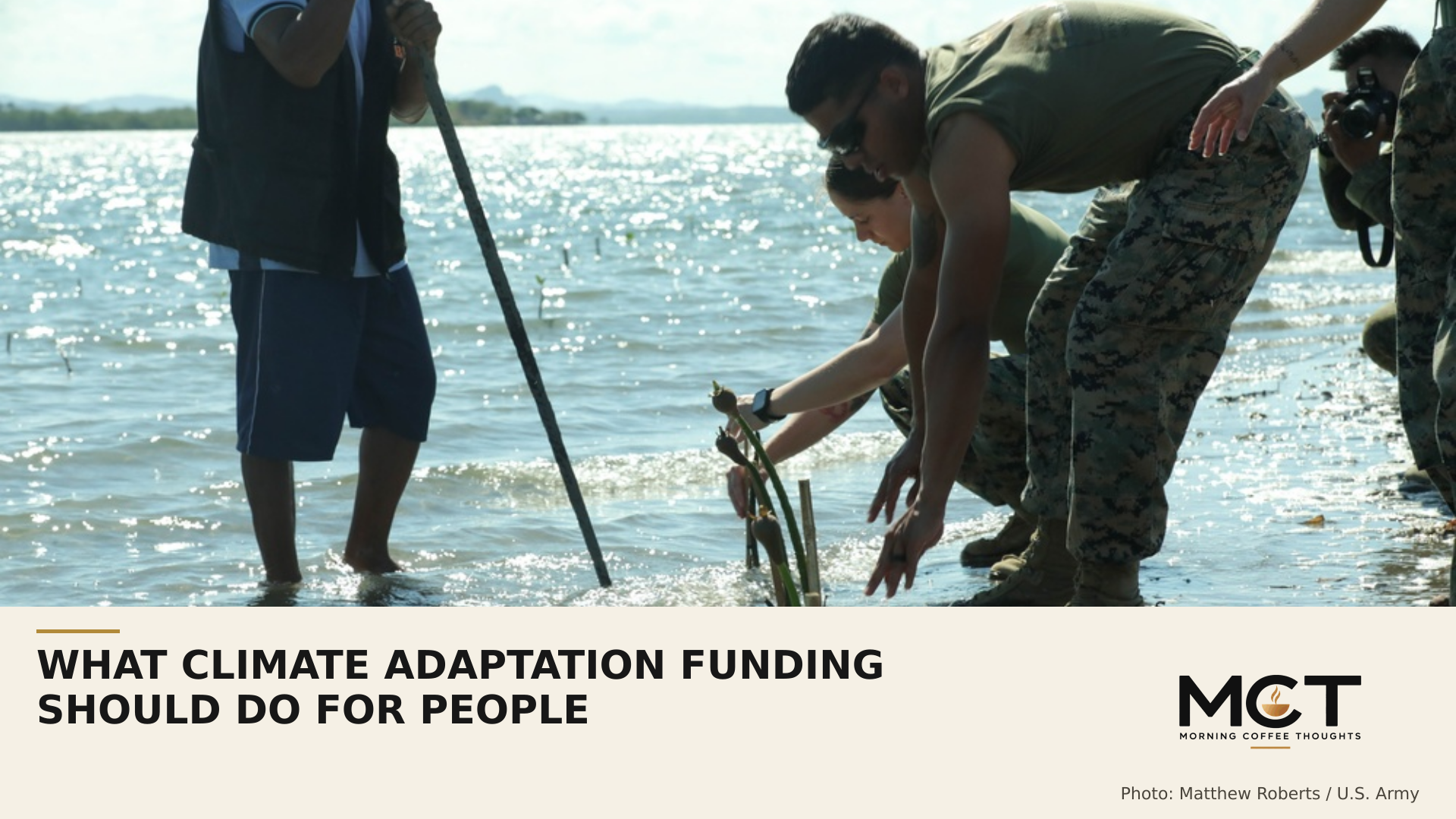
The United Nations Environment Programme (UNEP) released its Adaptation Gap Report 2026 on November 4, showing how far climate adaptation funding still falls short of what developing countries need. The Philippines had already raised a practical problem: even when support is promised, getting it can take too long or cost too much. UNEP report; Philippine statement.
For people facing floods or losing crops during a drought, the question is what that money will do to help them. The answer depends on what it pays for, how it reaches them and whether the help lasts.
1
IT PAYS FOR WAYS TO REDUCE CLIMATE DAMAGE
Adaptation means changing how people prepare for and live with climate risks. Funding can pay for flood defences or help farmers switch to crops that cope better with drought. UN climate adaptation guide.
For a farming family, a crop better suited to dry conditions could help preserve the harvest it depends on for food and income.
2
THE GLOBAL FUNDING GAP IS STILL LARGE
Public adaptation funding from developed to developing countries reached US$28.2–31.7 billion in 2024. That is the latest year of funding data in UNEP's report.
UNEP's central estimate puts developing countries' needs at about US$305 billion a year by 2035. The estimate uses 2024 prices and largely leaves out the private sector's own costs of adapting. UNEP executive summary, pages iv–v.
These figures compare past international funding with future annual needs across developing countries. They show the scale of the problem, but neither figure is a Philippine allocation or a calculation of how much the Philippines lacks.
3
SOME OF THE FUNDING HAS TO BE REPAID
Loans accounted for 55% of the 2024 funding covered by UNEP's figures for developing countries, while grants made up 44%. These are shares across developing countries, not Philippine shares. UNEP executive summary, page vi.
When a government takes out an adaptation loan, it has to budget for repayment alongside schools, health care and other public services. The interest rate and repayment period affect how much it owes and when the bills come due.
A grant provides funding without adding that loan repayment. Two offers of the same amount can therefore leave a country with very different costs in the years ahead.
4
THE PHILIPPINES SAYS GETTING THE MONEY IS TOO DIFFICULT
At the October 5–8 preparatory climate meeting in Nadi, Fiji, the Philippine delegation raised slow approvals and complicated, fragmented procedures. It also pointed to debt, high borrowing costs and difficulty accessing funding directly. Climate Change Commission's October 12 account.
That appeal came before UNEP's November report. For a community waiting for flood protection, an approval that comes too late can mean facing another period of heavy rain before the work is done.
5
THE PROJECT HAS TO MAKE PEOPLE SAFER
If a project is meant to reduce flooding, its success should be judged by how well it protects the people and homes it was designed to serve. The amount spent tells only part of what residents need to know.
That protection also has to last beyond the project's opening. Repairs need funding, and residents need someone who will respond when something stops working.
UNEP also warns that adaptation has limits and some climate losses will remain. UNEP report.
For a flood-control project, residents should be told the conditions it can handle and which areas it covers.
Families still need to know when they must evacuate, including if flooding goes beyond what the project can handle. Receiving adaptation funding should leave people better prepared, with a clear understanding of the dangers that remain.
SOURCES
- UNEP reporthttps://www.unep.org/en/news-and-stories/press-release/world-heads-overshoot-15degc-adaptation-too-slow
- Philippine statementhttps://climate.gov.ph/news/1168
- UN climate adaptation guidehttps://unfccc.int/topics/adaptation-and-resilience/the-big-picture/introduction
- UNEP executive summary, pages iv–vhttps://wedocs.unep.org/bitstreams/97ea09ad-1b46-4903-884f-f6c8e7681d70/download
- UNEP executive summary, page vihttps://wedocs.unep.org/bitstreams/97ea09ad-1b46-4903-884f-f6c8e7681d70/download
- Climate Change Commission's October 12 accounthttps://climate.gov.ph/news/1168
GOOGLE PREFERRED SOURCES
FOLLOW MCT ON GOOGLE
Google’s Preferred Sources feature lets you choose publications you want Google to prioritize for you. Select “Add to Preferred Sources” to make MCT easier to find in Top Stories and other eligible Google results. This does not subscribe you to email.