
Valentine's Day in the Philippines: Beyond Flowers
Explore the hidden stories of Valentine's Day in the Philippines, where motels fill up and intimacy takes on new meanings. This essay reflects on love, shame, and the unspoken truths of romance that emerge during this special occasion.
9 min read
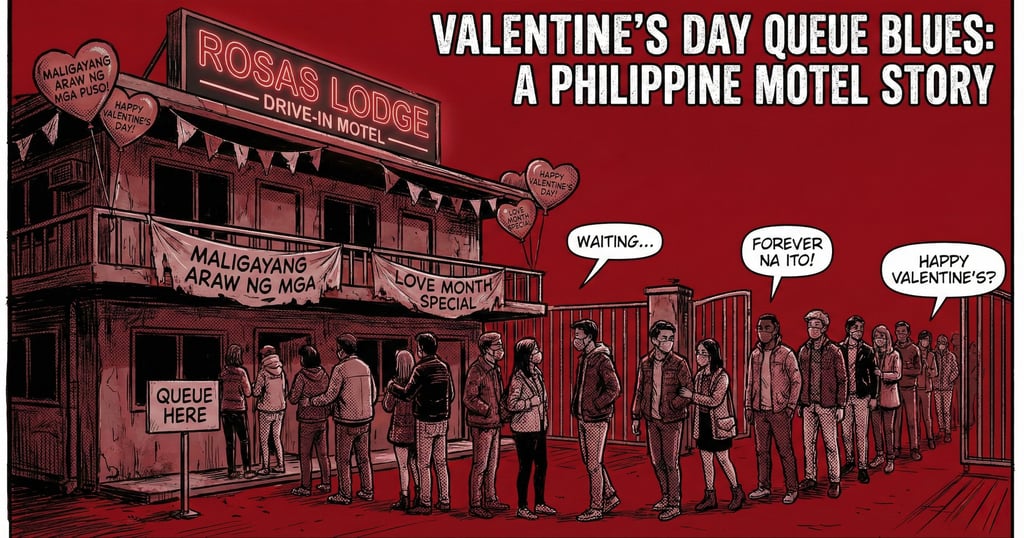
Every February 14 in the Philippines, love hotels and motels quietly become the real “fully booked” destinations. Not the fancy restaurants. Not the five-star staycations. The drive-in motels with curtained parking, dim lights, and neon “NO VACANCY” signs glowing like a secret language everyone understands—but no one openly talks about.
And honestly, that says a lot about how we love, how we live, and what we’re missing.
The Valentine’s Day We Don’t Post About
Scroll through social media on Valentine’s Day and it feels like the same movie on endless replay: bouquets pressed against chests, glittery “She said yes!” posts, couples clinking glasses in cafés, heart-shaped pizzas and drinks overloaded with syrup and whipped cream. The algorithm is drunk on romance.
Meanwhile, somewhere off-camera, people are lining up for a different kind of celebration. Outside certain motels, motorcycles and tricycles are parked bumper to bumper. Cars idle in slow-moving lines. Rooms are rented “short time” or overnight, and by late afternoon, the place is already fully booked.
No one tags the location. No one posts a mirror selfie in the room. No one writes, “Checking in at [Motel Name] with my jowa 🤭.” And yet, everybody knows it’s happening.
One of my favorite mental snapshots of this is from my 20s, one Valentine’s Day in Cubao. I happened to walk past a motel and the line outside was unbelievably long—pairs everywhere, men with women, men with men, women with women.
At first glance you’d expect it to be a crowd of twenty- and thirty-somethings, the age group we automatically cast as the stars of Valentine’s montages. But mixed into the sea of young faces were people with greying hair, lines on their foreheads, bodies that had clearly lived through several decades of life already. They looked like they were in their forties and fifties, waiting calmly, almost casually, for their turn.
In my head, I tucked that scene into a mental folder labeled, “Someday I will talk about how amusing this is.” It wasn't just queue that caught my attention, but the choreography of shame and defiance playing out in real time.
Many of the women tilted their heads down or lifted their hands to shield their faces, as if anonymity could be sketched out with fingers. The men, on the other hand, seemed less concerned—faces out, eyes scanning focused on their companion, sometimes scanning the scanning and the traffic.
Around them, the unofficial audience had formed. People slowed their steps. Some pointed. A few laughed outright. I laughed too, that awkward kind of laugh that comes with secondhand embarrassment, when you recognize something human but don’t quite know what to do with it. I won’t pretend I’m above any of it—I’ve had my own share of motel experiences, just not on Valentine’s Day. The idea of queuing with a crowd on the most cliché romantic date of the year has always felt too strange for me.
But that image—rows of couples, furtive glances, hands over faces, strangers watching from the sidewalk—has stayed. It’s the Valentine’s Day we don’t post about, the version that survives not in feeds but in whispers, jokes, and chismis: the yearly pilgrimage to privacy.
Why Motels, Really?
It’s easy to wrinkle your nose at that line outside the motel if you zoom in only on the surface. But anyone who’s grown up in a typical Filipino home already knows what’s underneath: privacy is rare, and often expensive.
For a lot of us, childhood meant sleeping in rooms that belonged to everyone: siblings squeezed into double decks, cousins on extra mattresses, a tita or lola on the other bed. Doors, when they existed, weren’t always meant to stay shut. A knock usually came with the doorknob already turning. Voices carried through thin walls. Even as adults, many still share space with family because rent laughs in the face of minimum wage.
In that kind of setup, where do you go to be soft with someone? Where can you stretch out a moment of intimacy without thinking about who might walk in, who might hear, whose footsteps are coming down the hall?
Fancy hotels exist, of course—but a single night’s stay can cost what some people earn in several days. Condos and Airbnbs are an option for a certain class, the ones who can swipe cards and book stays without calculating every peso.
For everyone else, there’s the mall, the park, the food court. Public places give you romance in small, supervised doses: a hand held under the table, a head on a shoulder during a movie. Sweet, yes, but never quite private.
So motels appear in the story almost by necessity. They are the in-between: more accessible than hotels, more private than any public date spot, bluntly honest about their purpose in a way our society refuses to be. Awkward, judged, often joked about—but practical.
On Valentine’s Day, when the whole country pretends romance is the main character, the motels simply reveal what’s been true all year: sometimes, the most precious gift two people can give each other is a closed door and borrowed space.
Conservative on Paper, Human in Practice
On paper, we love to call ourselves conservative and religious, a nation of family values and moral standards. The words roll off our tongues easily: “good girl,” “good boy,” “decent,” “wholesome.” We grow up with rules about curfews, about who can visit the house, about what is “bastos” and what isn’t. Sermons and elders tell us what love should look like: controlled, modest, always respectable.
And yet, year after year, neon signs outside motels tell a parallel story.
Behind those curtained garage doors, love doesn’t always look the way it does in church wedding montages. It looks like messy hair and hurried check-ins, nervous laughter at the reception desk, the relief of a lock that finally works both ways. It looks like two people choosing to ignore a thousand imagined eyes and, for a few hours, belong only to each other.
We like to think we are different, as a people—more moral, more reserved, more “mahiyaín” than the rest of the world. But human longing doesn’t vanish just because a culture decides to pretend it’s not there. Filipinos fall in love deeply. We get attached. We want to be held, to be kissed, to be chosen in ways that can’t be captured in a cute café flatlay.
Every Feb 14, the gap between what we claim and what we actually live through cracks open a little more. The motels don’t preach. They simply fill up.
The Price Tag of Privacy
If you pan out from the moral lens and look at this through economics, the picture changes again.
For some couples, intimacy can happen without ever entering a motel. They have condos, cars with tinted windows, houses with spare rooms. Privacy is built into the spaces they own or can easily access. They can wrap their intimacy in hotel key cards and Airbnb bookings—respectable, Instagrammable, and far from the fluorescent glare of a roadside motel in Cubao.
But for many others, love is squeezed into borrowed corners.
You hear it in the hushed late-night calls taken outside the house, hunched beside sari-sari stores or leaning on the barangay hall wall. You see it in the couples sitting on curbs, stretching a few more minutes together before someone has to go home. You feel it in the way people linger at terminal waiting areas, trying to turn a goodbye into something longer.
When your life is shared with parents, siblings, nieces and nephews, and maybe even grandparents, the idea of having a space that is just yours—just the two of you—starts to feel like a luxury item. And so, a short-time booking in a motel ceases to be purely about sex. It becomes a ticket to conditions many people take for granted: silence, softness, uninterrupted time.
No rose bouquet can fix the truth that we are a country where a lot of people simply do not have room to breathe freely in their own homes. In that context, a fully booked motel is not only about lust; it’s about scarcity. Scarcity of privacy. Scarcity of space. Scarcity of permission.
What Are We Really Laughing At?
We joke about it more than we admit we’re moved by it. Group chats light up with memes about “biglang nawala si ano, alam na.” People on the sidewalk chuckle when they see the line outside the motel, making soft, sharp comments as they pass. There’s an entire micro-genre of Valentine’s comedy that treats motels as punchlines.
But underneath the laughter sits a more uncomfortable question: what exactly are we laughing at?
Maybe we’re laughing at our own discomfort—at the parts of ourselves that recognize desire but have never been given a healthy language for it. Maybe we’re laughing because it’s easier than acknowledging that the couples in that line are not strangers to us at all; they are versions of us, or people we love, doing something we’ve been told to be ashamed of even when it’s happening inside committed relationships.
We reduce everything to libog because it’s simpler. It’s easier to throw the whole scene into one word and move on, than to say: this might be love, too. This might be someone’s only chance, this month, to be fully held. This might be a reunion of a long-distance couple who have been counting down the days from opposite sides of the world. This might be two people who fought, separated, and now are trying to stitch themselves back together in a neutral place.
We laugh. We look away. We look again. And in that restless dance of glancing and judging and pretending not to care, we reveal how badly we still need spaces where intimacy can be seen as something other than a scandal.
Shame at the Door
There’s a choreography to checking into a motel that almost everyone seems to know without being taught.
Eyes drop. Shoulder bags are pulled closer to the body. Some women adjust their masks or tilt their faces away from the street. Men tend to look straight ahead, or fidget with their phones, aware but less apologetic. Money quietly changes hands. Keys are slid across a counter. A curtain rises just long enough for a car to disappear inside.
Outside, the peanut gallery continues its commentary. The giggles, the side-eyes, the raised eyebrows, the “hala, oh,” whispered just loud enough to be heard.
Shame hangs somewhere in the doorway between those two worlds.
We grow up being told that a “good” person doesn’t do this, or if they do, they certainly don’t do it openly. And yet so much of our longing is bound up in exactly these moments: time alone, interrupted by no one, where we can stop performing and simply be someone’s favorite person for a while.
We carry guilt for wanting what is, at its core, deeply human: to be close. To be touched without fear. To have a space where we don’t have to keep one ear out for footsteps.
Valentine’s Day sharpens all of this. Flowers and chocolates are safe to display—they’re PG, easily framed, easily blessed with heart emojis. A rented room with fogged-up windows is not. So we hide it. We deny it. We pretend it’s not part of the story, even when it’s doing so much of the quiet emotional labor of connection.
Looking with Softer Eyes
It’s tempting to paint all of this—full motels, long lines, furtive couples—as a sign of moral decay. But if you stand there a little longer, if you let empathy sit beside you on the sidewalk, the picture softens.
You might see two call center agents, exhausted from mismatched shifts, using their one shared free night to feel like a couple instead of just voices on the phone. You might notice a pair who clearly know each other’s habits too well to be new lovers, moving with a comfort that only years can build. You might spot nervousness that looks less like lust and more like vulnerability: the kind of hesitation that comes with trusting someone with a part of you that the rest of the world never gets to see.
Not every story behind those doors is tender, of course. There will always be carelessness, betrayal, decisions that hurt more than they heal. But to pretend it’s only that is to flatten human experience into a single, judgmental headline.
Sometimes, a motel room is where a couple who has spent months oceans apart finally gets to exist in the same space again. Sometimes, it’s where two people who are tired of pretending they’re “just okay” with video calls can be real with each other. Sometimes, it is simply the only room in their entire lives where they can lock the door and not answer to anyone else.
If you listen closely, you might even hear the quiet prayer that sits beneath all the noise:
Please let there be a place in this world where I can just be yours for a while.
Love in the Time of “No Vacancy”
The phenomenon of fully booked motels every Valentine’s Day in the Philippines is messy, imperfect, and very human.
It’s not the kind of romance that gets invited to the front of the church. It’s not the soft, sanitized version we like to repost with inspirational captions. It doesn’t fit neatly into our idea of what “good” love is supposed to look like.
But it is part of our love story.
It reveals us as we live: romantic yet practical, conservative in our language but human in our behavior, publicly shy but privately hungry for closeness. It exposes how cramped our living spaces are, how tight our budgets run, how taboo our conversations about sex and intimacy still feel.
Maybe the real challenge going forward isn’t to erase this picture, but to understand what it’s showing us.
To imagine a future where intimacy doesn’t always have to sneak into three-hour bookings between work shifts. Where couples don’t have to choose between being “good” and being honest about what they need. Where we can talk about sex and closeness with nuance instead of only through sermons or jokes.
Until then, every February 14, the motels will keep lighting up their “NO VACANCY” signs as the sun goes down. People will keep lining up—some hiding their faces, some not bothering to. Bystanders will keep laughing. And somewhere inside all of that, two people will close a door behind them and, even just for a little while, find the space our society keeps forgetting to make room for.
Contact us
subscribe to morning coffee thoughts today!
inquiry@morningcoffeethoughts.org
© 2024. All rights reserved.
If Morning Coffee Thoughts adds value to your day, you can support it with a monthly subscription.
You can also send your donation via Gcash: 0969 314 4839.