
Marcos, Duterte, and the ICC: A President Who Uses a Court He Claims to Reject
This piece traces how Marcos, Duterte, and the ICC are now entangled in one story of power, impunity, and performative sovereignty. It follows Marcos from his 2011 vote for the Rome Statute to his current refusal to rejoin, even as he uses the Hague process against Duterte while insisting the court has “no jurisdiction” over the Philippines. At its core, the blog asks what it means for victims when a president publicly rejects the ICC but quietly relies on it to do the justice work his own institutions have failed to deliver.
14 min read
I’ve been watching the Palace briefings on the ICC, and they’re starting to sound like a recording on loop. The same lines, the same careful distance from any real decision. It makes me ask a simple question: when the script never changes, what is the actor trying to hide?gmanetwork+1
On March 9, Palace press officer Claire Castro repeated the line from New York: “Hindi nagbabago yung stance ng Pangulo. Hindi pa rin po tayo ngayon magrerejoin sa ICC.” No explanation. No elaboration. Just the script.[gmanetwork]
THE COURT HE ONCE VOTED FOR
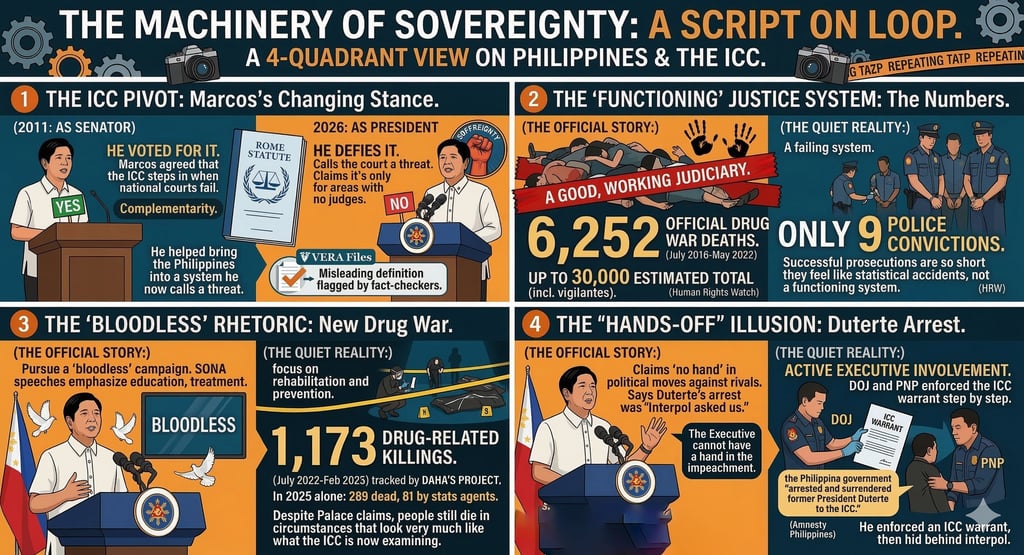
Here is the part that stands out for me. In 2011, Senator Ferdinand “Bongbong” Marcos Jr. was one of seventeen senators who voted to concur in the ratification of the Rome Statute. That vote made the Philippines the 117th state party to the ICC, after years of debate about whether we were ready to accept an external court for genocide, crimes against humanity, and war crimes.
The Rome Statute rests on a simple idea called complementarity. The ICC does not replace national courts; it steps in only when a state is unwilling or unable to genuinely investigate and prosecute the most serious crimes. It is not a court for countries with no judges. It is a court for situations where the judges, prosecutors, and police are not doing their job on the hardest cases.
In 2011, Marcos agreed to that logic. He helped bring the Philippines into a system he now calls a threat.
WHEN “SOVEREIGNTY” MEANS PR MANAGEMENT
As president, he has tried to redefine what the ICC is.
In January 2024, Marcos said, “Let me say this for the 100th time. I do not recognize the jurisdiction of ICC in the Philippines… I consider it as a threat to our sovereignty.” In July 2023, reacting to the ICC Appeals Chamber decision, he declared, “We’re done with the ICC.” He has also claimed the court was formed to provide justice “to areas where there is no judiciary, where there is no court system, where there is no police.”
That is not what the treaty says. The complementarity principle asks whether a state is genuinely investigating and prosecuting the crimes in question, not whether it has courts on paper. Fact‑checkers like VERA Files have flagged his description as misleading because it erases this standard and suggests any functioning court system makes the ICC irrelevant.
The ICC’s judges looked at our record. In January 2023, the Pre‑Trial Chamber authorized the resumption of the investigation into killings in the “war on drugs.” It found that domestic efforts were “limited,” focused on a small number of low‑level perpetrators, and did not examine whether there was a policy behind the violence. The Appeals Chamber upheld that ruling.
Marcos keeps saying our justice system is “good” enough to make the ICC unnecessary. If that were true, he would not need a Special Committee on Human Rights Coordination chaired by his own Executive Secretary, or a new DOJ task force to review drug war killings eight years after the bodies started piling up. For me, the creation of these bodies is itself proof that the old machinery failed, and that much of what exists now is about managing the story rather than fixing the system.
Rights groups have called the human rights committee “toothless” and the DOJ task force “minimal action” at best. So when Marcos says the ICC is a “threat to sovereignty,” what he is really defending is not a healthy justice system, but a system where image repair outruns actual accountability.
NINE CONVICTIONS OUT OF THOUSANDS
The numbers underneath all this are stubborn.
Between July 2016 and May 2022, the Philippine government officially reported 6,252 people killed in anti‑drug operations. Human Rights Watch and local groups estimate that including vigilante‑style killings, the toll could be in the range of 12,000 to 30,000.
Human Rights Watch says that since the start of the drug war, about nine police officers have been convicted for killings linked to it. From Kian delos Santos in 2018 to the Caloocan convictions in 2024, the list of successful prosecutions is so short it feels more like statistical accidents than the output of a functioning system.
Most cases never made it past the blotter or inquest stage. Many families were too afraid to file complaints. Those who did often saw their cases stalled, archived, or directed at rank‑and‑file officers, not the policy chain that encouraged “nanlaban” narratives and quotas.
These are the “processes” the ICC judged to be inadequate. These are the processes Marcos now presents as proof of sovereignty.
THE DRUG WAR NEVER ACTUALLY STOPPED
Marcos told foreign media he would pursue a “bloodless” anti‑drug campaign and focus on rehabilitation and prevention. The Palace has described the Marcos approach as “peaceful,” with SONA speeches emphasizing education, treatment, and dismantling drug syndicates.
The Dahas Project at UP has been tracking drug‑related killings since 2022. From July 2022 to February 2026, Dahas recorded 1,173 drug‑related killings. For 2025 alone, it logged 269 drug‑related killings; 81 of them were carried out by state agents during anti‑drug operations.
Unidentified assailants remain the leading perpetrators. In 2025, 90 people were killed by unknown gunmen, often described as riding tandem and masked. The violence is concentrated in Metro Manila and Cebu, with Cebu regularly responsible for at least 15 percent of drug‑related killings each year since 2023.
Despite this, the PNP chief in 2025 publicly denied that drug‑related killings linked to operations were continuing under Marcos, contradicting a 2022 PNP chief who had admitted they remained a concern.
So on paper, the war on drugs ended and the language softened. On the ground, people still died in circumstances that look very much like what the ICC is now examining.
THE PRESIDENT WHO IS ALWAYS “HANDS‑OFF”
This gap between words and actions shows up in other crises.
When Sara Duterte was impeached in the House in early 2025, Marcos told reporters the executive had nothing to do with it. “No. The executive cannot have a hand in the impeachment. Walang role ang executive sa impeachment,” he said, denying involvement in any move against her.
In the same interviews, he acknowledged talking to House leaders, including Speaker Martin Romualdez, and said he told his son Sandro to “support the process” and “do your duty” as mandated by the Constitution. Sandro later admitted he signed the impeachment complaint. The complaint gathered 215 votes, mostly from administration allies, leading to Sara’s removal.
The language was “hands‑off.” The outcome depended on his own political base.
The same pattern appeared when Rodrigo Duterte was arrested. After the ICC issued a warrant in March 2025, Duterte was arrested at NAIA and flown to The Hague. Marcos addressed the nation and anchored the entire operation on Interpol. “Mr. Duterte was arrested in compliance with our commitments to Interpol,” he said. “We did not do this because it was derived from or it came from ICC; we did this because Interpol asked us to do it.”
But his briefing and official reports show the steps: Interpol Manila received a diffusion notice and an official copy of the ICC warrant; the DOJ prosecutor general issued an order; the PNP enforced it at the airport; and Duterte was cleared to board a plane to the Netherlands. Amnesty Philippines described it in plain terms: the Philippine government “arrested and surrendered former President Duterte to the ICC.”
The pattern is consistent. On Sara’s impeachment, he says “no hand,” even as his son signs the complaint and his House allies move it forward. On Duterte’s arrest, he says it was “just Interpol,” even as his Justice department and police implement an ICC warrant step by step. On the ICC, he says “we’re done” and “no jurisdiction,” even as his government benefits from a process that finally put Duterte in a cell in The Hague.
The one thing he does not seem to want is his fingerprints on the justice he quietly allows to happen.
THE ICC IS DOING WHAT THE PHILIPPINES WOULDN’T
Whatever you think of the ICC, in this case it is filling a gap.
Duterte was arrested on March 11, 2025, based on a warrant issued by ICC judges on March 7 for crimes against humanity related to the drug war and earlier killings in Davao. He arrived in The Hague on March 12.
From February 23 to 27, 2026, the ICC held the confirmation of charges hearing in his case. Prosecutors laid out patterns of murder. Legal representatives of thousands of Filipino victims made oral submissions. In the Philippines, families of those killed gathered in Manila and Davao, lighting candles and carrying photos of sons, husbands, and fathers whose cases went nowhere in local courts.
Groups like Human Rights Watch and Amnesty International have said ICC proceedings are now one of the few concrete routes to accountability for drug war victims, given how little domestic prosecutions have accomplished at higher levels. That situation did not begin under Marcos. But he is the one choosing whether to rebuild the bridge to the court he once helped invite in.
HE HANDED HIS ENEMIES THE WEAPON THEY NEEDED
Marcos’ resistance to the ICC has not only blocked a safeguard. It has also made him vulnerable.
After Duterte’s arrest and transfer, his allies in the Duterte‑Dela Rosa‑Apology (DDA) bloc in Congress moved quickly. Senator Imee Marcos chaired a Senate hearing where Duterte’s Senate allies challenged the legality of the arrest, arguing that the ICC had no jurisdiction and that enforcing its warrant violated Philippine sovereignty. They called it illegal and politically motivated.
Sara Duterte described her father’s transfer as “clearly an illegal detainment.” Duterte himself sent a letter to the ICC claiming he had been effectively abducted and forced onto a plane. Those statements became the basis of a “kidnapping” framing.
By January 2026, at least two impeachment complaints had been filed against Marcos. One of the main grounds was “ordering and facilitating the kidnapping and surrender of former President Rodrigo Duterte to the ICC.” The complainant argued that Duterte was surrendered “despite the continued operation of Philippine courts,” mirroring Marcos’ own arguments about sovereignty and domestic justice.
Senator Imee filed a bill aimed at penalizing “extraordinary rendition,” which would punish officials who turn over Filipinos to foreign courts without clear legal basis. Commentators noted it was clearly inspired by Duterte’s Hague transfer.
All of this gained political traction because Marcos insists the ICC has no jurisdiction and that the Philippines is not a member. If he had moved to rejoin the Rome Statute and set out a clear cooperation framework, Duterte’s arrest could more easily be defended as compliance with treaty obligations. Instead, his own sovereignty script now feeds the story that the transfer was arbitrary and political.
From my perspective, he weakened his own defense when he chose not to restore the legal bridge he helped build as a senator.
WHO IS HE REALLY PROTECTING?
There is another dimension here. Marcos is not in the same ICC risk zone as Duterte.
The current ICC focus is on crimes tied to Duterte’s drug war and earlier Davao operations, not on acts unique to the Marcos presidency. Rodrigo Duterte is the one in custody. The alleged co‑perpetrators named publicly so far are from his circle and security apparatus.
Senator Koko Pimentel has argued that a leader who is not committing crimes against humanity “has nothing to fear” from ICC membership. He has called on Marcos to rejoin and treat ICC membership as an “insurance policy” in case Filipinos end up with another abusive, heartless leader and the justice system fails again.
That is one of the clearest ways to understand what is at stake. A president not ordering systematic atrocities has no reason to fear the ICC — only reason to use it as a shield for whoever comes after him.
The Duterte clan is not gone from politics. Sara Duterte remains a central figure. Lawmakers have described her remarks about “decapitating” Marcos Jr. and threats involving her father’s remains as “reckless” and “dangerous.” Analysts quoted in regional media have warned she could be “very dangerous” politically if she gains or regains higher power while feeling cornered, given her position as a former vice president and her base in Mindanao.
There are also reports of agencies recommending charges against her over alleged destabilization plots and power struggles. None of this is on the scale of Duterte’s drug war, but it underlines a style of politics that is comfortable with threats and institutional brinkmanship.
Rejoining the ICC would not only be about addressing past crimes. It would be a guardrail against any future leader—whether from the Duterte camp or elsewhere—who decides that fear and violence are acceptable tools of governance when domestic mechanisms look the other way.
Marcos could stand on his 2011 vote and say: I have nothing to hide from this court, and I want to make sure no one can do to Filipinos what Duterte did again. His refusal tells us he would rather keep that external brake off the system.
STANDING ON DUTERTE’S LEGAL GROUND
There’s another uncomfortable layer here. On the ICC, Marcos has ended up standing on the same rhetorical ground Duterte built for himself.
When the ICC first moved toward a drug war investigation, Duterte pulled the Philippines out of the Rome Statute and insisted the court had “no jurisdiction” over him, framing it as a foreign political weapon and saying he would never submit to a “foreign tribunal.” He justified withdrawal by pointing to “abuses” and “attacks on sovereignty,” even as international jurists reminded him that the ICC retains jurisdiction over crimes committed while the Philippines was still a member.
Marcos now repeats those sovereignty lines almost word for word. He has said “for the 100th time” that he does not recognize ICC jurisdiction in the Philippines, called the probe a threat to sovereignty, and argued that our “very good” justice system makes the court unnecessary. Imee Marcos has echoed this, claiming the ICC has “no jurisdiction” over drug war cases—a statement VERA Files flagged as misleading because it ignores the court’s residual jurisdiction over pre‑withdrawal crimes.
On the surface, they differ politically. In the ICC story, their language lines up. Both camps deny jurisdiction. Both describe the ICC as an illegitimate intrusion. Both lean on the idea that domestic systems are enough, despite years of evidence to the contrary.newsinfo.
The difference is in their position. Duterte used this line to try to escape scrutiny for a campaign he personally ordered. Marcos once voted to bring the Philippines under the Rome Statute, and now uses Duterte’s logic to justify staying out, even while relying on the ICC process that line was designed to resist.
The language matches. The institutional role does not. And that mismatch is part of what makes his refusal to rejoin the ICC so revealing.
A DIFFERENT WAY TO READ HIS REFUSAL
Seen this way, his refusal to rejoin the ICC is not just a single policy choice in 2026.
It sits on his 2011 yes‑vote to the Rome Statute. It sits on repeated mischaracterizations of what the ICC is for. It sits on a domestic record where thousands were killed and around nine officers were convicted. It sits on a “new” drug policy that still leads to deaths on the ground. It sits on a habit of denying involvement while his allies and institutions move in his favor. It sits on a decision to enforce an ICC warrant on Duterte while insisting the court has no authority here. And it sits against calls from people like Pimentel to use ICC membership as a safeguard for the future, which he has declined.
His refusal keeps three things in place:
It limits how far the ICC can go in examining the drug war and related abuses beyond Duterte’s immediate circle.
It lets Duterte’s allies sell the Hague transfer as “kidnapping” and “revenge,” because there is no renewed treaty framework to frame it as a normal legal obligation.
It preserves space for any future president to exercise power without the shadow of an external court that can step in when domestic justice fails.
At one point, I caught myself thinking Marcos was just diffident about the ICC. Maybe he was too cautious, too wary of stepping into something he couldn’t control. But diffidence is about shyness and lack of confidence—a kind of political timidity.
That is not what we’re seeing here.
On the ICC, Marcos speaks with certainty. He says for the “100th time” that he does not recognize its jurisdiction, calls it a threat to sovereignty, and insists our justice system is “good” and “working.” He orders agencies not to cooperate and repeats that the Philippines will not rejoin. There is no hesitation in those lines.
The hesitation shows up somewhere else. It shows up in his refusal to stand openly inside the logic of his own decisions. He enforced an ICC warrant, then hid behind Interpol. He handed over a former president, then denied the court’s jurisdiction. He benefits from a Hague process that finally put Duterte on a dock, then refuses to rebuild the legal bridge to the very court making that possible.
So no, this is not diffidence toward the ICC. This is something else: a leader who wants the option of justice as a tool, without accepting accountability for how, when, and on whom that tool is used.
We are told the ICC is an intrusion. But for the families who lit candles in Manila and Davao during the Hague hearings, the real intrusion happened years ago, when masked men entered their homes or streets and left bodies behind. They went to our own police, our own prosecutors, our own courts, and mostly encountered silence or delay.
So when those same families now look to a court in The Hague, it is not because they have given up on the Philippines as a country. It is because the machinery that was supposed to serve them chose to protect itself instead.
The President says we are “done with the ICC.” The victims’ actions show they are not done looking for a place where justice actually moves.
SOURCES:
GMA Network, https://www.gmanetwork.com/news/topstories/nation/979373/president-marcos-philippines-icc/story/
BusinessWorld Online, https://www.bworldonline.com/the-nation/2026/03/10/735409/palace-says-philippines-wont-rejoin-icc/
VERA Files, https://verafiles.org/articles/vera-files-fact-check-marcos-about-face-on-philippines-membership-to-the-icc
Philstar, https://www.philstar.com/headlines/2011/08/25/719947/dfa-welcomes-senate-concurrence-rome-statute
ICC, https://asp.icc-cpi.int/press-releases/press-releases-2011/pr717
Georgetown Journal of International Affairs, https://gjia.georgetown.edu/2022/01/28/the-icc-investigation-and-accountability-in-the-philippines/
Parliamentarians for Global Action, https://www.pgaction.org/ilhr/rome-statute/philippines.html
VERA Files, https://verafiles.org/articles/vera-files-fact-check-marcos-claim-on-the-purpose-of-icc-misleads
Human Rights Watch, https://www.hrw.org/news/2023/02/13/international-criminal-courts-philippines-investigation
Human Rights Watch, https://www.hrw.org/news/2025/01/16/philippines-marcos-rights-gains-fall-short
Human Rights Watch, https://www.hrw.org/news/2026/02/16/philippines-icc-hearing-to-confirm-duterte-charges
Amnesty International Philippines, https://www.amnesty.org.ph/2025/08/no-end-to-impunity-under-marcos-jr/
Human Rights Watch, “License to Kill”, https://www.hrw.org/report/2017/03/02/license-kill/philippine-police-killings-dutertes-war-drugs
VERA Files, https://verafiles.org/articles/269-dead-in-2025-in-marcos-bloodless-drug-war
DW, https://www.dw.com/en/philippines-drug-war-what-changed-under-president-marcos/a-68635719
University of the Philippines, https://up.edu.ph/keeping-count-keeping-watch-ups-human-rights-advocates-and-the-continuing-war-on-drugs/
Philippine Daily Inquirer, https://newsinfo.inquirer.net/2177687/domestic-accountability-for-drug-war-inadequate-intl-rights-group
Philippine Daily Inquirer, https://globalnation.inquirer.net/267169/intl-rights-groups-call-on-marcos-to-rejoin-icc
Al Jazeera, https://www.aljazeera.com/news/2023/3/14/philippine-police-officer-jailed-for-killing-teens-in-drug-war
Amnesty International, https://www.amnesty.org/en/latest/press-release/2019/07/philippines-un-investigation-urgently-needed-duterte-war-drugs/
ICC, https://www.icc-cpi.int/news/situation-philippines-rodrigo-roa-duterte-icc-custody
The Diplomat, https://thediplomat.com/2025/03/former-philippine-president-duterte-flown-to-the-hague-after-arrest/
Philstar, https://www.philstar.com/headlines/2025/03/12/2427748/duterte-arrested-put-flight-icc
Presidential Communications Office, https://pco.gov.ph/news_releases/pbbm-dutertes-arrest-ph-commitment-to-interpol/
Philippine Daily Inquirer, https://newsinfo.inquirer.net/2043086/marcos-on-dutertes-arrest-we-have-commitments-to-the-interpol
Amnesty International Philippines, https://www.amnesty.org.ph/campaigns/intl-justice-icc/
Philippine Daily Inquirer, https://newsinfo.inquirer.net/2170007/duterte-kidnapping-flood-control-kickbacks-among-accusations-vs-marcos
Philippine Daily Inquirer, https://newsinfo.inquirer.net/2032254/marcos-denies-hand-in-house-impeachment-of-vp-duterte
Philstar, https://www.philstar.com/headlines/2025/02/06/2419681/marcos-denies-hand-impeachment-raps-vs-vp-sara
Philippine Daily Inquirer, https://globalnation.inquirer.net/310221/ex-presidents-supporters-critics-keep-eye-on-icc-hearing
VERA Files, https://verafiles.org/articles/drug-war-victims-families-hope-for-the-best-despite-the-long-wait-for-justice
Manila Bulletin, https://mb.com.ph/2026/01/28/drug-war-victims-to-take-part-in-duterte-icc-hearing-from-feb-2327
ABS-CBN News, https://www.abs-cbn.com/news/nation/2026/3/10/ph-will-not-rejoin-icc-0854
Presidential Communications Office, https://pco.gov.ph/news_releases/pbbm-reiterates-icc-has-no-jurisdiction-over-ph-wont-cooperate-in-its-investigation/
Presidential Communications Office, https://pco.gov.ph/news_releases/pbbm-reiterates-icc-has-no-jurisdiction-to-conduct-probe-into-former-president-dutertes-war-on-drugs/
Presidential Communications Office, https://pco.gov.ph/news_releases/pbbm-were-done-with-the-icc/
Philippine News Agency, https://www.pna.gov.ph/articles/1195538
ICC, https://www.icc-cpi.int/news/icc-concludes-confirmation-charges-hearing-duterte-case
ICC, Case Information Sheet – The Prosecutor v. Rodrigo Roa Duterte, https://www.icc-cpi.int/sites/default/files/2026-02/DuterteEng.pdf
Amnesty International, https://www.amnesty.org/en/latest/press-release/2021/07/duterte-cannot-halt-investigation-into-war-on-drugs/
International Commission of Jurists (PDF), https://www.icj.org/wp-content/uploads/2018/03/Philippines-ICJ-Letter-ICC-Withdrawal-Advocacy-Open-letters-2018-ENG.pdf
Opinio Juris, https://opiniojuris.org/2018/04/12/the-departed-implications-of-the-philippines-withdrawal-from-the-icc/
Opinio Juris, https://opiniojuris.org/2026/01/19/the-iccs-residual-jurisdiction-the-situation-in-the-philippines/
Al Jazeera, https://www.aljazeera.com/news/2021/9/15/philippines-icc-agrees-to-probe-dutertes-war-on-drugs
Philippine News Agency, https://www.pna.gov.ph/index.php/articles/1245953
New Mandala, https://www.newmandala.org/dont-believe-marcos-the-icc-is-needed-for-drug-war-justice/
ASEAN Parliamentarians for Human Rights, https://aseanmp.org/publications/post/duterte-must-be-held-accountable-for-his-crimes-against-humanity-over-the-drug-war-southeast-asian-mps-say/
ReliefWeb / Amnesty International, https://reliefweb.int/report/philippines/philippines-ensure-long-awaited-accountability-war-drugs
Human Rights Watch, https://www.hrw.org/news/2023/09/07/continuing-human-rights-violations-under-president-marcos
Human Rights Watch, https://www.hrw.org/news/2023/01/11/philippines-no-letup-drug-war-under-marcos
LiCAS News, https://www.licas.news/2024/05/15/hrw-continued-abuses-undermine-marcos-jrs-human-rights-rhetoric/
Philippine Star, https://www.philstar.com/headlines/2024/02/21/2334929/marcos-not-changing-stance-icc
The Diplomat, https://thediplomat.com/2024/11/in-not-prosecuting-duterte-marcos-shows-political-and-moral-cowardice/
UNAV / Global Affairs, https://www.unav.edu/web/global-affairs/caught-in-the-crossfire-duterte-icc-case
Philippine Star Facebook, https://www.facebook.com/PhilippineSTAR/posts/just-in-president-marcos-reiterates-he-does-not-want-the-impeachment-of-vice-pre/
Philippine Star Facebook, https://www.facebook.com/PhilippineSTAR/posts/president-marcos-on-a-supposed-text-message-telling-congress-not-to-file-impeach/
Bombo Radyo Philippines (Facebook), https://www.facebook.com/bomboradyophilippines/posts/duterte-accuses-marcos-of-kidnappingformer-president-rodrigo-duterte-accuse/
One News PH (Facebook), https://www.facebook.com/ONENewsPH/posts/palace-rejects-dutertes-kidnapping-claim-says-transfer-to-icc-lawful-thebigstory/
Mindanao Times (Facebook), https://www.facebook.com/MindanaoTimes/videos/ph-will-not-rejoin-icc-marcos-watch-ferdinand-r-marcos-jr-maintained-that-the-ph/
BNC Philippines (Facebook), https://www.facebook.com/bncphl/posts/president-ferdinand-marcos-jr-has-not-changed-his-position-on-keeping-the-philip/
Manila Bulletin (Facebook – Sara threats coverage), https://www.facebook.com/ManilaBulletin/posts/malaca%C3%B1ang-asserted-that-the-threats-made-by-vice-president-sara-duterte-agai/
Inquirer Opinion, https://opinion.inquirer.net/177745/vp-saras-dangerous-rhetoric
Philippine News Agency, https://www.pna.gov.ph/index.php/articles/1238572
South China Morning Post, https://www.scmp.com/week-asia/politics/article/3274373/philippines-duterte-clan-faces-its-gravest-crisis-yet-vp-sara-could-be-v
Philippine Daily Inquirer, https://newsinfo.inquirer.net/1845073/ex-president-duterte-faces-raps-after-threatening-sara-critic/
Global Nation / Philippine Daily Inquirer, https://globalnation.inquirer.net/255035/pimentel-urges-marcos-anew-let-philippines-rejoin-icc
Contact us
subscribe to morning coffee thoughts today!
inquiry@morningcoffeethoughts.org
© 2024. All rights reserved.
If Morning Coffee Thoughts adds value to your day, you can support it with a monthly subscription.
You can also send your donation via Gcash: 0969 314 4839.