
"NO CRISIS HERE": ON GOVERNMENTS THAT TELL YOU NOT TO PANIC
The Philippine government says "no crisis here" — but it formed a crisis committee on the same day it said that. This blog traces the oil price surge triggered by the Strait of Hormuz closure, the data showing just how exposed the Philippines really is, and the old, familiar pattern of governments managing optics while ordinary people absorb the cost. "No crisis here" is what they say. The numbers say something else entirely.
9 min read
There's a thing governments do when they're caught flat-footed.
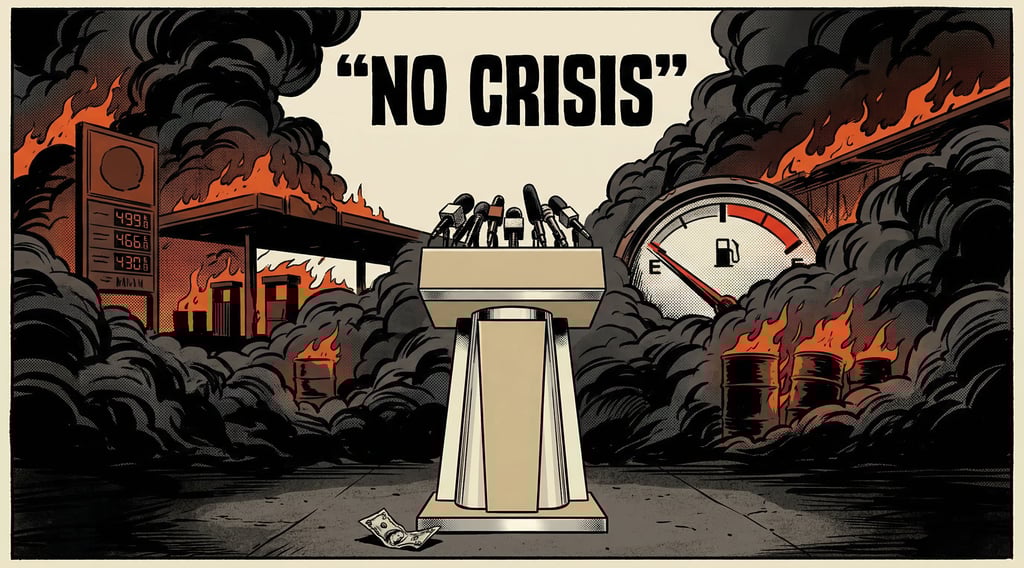
They smile at the press briefing. They choose their words very carefully. They say things like "price disruption, not oil crisis" while, in the same breath, announcing the creation of a crisis committee.
That happened here. Last Monday, March 23, 2026.
Malacañang Palace Press Officer Claire Castro told journalists that the Philippines is experiencing a "price disruption" and not an oil crisis. She said this while confirming that President Marcos had already ordered the creation of a crisis committee. When asked why you'd form a crisis committee if there's no crisis, she said the committee was needed for things to be "more systematic, organized, so that someone is focused on the situation."
I've been writing long enough to know what that sounds like.
It sounds like covering your bases while pretending the bases don't need covering.
WHAT'S ACTUALLY HAPPENING ON THE GROUND
Let me give you the facts as I've traced them.
On February 28, the United States and Israel launched airstrikes against Iran, including targets in Tehran. Iran retaliated by effectively closing the Strait of Hormuz, the narrow passage between Iran and Oman through which roughly 20% of the world's oil and liquefied natural gas travels.
The Philippines imports approximately 98% of its crude oil requirements, a significant chunk of it from the Middle East. When the Strait of Hormuz seized up, we didn't just feel it eventually. We felt it fast and we felt it hard.
By March 9, Dubai crude oil prices had already breached the $100-per-barrel mark. By March 10, fuel price hikes were already the ninth straight week of increases for gasoline and the eleventh consecutive week for diesel. Pump prices for diesel surged between P17.50 and P24.25 per liter in one round alone. As of this week, the DOE is projecting diesel could spike as high as P134.30 per liter and gasoline up to P112.40 per liter.
Jeepney drivers are skipping meals to make ends meet.
And the Palace says there's no crisis.
THE ANATOMY OF A GOVERNMENT REASSURANCE
I want to be fair here. I am a blogger, not a journalist, and I'm connecting dots from publicly available information. But the pattern I'm seeing is not new. And I think I know it well enough to call it out.
When President Marcos himself warned on March 7 that the country's oil reserves are sufficient for only 50 to 60 days, he was acknowledging a structural vulnerability loud and clear. The Philippines, with its 98% import dependency on crude oil, has virtually no buffer when a global chokepoint snaps shut. MUFG Research flagged this bluntly: they see the Philippines as facing not just higher oil prices but a potential looming energy shortage, with the peso vulnerable enough to breach the P60:$1 level. It already did, on March 19.
Then, after all of that, DTI Trade Secretary Cristina Roque told the public there is "no need for the public to panic or hoard."
I understand the logic. Panic buying genuinely does drive prices up and destabilize supply chains faster. That part is real. But there is a difference between managing public behavior and managing public perception to avoid political embarrassment. One of those is governance. The other is optics.
Analysts have been describing the Marcos administration's style for a while now. In a political discussion circulating in January 2026, commentators were calling it what it is: "governance by optics, governance by talk." The flood control corruption scandal that rocked the country in late 2025 made that clearer than any think piece could. Crisis communication in the Philippines, a PR professional wrote at the end of 2025, is "activated after impact, not before." It is treated as output, not infrastructure. Once a belief sets in, clarification no longer corrects it. It competes with it.
That's where we are now.
THIS IS AN OLD PLAYBOOK
Here is something I keep thinking about when I follow this story.
On March 28, 1979, a partial nuclear meltdown began at Three Mile Island, a nuclear power plant sitting on a small island in the Susquehanna River near Harrisburg, Pennsylvania. It was the worst nuclear accident in American history. The reactor core partially melted after coolant water drained and fuel rods overheated. For days, the surrounding communities had no clear picture of what was happening, because the people managing the information were not telling the full story.
The utility company's first public statement was that "everything is under control" and there was "no danger to those outside the plant." The lieutenant governor echoed it.
Within days, the governor himself had to revise his own position, saying the situation was "more complex than the company first led us to believe."
Despite official assurances that only about 12,000 people needed to leave, over 140,000 evacuated the area on their own. They did not panic in the irrational sense. They read the room. Research published by the American Sociological Association found that actual panic during disasters is extremely rare. What people do instead is gather more information and act in a manner consistent with what their situation actually demands. The 140,000 who left Three Mile Island were doing exactly that. They did not trust what the officials were saying, because the officials were not saying the full thing.
Behind official public pacifiers, a sociological study noted, is the presumption that people cannot be trusted with bad news.
And when that presumption drives communication, what you get is statements like "price disruption, not oil crisis" while simultaneously forming a crisis committee.
WHAT THE DATA ACTUALLY SAYS ABOUT OUR EXPOSURE
I want to slow down here and look at the numbers, because this is where I find myself genuinely worried rather than just analytically skeptical.
The Institute of International Finance identified the Philippines as among the Asian economies most significantly impacted by sustained disruptions in Gulf energy supplies, while simultaneously lacking the fiscal flexibility to counteract the shock. Thailand, India, and the Philippines were named specifically.
Every $10 per barrel increase in oil prices is estimated to cut Philippine GDP growth by around 0.2 percentage points and raise inflation by approximately 0.6 percentage points. And those are the conservative estimates. They likely underestimate the current impact because this crisis goes beyond prices. It involves potential energy shortages, supply chain disruptions, and effects that compound once oil prices cross certain thresholds.
MUFG Research, in a March 2026 analysis, estimated that if oil prices are sustained above $100 per barrel, the Philippines' GDP could fall to around 3.7% in 2026 and 5.7% in 2027, down from earlier projections of 4% and 6% respectively. If oil spikes to $130 per barrel, the cuts go even deeper.
The peso is already at P60:$1. The current account deficit could widen to near 3% of GDP under sustained high oil prices.
These are not numbers that describe a "price disruption."
WHO BENEFITS FROM THE WAIT
Here is a set of facts I want to place next to each other. I'll let you sit with them.
U.S. oil companies are projected to earn an additional $63.4 billion in 2026 alone from the Iran war-driven oil price surge, after prices rose 47% since February 28. Brent crude and WTI surged more than 40% in a single month. After Russia invaded Ukraine in 2022, ExxonMobil and Chevron collectively reported profits exceeding $30 billion in just one quarter. The pattern across conflicts is consistent.
Back home, the DOE was already catching retailers in Luzon and Mindanao illegally hiking prices ahead of scheduled adjustments as early as March 7. A local oil price analyst on record noted that when oil prices rise, companies hike simultaneously and fast. When prices fall, the reduction comes "very, very slow." A Credit Rating and Investors Services Philippines economist said the government's response to this crisis has been "too slow."
The Palace was still calling it a price disruption.
I'm not saying anyone made a deliberate decision to wait. But I am asking: who benefits from every day the government spends debating whether to call this a crisis? Every day without an emergency declaration is another day excise taxes stay in place, another day the price correction mechanism stays inactive, another day retailers hold the pricing power that consumers don't have.
The Senate unanimously passed a bill granting emergency powers to suspend excise taxes on fuel. The House passed it too. The legislature moved. The Palace continued managing the language.
Delay has a cost. And that cost lands on a specific set of people every single time.
THE PART THAT HURTS (AS A WRITER)
As someone who blogs about politics in this country, and who has spent years watching how language gets weaponized by the powerful, the "no crisis" framing bothers me for a reason beyond the political optics.
It puts the burden of interpretation on ordinary people.
When the government says "no crisis," it gives cover to anyone who wants to accuse those raising alarms of fearmongering. Presidential Communications Office Undersecretary Claire Castro called such declarations "fear-mongering." The Trade Union Congress of the Philippines immediately called her out for it. They said the declaration of a state of national emergency was critical precisely so the government could move decisively. Instead, the administration was still framing it as panic-management theater.
Meanwhile, jeepney drivers are hardly earning anything. Diesel is threatening to cross P134 per liter. The peso has already crossed the P60 line. Transport strikes have paralyzed major routes. An opposition bloc called the government response "grossly ineffective and purely reactive."
The IIF is calling us among the most vulnerable. Fortune Magazine is writing about existential threats to Asian energy security. The numbers are not hidden. They are public. The crisis committee, formed after weeks of denial, exists now on paper but has no announced members, no timeline, and no disclosed mandate.
THE QUESTION I CAN'T SHAKE
I keep coming back to this: why does it matter what a government calls something?
It matters because naming a thing correctly determines how fast you move. A "price disruption" gets a monitoring committee. A crisis gets emergency powers, emergency imports, emergency subsidies, and emergency communications that actually level with the public.
Three Mile Island taught us that confused communications from government are far more damaging than honest disclosure from the start. The utility company managed the story. The governor eventually had to revise his own statements. And 140,000 people left anyway, because ordinary people are better at reading a situation than governments give them credit for.
Filipino commuters, drivers, market vendors, and workers are doing the same thing right now. They are filling in the gaps. They are making their own calculations. They are watching diesel cross P120 per liter in some stations. They are watching jeepney fares get approved, then reversed in one news cycle. They are watching their peso buy less at the palengke every week.
When your government tells you not to panic, it has already decided something about you. It has decided you cannot handle the truth. That the best use of a crisis is not to solve it, but to manage how it looks.
The question isn't whether there's a crisis.
The question is: what are you going to do with the truth once the government finally admits it?
SOURCES
Philstar.com – Marcos orders crisis committee as Palace insists 'no oil crisis', https://www.philstar.com/business/2026/03/23/2516295/marcos-orders-crisis-committee-as-palace-insists-no-oil-crisis
ABS-CBN News – PH seeing 'price disruption,' not oil crisis, Palace says despite forming crisis committee, https://www.abs-cbn.com/news/nation/2026/3/23/ph-seeing-price-disruption-not-oil-crisis-palace-says-despite-forming-crisis-committee
GMA Network – Marcos orders creation of crisis committee amid Middle East conflict, https://www.gmanetwork.com/news/topstories/nation/981017/marcos-orders-creation-of-crisis-committee-amid-middle-east-conflict
Philstar.com – Oil prices rise amid suspended transit in Strait of Hormuz, says DOE, https://www.philstar.com/business/2026/03/02/2511514/oil-prices-rise-amid-suspended-transit-strait-hormuz-says-doe
GMA Network – Crude Reality: How Middle East tensions drove up fuel prices in PH, https://www.gmanetwork.com/news/money/economy/980974/crude-reality-how-middle-east-tensions-drove-up-fuel-prices-in-ph-gas-stations
Tribune.net.ph – Gov't only delaying inevitable, experts say: Marcos stops fare hike, https://tribune.net.ph/2026/03/18/govt-only-delaying-inevitable-experts-marcos-stops-fare-hike
MUFG Research – Philippines: Strait of Hormuz closure: Impact of higher oil prices and more, https://www.mufgresearch.com/fx/philippines-strait-of-hormuz-closure-impact-of-higher-oil-prices-and-more-9-march-2026
Inquirer Business – Philippines among Asian countries most vulnerable to global energy shock, https://business.inquirer.net/580138/philippines-among-asian-countries-most-vulnerable-to-global-energy-shock
Fortune Magazine – How the Strait of Hormuz poses an existential threat to Asia's energy, https://fortune.com/2026/03/21/iran-war-asia-energy-crisis-hormuz-oil-lng-stagflation
Partido Lakas ng Masa – PLM Statement on the Recent Oil Price Increases in the Philippines, https://www.facebook.com/partidolakasngmasa/posts/plm-statement-on-the-recent-oil-price-increases-in-the-philippinesfilipinos-ar
EBSCO – Three Mile Island Censorship Controversy, https://www.ebsco.com/research-starters/communication-and-mass-media/three-mile-island-censorship-controversy
Wikipedia – Three Mile Island Accident, https://en.wikipedia.org/wiki/Three_Mile_Island_accident
American Sociological Association – Panic: Myth or Reality, https://www.asanet.org/wp-content/uploads/savvy/images/members/docs/pdf/featured/clarke.pdf
Fire Adapted Network – The Panic Myth: What Does the Research Say, https://fireadaptednetwork.org/the-panic-myth-what-does-the-research-say-and-what-can-practitioners-do
CenPEG – Marcos Jr. Administration Faces Major Political Crisis in Wake of Corruption Revelations, https://www.cenpeg.org/post/marcos-jr-administration-faces-major-political-crisis-in-wake-of-corruption-revelations
LinkedIn – Philippines PR in 2025: Crisis Communication as Operating System, https://www.linkedin.com/posts/grace-acosta-leyco-8973bb138_publicrelationsphilippines-crisiscommunications-activity-74110507380
YouTube – The Spokes: Breaking Down the Philippines' 2026 Political Landscape, https://www.youtube.com/watch?v=zYYyC018pCY
Annahar – Energy Shockwaves: How the Iran War Reshaped Oil and Gas Profits, https://www.annahar.com/en/business-tech/289920/energy-shockwaves-how-the-iran-war-reshaped-oil-and-gas-profits
Philstar.com – Will US oil companies be the big winners from the Iran war, https://www.philstar.com/business/2026/03/04/2511986/will-us-oil-companies-be-big-winners-iran-war
Reuters – Oil poised for further gains as Middle East conflict threatens export facilities, https://www.reuters.com/business/energy/oil-poised-further-gains-middle-east-conflict-threatens-export-facilities-2026-03-15
Manila Bulletin – Ultra fuel price hike coming: Diesel up P19.62, gasoline up P10.43, https://mb.com.ph/2026/03/07/ultra-fuel-price-hike-coming-diesel-up-1962-gasoline-up-1043
YouTube – Gov't slow in responding to oil crisis, https://www.youtube.com/watch?v=atdzajXGttQ
World Nuclear Association – Three Mile Island Accident, https://world-nuclear.org/information-library/safety-and-security/safety-of-plants/three-mile-island-accident
CNBC – The U.S.-Iran war is the biggest oil supply disruption in history, https://www.cnbc.com/2026/03/09/the-us-iran-war-is-the-biggest-oil-supply-disruption-in-history.html
Al Jazeera – Will the US benefit from the oil crisis sparked by the war on Iran, https://www.aljazeera.com/news/2026/3/5/will-the-us-benefit-from-the-oil-crisis-sparked-by-the-war-on-iran
Philstar.com – No oil crisis, says DOE chief, https://www.philstar.com/headlines/2026/03/18/2515081/no-oil-crisis-says-doe-chief
SunStar Davao – Malacañang said panic buying is not necessary, https://www.facebook.com/sunstardavaonews/posts/the-malaca%C3%B1ang-said-on-tuesday-march-10-2026-that-panic-buying-is-not-necessary
PNA – Marcos orders creation of crisis committee amid Middle East conflict, https://www.pna.gov.ph/articles/1271525
ABS-CBN News – Double digit price hikes for diesel, gasoline loom again next week, https://www.abs-cbn.com/news/business/2026/3/20/double-digit-price-hikes-for-diesel-gasoline-loom-again-next-week-1354
The Diplomat – The Philippines in 2026: Can Marcos Restore Public Trust, https://thediplomat.com/2026/01/the-philippines-in-2026-can-marcos-restore-public-trust
Contact us
subscribe to morning coffee thoughts today!
inquiry@morningcoffeethoughts.org
© 2024. All rights reserved.