
Philippine Gas Prices: Why They Rise Fast and Fall Slow
Philippine gas prices keep rising — and the reasons go far deeper than wars or global oil markets. This piece breaks down the MOPS pricing formula, the Oil Deregulation Law that stripped the government of any power to intervene, and why prices shoot up in days but take weeks to come down. If you've ever stared at a pump and wondered why you're paying for oil nobody has bought yet, this is the explanation you've been looking for.
11 min read
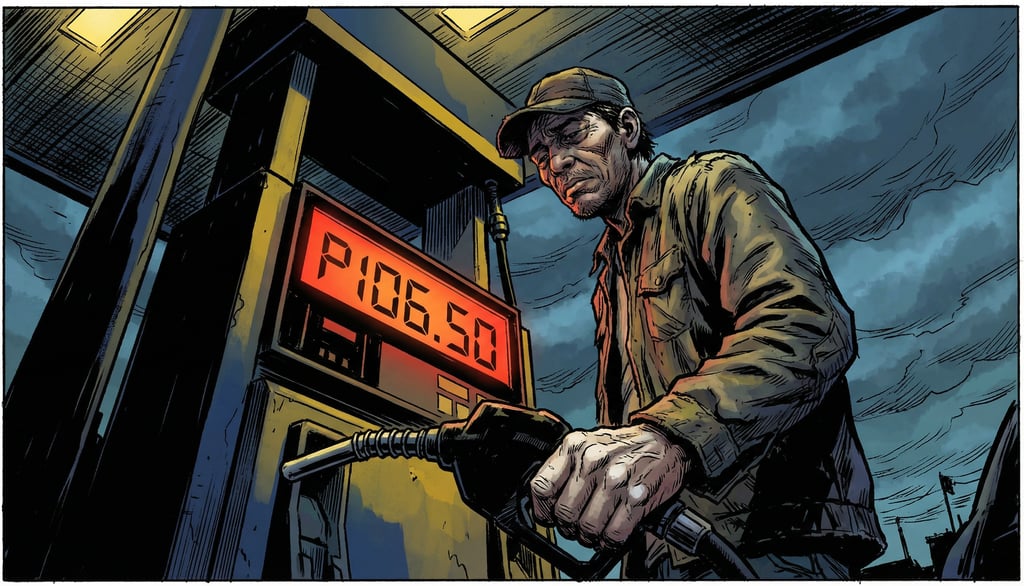

I filled up last week and just stared at the pump.
Not because I was surprised. I've been writing about this stuff long enough to know the drill. But there's a difference between knowing something intellectually and watching the numbers tick past a hundred pesos per liter and feeling it in your chest. That kind of moment has a way of making you want to understand the thing more clearly — not for the sake of understanding, but because people deserve to know why this keeps happening to them.
So let me try to explain it the way I'd explain it to anyone sitting across from me at a table. No jargon. No pretending this is complicated when, once you see the mechanics, it's actually just infuriating.
You Are Not Paying for the Gas in the Pump
This is the part that broke my brain a little when I first really understood it.
When you pull up to a gas station and pump diesel or gasoline into your tank, you are not paying for the oil that's already sitting in that underground storage. That oil was bought weeks ago — probably when global prices were different. You are paying for what it will cost the oil company to replace that stock next week.
It's called replacement cost accounting, and Energy Secretary Sharon Garin confirmed it herself in a March 2026 media briefing.
Here's how it works: every Tuesday, oil companies adjust pump prices based on the Mean of Platts Singapore (MOPS) — the average daily price of refined petroleum products traded at Singapore's regional hub. They take the previous week's MOPS average, treat it as the assumed cost of buying new stock, and price accordingly.
A concrete example: during the week of March 10, 2026, early MOPS trading data from just the first two days of that week was already projecting gasoline to rise by P13 to P15 per liter, and diesel by P16 to P18 per liter — before the week had even finished trading. That projection alone was enough for oil companies to announce their Tuesday hike.
By March 12, the cumulative staggered adjustments for that single week had hit P8.75 per liter for gasoline, P24.25 for diesel, and P36 for kerosene — the highest weekly movement in Philippine history. The fuel in the pumps that Tuesday? Bought weeks earlier, at a fraction of that price.
So if global oil prices spiked this week because of a war or a blocked shipping lane, you pay that spike this Tuesday — even though the fuel you're pumping today was loaded onto a tanker before any of that happened.
Does that make you angry? It should. Because it means the cost you pay at the pump has almost nothing to do with what the company actually spent on the fuel you're physically consuming. It has everything to do with what they expect to spend next week.
And the DOE? They can't touch it.
Why the Philippines Is Basically a Sitting Duck
Let me give you a number: 99%.
That's how much of the oil powering this country is imported. We produce almost none of our own. The crude that feeds our fuel supply comes 98% from the Middle East — Saudi Arabia, UAE, Iraq, Kuwait, Oman, Qatar. The refined gasoline and diesel we buy comes mostly from South Korea, Singapore, China, Japan, and Malaysia.
There is exactly one functioning oil refinery left in the entire country — the Petron Bataan Refinery, covering roughly 40% of national fuel needs. Shell shut their refinery in 2020. Caltex shut theirs in 2003. Both of them converted to import terminals.
Think about what that means for a moment.
When the Middle East gets unstable — when the Strait of Hormuz gets threatened, when US-Iran tensions flare, when OPEC adjusts production — we have zero buffer. Our refinery suppliers in South Korea and Singapore also source Middle Eastern crude. When they can't get it, they can't sell refined products to us.
There is no cushion. There is no domestic alternative. There is no safety net.
And then the peso gets involved.
The Peso-Dollar Gut Punch
All oil globally is priced in US dollars. So when the peso weakens, every liter of oil effectively costs more pesos — even if the dollar price didn't move.
The BSP has documented this. A peso that slides from P50 to P60 against the dollar translates to roughly P10 more per liter in peso terms, just from the currency move alone.
In March 2026, the peso broke through the P60-per-dollar level for the first time in history.
At the same time.
The Strait of Hormuz was being threatened.
MOPS prices were surging.
So we got hit by everything at once: a more expensive commodity priced in a more expensive currency. That's how you end up with a single-week adjustment that pushed gasoline up by P7.00 to P13.00 per liter, diesel by P17.50 to P24.25 per liter, and kerosene by P32.00 to P38.50 per liter. Diesel was approaching P130 per liter. Gasoline crossed P100.
Biggest pump price hike on record.
The Rockets and Feathers Problem
Ask anyone who pays attention to fuel prices in this country and they'll tell you what they've felt for years: prices go up fast and come down slow. Way too slow.
This isn't paranoia. It has a name in economics: the "rockets and feathers" effect.
Research from the University of the Philippines confirmed it happens here. When Dubai crude oil surged 42% between April and July 2008, Philippine retail gas prices went up 27%. When crude then crashed 75% between July and December 2008, retail prices only fell 50%. Consumers absorbed most of the pain on the way up. They did not receive most of the relief on the way down.
Why does this happen?
When prices rise, oil companies apply replacement cost logic immediately — they anticipate higher costs and pass them on right away. When prices fall, they sit on inventory bought at higher costs and wait. They want to be "sure" the drop is sustained before they roll back. No single Big Three company wants to be the first to cut aggressively when everyone else is holding the line — that's margin left on the table.
The DOE sees this happening every cycle. They have no legal mechanism to force faster rollbacks.
TRAIN Made It Worse — And That Tax Doesn't Move
On top of MOPS pricing, every Filipino also pays a fixed excise tax baked into the pump price. This is the TRAIN Law's legacy.
Before 2018, gasoline was taxed at P4.35 per liter. Diesel had zero excise tax.
After TRAIN:
Gasoline: P10.00 per liter
Diesel: P6.00 per liter
Kerosene: P5.00 per liter
LPG: P3.00 per kilogram
These are fixed per-liter amounts — not percentages. They don't adjust when global prices drop. They sit there permanently, making every rollback period less meaningful than it would otherwise be.
There's a theoretical safety clause in TRAIN that allows suspending excise tax increases — but legal experts say that clause only applied to the scheduled rate increases from 2018 to 2020, which have already happened. You can't invoke it now to suspend the tax itself.
Senator JV Ejercito filed a bill in 2026 to automatically suspend fuel excise taxes whenever Dubai crude exceeds $80 per barrel. A reasonable proposal. As of writing, it remains unenacted.
This Isn't Really a "Free Market"
The Oil Deregulation Law of 1998 — Republic Act 8479 — was sold to the public as the path to a competitive fuel market. Competition would drive down prices. Market forces would protect consumers. The government would step back and let the system work.
Twenty-eight years later, here is what we actually have:
Petron, Shell, and Caltex — the Big Three — still command about 43% of the petroleum products market. Petron alone holds roughly 23%. Independent players have grown and now hold over 53% combined, but the Big Three still anchor the weekly price adjustments. When Petron announces a Tuesday increase, smaller players follow within hours — not because of a conspiracy, but because everyone uses the same MOPS benchmark and the same replacement cost logic. The incentive to deviate is close to zero.
The Philippine Competition Commission studied this. Their 2021 market study noted that not a single new refinery has been built since deregulation in 1998. With Shell and Caltex out, Petron is the last man standing on the refinery side. That concentrates the supply chain even more.
And the DOE? Under RA 8479, their authority is limited to monitoring prices and publishing benchmarks. They cannot impose ceilings. They cannot cap prices. DOE Secretary Sharon Garin was honest about it in March 2026:
"We are constrained by the law and the deregulation that we do not have the powers to cap or to control the prices unless maybe they give us the authority or an amendment of the law, or emergency powers."
Congress wrote that law in 1998 and hasn't touched it since. Twenty-eight years of fuel crises, and the DOE still shows up to every press briefing with its hands legally tied behind its back.
What the Government Finally Did — and What It Didn't
On March 24, 2026, President Marcos signed Executive Order No. 110, declaring a State of National Energy Emergency.
The response package — branded UPLIFT — included:
P5,000 in financial assistance for over 1.4 million drivers and transport operators
Free rides (Libreng Sakay) and 50% discounts on LRT2 and MRT3
Government offices shifting to a four-day work week
Crackdown on price gouging and hoarding
Procurement of at least one million barrels of diesel from alternative suppliers
Oil companies voluntarily staggering price hikes across multiple weeks instead of hitting all at once
I'll give credit where it's due. That's a real response. People needed the relief.
But none of it touches the structure.
No amendment to RA 8479. No DOE given the authority to cap prices in emergencies. No automatic excise tax suspension mechanism. No new refinery. No strategic petroleum reserve of meaningful size — current stocks cover roughly two months at normal consumption. No serious energy transition push — as of 2025, 78% of the Philippines' energy portfolio still runs on oil and coal.
Senate President Tito Sotto III introduced Senate Bill 1984 in March 2026 to outright repeal RA 8479. The DOE secretary herself said the law needs review. These are not nothing. But we've been here before — every crisis cycle generates the same legislative noise, and then things ease up, and then the noise fades, and then it happens again.
Same mechanics. Different trigger. Same government response: reactive, temporary, theatrical.
The Part That Actually Keeps Me Up at Night
None of what I described above stays at the gas station.
The Philippines moves goods by road. Fish from Palawan, rice from Nueva Ecija, vegetables from Benguet — all of it loaded onto trucks that run on diesel. When diesel crosses P100, P120, P130 per liter, the trucking cost goes up. That cost gets passed to the market vendor. The market vendor passes it to the customer. The customer is you and me and every Filipino family trying to stretch a budget.
Jeepney operators who couldn't absorb higher fuel costs passed them onto commuters through fare increases. Low-income families — who spend the biggest share of their income on food and transportation — got squeezed the hardest. And they were the last people the government had in mind when they wrote the deregulation law in 1998.
Socioeconomic Planning Secretary Arsenio Balisacan warned that if Dubai crude hit $200 per barrel and diesel reached P162.50 per liter, the Philippines could face double-digit inflation. That number came from inside the cabinet — not from a protest rally.
So, Saan Tayo Nito Pupulutin?
Here's the honest afternoon coffee answer:
The fuel pricing system in the Philippines was designed primarily to protect industry freedom, not consumer welfare. The MOPS-based replacement cost formula, the Oil Deregulation Law's removal of regulatory authority, the TRAIN Law's fixed excise taxes, the collapse of refinery capacity, the near-total dependence on imported oil — none of these happened by accident. They happened because of decisions made by people in power, most of whom were not worried about what a P130 diesel price does to a jeepney driver in Cabanatuan.
The system isn't broken. It's working exactly as it was built to work.
The question is whether the 2026 crisis — the biggest price spike on record, a historic peso collapse, a declared national energy emergency — is finally enough to make the people who write laws decide to build it differently.
I've been covering Philippine politics long enough to be skeptical.
But the fact that RA 8479's repeal is now being debated openly, that the DOE secretary is publicly calling for a review, that the peso-oil double hit has made this impossible to ignore — that's different from every previous cycle.
Maybe. We'll see.
I'm going to finish my coffee and watch what Congress does next.
SOURCES:
GMA Network - Philippine fuel pump prices explainer
https://www.gmanetwork.com/news/money/economy/979486/philippine-fuel-pump-prices/story/Lawphil - Republic Act No. 8479
https://lawphil.net/statutes/repacts/ra1998/ra_8479_1998.htmlInquirer Business - Staggered hikes eyed if oil prices surge amid airstrikes
https://business.inquirer.net/577093/staggered-hikes-eyed-if-oil-prices-surge-amid-airstrikesMetrobank - How Rising Fuel Prices Affect You
https://www.metrobank.com.ph/articles/learn/how-to-budget-for-rising-gas-pricesIISD - One Fuel, Two Prices PDF
https://www.iisd.org/system/files/publications/one-fuel-two-prices-international-experiences-dual-pricing-of-fuel.pdfWTO - Republic Act No. 8479 PDF
https://importlicensing.wto.org/sites/default/files/members/117/Republic%20Act%20No.8479%20-%20Downstream%20oil%20industry_10.02.pdfGMA Network - Why fuel prices in the Philippines are suddenly surging (YouTube)
https://www.youtube.com/watch?v=Co8mBZnkLDwBria - 2022 Gas Price Fluctuation: Why Does it Go Up and Down?
https://www.bria.com.ph/articles/2022-gas-price-fluctuation-why-does-it-go-up-and-down/Top Gear PH - Why is fuel cheaper in some areas?
https://www.topgear.com.ph/features/tip-sheet/why-is-fuel-cheaper-some-areas-a00013-20180713Inquirer News - Sotto wants oil deregulation act repealed
https://newsinfo.inquirer.net/2197523/sotto-wants-oil-deregulation-act-repealedeJournals PH - Fuel Price Increase: Unveiling the Torments and Agonies
https://ejournals.ph/article.php?id=24114Reddit Philippines - Why the prices are not going back down
https://www.reddit.com/r/Philippines/comments/11xiycg/why_the_prices_are_not_going_back_down_after_the/CleanTechnica - Gas and Diesel Prices in ASEAN
https://cleantechnica.com/2026/03/10/how-are-prices-of-gas-diesel-in-asean-and-where-do-we-go-from-here/GMA Network - What is the Oil Deregulation Law?
https://www.gmanetwork.com/news/money/economy/980552/understanding-the-oil-deregulation-law-and-its-impact-on-fuel-prices/story/DOE - Oil Firms agree on staggered fuel price adjustments
https://doe.gov.ph/articles/3358435--doe-oil-firms-agree-on-staggered-fuel-price-adjustments-department-urges-more-companies-to-Fuels and Lubes Asia - Market share shifts in favor of smaller players
https://www.fuelsandlubes.com/market-share-shifts-in-favor-of-smaller-players-in-philippines/UP Diliman - Behavior of Retail Gasoline Prices in the Philippines PDF
https://pmr.upd.edu.ph/index.php/pmr/article/download/303/302/S&P Global - Singapore oil product MOPS Strip calculation
https://www.spglobal.com/energy/en/pricing-benchmarks/our-methodology/subscriber-notes/012826-singapore-oil-product-mops-strip-calculation-to-roll-over-on-feb-16Philstar - Major oil firms raise market share in H1
https://www.philstar.com/business/2023/10/23/2305745/major-oil-firms-raise-market-share-h1econwpa - Price Adjustments and Asymmetry in the Philippine Retail Gasoline Market PDF
https://econwpa.ub.uni-muenchen.de/econ-wp/io/papers/0209/0209001.pdfPhilippine Competition Commission - Market Study on the Refined Petroleum Industry PDF
https://www.phcc.gov.ph/storage/pdf-resources/1678085292_PCC-Issues-Paper-2021-05-Market-Study-on-the-Refined-Petroleum-Industry.pdfStatista - Leading petroleum companies in the Philippines
https://www.statista.com/statistics/1255537/market-share-of-petroleum-companies-philippines/AgEcon Search - Rockets and Feathers PDF
https://ageconsearch.umn.edu/record/344062/files/29388.pdfManila Bulletin - Why gas prices rise today for oil bought weeks ago
https://mb.com.ph/2026/03/09/why-gas-prices-rise-today-for-oil-bought-weeks-agoBusinessWorld - Smaller oil firms edge out majors in first half
https://www.bworldonline.com/corporate/2021/09/27/399124/smaller-oil-firms-edge-out-majors-in-first-half/JSTOR - Rockets and Feathers: Understanding Asymmetric Pricing
https://www.jstor.org/stable/25593733Grant Thornton PH - Revisiting TRAIN's Impact on Individuals
https://www.grantthornton.com.ph/insights/articles-and-updates1/lets-talk-tax/all-aboard-revisiting-trains-impact-on-individualsPhilstar - Staggered fuel price hikes start next week
https://www.philstar.com/headlines/2026/03/06/2512414/staggered-fuel-price-hikes-start-next-weekGMA Network - PH can't cap pump prices due to deregulation law
https://www.gmanetwork.com/news/topstories/nation/979292/ph-can-t-cap-pump-prices-due-to-deregulation-law-doe-says/story/PIDS - Effects of TRAIN fuel excise taxes on goods and prices PDF
https://pidswebs.pids.gov.ph/CDN/PUBLICATIONS/pidspn1911.pdfGMA Network - Fuel prices may soar P19 per liter for diesel
https://www.gmanetwork.com/news/money/economy/979099/fuel-prices-next-week-middle-east-conflict/story/YouTube - PH energy chief says oil deregulation law needs review
https://www.youtube.com/watch?v=ylZqSKZ7hWAInquirer News - Ejercito seeks automatic fuel tax halt
https://newsinfo.inquirer.net/2189357/ejercito-seeks-automatic-fuel-tax-halt-amid-oil-price-surgeYouTube - Philippines Declares National Emergency Over Soaring Fuel Prices (LIVE)
https://www.youtube.com/watch?v=p7b2PNDDhqYDOF - Suspending fuel excise tax to benefit rich, not poor families
https://www.dof.gov.ph/dof-suspending-fuel-excise-tax-to-benefit-rich-not-poor-families-better-to-give-p33-b-cash-aid-to-low-income-households/ABS-CBN - DOE backs calls to review Oil Deregulation Law
https://www.abs-cbn.com/business/07/19/22/doe-backs-calls-to-review-oil-deregulation-lawBSP - Q&A on the exchange rate impact PDF
https://www.bsp.gov.ph/Media_and_Research/Primers%20Faqs/fximpact.pdfYouTube - DOE says 98% of PH crude oil imports come from other countries
https://www.youtube.com/watch?v=kfxnr39jttMPhilstar - Marcos declares national energy emergency over fuel crisis
https://www.philstar.com/headlines/2026/03/24/2516571/marcos-declares-national-energy-emergency-over-fuel-crisisBloomberg - Philippine Peso Drops Past Key 60-Per-Dollar Level
https://www.bloomberg.com/news/articles/2026-03-19/php-usd-philippine-peso-drops-to-key-60-per-dollar-level-on-oil-pressureInquirer Business - PH to remain heavily dependent on oil imports
https://business.inquirer.net/126791/ph-to-remain-heavily-dependent-on-oil-imports-adbGMA Network - Marcos declares state of national energy emergency
https://www.gmanetwork.com/news/topstories/nation/981224/president-marcos-energy-emergency/story/Philstar - Why we must break our dependence on imported oil
https://www.philstar.com/opinion/2026/03/17/2514895/why-we-must-break-our-dependence-imported-oilNew York Times - Philippines Declares National Emergency Over High Fuel Prices
https://www.nytimes.com/2026/03/24/world/middleeast/philippines-national-emergency-high-fuel-prices.htmlPCO - President Marcos declares State of National Energy Emergency
https://pco.gov.ph/news_releases/president-marcos-declares-state-of-national-energy-emergency-activates-uplift-as-whole-of-government-response/Statista - Oil industry in the Philippines
https://www.statista.com/topics/11403/oil-industry-in-the-philippines/CEIC Data - Philippines Crude Oil Imports
https://www.ceicdata.com/en/indicator/philippines/crude-oil-importsLinkedIn - Independents seize majority share of the Philippine fuel market
https://www.linkedin.com/posts/f-l-asia_independents-seize-majority-share-of-the-activity-7426590595147632640-CI-JManila Bulletin - ₱100/liter near? Fuel prices keep rising for second straight week
https://mb.com.ph/2026/03/11/100liter-near-fuel-prices-keep-rising-for-second-straight-weekManila Bulletin - Diesel may go up by around ₱18; gasoline by ₱15 next week
https://mb.com.ph/2026/03/12/diesel-may-go-up-by-around-18-gasoline-by-15-next-weekPower Philippines - Tabangao refinery
https://powerphilippines.com/tag/tabangao-refinery/Wikipedia - Petron Corporation
https://en.wikipedia.org/wiki/Petron_CorporationWikipedia - List of oil refineries
https://en.wikipedia.org/wiki/List_of_oil_refineries
Contact us
subscribe to morning coffee thoughts today!
inquiry@morningcoffeethoughts.org
© 2024. All rights reserved.
If Morning Coffee Thoughts adds value to your day, you can support it with a monthly subscription.
You can also send your donation via Gcash: 0969 314 4839.