
The Chinese Tourist Gambit: Why The Marcos Administration Is Courting Beijing Amid Lessons Unlearned
A deep dive into the Chinese tourist 14-day visa-free policy and what it reveals about the Marcos administration’s priorities. This blog unpacks the numbers behind Philippine tourism, the regional context, and the real impact of courting Beijing. It also examines Christina Frasco’s role—where she is part of the problem, and where the system itself is failing.
25 min read
The Department of Tourism's push for more Chinese tourists through a new 14-day visa-free policy that started on January 16, 2026 is making a lot of people uneasy. Under this policy, Chinese nationals can now enter through NAIA in Manila or Mactan-Cebu International Airport and stay for up to 14 days for tourism or business, without a visa, as long as they have a valid passport, hotel booking, and return or onward ticket. It is a one-year pilot program, the stay cannot be extended or converted into another visa type, and the government says background checks will be done to screen out those with derogatory records.
When you put that beside everything that has happened with China in the West Philippine Sea, and the POGO mess, you can understand why people see this and think: after all that, bakit ganito na naman?
The short answer coming from government is that it is trying to balance economic pressure, regional competition, and foreign policy. The administration has reversed some of Duterte's worst missteps with China, but it is also taking new risks that could backfire if the limits and safeguards do not hold.
The Numbers Tell A Complex Story
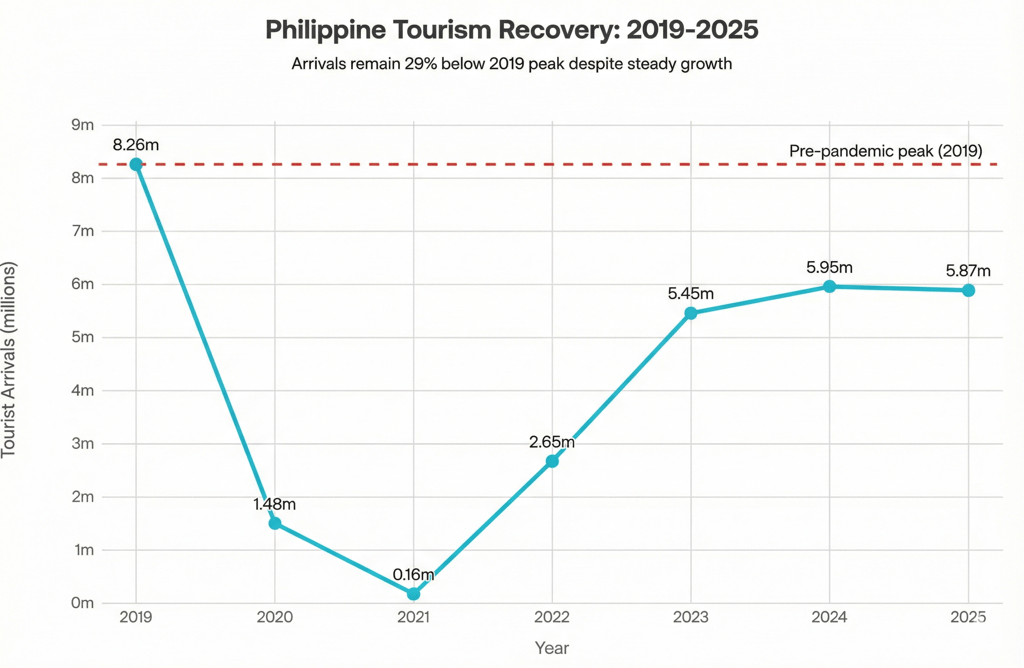
First, the numbers show that Chinese tourists are not the ones dominating our arrivals right now. In 2025, the Philippines had about 6.48 million international visitors. Around 5.94 million of those were foreign tourists and about 543,000 were returning overseas Filipinos. Total spending from these visitors reached roughly PHP 694 billion. That is a lot of money, but still far below the pre-pandemic peak in 2019, when we saw 8.26 million arrivals. To make it worse, 2025 arrivals actually dipped slightly compared to 2024, from around 5.95 million down to about 5.87 million. So our recovery is not only incomplete; it has started to stall.
Within that 6.48 million, Chinese tourists only accounted for 262,144 visitors, putting them in sixth place among our source markets. Before the pandemic, in 2019, they were second, at about 1.7 million. That means Chinese arrivals have dropped by around 70 percent from their pre-pandemic level.
South Korea's Alarming Decline
If you are looking for a real tourism crisis, you should look at South Korea, not China. In 2025, South Koreans made up about 1.34 million visitors, or roughly 21.66 percent of all arrivals, which means they are still our top market. But that number represents a drop of about 21 percent from 2024.
That decline is driven by a mix of factors mostly outside the control of our Department of Tourism: the weakening of the Korean won, political and economic turmoil in South Korea, and safety concerns. Korean media have carried stories about kidnappings and crimes in the Philippines that make potential tourists think twice about visiting. These stories add to the sense that the Philippines is not as safe or as easy to visit as some of our neighbors.
The United States sits in second place with about 1.06 million visitors, contributing around 17 percent of arrivals. After that come Japan with roughly 340,000, Australia with about 330,000, and Canada with about 240,000 visitors. India is an emerging growth market, showing around 21 percent growth in arrivals. On top of this, more than 150 nationalities already enjoy visa-free entry to the Philippines under executive orders that have been in place for years. So, in that context, China was an exception, not the norm.
All of that makes it clear that Chinese tourists are just one piece of a much larger tourism picture. They are getting a lot of attention now because of politics, but in terms of numbers, they are far from being the only or even the main story.
Still Below Pre-Pandemic Levels
If you trace the story of our arrivals from 2019 to 2025, it goes like this. In 2019, we hit the high point at 8.26 million arrivals. Then the pandemic hit, and in 2020 arrivals crashed to about 1.48 million. In 2021 it got even worse, dropping to around 163,879. Recovery started in 2022 with about 2.65 million arrivals, then jumped in 2023 to 5.45 million. In 2024, we inched up again to about 5.95 million. But in 2025, instead of continuing upward, we slid back a bit to around 5.87 million.
So even after all the reopening and all the campaigns, we are still about 29 percent below where we were in 2019. And instead of steadily climbing back up, we have already seen a small decline. Meanwhile, our neighbors are not just recovering, they are surpassing their old numbers. We are lagging behind.
Why China, Why Now?
The 14-day visa-free policy for Chinese citizens is being framed by the government not as a political signal to Beijing, but as a tool to make us more competitive in tourism and trade.
Before this policy, Chinese travelers to the Philippines had to undergo a slower and often clogged visa process. This got worse after e-visas for Chinese nationals were suspended in 2023, mainly due to security concerns linked to POGOs and related crimes. In contrast, places like Thailand and Malaysia were already offering visa-free or very easy entry for Chinese tourists. So if you were a Chinese traveler and you had to choose where to go, of course you would lean toward the destinations that made things easier.
Now, the Philippines is trying to catch up. From January 16, 2026 to January 15, 2027, Chinese passport holders can enter Manila or Cebu without a visa and stay up to 14 days per visit, provided they meet the requirements. They can come multiple times during the year, but they cannot stay longer than 14 days per trip, and they cannot convert that stay into a different immigration status inside the country.
The government and business groups are hoping that this will push Chinese arrivals toward around 1.4 million in 2026 and bring in roughly $1.2 billion in new spending, both from tourists and business visitors. The expectation is that this will not just help hotels and resorts, but also sectors like construction, engineering, manufacturing, logistics, and the events industry through increased trade fairs, expos, and corporate visits.
Some Filipino-Chinese business groups have warmly welcomed the policy, calling it forward-looking. They argue that it improves our competitiveness in ASEAN and helps us tap into one of the biggest outbound tourism markets in the world.
For Chinese companies and investors, the policy means they no longer have to wait weeks for visa appointments or pay consular visa fees just to come here on a short business trip. For Metro Manila's BPO industry, which often hosts Chinese client teams, it makes short-notice visits much easier and cheaper to arrange.
Not A Blank Check: Policy Limits
On paper, this is not an unlimited opening. It is a one-year pilot. It is restricted to just two airports, NAIA and Mactan-Cebu. Stays are capped at 14 days, cannot be extended, and cannot be turned into some other kind of visa once the person is already here. The policy also requires valid passports with at least six months of validity, confirmed hotel bookings, and return or onward tickets. National Security Adviser Eduardo Año and the Department of Foreign Affairs have said that security agencies will vet travelers and deny entry to those with derogatory records.
In other words, the official line is that we are opening the door slightly, in specific places, under strict conditions, and for a limited time. The idea is that we will test this arrangement, watch for problems, and then decide whether to continue, adjust, or stop.
Why The Timing Feels Wrong
The big problem is timing. The visa-free policy was rolled out with very little public discussion and very close to its implementation date. All of this happened while Chinese ships are still harassing Philippine vessels and fishermen in the West Philippine Sea, especially around Ayungin Shoal and Escoda Shoal.
There was a violent confrontation in June 2024 where a Filipino soldier lost part of his thumb. In another incident in December 2024, three Filipino fishermen were injured after Chinese vessels used water cannons to drive them away from Escoda Shoal. Chinese forces continue to enforce their own so-called laws in areas that are within our exclusive economic zone.
So when the government suddenly announces that Chinese citizens can now enter Manila and Cebu without a visa for 14 days, a lot of people understandably see that as mixed messaging. On paper, it looks technical and limited. But emotionally and politically, it feels like a concession, or at least like a tone-deaf move, because it comes while tensions at sea are still very high.
The Duterte "China Problem": Lessons Learned And Ignored
What Duterte Got Wrong
To understand the anxiety around this new policy, we have to look back at Duterte's legacy with China, because that is where a lot of the anger and mistrust comes from.
First, there was the secret "gentleman's agreement" with Xi Jinping over the West Philippine Sea. Duterte quietly agreed that the Philippines would not repair or build new structures in disputed waters. This was never openly disclosed to the Filipino public. It effectively limited our own actions in our own maritime zones and allowed China to consolidate its presence while we held back. Under Marcos, this agreement was exposed and heavily criticized, and many see it as one of the reasons Chinese aggression escalated: they got used to the idea that the Philippines would just stand down.
Second, Duterte leaned heavily into China's promises of infrastructure loans and investments under the Belt and Road Initiative. In 2016, Beijing talked about around $24 billion in loans and investments for Philippine projects. In reality, only around $1.1 billion in loans ever really materialized. Eventually, the Marcos administration cancelled three big China-backed rail projects—the Subic-Clark Railway, the PNR South Long-Haul, and the Mindanao Railway—because China kept delaying and dragging its feet. In short, we took the political hit of moving closer to China, but the grand infrastructure payoff that was promised largely did not arrive.
Third, Duterte's government opened the door wide to Philippine Offshore Gaming Operators or POGOs, starting around 2016–2017. These operations targeted Chinese gamblers and brought tens of thousands of Chinese workers into the country. Over time, POGOs became tightly linked with all kinds of crimes: financial fraud, money laundering, human trafficking, kidnapping, torture, and even killings. Reports emerged that Xi Jinping himself had suggested to Duterte that the Philippines should ban POGOs, but Duterte refused, pointing to their economic contribution. By the time Marcos banned POGOs in 2024, the damage had already been done to our reputation and domestic security.
Duterte's broader stance on the West Philippine Sea was also very clear. He repeatedly said he would not go to war with China and often brushed aside the 2016 Hague ruling that invalidated China's sweeping claims. He prioritized the promise of loans, investments, and later vaccines over a more assertive defense of our maritime rights. That created a situation where we seemed too dependent on China's goodwill, without getting a fair return.
What Marcos Has Actually Changed
To be fair, Marcos has tried to walk a different path.
He decided to move the Philippines away from China's Belt and Road Initiative and instead lean more toward partners like the United States and Japan for infrastructure. His administration finally pulled the plug on POGOs, something Duterte loudly refused to do. He expanded our defense cooperation with the U.S. by approving more EDCA sites and increasing joint military exercises, strengthening the security side of our foreign relations.
On the West Philippine Sea, Marcos has taken a firmer line. He has been more vocal in saying that the Philippines will not give up any territory and has publicly backed Filipino officials who speak out against Chinese aggression. When China complained about statements by Philippine Coast Guard spokesperson Jay Tarriela, Marcos said he stands by his officials and wants them to tell the truth to the Filipino people about what is happening at sea. The National Security Council also reminded Beijing that our agencies do not need any foreign country's approval to talk to Filipinos.
So in that sense, yes, the Marcos administration has stepped away from Duterte's habit of accommodating China at all costs. But at the same time, it still has to face economic realities. China remains one of our largest trading partners. Our tourism recovery is slow, and we cannot afford to completely shut out a huge potential tourism market. That is the tension: we want to be politically tougher, but we are still economically open.
Christina Frasco's Performance: Underfunded, Not Underperforming?
Christina Garcia Frasco's time at the Department of Tourism has been noisy: rebranding controversies, questions about her visibility in campaigns, rumors of being replaced, and now the China visa debate. But when you look at the numbers, her main defense—that DOT is "underfunded, not underperforming"—has a solid basis.
The Budget Story
DOT's promotional budget has been slashed hard:
In 2023, the department had PHP 1.2 billion for promotions. In 2024, that was cut to PHP 200 million, which is about an 83 percent reduction. In 2025, it was cut again to just PHP 100 million, another 50 percent drop. Only in 2026 did the Senate restore about PHP 1 billion for promotions.
Before the pandemic, DOT usually had more than PHP 1 billion a year to promote the country. So Frasco's team was being asked to sell the Philippines to the whole world using far less than what some big brands spend on a single global ad campaign.
Despite that, Frasco points out that in 2024, with just PHP 200 million in promotional money, tourism still generated around PHP 760.5 billion in revenue. By her calculation, that is a return of over 1,900,000 percent on that promotional budget. Tourism in general contributed roughly PHP 3.86 trillion to the economy, created around 6.75 million direct jobs, and supported around 10 million more indirectly.
Some lawmakers and industry observers have suggested the budget cuts were not just about fiscal discipline but about politics. Representative Rodante Marcoleta publicly said he saw "partisan politics" behind the tourism budget reductions. Travel industry commentators wrote that the cuts "reek of political manipulation" meant to make DOT look ineffective. When President Marcos heard about the constraints, he acted quickly and transferred PHP 400 million from his own contingency fund in early 2025 to partially restore DOT's promotional capacity, a move that signals he saw value in what Frasco was doing and did not want the department crippled.
What DOT Has Done Right
Even with such a small budget, DOT under Frasco has not been idle. In 2025, the department helped open 19 new direct international flight routes connecting not just Manila but also regional airports like Clark, Iloilo, and Kalibo to different international cities. Cruise tourism also grew, with around 136 cruise ship arrivals bringing in roughly 156,000 passengers and 115,000 crew members.
On the branding side, the Michelin Guide finally entered the Philippine market, listing 108 restaurants in Manila and Cebu and giving the country a stronger profile for food tourism. The Philippines hosted Terra Madre Asia and Pacific in Bacolod, putting a spotlight on our food, farms, and local products. DOT also worked with other agencies to improve tourism roads, upgrade airports and seaports, streamline visa processes, and improve digital connectivity in tourist spots.
One major policy win was the implementation of the VAT refund mechanism for non-resident tourists under Republic Act 12079, making the Philippines more competitive with neighbors who already offered tax-free shopping incentives. DOT also launched the Philippine Hotel Industry Strategic Action Plan covering 2023 to 2028, setting a roadmap for upgrading standards and attracting more investments. Tourism investments reached around PHP 508.8 billion in 2023, with over half going into accommodations.
The department rolled out Tourist Rest Areas around the country, set up a 24/7 Tourist Assistance Call Center, introduced hop-on hop-off bus tours in major cities, and improved WiFi at key tourism sites. These may sound like small touches, but they add up to a more visitor-friendly experience, especially for first-time tourists.
For 2026, DOT's strategy is to focus hard on recovering the South Korean market, deepening already strong ties with the United States and Canada, and going after growth in India and the Middle East. Halal tourism and Muslim-friendly facilities are part of that plan. Frasco has said the restored PHP 1 billion promotional budget will be used more aggressively to push Philippine destinations abroad. In that wider plan, Chinese tourists are just one part, not the main focus.
The Metrics That Actually Matter
While lawmakers and commentators obsess over arrival numbers, Frasco and her team argue that other metrics tell a better story.
Tourism revenue in 2024 hit PHP 760.5 billion, an all-time record and about 126 percent recovery compared to the PHP 600 billion earned in 2019. That is a 9 percent increase over 2023. International tourists now spend an average of a little over $2,000 per trip in the Philippines, which benchmarking from the World Travel and Tourism Council suggests is the highest per-capita spending in ASEAN. Their average length of stay has also increased, from about nine nights before the pandemic to over eleven nights now. DOT data shows that roughly 70 percent of visitors are repeat tourists, meaning once people manage to get here, they tend to like the experience enough to come back.
The Philippines also has the largest domestic tourism market in Southeast Asia, valued at around $52.1 billion in 2023 according to WTTC. That means Filipinos themselves are traveling and spending heavily inside the country despite all the complaints about high costs and hassles. Employment tied to tourism, both directly and indirectly, reached about 16.4 million people in the first quarter of 2024, or roughly a third of total employment according to PSA and NEDA figures that DOT cites.
On the governance side, the Department of Tourism has repeatedly passed Commission on Audit scrutiny with good marks. In 2024, COA once again issued an "unmodified opinion" on the department's financial statements, meaning its books were considered fairly presented according to standards. Around the same time, DOT also secured another ISO 9001:2015 certification for its quality management system, covering accreditation, regulation enforcement, and training services. This is already the seventh year the department has held ISO certification and the third straight year under Frasco with an unmodified COA opinion. That suggests an agency that is organized, process-driven, and not mired in big audit scandals or financial mismanagement.
Public Approval Versus Political Attacks
Here is where things get strange. In May 2024, Frasco received a 92 percent approval rating in the "Boses ng Bayan" survey by RP-Mission and Development Foundation, which covered 10,000 respondents nationwide. She ranked second among Marcos cabinet officials, just behind DSWD Secretary Rex Gatchalian who had 94 percent. A follow-up survey in September 2025 still had her at around 89 percent approval. These surveys measured public perceptions of responsiveness, efficiency, and visibility.
So whatever the noise on social media and in congressional hearings, the general public does not see her as a disaster. In fact, they see her as performing well. President Marcos himself retained her after a cabinet performance review in mid-2025, praised tourism as a "major economic pillar," and acted quickly to transfer PHP 400 million from his contingency fund to help restore her slashed budget. State media and the Presidential Communications Office have run stories about "Philippine tourism flourishing under Marcos," explicitly crediting DOT and Frasco's programs.
Yet at the same time, two lawmakers, Representatives Jude Acidre and Paolo Ortega, have publicly attacked her performance. Acidre called her work "mediocrity" and said the absence of tourism accomplishments in the President's State of the Nation Address proved DOT was underperforming. Ortega complained that the country was attracting fewer tourists and that those who did come were supposedly spending less, comparing the Philippines' roughly $13 billion in tourism receipts to Thailand's $39 billion and Vietnam's $16 billion.
In early January 2026, rumors spread that Malacañang was considering replacing her with a corporate executive from the aviation industry, possibly airline president Stanley Ng. The Palace denied the reports, but the fact that they circulated at all suggests there are factions working to undermine her position.
What Frasco Has Mishandled
At the same time, there are clear missteps that belong to Frasco and her team, and these cannot be blamed on budget cuts or political enemies.
The "Love the Philippines" campaign is the biggest one. In 2023, DOT launched this new slogan and campaign, spending about PHP 49 million. Shortly after the launch, people discovered that the main promotional video included stock footage of other countries such as Dubai, Thailand, Indonesia, and Switzerland, instead of showing only Philippine scenes. This turned into a national embarrassment: our own tourism ad was using foreign footage to promote the Philippines.
Senator Nancy Binay, who chairs the Senate tourism committee, called the campaign "unsalvageable" and said the slogan had become a "laughing stock." She urged DOT to just go back to "It's more fun in the Philippines." Senator Grace Poe described the situation as frustrating and asked that it never happen again. The ad agency, DDB Philippines, apologized and took responsibility, and the DOT ended its contract with them. Senator Jinggoy Estrada praised Frasco's "swift action" to terminate the contract and protect public funds, and Senators Sonny Angara and Bong Go defended her, saying the blunder should not erase DOT's gains.
But Frasco chose to keep the "Love the Philippines" slogan despite Binay and others calling it "beaten and battered in the real world." She repeatedly used the slogan in speeches, and the logo stayed on stage at events. That decision made it easier for critics to say she was stubborn and tone-deaf, more concerned with defending her brand architecture than reading the room.
Then there is the issue of self-promotion. Many people have complained that DOT's materials and events put Frasco's face front and center, sometimes more than the destinations themselves. One incident that fueled this perception was when she appeared on the cover of a magazine with a beach backdrop tied to Expo 2025 Osaka. A photographer who had shot hundreds of thousands of photos and thousands of videos from all over the country for DOT projects publicly expressed frustration that her image was chosen over the many destination shots. This criticism became so widespread that it trended with the phrase "Bakit mukha mo ang pino-promote?"
In ABS-CBN and ANC interviews in January 2026, Frasco pushed back hard, calling the allegation "a complete and utter lie" and insisting that the department's focus is on promoting tourist spots, not her. She also explicitly denied having any ambition to run for national office, saying "Wala po akong ambisyon na tumakbo for any national position." Whether or not she is truly overexposed in the materials, the perception that she is using DOT as a personal platform has taken root among some segments of the public, especially the politically skeptical and online critics.
Things Beyond Her Control
Lawmakers and commentators have compared our roughly 5 to 6 million tourist arrivals with Thailand's 30-plus million, Malaysia's around 40 million, Vietnam's more than 21 million, and Indonesia's roughly 14 million. It is easy to look at those numbers and say, "DOT is failing." But the causes are wider and deeper.
Bank of America Global Research called the Philippines "a clear laggard" in a 2024 report, pointing out that our arrivals were still below 70 percent of 2019 levels while Vietnam was already at 105 to 110 percent, Thailand close to 90 percent, and Malaysia and Singapore in the 80 to 90 percent range. The same report highlighted that Chinese arrivals here were still below 20 percent of 2019 levels and that outbound seat capacity from China to the Philippines was stuck at around 46 percent of pre-pandemic levels, even as seat capacity to other ASEAN countries was expanding. Bank of America itself noted that one of the biggest reasons for the lag is not DOT's marketing but the collapse of Chinese tourism and the slow rebuilding of air links to China, affected by the shutdown of POGOs and by security-driven visa restrictions imposed by DFA and immigration, not by DOT.
The fall in South Korean arrivals has more to do with the Korean won, domestic politics in Korea, and safety fears than with our slogans. The suspension of Chinese e-visas in 2023 was driven by security concerns about POGOs and Chinese-related crime, and that decision was made outside DOT. Natural disasters—typhoons, floods, landslides—hit the Philippines regularly and disrupt travel plans, especially in the fourth quarter of the year. Meanwhile, chronic problems with our airports, roads, ferries, and even internet connectivity belong to many departments and local governments, not just DOT.
International media have picked this up. The Straits Times ran a piece in early 2026 describing how the Philippines "struggles to draw tourists as it lags regional peers," quoting travelers who said visiting here felt "more hassle than fun" because of NAIA congestion, unreliable inter-island connections, and patchy internet connectivity. They noted that tourist arrivals for the first 11 months of 2025 actually fell by 2.2 percent year-on-year, which is the opposite direction of the regional trend.
So in the end, Frasco is both someone who has made poor judgments in certain high-profile cases and someone trying to do her job with very little money in a country whose tourism foundations are weak.
The Aviation Reform Angle
An Inquirer opinion piece titled "The Frasco story: Friction created by reform" offers a different lens on why the attacks keep coming. The column argues that Frasco has publicly identified "genuine barriers to growth: connectivity issues, exorbitant airfare, aviation market framework that favors established players." The piece says that "for vocalizing what the industry has long whispered in private, she faces repercussions."
According to this view, when Frasco challenged aviation monopolies and pricing power, she posed a threat to powerful business arrangements. The opinion writer warns of "whispers regarding possible conflicts of interest—with individuals from the aviation industry eyeing positions in tourism" and describes the attacks on her as "a strategy to undermine reform advocates without addressing policy."
The column urges readers to "support those who advocate for transparency and competition" and to "refuse to let cynical narratives obstruct reforms."
This framing does not erase the branding fiasco or the self-promotion issue, but it suggests that some of the "poor job" narrative is not organic outrage from tourists. Instead, it may be pushback from players who do not want DOT poking at pricing power and monopolistic practices in the airline and aviation sectors. If true, this would mean Frasco is being punished not just for her mistakes but also for threatening entrenched business interests.
The Contradictions In Frasco's Record
Taken all together, Frasco's performance is full of contradictions that make simple judgments difficult.
She has a 92 percent public approval rating in mid-2024 and 89 percent in late 2025, yet she faces congressional attacks and persistent replacement rumors.
She presides over record tourism revenue of PHP 760.5 billion and the highest per-capita tourist spending in ASEAN, yet the Philippines is called "a clear laggard" in arrivals by international analysts. She runs a department with clean COA audits and ISO certification for seven straight years, yet she approved a PHP 49 million branding campaign that used foreign footage and became a national joke. She has challenged aviation monopolies and called out exorbitant airfares, yet she is accused of self-promotion and using DOT as a personal platform. President Marcos retained her after a performance review and gave her PHP 400 million from his own contingency fund, yet Congress slashed her promotional budget by 83 percent.
These contradictions point to a more complex story than either "Frasco is doing great" or "Frasco is failing."
She is technically competent. The audits, the ISO certification, the revenue numbers, the employment figures, and the public approval ratings all suggest someone who can manage an agency, implement programs, and deliver measurable results under severe resource constraints.
But she is politically clumsy. The "Love the Philippines" disaster, the decision to keep the slogan despite senatorial objections, the self-promotion perception that she cannot seem to kill, and her defensive communication style all suggest someone who does not read the room well and who struggles to manage narratives and build coalitions.
She is also caught in forces beyond her control. The Chinese tourist collapse, the South Korean market crisis, the infrastructure deficits, the high cost of domestic travel, and the congressional budget cuts are not things she caused or can fix alone. Yet she takes the blame because she is the visible face of tourism.
And she may be caught in a political and business crossfire. If the Inquirer opinion piece is correct, some of the attacks on her are retaliation for challenging airline pricing and monopolistic practices. If Representative Marcoleta is correct, some of the budget cuts are partisan politics meant to weaken her and make DOT look ineffective. If both are true, then Frasco is being squeezed from multiple directions, not just judged on her actual performance.
So Is Frasco Part Of The Problem?
The honest answer is yes, but only in specific ways.
She is part of the problem when it comes to judgment, optics, and political skill. The "Love the Philippines" fiasco was avoidable. The self-promotion issue, even if exaggerated, reflects poor sensitivity to how she is perceived. Her defensive communication style, where she leads with "underfunded not underperforming" instead of acknowledging what DOT could do better, makes it harder to build support and easier for critics to paint her as arrogant or out of touch.
But she is not the problem when it comes to the structural reasons why Philippine tourism lags behind Thailand, Vietnam, Malaysia, and Indonesia. She does not control NAIA, she does not set airline ticket prices, she does not build roads and ferries, she does not decide visa policies for Chinese nationals, and she cannot fix South Korea's economy or political crisis. Those are whole-of-government failures, historical infrastructure deficits, and external shocks.
If you replaced Frasco tomorrow with the most competent, politically savvy tourism secretary in the world, that person would still face the same broken system: congested airports, expensive domestic flights, poor inter-island connectivity, high costs that make local travel more expensive than going abroad, and a Chinese tourist market that has collapsed for reasons tied to geopolitics and the POGO legacy that predates her.
But would a different secretary avoid a PHP 49 million campaign with foreign footage? Probably. Would a different secretary better manage the optics of visibility and avoid the "Bakit mukha mo ang pino-promote?" issue? Possibly. Would a different secretary communicate in a way that builds more support in Congress instead of triggering budget cuts? Maybe.
So Frasco is a problem, but not the problem. She has made the optics worse and given critics easy ammunition to avoid addressing the harder structural issues. But the system is broken in ways that go far beyond her mistakes. The real question is whether focusing all the blame on her allows everyone else—Congress, DOTr, CAAP, airlines, LGUs, and the Duterte-era China and POGO hangover—to escape accountability for their roles in making Philippine tourism "more hassle than fun."
The Structural Problem: Philippine Tourism's Competitive Disadvantage
This is the part that hurts: even if DOT had a perfect slogan and a flawless secretary, Philippine tourism would still struggle because the system itself is broken.
Infrastructure: The First And Last Impressions Are Bad
Analysts and travel writers describe a common experience: it is harder, slower, and more stressful to travel around the Philippines than our neighbors.
Common complaints include:
NAIA is congested and outdated. Arriving there gives a poor first impression.
Inter-island travel is messy. You often need multiple flights plus boats just to reach a single destination like Boracay.
Domestic flights are prone to delays and cancellations. A typhoon or even light bad weather can trigger chains of disruption.
Internet and mobile connectivity are weak in many places, even in Metro Manila, which matters a lot for digital nomads and younger travelers.
The result: traveling around the Philippines feels like a project. Meanwhile, going to Bangkok, Bali, or Hanoi feels easy.
The Cost Paradox: Domestic Travel Is More Expensive
Another painful aspect: traveling within the Philippines is often more expensive than traveling abroad.
Examples:
A trip to Siargao can cost more than a trip to Hong Kong, Bangkok, or Vietnam, according to Bianca Gonzalez and many others sharing their experiences online.
Manila–El Nido flight: around PHP 14,000–16,000 roundtrip.
Manila–Siargao flight: around PHP 7,000–14,000 roundtrip.
A night in a Batangas resort: PHP 5,500–10,000 for mid-range quality.
On top of that, international airfare is often heavily discounted through promos and flash sales. Domestic promos exist but are fewer, shorter, and less generous.
Because of logistics costs, fuel, limited competition on certain routes, and uneven service standards, domestic trips end up feeling like "more expensive, less comfortable" options. Many Filipinos now find it is cheaper and easier to go to Singapore, Vietnam, or Thailand than to explore their own country.
How Our Neighbors Are Doing
Here is the rough picture for 2025. Thailand pulled in around 32.9 million tourists. Malaysia had about 40 million, more tourists than its total population. Vietnam reached about 21.2 million and is still growing by more than 20 percent year-on-year. Indonesia had around 14 million visitors between January and November, and Bali alone attracted about 7 million tourists, more than our entire country. Singapore brought in roughly 18 million visitors while focusing on higher-spending segments. The Philippines, in contrast, sits at about 5.87 million, and that is after a slight year-on-year decline and still far below pre-pandemic levels.
Our neighbors are not just selling pretty beaches or nice views. They are selling ease of entry, cheap and reliable flights, strong internal transport, and a sense of order. That is the competitive disadvantage we are facing.
ASEAN Chairmanship: A Missed Chance Or An Opening?
The Philippines is chairing ASEAN in 2026, hosting tourism meetings and bigger regional events. This could be used to fix airport bottlenecks, showcase new routes and better connectivity, and push for investor interest in tourism infrastructure. But if it is treated as a "just for show" hosting—nice events, pretty backdrops, no deep reforms—then we will get a small spike in arrivals and no lasting change.
The Economic Context: Why Tourism Matters More Than Ever
Tourism is not just about "fun" or "branding." It is one of the sectors keeping the economy afloat.
The Philippines is expected to have missed its GDP growth target again in 2025. Growth is likely around 4.8–5 percent instead of the 5.5–6.5 percent the government wanted. Public construction is down because of a big corruption scandal in flood control projects, and investor confidence is shaky.
That means less money moving through the system, slower job creation, and more pressure on remittances, tourism, and services to pick up the slack. Tourism contributed about PHP 3.86 trillion to the economy and supports millions of jobs, both directly and indirectly. It is one of the few sectors that can grow without huge imports or complex manufacturing chains. But you still need airports, roads, ferries, and a sense of safety.
So when the government pushes for policies like visa-free entry for Chinese tourists, it is partly because tourism looks like a quick way to support growth, especially when other areas are dragging.
Answering The Core Questions
Let me go back to the questions at the start of this whole thing.
Is The Chinese Tourist Push A Concession?
On paper, the 14-day visa-free policy is not a direct surrender to China. It is limited to one year, limited to two airports, limited to 14-day stays, and under security screening and basic requirements. It is also similar to what we already give to many other countries under EO 408 and similar to what Thailand, Malaysia, and others are doing to attract Chinese visitors.
But the context makes it feel like a concession. Chinese vessels are still harassing our ships and fishermen. Chinese officials still issue statements that challenge our rights in the West Philippine Sea. Then suddenly, we make it easier for Chinese nationals to enter the country at a time when emotions are high.
So in design, it is economic and practical. In timing and perception, it feels more like a political gamble. It will only turn into a true concession if problems appear—illegal activities, security issues, POGO-like patterns—and the government refuses to adjust or cancel the policy. That is the real test.
Has This Administration Learned From Duterte's China Problem?
In some important ways, yes. It walked away from China's Belt and Road promises. It finally killed POGOs. It strengthened ties with the U.S. and other allies. It speaks more bluntly and consistently about defending the West Philippine Sea.
But in other ways, it is still caught in the same trap: we need Chinese trade and Chinese tourists, and that need softens how far we are willing to push back in other arenas.
The difference is that under Duterte, the tilt toward China was sold as a "new golden age" with very little transparency. Under Marcos, the tilt is smaller, more cautious, and still tries to hold on to alliances with the U.S., Japan, and others. But the balancing act is fragile.
Are Chinese Tourists The Only Focus?
No. The data makes that clear. South Korea is our biggest market. The U.S. is stable and large. Japan, Australia, Canada, India, and the Middle East are all important growth or focus areas.
DOT's 2026 plan is to recover South Koreans, deepen the U.S. and Canada markets, grow India and halal/Muslim-friendly tourism, and use the restored PHP 1 billion budget more aggressively.
Chinese tourists are just one piece of that puzzle. They are getting a lot of attention right now because of geopolitics, not because they are the majority of visitors.
Final Thoughts: Pragmatism, Risk, And What Really Needs Fixing
So where does this leave us?
The visa-free policy for Chinese tourists is a tactical move inside a bigger mess. It tries to bring in more money and visitors in a tough year. It has limits, it has security conditions, and it mirrors what our neighbors are doing. On paper, it is pragmatic. In reality, it is risky because of timing, public distrust, and our bad experience with POGOs and Duterte's quiet deals.
The Marcos administration has fixed some of Duterte's worst China mistakes. It is more assertive in the West Philippine Sea, more open to allies, and less dependent on Chinese loans. But it still has not articulated a full, clear strategy for tourism that goes beyond short-term arrivals and slogans.
Frasco is not the only problem. The entire tourism system—from airports to ferries to pricing to safety—is dragging us down. When domestic travel costs more than flying to another country, and when it is harder to reach Siargao than Bali, people will vote with their wallets. No slogan can fix that.
The hardest truth is this: we can welcome Chinese tourists, Koreans, Americans, or anyone else, but until we fix infrastructure, costs, and service quality, we will always be underperforming compared to our neighbors. The Chinese visa-free policy might give us a bump. It might also give us new headaches. The real question is whether this government is willing to do the heavy, boring, political work of fixing the foundations, not just playing with the front-facing parts.
Because in the end, if the product is broken, it does not matter who we invite in. They will come once, and then they will go somewhere else.
SOURCES:
https://docs.google.com/document/d/1A9axKhQhw0RvtjkY2vI-5yEnKT9t0VJd4vqz8ZRLQ8o/edit?usp=sharing
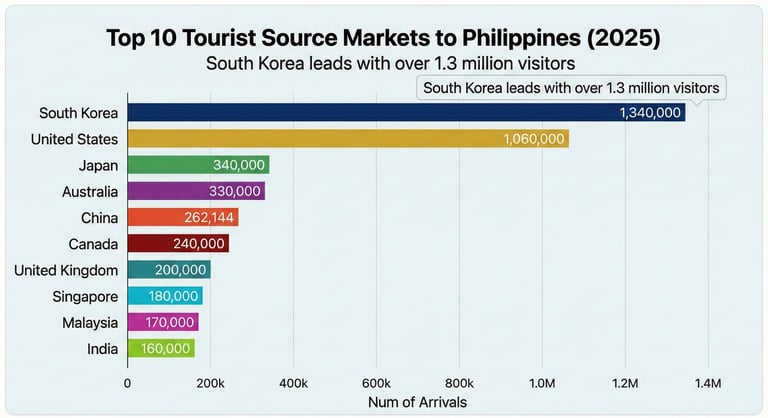
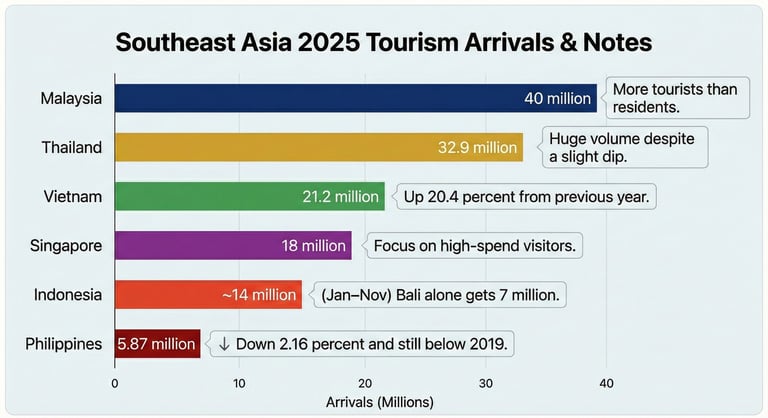
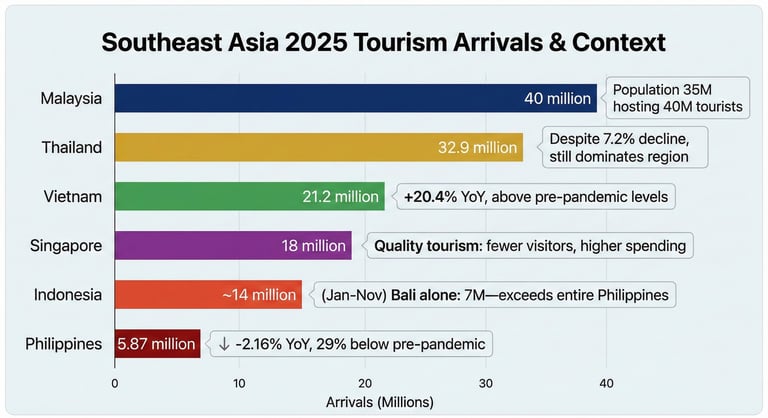
(If you want to see the receipts for all of this, the charts below say it better than I can. One shows who actually visits us (spoiler: South Korea and the US, not China), another shows how badly we’re trailing our Southeast Asian neighbors, and another shows how we’ve been cutting the tourism budget even while expecting it to carry the economy. Scroll through them with that in mind and the pattern becomes hard to ignore.)
Contact us
subscribe to morning coffee thoughts today!
inquiry@morningcoffeethoughts.org
© 2024. All rights reserved.
If Morning Coffee Thoughts adds value to your day, you can support it with a monthly subscription.
You can also send your donation via Gcash: 0969 314 4839.