
THE MINORITY SENATORS DIDN'T OBSTRUCT. THEY PROTECTED THE SENATE.
The minority senators didn't walk out in chaos — they walked out by the rules. This is the full, fact-checked story of what happened on May 26, 2026, why the Senate majority is desperate for remote voting, and why the SB-11 bloc was right. Before you believe the trolls, read this.
14 min read

[BLOGGER'S NOTE: This article is based on information available as of May 27, 2026. This story is still developing. Details may be incomplete, and additional facts may emerge as the situation unfolds. This post will be updated as new and verified information becomes available.]
There are moments in politics when the most powerful thing you can do is stand up and leave.
On the evening of May 26, 2026, eleven senators walked out of the Philippine Senate plenary hall. The DDS trolls immediately went to work — calling them obstructionists, law-benders, and drama queens. Social media lit up with coordinated attacks. The narrative was spun fast: they walked out because they were losing.
That is not what happened.
Let me tell you what actually happened, and why those eleven senators did exactly the right thing.
THE WALKOUT: WHAT ACTUALLY WENT DOWN
On May 26, the Senate majority — led by the newly installed Senate President Alan Peter Cayetano — pushed to immediately bring to the plenary floor a motion to amend Senate rules. The proposed amendment, originally introduced by Sen. Rodante Marcoleta on May 11, sought to allow senators to attend and participate in sessions "for justifiable reasons" through teleconference, video conference, or other remote means.
The minority bloc — calling themselves Solid Bloc 11, or SB-11 — objected. Not because they were afraid of a vote. Not because they wanted chaos. They objected because the majority was attempting to rush a vote without proper deliberation, without a proper committee report, and without allowing all members to raise their concerns and questions.
Lacson made the point precisely, and he came loaded with the rule book. He invoked Section 24 of the Senate Rules — which governs committee referrals and requires a duly constituted Committee on Rules to act on a proposal before it can be brought to the plenary floor.
The motion had already been referred to that committee on May 11. The committee should have deliberated first. But here was the problem: the Committee on Rules did not exist.
All committee posts were declared vacant when the Cayetano majority seized the leadership on May 11. No members. No chairman. Not even a Majority Leader had been elected to guide it through the process.
As Lacson put it: "How can the Committee on Rules properly function in the absence of the committee members? They were vacated. Walang chairman at members ang Committee on Rules. We cannot invoke continuity."
Cayetano hit back by invoking Section 136 of the Senate Rules — which he argued allowed the chamber to take up amendments directly on the floor, bypassing the committee, as long as a vote was held first to bring the matter to the plenary. He called the question of constituting the committee "irrelevant" and moved repeatedly to divide the chamber and put it to a vote.
Sotto, the former Senate President, sided with Lacson and backed the minority's position: the Rules Committee must be constituted first.
Sen. Kiko Pangilinan pushed back further, also citing Section 136 — but pointing out that since the motion could be treated as a new motion, it could not be voted on until the following Monday, June 1, at the earliest.
The Rules Committee — the very committee that should have handled this — had not even been formally constituted following the leadership shakeup that installed Cayetano just two weeks earlier. The majority was trying to amend the chamber's own rules using a committee that didn't exist yet, invoking a rule to bypass another rule, in a session presided over by the very man who benefited from the outcome.
Sen. Erwin Tulfo didn't mince words on the floor. "Why the rush? Why is the majority so eager to tackle this motion and create division?" he demanded. And then he said the quiet part loudly: "Is it because they fear that two of our colleagues might face jail time this weekend?"
The chamber went quiet. The implication was unmistakable.
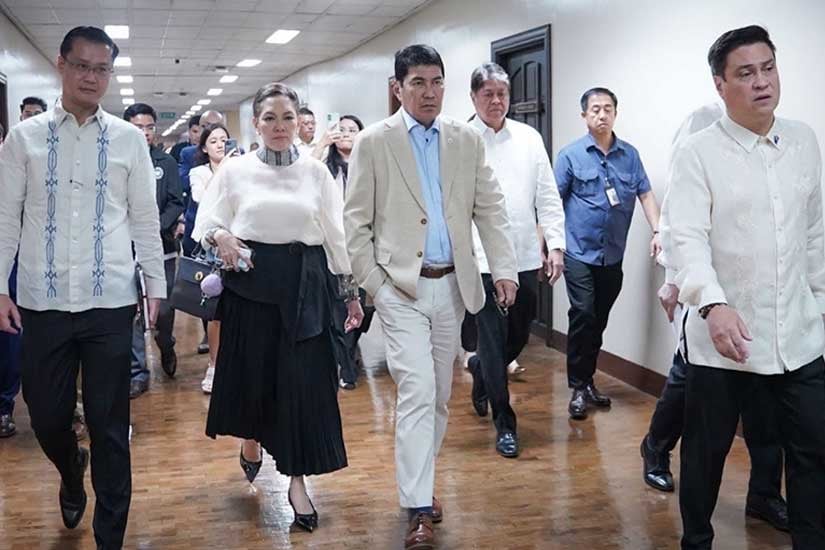
Led by Sen. Juan Miguel "Migz" Zubiri, the minority senators walked. "Let's go! We will no longer take part in this debate!" he said. And out they went — Senators Francis "Kiko" Pangilinan, Risa Hontiveros, Panfilo "Ping" Lacson, JV Ejercito, Erwin Tulfo, and others. Minority Leader Tito Sotto remained behind to formally declare that there was no longer a quorum — and Senate President Pro Tempore Loren Legarda, who was presiding at the time, had no choice but to adjourn the session.
The majority couldn't vote on the motion. The walkout worked.
In a joint statement released that night, the eleven senators said it plainly: "We walked out because the proceedings appeared chaotic rather than orderly. The proposed rule change impacts how senators can attend sessions and participate in legislative activities, and such a measure warrants thorough public discourse rather than being expedited by the majority's dominance."
A principled minority that refuses to be steamrolled is doing exactly what it was elected to do.
UNDERSTAND THE NUMBERS
Here is the math, and it matters.
The Senate has 24 members. A quorum — the minimum number of senators needed to conduct business — is 13. The Cayetano-led majority bloc controls exactly 13 senators. That's their entire margin. Every vote counts. Every warm body in that chamber counts.
But one of their 13 is Sen. Ronald "Bato" dela Rosa — a fugitive. He is not in the Senate. He is in hiding, evading an International Criminal Court arrest warrant for crimes against humanity — specifically, his alleged role as co-perpetrator in the murders of at least 32 persons during Rodrigo Duterte's drug war. The NBI has confirmed it has leads on his whereabouts. The Supreme Court denied his bid for a temporary restraining order. The Palace itself has called him a "fugitive from justice."
Without Bato, the majority has 12. They need 13 for a quorum. They cannot function.
This is not a minor inconvenience. This is a structural crisis for the Cayetano majority. The entire push for remote voting is, at its core, a lifeline for a bloc that is hemorrhaging numbers — not because of politics, but because some of their members are facing the law.
THE BIGGER PICTURE: WHY THEY WANT REMOTE VOTING SO BADLY
The remote voting proposal isn't just about Bato. Read the room. There is a domino effect happening.
The Bato dela Rosa crisis. The ICC unsealed Dela Rosa's arrest warrant on May 11, 2026. He had been in hiding for six months before dramatically resurfacing at the Senate. On May 13, gunfire broke out inside the Senate as authorities attempted to arrest him. He fled again. He is now a fugitive. He cannot walk into the Senate floor without risking arrest. Remote voting would allow him to vote from wherever he is hiding.
The flood control scandal. Ombudsman Jesus Crispin Remulla has confirmed that plunder and graft charges are being prepared against several senators tied to anomalous flood control projects. Among those being investigated: Senators Jinggoy Estrada and Joel Villanueva. Estrada specifically faces graft counts, and if plunder charges are filed, it is a non-bailable offense — meaning he could face immediate detention. If jailed, the Cayetano majority shrinks even further.
The Villar siblings. Senators Mark Villar and Camille Villar appeared before the Department of Justice in April 2026 for a preliminary investigation on Securities and Exchange Commission complaints against Villar Land Holdings Corp., which allege market manipulation, fraud, and insider trading. Camille Villar is specifically accused of insider trading. These are pending cases — but they signal legal trouble for more Cayetano allies.
The Sara Duterte impeachment. Senate President Cayetano is a known Sara Duterte ally. The impeachment trial began on May 18, 2026, with Cayetano himself as the presiding officer of the impeachment court. Under the Constitution, convicting Sara requires a two-thirds vote — 16 of 24 senators. Acquittal requires only 9. Duterte's camp needs to protect their 9 votes. Every senator matters. Remote voting, in this context, would allow compromised or physically absent senator-judges to still cast votes in her favor.
Read the anatomy of this push carefully: what the majority is selling as procedural reform is, in reality, a rescue operation for senators who cannot walk through the Senate's front door without risking arrest.
WHAT THE SENATE RULES ACTUALLY SAY
Read the text. No interpretation needed.
Senate Rule XIV, Section 41 is explicit. The Senate President may convene and hold a session through teleconference, video conference, or other remote means only under two conditions:
Force majeure — events beyond human control, like natural disasters or calamities
A national emergency — as determined by the majority of all Senate members, which prevents the Senate from convening or senators from being physically present in the session hall
A senator hiding from an international arrest warrant is not a force majeure. Being investigated for plunder is not a national emergency. Choosing not to show up because you might get arrested is not an uncontrollable circumstance — it is a consequence of one's own actions.
Lacson said it best in an interview on True FM: "Even sa rules ng Senado hindi rin pupwede. Ang umiiral na rules pag may force majeure or emergency tulad ng Covid noong panahon ng Covid pinayagan namin yan, di kami maka-session kung may lockdown." (Even the Senate rules do not allow such remote participation. Under the rules, it is only allowed during force majeure or emergency like COVID. During COVID, we had to resort to remote participation because of the lockdown.)
Hontiveros and Erwin Tulfo both echoed this: senator-judges and lawmakers are required to be physically present on the floor, especially when dealing with critical national issues like an impeachment trial. This is not an opinion. This is the rule.
And crucially: the jurisprudence of the Philippine Constitution, specifically Section 16(2) of Article VI, mandates that a majority of each House constitutes a quorum to do business — and existing jurisprudence and Senate rules require senators to be physically present to cast a valid vote. A vote cast remotely, under current rules, would be invalid. The majority was not just trying to bend a rule. They were trying to rewrite it on the fly, without proper process, to save their allies from the law.
This is not the first time remote participation has been attempted. Every previous effort either collapsed on its own or was actively killed:
August 2019 — The De Lima Proposal. Someone floated the idea of letting detained Sen. Leila de Lima join Senate sessions remotely from the PNP Custodial Center. Sen. Bong Revilla killed it immediately: "Equal protection and fair play dictates that Leila De Lima cannot be allowed to participate in Senate proceedings, even if only remotely. To allow her to vote in absentia would be a travesty against the Senate." No basis in the rules, he said. End of discussion.
May 4, 2020 — COVID Teleconferencing Adopted, De Lima Still Excluded. Senate Resolution No. 372 amended Rule XIV to allow remote sessions — but only under force majeure or national emergency. On the same day the rule was adopted, Senate President Sotto III said de Lima still could not participate. The Senate had no jurisdiction over her while she was detained, he said — only the courts and the PNP did. The new rule was created and she was locked out of it in one single session.
June 2020 — Muntinlupa RTC Says No. De Lima filed a formal omnibus motion asking a Muntinlupa court to allow her to join plenary sessions via teleconference. On June 18, 2020, the court denied it for lack of merit. She appealed. The appeal also went nowhere.
2007 to 2011 — Antonio Trillanes IV. Elected in 2007 with over 11 million votes while still behind bars for the 2003 Oakwood Siege charges, he filed an omnibus motion requesting permission to attend Senate sessions and perform his legislative duties. Both the Makati RTC and the Supreme Court denied him. The Supreme Court was blunt: allowing him to attend sessions "would render him a free man." Elected by millions. Denied anyway.
July 2014 — Juan Ponce Enrile. Arrested at age 90 — a sitting senator, a former Senate President — on plunder charges tied to the pork barrel scam, accused of pocketing P172 million in illegally diverted public funds. He was the third sitting senator arrested in that case, alongside Jinggoy Estrada and Bong Revilla. No remote participation was extended to him either. He served his detention the old-fashioned way — physically present to his consequences.
There is one more layer that former Senate President Franklin Drilon and others have raised — and it is a fatal practical flaw in the entire proposal.
Even if the Senate majority successfully amends its rules to allow remote voting, any senator who is under the jurisdiction of the Sandiganbayan cannot simply pick up a device and start voting.
Under Philippine law, a person under detention cannot be released, transferred, or granted special privileges without a separate court order. The detaining court — in this case the Sandiganbayan — has its own rules governing detainees, and the Senate cannot override a court's custody order. Any detainee seeking to use electronic devices or communications technology while in custody would need explicit authorization from that court.
The Senate can change its own rules all it wants. It cannot change the rules of a co-equal branch. And the Sandiganbayan has shown no indication it will play along.
To make matters worse: on the very same day the minority walked out — May 26, 2026 — the Sandiganbayan issued a precautionary hold departure order against Sen. Rodante Marcoleta himself, the very senator who authored the remote voting proposal, on charges of plunder, indirect bribery, and violation of Presidential Decree 46. The man pushing hardest for the rule change is now himself a subject of the court he was trying to work around.
TED FAILON ASKED THE RIGHT QUESTION
During a live interview on True FM, veteran journalist Ted Failon pressed Sen. Risa Hontiveros with a question that deserves a real answer. He asked: What makes senators so special? Samantalang ordinary people — when we are not at work, we are not allowed to get paid, if we are absent, we don't get to participate in anything. Why is there an exception for senators?
It is a fair question. And the honest answer only strengthens the minority's position.
There is no exception. Under normal circumstances, senators are held to the same standard as every Filipino worker — if you are not present, you do not participate. A senator who cannot show up to the floor has no business voting on laws that affect 110 million people. Physical presence is not a technicality. It is accountability.
And then Failon raised the second point — one that cuts even deeper. He noted that in cases of incarceration, detainees are not allowed to use gadgets or technology. This is standard practice in Philippine detention facilities. This is not an accident of policy. It is intentional.
Look no further than Leila de Lima. She was a senator — an elected senator — when she was detained at Camp Crame in February 2017 on drug charges her supporters and international human rights groups universally condemned as politically motivated. She sat in that cell for six years, eight months, and 21 days. During that time she had no cell phone, no internet access, no laptop, no electronic gadget. In 2020, during the pandemic, when the Senate adopted rules for remote participation, the Senate refused to allow de Lima to join via teleconference. Senate President Vicente Sotto III said the Senate "would have no jurisdiction" over her while she was detained, and that "only the courts and the PNP would have jurisdiction."
A Muntinlupa court denied her motion to attend Senate proceedings via videoconferencing.
So let's make this plain: when Leila de Lima — a sitting senator who was not a fugitive, who did not flee, who surrendered herself — asked to participate remotely in Senate sessions from her detention cell, they said no. When Bato dela Rosa — a fugitive from an international court, who ran from authorities, who was present during a Senate shooting — wants to vote remotely from wherever he is hiding, suddenly the majority wants to change the rules.
The double standard was deliberate. It was always the point
TO THE TROLLS PEPPERING THE SB-11 RIGHT NOW
The attacks being hurled at the 11 senators on social media right now follow a pattern that every Filipino who has been paying attention already knows.
They're calling it a "walkout." As if leaving a session that has no quorum without their presence is a scandal. As if using parliamentary procedure to block a rules amendment that violates existing rules is somehow unethical. As if the minority stopping the majority from railroading an illegal amendment is the problem here.
One commenter in a Philippine Star post captured the mob's logic: they call it "bending the law." But as another commenter rightly pointed out, "Hindi 'bending the law' ang pagpapasipot sa senador sa session hall, ang bending the law ay yung paggawa ng bagong rules para lang paboran ang isang taong tumakas sa batas."
Translation: Making a senator show up to session is not bending the law. Rewriting the rules to benefit someone who ran from the law — that is bending the law.
The minority bloc's walkout was strategic, constitutional, and legally sound. The quorum requirement exists precisely to prevent the majority from steamrolling the minority. The walkout forced adjournment. It prevented a hasty vote on a rule amendment that had not gone through the proper committee process. It bought time for deliberation — which is exactly what the legislative process is supposed to guarantee.
And yes, the DDS troll army is loud right now. They are always loud when the facts are against them. But the facts here are not ambiguous.
WHAT THIS IS REALLY ABOUT
At its core, this Senate crisis is a collision between the law and those who want to escape it.
One side has an ICC-wanted fugitive in their bloc, senators facing plunder investigations, and an impeachment defendant whose acquittal depends on keeping numbers together. They need remote voting to hold that coalition together — or at least to preserve the fiction that their absent members can still function as legislators.
The other side has eleven senators who looked at what was happening, identified it for what it was, and walked out.
That is not chaos. That is courage.
The Senate is not a convenience. It is the highest legislative body in the republic. Its members are elected by tens of millions of Filipinos who trust them to show up — literally and figuratively. Senators are not entitled to vote on the laws of this country from hiding. They are not entitled to participate in an impeachment trial from an undisclosed location. The privileges of office do not extend to those who flee from accountability.
The Solid Bloc 11 understood this. They stood their ground — and when standing their ground meant walking out, they walked.
That is what doing the right thing looks like.
SOURCES
Philstar — https://www.philstar.com/headlines/2026/05/27/2530834/remote-vote-sparks-walkout-sb-11
ABS-CBN News — https://www.abs-cbn.com/news/nation/2026/5/26/minority-senators-walk-out-after-clash-on-electronic-voting-rule-discussion-1956
ONE News PH — https://www.onenews.ph/articles/with-videos-remote-vote-sparks-walkout-by-sb-11
GMA Network — https://www.gmanetwork.com/news/topstories/nation/989065/minority-senators-walkout-debate-participation-senate/story/
Manila Bulletin — https://mb.com.ph/2026/05/26/senators-clash-over-marcoletas-push-for-online-participation-for-senators-minority-walks-out
ONE News PH (Lacson remote voting) — https://www.pna.gov.ph/articles/1275635
Manila Bulletin (Lacson virtual participation) — https://mb.com.ph/2026/05/22/lacson-bid-for-virtual-participation-in-vp-impeachment-trial-other-senate-proceedings-wont-prosper
ICC Official Statement — https://www.icc-cpi.int/news/situation-philippines-icc-judges-unseal-arrest-warrant-against-ronald-marapon-dela-rosa
Philstar Full Text ICC Warrant — https://www.philstar.com/headlines/2026/05/12/2527309/full-text-icc-warrant-arrest-ronald-bato-dela-rosa
DW News — https://www.dw.com/en/philippines-icc-warrant-ronald-dela-rosa-war-on-drugs/a-77236603
BBC (Bato escapes ICC arrest) — https://www.bbc.com/news/articles/cn8p1zrr9nxo
BBC (Senate shooting) — https://www.bbc.com/news/articles/c5y7edln4j0o
LA Times (Senate gunfire) — https://www.latimes.com/world-nation/story/2026-05-13/gunfire-breaks-out-in-philippine-senate-where-authorities-have-tried-to-arrest
PNA (police tracker teams) — https://www.pna.gov.ph/articles/1275651
The Diplomat (Sara impeachment trial) — https://thediplomat.com/2026/05/philippine-senate-kicks-off-impeachment-trial-of-vice-president-sara-duterte/
Inquirer (conviction vote count) — https://www.facebook.com/inquirerdotnet/posts/how-many-votes-are-needed-to-convict-or-acquit-vp-saraunder-the-constitution-con
Inquirer Opinion (impeachment trial analysis) — https://opinion.inquirer.net/191625/the-impeachment-trial-has-not-begun-but-it-is-already-over
Khaleeji Times (Ombudsman flood control plunder) — https://www.khaleejtimes.com/world/asia/philippine-ombudsman-set-to-file-plunder-raps-vs-lawmakers-contractors-in-flood-control
Politiko PH (Jinggoy jail threat) — https://politiko.com.ph/2026/05/18/alan-cayetanos-numbers-crumbling-jail-threat-for-jinggoy-rocks-senate-power-play/daily-feed/
Philstar (Villar siblings SEC case) — https://www.philstar.com/business/2026/04/20/2522333/villar-siblings-file-answers-sec-case-real-estate-firm
Senate Rules of the Philippines PDF — https://legacy.senate.gov.ph/rules%20of%20the%20senate-final.pdf
Senate Pocket Rules January 2026 PDF — https://senate.gov.ph/hq/uploads/temp/16394881-a838-4d3e-90ee-af89cede94b7.pdf
Alan Peter Cayetano Facebook (Section 136) — https://www.facebook.com/alanpetercayetano/videos/plenary-session/1727481295358280/
Wikipedia (2026 Senate President election) — https://en.wikipedia.org/wiki/2026_President_of_the_Senate_of_the_Philippines_election
SunStar (Cayetano elected Senate President) — https://www.sunstar.com.ph/manila/alan-peter-cayetano-elected-as-new-senate-president
PNA (Cayetano takes Senate helm) — https://www.pna.gov.ph/articles/1274753
Philstar (Revilla slams De Lima remote proposal 2019) — https://www.philstar.com/headlines/2019/08/27/1946870/special-treatment-revilla-slams-proposal-let-de-lima-join-sessions
Senate Press Release Revilla 2019 — https://legacy.senate.gov.ph/press_release/2019/0827_revilla1.asp
Senate PRIB Press Release (teleconferencing May 4, 2020) — https://legacy.senate.gov.ph/press_release/2020/0504_prib3.asp
PNA (Senate adopts hybrid sessions COVID) — https://www.pna.gov.ph/articles/1101826
FIDH (De Lima prevented from participating) — https://www.fidh.org/en/issues/human-rights-defenders/arbitrarily-imprisoned-senator-de-lima-prevented-from-participating
FIDH (De Lima incommunicado detention) — https://www.fidh.org/en/issues/human-rights-defenders/philippines-incommunicado-detention-of-senator-leila-de-lima
PNA (Court junks De Lima motion) — https://www.pna.gov.ph/articles/1106458
Senate Press Release De Lima dismayed 2020 — https://legacy.senate.gov.ph/press_release/2020/0619_delima2.asp
Senate Press Release De Lima appeals 2020 — https://legacy.senate.gov.ph/press_release/2020/0626_delima2.asp
OMCT (De Lima one-year anniversary) — https://www.omct.org/en/resources/urgent-interventions/release-of-senator-leila-de-lima-urged-on-the-one-year-anniversary-of-her
Amnesty International (De Lima 2023) — https://www.amnesty.org/en/latest/news/2023/02/philippines-leila-de-lima-detention/
Amnesty International (De Lima acquittal 2024) — https://www.amnesty.org/en/latest/news/2024/06/philippines-leila-de-lima-as-last-bogus-charge-dismissed/
Amnesty International PH (2,454 days) — https://www.amnesty.org.ph/2024/03/leila-de-lima-how-i-survived-2454-days-in-arbitrary-detention/
CNN (De Lima acquitted 2024) — https://www.cnn.com/2024/06/24/asia/philippines-leila-de-lima-acquitted-intl-hnk
BBC (De Lima acquitted 2024) — https://www.bbc.com/news/articles/cqeeeq8r18go
ONE News PH (Panolong mockery of law) — https://www.facebook.com/ONENewsPH/posts/panolong-marcoleta-move-to-allow-electronic-voting-by-senators-is-a-mockery-of-l/151938
Respicio.ph (quorum and voting majorities) — https://www.respicio.ph/bar/2025/political-law-and-public-international-law/legislative-department/quorum-and-voting-majorities
Contact us
subscribe to morning coffee thoughts today!
inquiry@morningcoffeethoughts.org
© 2024. All rights reserved.
If Morning Coffee Thoughts adds value to your day, you can support it with a monthly subscription.
You can also send your donation via Gcash: 0969 314 4839.