
The Quiet Power Of Time: How The Philippine Congress Lower House Kills Bills
The Philippine Congress lower house decides how often it shows up, how long it works, and which bills quietly die on the calendar. It’s where “productivity” is measured in press releases while landmark reforms wait for a quorum that never comes. Watching the Philippine Congress lower house means watching how time itself gets used as a political weapon.
12 min read
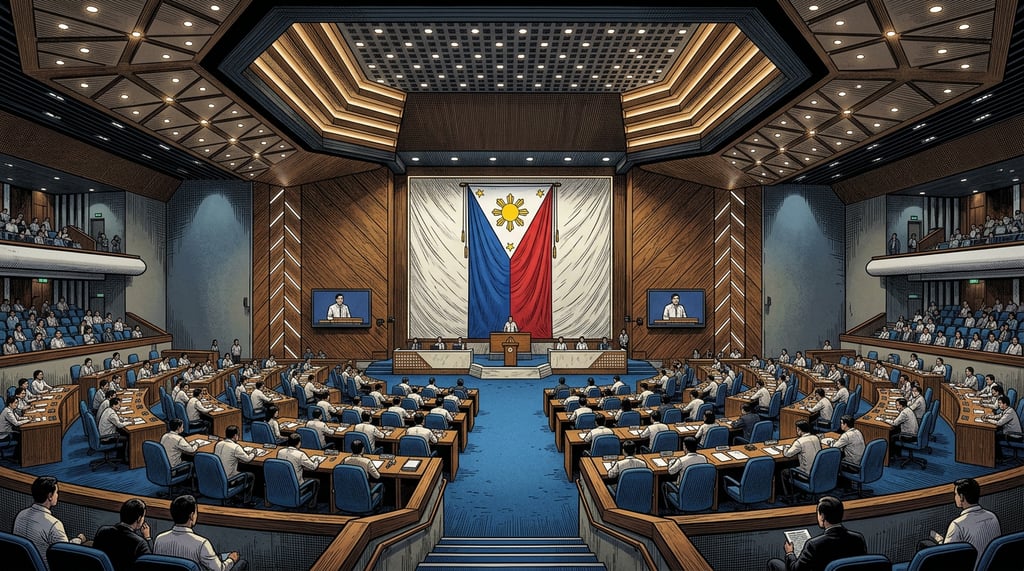

In May 1923, a New York Times correspondent wrote a story from Manila with a headline that read: "100 Days of Filibustering is Record Set by Filipinos." The story described a Philippine Legislature that would show up, then immediately vote to go home. Day after day. For 100 days.
By then, Congress had done almost nothing with its time. The Governor-General finally had to issue an executive order extending the session by four days just to force passage of over 100 bills.
That was over a century ago.
The 19th Congress of the Philippines — which ran from July 2022 to June 2025, a full three years — met for a total of 188 session days. By the House's own count. That works out to roughly 63 days a year.
Let's mull over that number for a moment.
HOW THE CALENDAR GOT THIS WAY
The strange thing about this calendar is it didn’t fall from the sky. It was written into the rules, then slowly loosened until almost nothing was left.
The 1935 Constitution had a hard ceiling: Congress could not sit in regular session for more than 100 days. That was a cap, not a floor, but it still meant Congress had to actually show up and work toward that limit. Under the American colonial period, the budget cycle and the school year shaped when lawmakers went to session and when they went home.
Then martial law happened. From 1972 to 1978, there was no functioning legislature. Congress was padlocked.
Ferdinand Marcos ruled by decree (issuing laws directly from Malacañang). The Batasang Pambansa eventually met in 1978, and the 1973 Constitution that governed it included one notable safeguard: recesses — the official breaks from session — could not exceed 30 days each and could not total more than 90 days in a year.
When the 1986 Constitutional Commission (ConCom) convened to write the current constitution, they faced a real dilemma. The legislature had been suppressed for 14 years.
The instinct of the framers was to restore full autonomy. Commissioner Hilario Davide Jr., who led the committee in charge of Congress, worked with a body determined to rebuild democratic institutions from the ground up.
What they produced was Article VI, Section 15 of the 1987 Constitution. It sets the opening date of regular sessions — the fourth Monday of July — and says Congress may continue “for such number of days as it may determine.” No minimum. No floor. No recess limit.
The 90-day annual recess cap from the 1973 Constitution vanished. The records of the ConCom don’t contain an explicit debate about why it was dropped. It simply wasn’t included.
This wasn’t some cartoon-villain plot baked into the text. The framers were focused on autonomy, not on imagining how a future majority would twist that autonomy. But what that omission produced is right there in the numbers, and it is hard to look at those numbers and feel good about the decision.
WHAT 63 DAYS A YEAR ACTUALLY MEANS
On paper, 63 session days might not sound that bad. Until you look at how other parliaments spend their year.
The US House of Representatives typically meets for around 130 to 150 legislative days per year. The UK House of Commons sits around 150 to 170 days annually, with recesses totaling about 13 weeks.
Japan’s Diet (its national parliament) has a statutory minimum of 150 calendar days for its ordinary session (its main yearly sitting), plus additional days in extraordinary sessions. Even Malaysia — which has its own history of thin parliaments — averages roughly 70 sitting days per year.
The Philippines sits at the bottom of that comparison at roughly 63 session days annually, and unlike Japan and South Korea, there is no constitutional or statutory minimum. Congress is legally free to sit for as few days as it chooses.
Here is what a typical Philippine congressional year looks like in practice. After opening in late July, the first recess begins in early October — lasting about 37 days for the All Saints’/All Souls’ Day break.
Then Congress returns and sits through December before another recess of roughly 37 days for Christmas and New Year. Then back in late January, before a Holy Week recess of about 44 days.
Then a brief final sprint before the sine die adjournment (the official end of the regular session) in early June, followed by a summer gap of about 51 days until the next session opens.
In the 19th Congress’s first regular session, the total break days in the session year alone came to approximately 169 calendar days in formal recess. None of these recesses — except the summer gap between Congresses — has any basis in the Constitution. They are set entirely by concurrent resolutions (internal schedule agreements between the House and Senate).
The calendar is not something that was imposed on Congress. Congress built it.
WHAT GETS KILLED BY THE CLOCK
This is where the calendar stops being boring and starts becoming dangerous.
There is a rule in both chambers that all pending bills lapse at the end of each Congress. Every bill that did not make it through both houses and get signed by the President dies. It has to be refiled from scratch in the next Congress.
The Freedom of Information bill has been filed, passed in some form, and died in at least five separate Congresses. It passed the Senate in the 15th, 16th, and 17th Congresses but died in the House each time.
On June 4, 2010, the last session day of the 14th Congress, only 128 of 268 House members showed up — seven short of the quorum needed to ratify the bill. The FOI bill died that afternoon.
Then in the 15th Congress, the House again repeatedly failed to muster a quorum on days when the FOI bill was scheduled for discussion. Sessions were suspended abruptly, sometimes without even a roll call vote, and the measure quietly stalled.
The Freedom of Information Act, as of 2026, has still never been enacted. It has been in active legislative circulation for more than 30 years.
The Anti-Political Dynasty bill is constitutionally mandated. Article II, Section 26 of the 1987 Constitution instructs Congress to pass an enabling law (the statute needed to put that constitutional rule into effect) to implement it. It has been filed in every Congress since 1987. It has never passed second reading in either chamber. Not once.
The first Bangsamoro Basic Law under President Aquino failed in the 16th Congress, derailed by the political fallout from the Mamasapano clash and the collapse of support that followed. A revised version — the Bangsamoro Organic Law — was later passed in the 17th Congress and signed into law in July 2018.
It is worth being specific about what this means. The majority leadership in both chambers controls which bills reach the floor, when votes happen, and when the chamber adjourns.
A bill can be killed without ever being voted down. A recorded “no” vote creates a story. It creates a list of names. It creates a target. Letting the clock run out does not.
A bill can die because the leadership “fails” to muster a quorum. Because the session is suspended. Because no one answers the roll call. On paper, no one opposed the measure. In practice, enough people stayed away to make sure it never made it to law.
Not every dead bill is a victim of the calendar; some are vetoed, some are struck down, some are overtaken by scandal. But when the majority wants to avoid fingerprints, the clock is the cleanest weapon.
THE PRODUCTIVITY CLAIM AND WHAT IT OBSCURES
The system knows this looks bad. That’s why the PR machine leans hard on the word “productivity.”
Speaker Martin Romualdez, at the end of the 19th Congress, said his chamber passed 1,565 measures in 188 session days — roughly 28 measures per session day. That sounds impressive.
The same period saw 13,867 measures filed. Of those, about 280 became law — an enactment rate somewhere around 2 percent. And 739 House-approved measures were still pending before the Senate at the sine die adjournment. They lapsed with the gavel.
The “28 bills a day” figure is technically true but basically meaningless. The measures Congress passes quickly tend to be local in scope: naming roads, declaring new holidays, creating barangays, upgrading hospitals to higher categories. These matter to local communities. They are not the same thing as passing an FOI law or an anti-dynasty statute.
The budget is the clearest example of how structure and time collide. When Congress fails to pass the General Appropriations Act on time, the country operates on a reenacted budget — an automatic extension of the previous year’s appropriations while the new budget is delayed. This has happened multiple times in recent decades, and ordinary people pay the price.
Under the 1987 Constitution, Congress has months between the President’s budget submission and the end of the fiscal year to do its work. When that window is missed and reenactment kicks in, it is not just a technical delay. It is a sign that the one bill government cannot afford to drop still fell through the cracks of a calendar Congress designed for itself.
Congress has from July to December to pass the most important piece of legislation it handles every year. When it needs emergency extensions or ends up with a reenacted budget, it is not because the calendar was too tight. It is because the calendar was not used.
WHO BENEFITS FROM THIS ARRANGEMENT
The point of all this is not just that Congress is lazy. It is that the schedule is built to protect the people who already hold power.
The legislative calendar is set by concurrent resolution, a schedule both chambers approve for themselves. In practice, this means the Senate President and the House Speaker control the calendar, along with their majority leaders. They decide when recesses begin, how long they run, and whether the calendar gets amended when things get tight.
They have no structural incentive to extend session days. More working days mean more floor time for minority members to raise uncomfortable issues.
More opportunities for interpellations that generate headlines. More time for civil society to mobilize against legislation the majority wants to pass quietly, or against legislation the majority wants to quietly kill.
Short sessions protect incumbents from scrutiny. Long breaks give legislators time to work their districts, raise funds, and manage their political networks. A quorum call on the last day of a Congress is, functionally, a veto that leaves no fingerprints.
The ConCom’s decision to give Congress complete self-determination over its own calendar was rooted in good faith. The post-Marcos era demanded that democratic institutions be trusted to govern themselves. What the framers may not have fully anticipated is that the people who benefit most from a short session are exactly the people who get to decide how short it is.
The 1973 Constitution — the Marcos-era constitution designed for a rubber-stamp legislature — at least had a 90-day annual recess limit. The 1987 Constitution, drafted to restore democratic governance, removed it.
That gap has never been closed. No serious charter change proposal has targeted the legislative calendar. The Cha-cha debates of various administrations focused on economic provisions, unicameralism, federalism, term limits. Not on whether Congress should be required to actually show up.
In 1923, a colonial-era legislature went 100 days without passing a bill. The pattern was documented, criticized, and filed away. Over a century later, the Philippine Congress meets for roughly 63 days a year and calls it productive.
At some point, the question stops being whether Congress is working hard enough on the days it shows up. The question is why nobody who has the power to change the calendar has any reason to do so.
SOURCES:
The LawPhil Project, 1987 Philippine Constitution, https://lawphil.net/consti/cons1987.html
The LawPhil Project, 1935 Philippine Constitution, https://lawphil.net/consti/cons1935.html
The LawPhil Project, 1973 Philippine Constitution, https://lawphil.net/consti/cons1973.html
Supreme Court E-Library, Constitutional Commission Journal No. 35, https://elibrary.judiciary.gov.ph/thebookshelf/showdocs/11/50989
Supreme Court E-Library, ConCom Law, https://elibrary.judiciary.gov.ph/thebookshelf/showdocs/3/357
Supreme Court E-Library, G.R. No. 236118 (TRAIN quorum case), https://elibrary.judiciary.gov.ph/thebookshelf/showdocs/1/69133
Scribd, 18th Congress Schedule (Senate Concurrent Resolution), https://fr.scribd.com/document/428617622/18th-Congress-Schedule
Inquirer, House sets 19th Congress first regular session calendar, https://newsinfo.inquirer.net/1639522/house-adopts-concurrent-reso-setting-calendar-for-19th-congress-first-regular-session
Congress.gov.ph, Speaker's Opening Speech, Third Regular Session July 22 2024, https://www.congress.gov.ph/media/press-releases/view/?content=8981
Congress.gov.ph, 19th Congress Sine Die Press Release, https://www.congress.gov.ph/media/view/?content=5888
Philippine News Agency, 18th Congress passed 311 bills that became law, https://www.pna.gov.ph/articles/1176541
Inquirer, House of Representatives: At least 96 bills enacted into law in 17th Congress, https://newsinfo.inquirer.net/998192/house-of-representatives-at-least-96-bills-enacted-into-law-in-17th-congress
PhilStar, 13,867 measures filed, 280 laws enacted — House, https://www.philstar.com/headlines/2025/06/11/2449690/13867-measures-filed-280-laws-enacted-house
ANC 24/7 (YouTube), Romualdez: 19th Congress passed 1,565 measures in 188 session days, https://www.youtube.com/watch?v=R8r6I8c1SFw
ABS-CBN, By the numbers: Bills passed into law under Duterte administration, https://www.abs-cbn.com/spotlight/07/25/22/by-the-numbers-bills-passed-into-law-under-duterte-admin
PhilStar, House kills Freedom of Information bill, https://www.philstar.com/headlines/2010/06/05/581146/house-kills-freedom-information-bill
PCIJ, House fails to ratify FOI due to supposed lack of quorum, https://pcij.org/2010/06/08/house-fails-to-ratify-foi-due-brto-supposed-lack-of-quorum/
Inquirer, FOI Bill in jeopardy as House fails to muster quorum again, https://newsinfo.inquirer.net/349141/foi-bill-in-jeopardy-as-house-fails-to-muster-quorum-again
PhilStar, Congress extends sessions up to December 23, https://www.philstar.com/headlines/2025/12/11/2493364/congress-extends-sessions-december-23
Inquirer, House OKs reso amending schedule, pushing first break to October 11, https://newsinfo.inquirer.net/2094962/house-oks-reso-amending-schedule-pushing-first-break-to-october-11
ABS-CBN, Senate approves change in adjournment to Dec 23 to ensure budget ratification, https://www.abs-cbn.com/news/nation/2025/12/9/senate-approves-change-in-adjournment-of-session-to-dec-23-to-ensure-budget-ratification-1940
VERA Files, 2026: New year, old resolve, or more ghost projects?, https://verafiles.org/articles/2026-new-year-old-resolve-or-more-ghost-projects
VERA Files, SONA 2024 Promise Tracker, https://verafiles.org/articles/sona-2024-promise-tracker
IBON Foundation, Submission to UN CESCR January 2025, https://www.ibon.org/wp-content/uploads/2025/02/IBON-Foundation-Submission-CESCR_PHL-2501-31.pdf
IBON Foundation, Another misfiring LEDAC agenda, https://www.ibon.org/tag/philippine-congress/
Respicio & Co., What Happens to Legislative Bills When a New Congress Starts in the Philippines, https://www.respicio.ph/commentaries/what-happens-to-legislative-bills-when-a-new-congress-starts-in-the-philippines-1
IPU Parline, Philippines House of Representatives, https://data.ipu.org/parliament/PH/PH-LC01/working-methods/structure
IPU Parline, Indonesia House of Representatives, https://data.ipu.org/parliament/ID/ID-LC01/working-methods/structure
IPU Parline, Thailand House of Representatives, https://data.ipu.org/parliament/TH/TH-LC01/working-methods/structure
IPU Parline, South Korea National Assembly, https://data.ipu.org/parliament/KR/KR-LC01/working-methods/structure
US Senate, Dates of Sessions of the Congress, https://www.senate.gov/legislative/DatesofSessionsofCongress.htm
US House of Representatives History, List of all Sessions, https://history.house.gov/Institution/Session-Dates/All/
UK Government, Guide to Parliamentary Work, https://www.gov.uk/government/publications/guide-to-parliamentary-work/guide-to-parliamentary-work-html
Japan House of Councillors, Guide Activities, https://www.sangiin.go.jp/eng/guide/activi/index.htm
Japan Up Close, Government Basics: Key Numbers Related to National Diet of Japan, https://japanupclose.web-japan.org/policy/p20230106_1.html
Official Portal of the Parliament of Malaysia, Calendar, https://www.parlimen.gov.my/takwim-dewan-rakyat.html?uweb=dr&lang=en
Parliament of Malaysia Journal, The Case for Shared Control of Parliamentary Time in the Dewan Rakyat, https://journalmp.parlimen.gov.my/jurnal/index.php/jmp/article/download/148/75
Free Malaysia Today, Parliament to sit for 69 days in 2024, https://www.freemalaysiatoday.com/category/nation/2024/01/03/parliament-to-sit-for-69-days-in-2024-5-fewer-than-last-year
DAP Malaysia, DAP wants number of sitting days in Parliament to be increased, https://dapmalaysia.org/en/dap-wants-number-of-sitting-days-in-parliament-to-be-increased/
The New York Times, 100 Days of Filibustering is Record Set by Filipinos, https://www.nytimes.com/1923/05/13/archives/100-days-of-filibustering-is-record-set-by-filipinos-governor.html
Philippine STAR, Senate adjourned its session on February 5 2025, https://www.facebook.com/PhilippineSTAR/posts/the-senate-adjourned-its-session-on-wednesday-february-5-2025-which-marks-the-be/1067376795426199/
Tempo Indonesia, Indonesia's DPR Begins Recess Period from October 3 to November 3, https://en.tempo.co/read/2053992/indonesias-dpr-begins-recess-period-from-october-3-to-november-3
BusinessWorld, Proposal reviving Cha-cha talks in the works, congressman says, https://www.bworldonline.com/editors-picks/2025/07/10/684623/proposal-reviving-cha-cha-talks-in-the-works-congressman-says/
EIN Presswire, Chiz on passing 137 bills on his first 100 days as Senate chief, https://www.einpresswire.com/article/747104636/chiz-on-passing-137-bills-on-his-first-100-days-as-senate-chief
PNA, House adjourns sine die, June 1 2022, https://www.pna.gov.ph/articles/1175694
PNA (Facebook), 7,030 bills and 645 resolutions filed at the House in 22 session days of 20th Congress, https://www.facebook.com/pnagovph/posts/a-total-of-7030-bills-and-645-resolutions-were-filed-at-the-house-of-representat/1288661999976918/
House of Representatives YouTube, House 1st Regular Session 32 Day 2 March 10 2026, https://www.youtube.com/watch?v=DudXjmqgEGM
Antonio Contreras, Facebook post on Session Days, https://www.facebook.com/tonton.contreras/posts/session-daysthe-constitution-used-a-very-specific-phrase-session-daysnot-calenda/10227412871221648/
National Assembly Act of South Korea, https://elaw.klri.re.kr/eng_service/lawView.do?hseq=25732&lang=ENG
Anycase.ai, Commonwealth Act No. 17, https://anycase.ai/reader/law/statutes/commonwealth_act/1935/12/m3FkA6mA2WRu
The Diplomat, Why Did Duterte Veto the Philippine SIM Card Registration Act?, https://thediplomat.com/2022/04/why-did-duterte-veto-the-philippine-sim-card-registration-act/
Philippine News Agency, Duterte vetoes SIM registration bill, https://www.pna.gov.ph/articles/1172272
PhilStar, Duterte rejects bill requiring SIM card, social media account registration, https://www.philstar.com/headlines/2022/04/15/2174584/duterte-rejects-bill-requiring-sim-card-social-media-account-registration
ABS-CBN, Duterte vetoes SIM card registration act due to social media provision, https://news.abs-cbn.com/news/04/15/22/duterte-vetoes-sim-card-registration-act
Bangsamoro Government / OPAPP, Duterte signs Bangsamoro Organic Law, https://peace.gov.ph/2018/07/prrd-signs-bangsamoro-organic-law/
Wikipedia, Bangsamoro Organic Law, https://en.wikipedia.org/wiki/Bangsamoro_Organic_Law
PNA, TIMELINE: The Bangsamoro peace process, https://www.pna.gov.ph/articles/1059598
New Mandala, The Mamasapano clash, memories of violence, and Muslim belonging in the Philippines, https://www.newmandala.org/mamasapano-memories-muslim-belonging-philippines/
PCIJ, House fails to ratify FOI due to supposed lack of quorum, https://pcij.org/2010/06/08/house-fails-to-ratify-foi-due-brto-supposed-lack-of-quorum/
GMA News, Absence of House members kills Freedom of Info bill, https://www.gmanetwork.com/news/topstories/nation/192676/absence-of-house-members-kills-freedom-of-info-bill/story/
Makati Business Club, Freedom of Information Bill Briefing, https://mbc.com.ph/wp-content/uploads/MBCRR-119.pdf
Stratbase ADR Institute, The pernicious effects of the reenacted budget, https://adrinstitute.org/2019/04/24/the-pernicious-effects-of-the-reenacted-budget/
The GUIDON, New year, old budget: The case of delayed appropriations, https://theguidon.com/2019/04/new-year-old-budget-case-delayed-appropriations/
Manny Villar, Reenacted Budget per se is Not Bad, https://www.mannyvillar.com.ph/multimedia/reenacted-budget-per-se-is-not-bad/
Wikipedia, National Diet, https://en.wikipedia.org/wiki/National_Diet
The House of Representatives, Japan – Diet functions, https://www.shugiin.go.jp/internet/itdb_english.nsf/html/statics/guide/dietfun.htm
Britannica, Diet | Japan, History, Structure, & Powers, https://www.britannica.com/topic/Diet-Japanese-government
House of Representatives, Japan – Structure of the National Diet, https://www.shugiin.go.jp/internet/itdb_english.nsf/html/statics/guide/structure.htm
Contact us
subscribe to morning coffee thoughts today!
inquiry@morningcoffeethoughts.org
© 2024. All rights reserved.