
The Real Cost of the E-Jeepney in the Philippines — And Who's Paying for It
What gets announced as a modernization story is, on closer inspection, a procurement story. And the people paying for it — one P33,000 monthly amortization at a time — are the same drivers and operators the program claims to be helping.
12 min read
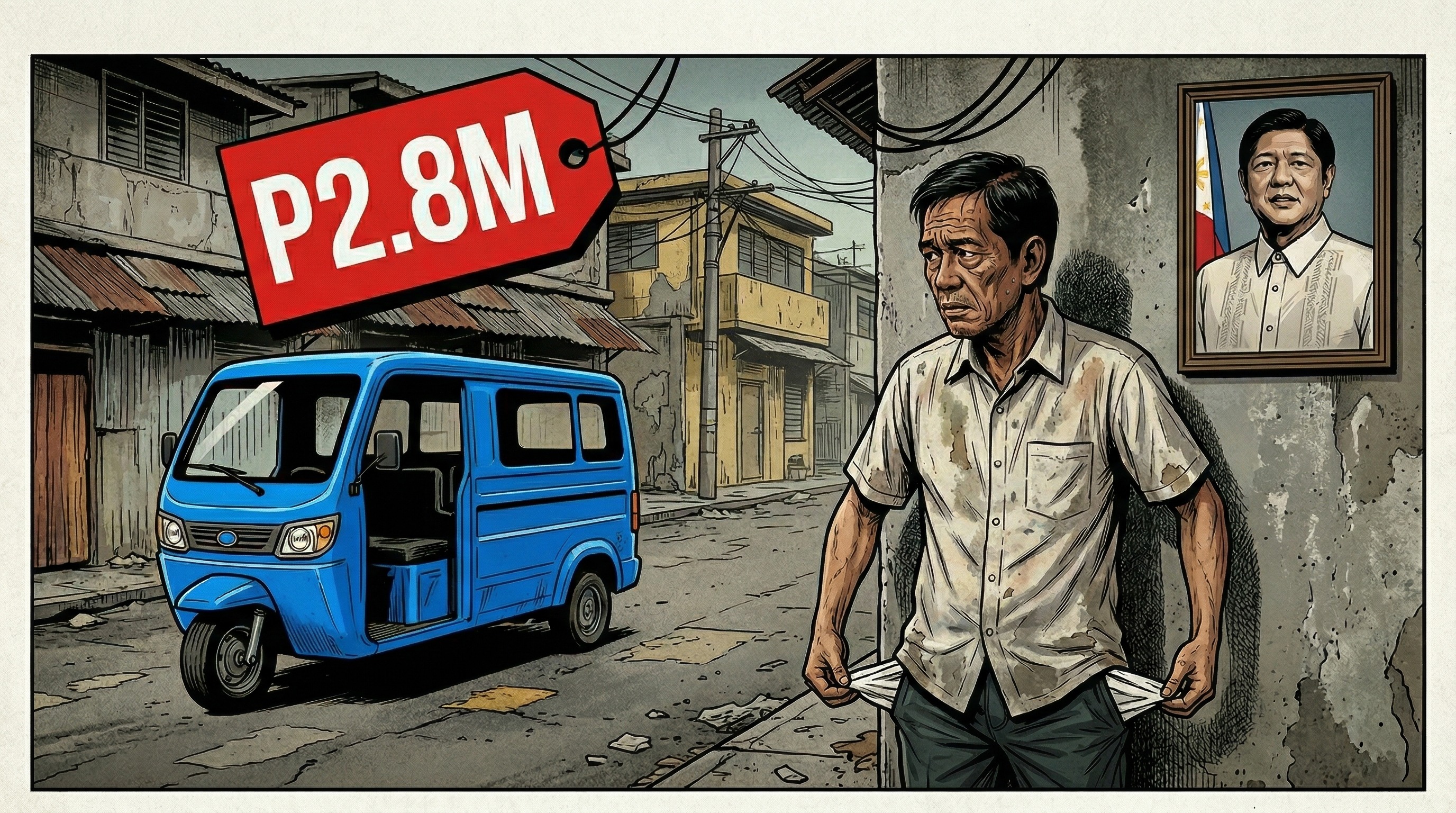

The government is pushing electric vehicles as the future of Philippine public transport. Clean, modern, efficient. The pitch is good. But then the price flashes on screen — P2.8 million per unit — and the first question that comes to mind is the simplest one: how is an ordinary jeepney driver supposed to afford that?
These are people who, under normal conditions, net P600 to P1,000 a day after fuel and food. As of March 2026, with fuel prices spiking due to Middle East tensions, that number has dropped to P200 to P500 daily. People who have been running the same routes for decades, often on a vehicle they own outright, paid for piece by piece. The government is now telling them that vehicle is illegal — and the replacement costs more than most of them will earn in a decade of driving.
That one number is where this story starts.
The Policy Architecture: What the Government Built
The current EV push in Philippine public transport rests on three interlocking policy pillars: the PTMP (Public Transport Modernization Program), the EVIDA law (Electric Vehicle Industry Development Act), and the CREVI (Comprehensive Roadmap for the Electric Vehicle Industry).
The PTMP (Public Transport Modernization Program)
Originally launched in 2017 as the PUVMP (Public Utility Vehicle Modernization Program) under Department Order No. 2017-011, the program's central mandate is simple: replace all jeepneys 15 years or older with units fitted with at least Euro 4-compliant engines or fully electric powertrains. All individual operators must consolidate into cooperatives or corporations with a minimum fleet of 15 units to secure a franchise — effectively ending the era of the individual jeepney owner-operator.
The Marcos administration continued the program and set a hard deadline: consolidate by December 31, 2023, or be declared colorum. Operators who failed to comply had their franchises revoked. As of 2024, unconsolidated jeepneys could be apprehended on two grounds — operating without a franchise and failure to register.
Once a cooperative gets consolidation approval, they have 27 months to actually purchase compliant vehicles. That is the window operators are working with. And within that window, they are expected to absorb a unit that costs more than most of them will earn in years.
EVIDA (Electric Vehicle Industry Development Act)
Republic Act 11697, or EVIDA, lapsed into law in April 2022. It provides the legal framework governing the manufacture, importation, installation, and regulation of EVs in the Philippines. The law gives fully battery-electric vehicles zero excise tax under the TRAIN Law (Tax Reform for Acceleration and Inclusion), and a 50% excise tax discount for hybrids. BEV (Battery Electric Vehicle) owners also get a 30% discount on MVUC (Motor Vehicle User's Charge), an eight-year exemption from number coding, and priority registration at the LTO (Land Transportation Office).
These incentives are primarily designed to reduce the burden on EV importers and manufacturers. The downstream benefits to individual operators and drivers are indirect and often negligible against a P2.8 million price tag.
CREVI (Comprehensive Roadmap for the Electric Vehicle Industry)
CREVI is the government's long-range blueprint for building a domestic EV ecosystem, operating in three phases. The short-term phase covering 2023 to 2024 focused on policy creation, pilot programs, EV battery research, and initial EVCS (Electric Vehicle Charging Station) deployment. The medium-term phase running 2025 to 2028 targets the growth of domestic EV manufacturing, industry standard-setting, and supply chain expansion. The long-term phase from 2029 to 2050 envisions a nationwide EV network powered by renewable energy with full digitalization of transport systems.
The headline target: at least 2.5 million EVs on Philippine roads by 2040, scaling up to a 50% EV fleet share under the Clean Energy Scenario. By 2028, the government aims to have 7,300 EV charging stations nationwide, growing to 20,400 by 2040.
EVIS (Electric Vehicle Incentive Strategy)
The EVIS, developed by the DTI-BOI (Department of Trade and Industry – Board of Investments), is designed to bridge the cost gap between EVs and traditional vehicles through targeted fiscal incentives for manufacturers. It targets the production of up to nine million EVs and the deployment of nearly 400,000 charging stations by 2040. The DTI projects it will attract P120 billion in capital investments, generate 680,000 jobs, produce P11.4 trillion in economic output, and save up to $30 billion in foreign exchange.
How the Government Plans to Sell It to Operators and Drivers
The government's pitch rests on a package of financial instruments, legal pressure, and non-fiscal perks. It is, in theory, a carrot-and-stick approach. In practice, the stick is much heavier than the carrot.
The Financing Pathway
The primary financial pathway for operators is a loan from GFIs (Government Financial Institutions) — specifically the DBP (Development Bank of the Philippines) or LBP (Land Bank of the Philippines) — covering up to 95% of the acquisition cost of a modern PUV unit, repayable over seven years at a fixed 6% interest per annum. Only transport cooperatives or corporations registered with the OTC (Office of Transportation Cooperatives) and holding a valid LTFRB franchise are eligible.
The DBP runs this through its PASADA (Program Assistance to Support Alternative Driving Approaches) Financing Program, which had released over P753 million in loans to 53 transport cooperatives as of early 2020. Land Bank has a separate P1 billion financing pool through its SPEED (Special Environment-Friendly and Efficiently Driven) Jeepney Program.
Here is what makes this particularly telling: even the government's own banks — Land Bank and DBP — have publicly stated that the modern jeepney unit cost is too expensive for PUV drivers and operators. The institutions being asked to finance the program are the same ones flagging that the program's price point doesn't work.
The Equity Subsidy: A Moving Target
On top of the loan, the government provides an equity subsidy — a direct grant to cooperatives to reduce the amount they need to borrow. It is the only direct financial intervention the government makes to support the transition.
The subsidy's trajectory is its own story. It started at P80,000 to P160,000 per unit from 2018 to 2022 — covering roughly 3 to 6% of the P2.8 million price. By 2023, it was raised to P280,000, covering about 10%. In 2026, it was increased again to P400,000 — the highest it has ever been — and it still only covers 14% of the unit cost. Every time the government raised the subsidy, it was presented as a significant improvement. Every time, it remained a fraction of the actual problem.
The Non-Fiscal Pitch and the Stop-Gap Measures
Beyond the loan and subsidy, the government markets the program through non-monetary perks: priority vehicle registration at the LTO, expedited franchise processing at the LTFRB, exemption from number coding and the MMDA (Metropolitan Manila Development Authority) vehicle volume reduction scheme, special EV license plates, and access to training on fleet management, financial planning, and driver safety.
When that wasn't enough, the government reached for emergency measures. In March 2026, with fuel prices spiking and a nationwide transport strike looming, the government began distributing P5,000 fuel subsidies to PUV drivers and operators starting March 24, covering around 245,000 operators and 1.18 million PUV units. That same week, the LTFRB approved fare hikes — traditional jeepney fares went up to P14 minimum, modern jeepneys to P17, effective March 19, 2026.
Manila City went further. Mayor Isko Domagoso launched a free ride program under Executive Order No. 14, hiring over 1,400 jeepney drivers at approximately P3,000 per day to ferry commuters for free. The reason: drivers were only netting P200 to P500 daily due to fuel prices, making it impossible to keep operating. The city was essentially subsidizing the daily survival of the drivers that the national government's modernization program had promised to uplift.
None of this is structural. It is emergency relief layered on top of a program that was never priced for the people it was meant to serve.
The Stick: Colorum or Comply
What the government doesn't advertise as loudly is the coercive dimension. The program has been enforced through escalating deadlines: consolidate by December 31, 2023, then by April 30, 2024 — after which unconsolidated units were declared colorum and subject to apprehension. Transport group PISTON (Pagkakaisa ng mga Samahan ng Tsuper at Operators Nationwide) called this the moment drivers formally became illegal for refusing to join a program they called "oppressive and unjust."
By March 2025, DOTr Secretary Vince Dizon found that only 43% of PUVs had fully approved consolidation applications — far below the 86% consolidation rate the LTFRB had been publicly reporting. In May 2025, Dizon re-opened the consolidation window under DO (Department Order) 2025-009, effectively acknowledging that the coercive approach had not worked.
The Core Problem: Price vs. Reality
The government's financing package sounds workable until you run the math.
For a P2.8 million unit, after the P400,000 subsidy, the operator still owes P2.4 million in principal. At 6% interest over seven years, total repayment climbs to approximately P2.8 to P3 million — around P33,000 to P40,000 per month. Each unit needs to earn roughly P6,000 to P7,000 daily just to cover amortization. That's before fuel, maintenance, driver wages, or any profit.
The CHR (Commission on Human Rights) noted that "the majority of the program's financial burden will fall on drivers and operators," urging the government to "efficiently subsidize" the program. A UP CIDS (University of the Philippines Center for Integrative and Development Studies) study found that the financial obligations imposed by the PTMP exceed the operator-drivers' capacity to pay, "often forcing them to incur daily income deficits and compromise the basic needs of their households."
One jeepney driver, Popoy dela Cruz, put the driver's calculus plainly: under normal conditions, a driver nets P600 to P1,000 a day after expenses. At that rate, absorbing a P2.8 million vehicle means roughly 4,500 to 4,700 days — about 12 years of net earnings — just to cover the unit cost alone, before interest. In March 2026, with daily earnings down to P200 to P500, that calculus gets even worse.
Specs of the Government-Backed EV Units
The e-jeepney models currently in play vary widely in price and capability, and that range is itself part of the story.
At the more affordable end, the LCS-EMON e-J01 Basic — assembled in Batangas — seats 22 passengers with 6 standing, includes air-conditioning, and delivers 100 to 120 km per full charge at around P1.2 million. The premium variant comes in at P1.5 million. Francisco Motors' Pinoy Transporter, a PTMP-compliant local build, offers 22-plus seating, a PWD (Person with Disability) ramp, and air-conditioning at P985,000 to P1.997 million depending on the variant. The BASIC GEEP sits at the more advanced end — a 50 kW rated motor peaking at 110 kW, a 66 kWh battery pack, 180 to 200 km range, plus GPS tracking, passenger Wi-Fi, and an AFCS (Automated Fare Collection System) as standard.
Then there are the Chinese-brand units — Wuling, JAC, Kingling, Yutong — dominating the DOTr-accredited lineup at P2.48 million to P2.8 million per unit for a standard 23-seater. Sarao Motors confirmed in January 2026 that the P2.8 million price tag remains current. The DOST (Department of Science and Technology) prototype, running a lithium-ion battery with a 55 km range and 23-seat capacity, remains at the experimental stage.
The range tells you everything. A locally produced, PTMP-compliant e-jeepney can be built for under P1 million. The government-endorsed mainstream options cost nearly three times that.
The Price Markup Problem: Who's Benefitting?
The numbers raise a blunt question: why are Chinese-made e-jeepneys selling at P2.6 to P2.9 million under the PTMP when local manufacturers produce compliant units at P985,000?
Senator Raffy Tulfo said in early 2024 that the government could save P1.7 million per unit by choosing local over imported Chinese units, and that at P900,000, the subsidy alone could have made modernization essentially cost-free for drivers. He called the program's pricing gap something that "reeks of corruption." The Asian News Network reported that among the 54 DOTr-compliant modern PUV models as of January 2024, Chinese brands command the P1.8 million to P2.8 million range while local and Japanese manufacturers offer compliant units at P900,000 to P985,000.
Now here is the irony that the government has never satisfactorily explained. In 2024, President Marcos signed Executive Order No. 12, zeroing out import duties on EVs and components — including e-jeepneys and e-buses — until 2028. The measure was expanded and extended multiple times. A House Bill (HB 10960) is even pushing to extend it beyond 2028. The government is simultaneously telling operators to modernize while making it structurally cheaper to import Chinese EVs than to support Filipino manufacturers building the same vehicles for half the price. Zero tariffs on imports and a 14% equity subsidy are pointing in opposite directions.
The PIDS (Philippine Institute for Development Studies) confirmed that while modern jeepneys are often locally assembled, their major components — engines, drivetrains, electronics — come from foreign companies, driving up the cost far beyond what local content alone would justify. Chinese units nevertheless dominate the accredited lineup.
For context, small electric passenger minibuses with similar specs are available on global platforms for $16,000 to $47,500. A full-size Yutong electric bus starts at around $98,000. The Philippine-sold variants of the same Chinese brands land at $46,000 to $50,000 for a 23-seater jeepney. Even accounting for import duties and logistics, the gap between what these units cost and what they are being sold for under the program has never been satisfactorily explained by the government.
The Program's Own Admission of Failure
The clearest signal that the program isn't working came from DOTr Secretary Vince Dizon himself. In March 2025, he ordered a full review of the PTMP under Special Order 2025-0152, directing a committee to consult transport stakeholders, identify issues, and recommend changes. His own description of the program's state: "Para itong sinulid na nagkabuhol-buhol" — it's like a tangled thread.
Senator Grace Poe welcomed the review but immediately raised the unanswered questions: "Is there a new scheme to make the modern jeepney units more affordable? Are all routes covered?" As of March 2026, the PTMP budget has been increased to P2.5 billion. The structural problem — that the government's flagship EV for public transport costs more than most operators can repay in a decade of driving — remains unresolved.
The fare hike approved in March 2026, the P5,000 fuel subsidy, the Manila City free ride program — these are not signs of a modernization program succeeding. They are signs of a transport sector in distress, patched together week by week while the long-term plan stays stuck on paper.
The Real Bottom Line
The answer to that first question — how can ordinary operators and drivers afford this? — is that most of them can't.
Not under the current structure. The government has built a real policy architecture — EVIDA, CREVI, EVIS, the DBP and LandBank loans, the equity subsidy. None of it is fake. The plan exists. The institutions are real. But a plan built on a P400,000 subsidy for a P2.8 million vehicle still leaves the operator holding P2.4 million in debt, expected to earn P6,000 to P7,000 daily just to service the loan. That's before wages, before maintenance, before a single peso goes home.
The cruelest part? A local manufacturer can already build a PTMP-compliant e-jeepney for under P1 million. Francisco Motors does it. LCS-EMON does it at P1.2 million in a plant they built in Batangas. The technology and the local capacity are there. The question was never whether affordable EVs could be built in the Philippines. The question is why the government is extending zero import tariffs on Chinese EVs until 2028 while the same operators it claims to be helping are earning P200 to P500 a day and relying on Manila City's mayor to keep the lights on.
What gets announced as a modernization story is, on closer inspection, a procurement story. And the people paying for it — one P33,000 monthly amortization at a time — are the same drivers and operators the program claims to be helping.
SOURCES
Vera Files, verafiles.org/articles/fact-sheet-whats-in-store-for-drivers-left-behind-in-the-puv-modernization-plan
Wikipedia – PUVMP, en.wikipedia.org/wiki/Public_Utility_Vehicle_Modernization_Program
The Defiant, thedefiant.net/forcing-jeepney-operators-into-cooperatives-could-lead-to-the-corporatization-of-public-transport-in-the
PNA – Navigating jeepney modernization, pna.gov.ph/opinion/pieces/813-navigating-the-landscape-of-jeepney-modernization
SunStar Manila – Colorum warning, sunstar.com.ph/manila/puv-non-compliant-of-consolidation-policy-to-be-considered-colorum
GMA Network – Colorum after April 30, gmanetwork.com/news/topstories/nation/905421/unconsolidated-jeeps-considered-colorum-if-they-ply-routes-says-dotr-ex
Daily Tribune – Tulfo on expensive jeepneys, tribune.net.ph/2024/01/08/tulfo-no-to-expensive-modern-jeepneys-from-china
Inquirer – Tulfo rejects China manufacturers, newsinfo.inquirer.net/1885113/tulfo-rejects-china-manufacturers-inclusion-in-puv-modernization
Asian News Network – PUV modernization China imports, asianews.network/puv-modernization-filipino-jeepneys-out-china-imports-in
PIDS – PUV Modernization Program, serp-p.pids.gov.ph/feature/public/index-view?feauredtype_id=1&slug=public-utility-vehicle-modernization-program
GMA Network – P7K daily for P2.8M modern jeep, gmanetwork.com/news/topstories/nation/893683/p7k-daily-needed-for-p2-8-m-worth-modern-jeep-ltfrb-says-there-are-chea
Inquirer – Modern jeepney cost P6K daily, newsinfo.inquirer.net/1887140/modern-jeepneys-high-cost-may-press-drivers-to-earn-p6k-a-day-lawmaker
AlterMidya – Cagayan de Oro jeepney owners, altermidya.net/in-cagayan-de-oro-jeepney-owners-are-forced-to-sell-jeepneys-over-uncertainties
LTFRB – 25 co-op applications for subsidy, newsinfo.inquirer.net/2144776/ltfrb-okays-25-puv-co-op-applications-for-subsidy
DBP – PASADA Financing Program, dbp.ph/newsroom/dbp-assistance-for-puv-modernization-reaches-p753-million
DBP – South Luzon PUV modernization, dbp.ph/newsroom/dbp-bankrolls-south-luzon-puv-modernization-project
Inquirer – LTFRB loan terms, newsinfo.inquirer.net/2079312/ltfrb-to-talk-with-govt-banks-on-operators-loan-terms-for-new-jeeps
ABS-CBN – Subsidy increase to P400K, abs-cbn.com/news/business/2025/11/27/dotr-to-increase-public-transport-modernization-subsidy-to-p400k-in-2026-1911
DOTr Facebook, facebook.com/DOTrPH
Daily Tribune – Jeepney consolidation reopened, tribune.net.ph/2025/05/07/jeepney-consolidation-re-opened-anew
PNA – Poe on consolidation, pna.gov.ph/articles/1249570
Philstar – Tricycle jeepney P5,000 fuel subsidy, philstar.com/headlines/2026/03/11/2513569/tricycle-jeepney-drivers-get-p5000-fuel-subsidy-starting-march-17
Inquirer – DOTr rollout of fuel subsidies, newsinfo.inquirer.net/2200323/dotr-begins-rollout-of-fuel-subsidies-for-puv-drivers-operators
ABtheFlame – Jeepney modernization steep price, abtheflame.net/issues/2023/08/jeepney-modernization-program-drivers-have-a-steep-price-to-pay
GSMH Law – EVIDA Primer, gsmhlaw.com/primer-on-electric-vehicle-industry-development-act-republic-act-no-11697
Stratbase ADRI – Philippines EV global industry paper, adrinstitute.org/wp-content/uploads/2025/04/stratbase-adri-april-2025-issue-occasional-paper.pdf
Gulf News – EVIDA law 2026, gulfnews.com/business/energy/philippines-boosts-ev-adoption-with-tax-breaks-driving-privileges-under-new-law-1.500475318
BYD Cars PH – EVIDA Law explainer, bydcarsphilippines.com/blog/evida-law-electric-vehicles-philippines
Clean Air Asia – CREVI, cleanairasia.org/our-resources/publications/comprehensive-roadmap-electric-vehicle-industry-2023-version-submitted
PNA – 2.5 million EVs by 2040, pna.gov.ph/articles/1261655
Climate Policy Database – CREVI, climatepolicydatabase.org/policies/comprehensive-roadmap-electric-vehicle-industry-crevi
DOE Facebook – EV charging infrastructure, facebook.com/DOEgovph
NewsBytesph – EVIS 680,000 jobs, newsbytes.ph/2025/06/24/govt-incentive-strategy-for-e-vehicles-to-create-nearly-680000-jobs
InsiderPH – EVIS DTI FIRB, insiderph.com/dti-seeks-firb-nod-on-ev-plan-to-deliver-120b-in-investments-680000-jobs
Manila Bulletin – Marcos admin fresh EV incentives, mb.com.ph/2025/10/23/marcos-admin-plans-fresh-incentives-to-lure-ev-makers
CleanTechnica – South Luzon e-jeepney plant, cleantechnica.com/2025/07/06/south-luzons-first-electric-jeepney-assembly-plant-begins-operations
CleanTechnica – New e-jeepney variant EV show, cleantechnica.com/2025/11/03/new-electric-jeepney-variant-presented-at-electric-vehicle-show
Francisco Motors – Pinoy Transporter, facebook.com/elmerbfrancisco
DOST – e-Jeep LPG modernization, pco.gov.ph/other_releases/dost-touts-e-jeep-lpg-powered-jeeps-for-puj-modernization
Alibaba – Chinese EV bus prices, alibaba.com/showroom/new-yutong-bus-prices-2.html
VehicleBus – Yutong bus cost, vehiclebus.com/cost-of-yutong-bus
Philstar – Retrofitting jeeps more feasible, philstar.com/headlines/2026/01/12/2500371/retrofitting-traditional-jeeps-more-feasible-than-buying-new-units
PNA – DOTr creates review committee, pna.gov.ph/articles/1247203
Manila Bulletin – DOTr special panel PTMP, mb.com.ph/2025/3/31/do-tr-forms-panel-to-tackle-puv-modernization-issues
Philstar – DOTr probe slow PUV consolidation, philstar.com/nation/2025/03/26/2431071/dotr-probe-slow-puv-consolidation
Inquirer – Poe PTMP review, newsinfo.inquirer.net/2048902/poe-ptmp-review-should-tackle-financial-losses-of-drivers-operators
Philstar – P50 minimum fare in 5 years, philstar.com/headlines/2024/01/03/2323180/p50-minimum-jeepney-fare-seen-5-years-under-puv-modernization
Top Gear PH – LTFRB fare hikes 2026, topgear.com.ph/news/motoring-news/ltfrb-announce-fare-hikes-2026-a6938-20260316
Inquirer – Group jeepney drivers losing P400 a day, newsinfo.inquirer.net/2193918/group-jeepney-drivers-losing-p400-a-day-subsidy-wont-suffice
GMA Network – PUV coops 27 months to replace old units, gmanetwork.com/news/topstories/nation/894048/puv-coops-have-27-months-to-replace-old-units-ltfrb/story
Inquirer – Transport modernization still on, Dizon open to changes, newsinfo.inquirer.net/2046481/transport-modernization-still-on-dizon-open-to-changes
Philstar – Manila to pay jeepney drivers P3,000 a day, philstar.com/headlines/2026/03/27/2517251/manila-pay-jeepney-drivers-p3000-day-free-ride-program
Manila Bulletin Tempo – Manila free ride program, tempo.mb.com.ph/2026/03/27/manila-to-shoulder-jeepney-drivers-income-for-free-ride-program
Inquirer – Manila to pay for free jeep rides, newsinfo.inquirer.net/2202612/manila-to-pay-for-free-jeep-rides
Reuters – Philippines extends zero tariff on EVs until 2028, reuters.com/business/autos-transportation/philippines-extends-zero-tariff-policy-electric-vehicles-parts-until-2028
Inquirer – Marcos okays zero tariff for hybrid e-vehicles, newsinfo.inquirer.net/1941537/marcos-okays-zero-tariff-for-hybrid-e-vehicles
Top Gear PH – House Bill zero tariff extension, topgear.com.ph/news/industry-news/house-bill-1096-zero-tariffs-on-electric-vehicles-a6888-20241205
GMA Network – DOTr open to changes in PUV modernization, gmanetwork.com/news/topstories/nation/940299/dotr-open-to-changes-in-puv-modernization-program-present-solution-in-2
UP CIDS – Addressing the blind side of jeepney modernization, cids.up.edu.ph/wp-content/uploads/2022/02/UP-CIDS-Discussion-Paper-2021-02.pdf
Community Legal Help – PTMP on the wrong side of the road, communitylegalhelp.org/ptmp-puvmp-on-the-wrong-side-of-the-road
LCS EMON TikTok – e-Jeepney specs, tiktok.com/@imseanpot/video/7504338592559369490
Rosa Luxemburg Manila – Jeepney modernization just transition, rosaluxmanila.org/jeepney-modernization-and-the-long-road-to-just-transition
Contact us
subscribe to morning coffee thoughts today!
inquiry@morningcoffeethoughts.org
© 2024. All rights reserved.
If Morning Coffee Thoughts adds value to your day, you can support it with a monthly subscription.
You can also send your donation via Gcash: 0969 314 4839.