
WE HAVE BECOME THE CRUELTY WE CLAIM TO FIGHT: A GOOD FRIDAY REFLECTION
On Good Friday, while most are resting, one blogger couldn't stop thinking about cruelty — not the ancient kind, but the kind that lives in our comment sections and group chats. This is a Good Friday reflection on the cruel streak running through Filipino social media: the bullying, the pile-ons, the tribal rage that burns fellow citizens instead of broken systems. Congressman Egay Erice raised the question. Here's the thinking out loud.
11 min read
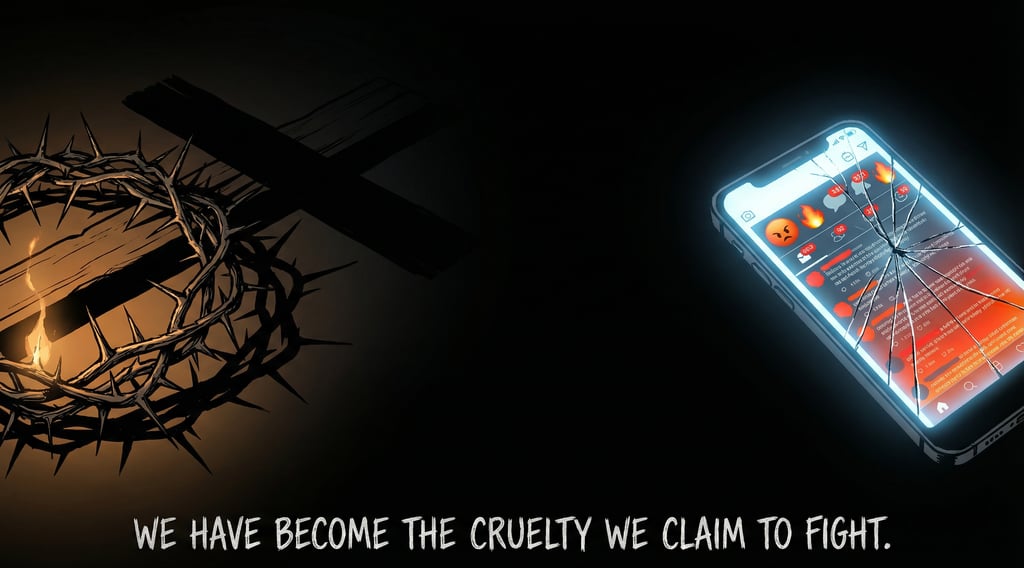
Good Friday, April 3, 2026.
Most Catholic Christians are resting today. I decided not to. My research tools expire on April 25, and I need to maximize every day I have left. So here I am, thinking out loud on what might be the most fitting day to talk about cruelty — a day that commemorates a man who was publicly shamed, scourged, labeled a criminal, and executed in front of a jeering crowd.
Congressman Egay Erice of Caloocan's 2nd District reached out and suggested this topic. He's one of the few people in the minority bloc of the House who actually talks about things that matter beyond floor privilege speeches. He wanted to talk about a cruel streak running through our society — visible, loud, and mostly lived out on social media. I had written about this before, back in what I now think of as MCT 1.0. I can't find the original piece. So this is the redo, updated for what's happening right now.
There is a cruel streak in how we now treat each other online. Scourging. Labeling. Judging. The kind of behavior that would embarrass us in person but feels perfectly acceptable behind a screen. Bullying, gossip, defamation, exclusion, pile-ons — all of it disguised as accountability or righteous anger. Filipinos are so deeply divided by political colors that objectivity has become suspicious. If you don't pick a side, both sides will come for you. Truth has been sacrificed at the altar of partisanship.
Erice is right. And the data is damning.
THE PHILIPPINES IS AMONG THE MOST ONLINE COUNTRIES IN THE WORLD
By October 2025, the Philippines had around 95.8 million social media identities — in a country of roughly 115 million people. Filipinos spend an average of three hours and thirty-three minutes daily on social media platforms. Younger users, especially those aged 16 to 24, can spend close to nine hours a day online.
We are not just online. We are submerged.
Everything that happens in our politics, our neighborhoods, our families passes through social media first. And social media, by design, rewards the loudest, the angriest, and the most extreme voices. Once you understand that, everything else in this piece makes sense.
THIS IS NOT NEW. WE JUST FORGOT HOW TO HIDE IT.
My thesis in MCT 1.0 was simple and unsettling: modern Filipinos are nice on the surface. Genuinely warm, hospitable, conflict-avoidant. But underneath that — underneath the po and opo, the smiling and the pakikisama — there was a quiet violence bubbling under the surface. A suppressed aggression that had simply learned to wear a polite face.
And then 2016 happened.
One man with a violent and crass rhetoric walked onto the national stage and something cracked open. Rodrigo Duterte didn't create the cruelty. He gave it permission.
Filipino psychologists have found that our anger often comes out sideways — through backstabbing, rumor-spreading, silent treatment, relational aggression — rather than direct confrontation. The aggression is there; it just hides behind hiya and pakikisama. For a long time, social courtesy and shame culture kept that violence half-buried. You swallowed the insult, you joked it away, you ranted in private.
Then we elected a president who turned public profanity, rape jokes, and kill threats into normal political language. Outrage became selective. Some people laughed. Some people shrugged. Some people cheered. And little by little, the invisible fence of hiya — that thing that used to keep us from saying certain things aloud — exposed the corrosion underneath.
Scholars who studied Duterte's rise described his appeal as tapping into "latent anxieties" and long-standing punitive instincts in the population. The key word is latent. The anger was always there. He just activated it and made it feel righteous.
The Trump parallel runs along the same track. Commentators in the US have written about a "culture of cruelty" that flourished under his leadership — a political style built on humiliation, mockery, and open contempt. Trump didn't invent American cruelty either. He removed the social cost of being openly cruel. He made it look like strength.
Same pattern, different country. A leader at the top decides shame is optional. The rest of the country adjusts its moral settings downward.
That was my suspicion in that old essay: that maybe cruelty is closer to our default setting than we'd like to admit. That the niceness was real but fragile — and it didn't take much to flip it into something darker. Every year online makes it harder to argue with that original instinct.
THE COLORS THAT DIVIDE US
The 2022 presidential election cracked something that hasn't healed. Supporters of both Marcos Jr. and Robredo clashed intensely — broken families, severed friendships, physical confrontations. The polarization was driven partly by disinformation but also by something older: long-standing grievances with how democracy has worked, or failed, for different classes and communities.
Pink, red, and green became more than colors. They became identity markers — codes that triggered immediate recognition and emotional reaction. To wear the wrong color or hold the wrong opinion was enough to make you an enemy.
That tribal logic didn't end after the elections. The 2025 midterms were basically a referendum on the Marcos-Duterte split, with coordinated disinformation operations keeping tensions high across platforms. Researchers who tracked X after key events found that a significant portion of accounts jumping into political conversations were fake or newly activated. Social media now runs on cruelty, pushed into our feeds every day.
KUYOG, EKIS CULTURE, AND THE MOB WE BECAME
We have a word for this. Kuyog — collective antagonism, mobbing someone, piling on. It starts in private chats. Then becomes tagging. Then escalates into full public harassment. (e.g. pasikatin natin to si kuya...)
Studies show that more than nine out of ten Filipinos now act cautiously online, worried about backlash and cancellation. People keep quiet even when they have something important to say, because they are afraid of being the next target. Around four in ten say the punishment of cancellation often becomes more serious than the original offense. The kuyog becomes a performance. People pile on not because they really care, but because it feels good to be on the right side of the mob.
In extreme cases this spills into red-tagging — branding activists, Indigenous leaders, and community organizers as communist or terrorist threats without evidence. Human rights bodies and the courts have warned that red-tagging threatens the right to life, liberty, and security. Armed forces units and aligned pages have been caught posting materials doing exactly that. Words aren't just words anymore. "Words can be weapons" stopped being a metaphor a long time ago.
HOW THE MACHINE WORKS AGAINST US
None of this is entirely spontaneous.
Researchers who study dehumanization online describe a consistent pattern across countries. First, threat: people feel another group is a danger to their identity or way of life. Second, distortion: information that doesn't fit the fear gets dismissed or mocked. Third, rigidification: positions harden until change feels like betrayal.
That is exactly how our political discourse looks now. And it was built deliberately.
Under Duterte, disinformation became part of the operating system — troll armies, fake pages, coordinated narratives. The Marcos-Duterte tandem then used that same infrastructure in 2022 to drown out critics and frame their victory as inevitable. That’s right — Ferdinand “Bongbong” Marcos Jr. also rode on this machinery of online trolling and hate, lest we forget.
Now, with that alliance fractured, the same digital weapons are aimed at each other. Marcos vs. Duterte factions, both claiming to represent the people, both using identical tactics, both generating heat that ordinary Filipinos absorb and carry into their own timelines.
This is the disinformation paradox: a political class that rose on manufactured rage now claims to be fighting it. And in the middle of that contradiction, millions of ordinary users become the raw material — their emotions, their loyalties, their outrage harvested like a crop.
WHAT IT IS DOING TO OUR CHILDREN
It's not just adults.
In PISA assessments, the Philippines has consistently ranked among the worst in the world on bullying. Roughly one in three Filipino students reports being bullied regularly — far above global averages. Local DepEd data shows thousands of bullying cases in NCR alone in a single school year, with numbers rising instead of falling. The government has noticed. Task forces formed. Committees convened. Strong words issued.
But kids don't learn cruelty from policy briefs. They learn it from what they see every day.
When they watch their titos and titas mocking political opponents as bobo or bayaran, when they grow up hearing leaders casually joke about killing and rape without consequence, when the adults around them treat kuyog as normal — that becomes the template for how power and authority works.
Research on Filipino adolescents and cyberbullying shows something grim: many of those who bully are also victims. The cycle feeds itself. You hurt others because you've been hurt, because you think that's what surviving looks like, because you don't want to be the next target.
We are raising a generation that has learned — from us — that the safest way to exist online is to either disappear or attack first.
THE ENERGY THAT SHOULD HAVE SAVED US IS KILLING US
What scares me most is not just the cruelty. It's the sheer energy behind it.
Filipinos are not apathetic. We are the opposite. Hyper-engaged, over-invested, always ready to argue, always ready to defend our camp, our idol, our color. We will spend hours fighting strangers in the comments, sharing call-out posts, joining livestreams to "defend the truth."
But look closely at where that energy actually goes.
We will tear apart a random private citizen over one screenshot. We will drag a minor over a careless TikTok. We will flood a comment section because someone criticized our preferred politician. Yet when the Commission on Audit releases another report on billions lost to corruption, when climate disasters hit the same communities again and again, when workers beg for a humane transition — the rage is softer, the posts fewer, the attention span shorter.
Our anger is loudest where it is safest and least useful.
We have a nation's worth of power bottled up in people who feel deeply and care intensely. But the system has trained us to spend that power on each other instead of on the structures that actually keep us poor, ignorant, and exhausted. The troll farms understand this. The political strategists understand this. They don't have to convince us to be cruel. They just have to point us in the wrong direction, get out of the way, and watch us go at each others throat.
And we fall for it, consistently, repeatedly.
We end up with a vicious, misdirected, and ultimately useless energy — a national strength turned inward like a weapon. The same fire that could have forced better schools, cleaner elections, working hospitals, and real accountability is being used to burn fellow citizens to the ground over partisan loyalty and manufactured scandals.
The country doesn't collapse because nobody cared. It collapses because people cared so intensely about the wrong battles that there was nothing left for the ones that mattered.
THE GOOD FRIDAY QUESTION
Today is Good Friday. A day that, at its core, is about what happens when a crowd decides it has the right to destroy someone.
The crowd didn't need proof. They had momentum. They had numbers. They had tribal leaders pointing fingers. The scourging, the labeling, the public humiliation all felt righteous to the people doing it. They were sure they were on the right side.
I'm not making this a religious argument. I'm making a cultural one.
Congressman Erice is right to name this cruel streak. It takes some courage to raise a moral question in the middle of a political career, when the tribal logic of social media would rather you just pick a side and start throwing stones. The cruelty he's describing isn't a fringe problem. It lives in our comment sections. It lives in our group chats. It lives in the way we talk about our political opponents — not as people we disagree with, but as enemies who deserve to suffer.
WHERE DO WE EVEN START
I don’t have neat solutions for this. If someone insists they do, they’re likely trying to sell you something.
But here is what I think:
It starts with recognizing that we have outsourced our moral judgment to the algorithm. That the people running the troll farms and the disinformation networks — on all sides of this divide — are counting on us to keep scourging each other so we don't look up long enough to ask who built the cross.
It needs to happen, and it falls squarely on the government to get it done.
But the government cannot fix what happens inside us — the instinct to mob, to cancel, to label, to exclude people who chose the wrong political color.
That part is on us.
It is Good Friday. The image at the center of this day is a man who was scourged in public, labeled a criminal, mocked, and abandoned by people who were afraid of the crowd.
We know how the story ends. The question is whether we're willing to look at our timelines today and ask: which role are we playing?
Sources
Radar.ph, 95.8 million Philippine social media identities by October 2025, https://www.facebook.com/radarphmedia/photos/more-than-8-in-10-filipinos-are-now-active-on-social-media
PEP Alerts via OBERLO, Filipinos spend 213 minutes (3 hrs 33 mins) daily on social media, https://www.facebook.com/PEPalerts/posts/while-the-philippines-fell-from-the-top-spot
World Vision Philippines, Safer Internet Day 2025: Philippine laws protecting children online, https://www.worldvision.org.ph/safer-internet-day-2025-philippine-laws-that-protect-children-against-online-scams-abuses-and-exploitation
UP CIDS, Polarization in the 2022 Philippine Presidential Election (PDF), https://cids.up.edu.ph/wp-content/uploads/2025/03/Polarization-in-the-2022-Philippine-Presidential-Election.pdf
IIARI Journal, Meme-ingful Visual: Exploring Pragmatic Implications of Philippine Political Memes, https://iiari.org/wp-content/uploads/trp.v5.2.3946.pdf
IFRI, Mid-term Elections in the Philippines 2025: The Clan War Reaches New Heights, https://www.ifri.org/sites/default/files/2025-05/ifri_loesch_philippines_elections_2025eng.pdf
RNG Luzon, Cancel Culture Fuels Fear and Division in Online Spaces (2026), https://www.rngph.com/cancel-culture-fuels-fear-and-division-in-online-spaces/
Milieu Insight, Is Cancel Culture Doing More Harm Than Good in the Philippines, https://www.mili.eu/ph/insights/is-cancel-culture-doing-more-harm-than-good-in-the-philippines
Lampoon Magazine, The Cancel Culture: Call for Accountability or Social Punishment, https://lampoonmagazine.com/cancel-culture-and-the-philippines/
Human Rights Watch, World Report 2026: Philippines, https://www.hrw.org/world-report/2026/country-chapters/philippines
Philippine News Agency, Online Hate Speech Leads to Real-Life Violence — CHR, https://www.pna.gov.ph/articles/1206573
NC State University, How Social Media Platforms Can Contribute to Dehumanizing Other People, https://news.ncsu.edu/2020/05/social-media-and-hate/
East Asia Forum, The Disinformation Paradox Gripping the Philippines, https://eastasiaforum.org/2025/06/28/the-disinformation-paradox-gripping-the-philippines/
EDCOM 2, High Incidence of Bullying in PH Public Schools Alarming, https://edcom2.gov.ph/high-incidence-of-bullying-in-ph-public-schools-alarming-edcom-2/
OECD / PISA 2022 Philippines Country Note (PDF), https://www.oecd.org/content/dam/oecd/en/publications/reports/2023/11/pisa-2022-results
Inquirer News, 1 in 3 Filipino students bullied in school — PISA study, https://newsinfo.inquirer.net/1873526/1-in-3-filipino-students-bullied-in-school-pisa-study
GMA News, DepEd NCR logs 2,500 bullying cases in SY 2024-2025, https://www.gmanetwork.com/news/topstories/nation/942851/deped-ncr-logs-2-500-bullying-cases-in-sy-2024-2045/story/
Philippine News Agency, DepEd intensifies efforts vs. alarming rise in bullying, https://www.pna.gov.ph/articles/1248191
Philippine Institute for Development Studies, School Bullying Contributes to Lower PISA Achievement (PDF), https://pidswebs.pids.gov.ph/CDN/document/pidsdps2445.pdf
National Library of Medicine / PMC, Empathy, Cyberbullying, and Cybervictimization Among Filipino Adolescents, https://pmc.ncbi.nlm.nih.gov/articles/PMC8650871/
Our World in Data, Political Polarization Score 2025, https://ourworldindata.org/grapher/political-polarization-score
FMA.ph, Digital Rights Round-up January 2026, https://fma.ph/digital-rights-round-up-january-1-to-31-2026/
Wikipedia, Edgar Erice, https://en.wikipedia.org/wiki/Edgar_Erice
BTI Transformation Index, Philippines Country Report 2026, https://bti-project.org/en/reports/country-report/PHL
De La Salle University Animo Repository, Anger Expression Among Filipino Emerging Adults, https://animorepository.dlsu.edu.ph/etd_masteral/5732/
Nicole Curato, Politics of Anxiety, Politics of Hope: Penal Populism and Duterte's Rise to Power — Journal of Current Southeast Asian Affairs (2016), https://journals.sagepub.com/doi/10.1177/186810341603500305
Populism Observer, Interview: Rodrigo Duterte — The Trump of the East (Nicole Curato), https://populismobserver.com/2017/09/11/interview-21-rodrigo-duterte-the-trump-of-the-east/
DLSU Asia-Pacific Social Science Review, Human Rights in a Time of Populism: Philippines under Rodrigo Duterte, https://animorepository.dlsu.edu.ph/apssr/vol19/iss3/6/
AsiaGlobal Online / HKU, The Philippines Beyond the Dark Spell — on Curato's latent anxieties argument, https://www.asiaglobalonline.hku.hk/philippines-duterte-populism
Policy Magazine (Canada), It's the Cruelty, Stupid: Beyond the Empathy Gap, https://www.policymagazine.ca/its-the-cruelty-stupid-beyond-the-empathy-gap/
American Survey Center, What Trump Has Done to Our Politics, https://www.americansurveycenter.org/newsletter/what-trump-has-done-to-our-politics/
Yale Human Rights Journal, Proud to Murder: Duterte's War on Drugs in the Philippines, https://www.yalehrj.org/post/proud-to-murder-duterte-s-war-on-drugs-in-the-philippines
Inquirer Opinion, Duterte, Trump, and Populism, https://opinion.inquirer.net/102168/duterte-trump-populism
La Verite PH, When Outrage Becomes Selective: The Dangerous Normalization of Rape Jokes, https://www.facebook.com/LaVeritePH/posts
Philstar Opinion, Countering Cancel Culture (March 2026), https://www.philstar.com/opinion/2026/03/20/2515476/countering-cancel-culture
Contact us
subscribe to morning coffee thoughts today!
inquiry@morningcoffeethoughts.org
© 2024. All rights reserved.
If Morning Coffee Thoughts adds value to your day, you can support it with a monthly subscription.
You can also send your donation via Gcash: 0969 314 4839.