
When Alan Cayetano Got Mad at a Cartoon and Not at China
Alan Cayetano turned a simple Senate resolution condemning the Chinese Embassy into a full-blown attack on Jay Tarriela’s caricature of Xi Jinping. This piece walks through Cayetano’s record—from the “golden era” with Beijing, to “quiet diplomacy,” Benham Rise, the UNGA resolution, SEA Games, and ABS-CBN—to show how often he’s softened real pushback while sounding principled. It argues that his outrage over a cartoon is not a stand on decency, but the latest example of a senator protecting China’s comfort more than defending Filipinos.
12 min read
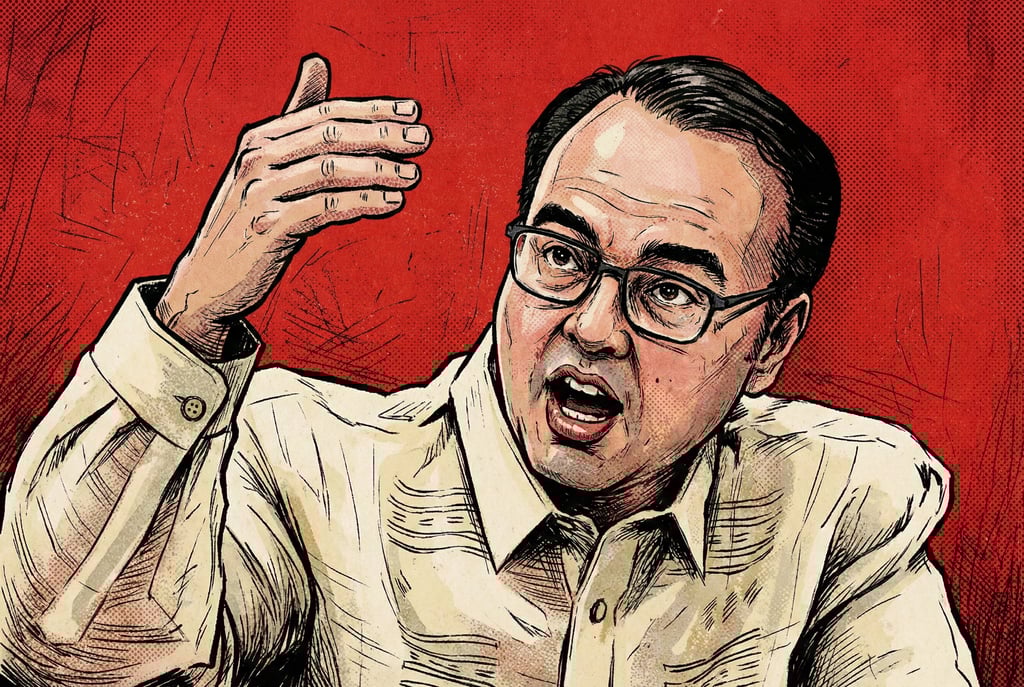
The day the Senate spent hours arguing about a cartoon of Xi Jinping, Chinese ships were still parked in our waters.
I’ve already written before about why I don’t trust Alan Peter Cayetano as a public official, and nothing in that old piece has aged badly.
While Senator Cayetano zeroed in on whether Commodore Jay Tarriela was “bastos” for using a caricature, Chinese vessels stayed in the West Philippine Sea, Chinese propaganda kept casting us as the aggressors, and Beijing’s diplomats continued issuing smug statements about our own officials.
Sitting with that, ang hirap hindi magtanong: how did we reach the point where a Filipino officer gets more heat in our Senate than the foreign power actually occupying our territory?
You can revisit that earlier context here if you want the longer backstory on why his “principles” don’t land for me: why I don’t trust Cayetano.
HOW A RESOLUTION ABOUT CHINA TURNED INTO A TRIAL OF TARRIELA
On paper, the resolution was simple: condemn the Chinese Embassy’s statements attacking Philippine officials and the people defending the West Philippine Sea.
Cayetano turned that into something else.
He kept going back to three things: that Tarriela’s caricature was undiplomatic and reckless, that passing the resolution would “bless” this behavior, and that doing so could endanger OFWs, our economy, and our “moral decency.”
In his version of “good diplomacy,” the Senate’s job was to distance itself from a supposedly “bastos” officer and tread lightly so we wouldn’t upset Beijing.
None of that changes what was actually on the table.
Instead of asking, “Should the Senate defend its own people from foreign bullying?” the chamber got dragged into, “Did one officer embarrass Xi too much?”
To sell the point, Cayetano threw out that now-familiar analogy: if Tarriela can circulate a cartoon of Xi, then his own staff could just as well make a meme humiliating Kiko Pangilinan.
Pangilinan shut that down: “I am not from China. Why will your staff put a meme towards me? You’re comparing apples and oranges.”
He was right. China is a foreign power illegally occupying our waters; a meme about a colleague is office politics.
From a Filipino perspective, the whole thing felt baliktad.
You have a resolution meant to answer foreign intimidation, and somehow the heat lands on the guy who called the bully a bully.
THE “GOLDEN ERA” HE HOPES WE FORGET
Cayetano’s central claim here is moral: that Tarriela is “bastos,” “undiplomatic, reckless, and unprofessional,” and that the Senate should not endorse that.
But the moment you line that up with his own record as Foreign Affairs Secretary, his moral authority to lecture anyone on being “too soft” or “too harsh” on China collapses.
When he was DFA chief under Rodrigo Duterte, he was the one selling the “golden era” with China.
In March 2018, during a meeting with Chinese State Councilor Wang Yi, Cayetano said Philippines–China ties were in a “golden era” of cooperation, while China was militarizing artificial islands in our exclusive economic zone and harassing Filipino fishermen.
If he is so concerned now about the Philippines’ “image,” it’s worth asking why he publicly celebrated a “golden era” with the same country bullying our own fisherfolk.
China’s foreign ministry rewarded him.
In October 2018, Wang Yi thanked Cayetano in Davao for “firmly implementing President Duterte’s independent foreign policy and friendly policy toward China” and for “eliminating various interferences” so relations could get “back to the right track.”
“Interferences” here meant anything that might upset Beijing: protests that bite, sharper public positions, real efforts to lean on the 2016 arbitral award.
When China’s top diplomat is praising you for clearing obstacles to Beijing’s agenda in our waters, your credibility as a defender of Philippine dignity is close to zero.
That’s the same man now wagging his finger at a Filipino officer for a cartoon.
“QUIET DIPLOMACY” AND WHAT IT REALLY GAVE US
Cayetano scolded Tarriela for being too confrontational.
But when he held the DFA portfolio, his problem wasn’t too much confrontation—it was the opposite: do as little as possible in public, then call it “maturity.”
When outrage grew over China’s militarization and harassment in the West Philippine Sea, Cayetano said the Duterte administration preferred “quiet diplomacy” over “megaphone diplomacy.”
He claimed the DFA had filed “several dozens, maybe 50, 100” diplomatic protests against China.
When people checked, that number turned out to be slippery.
CMFR noted that Cayetano’s definition of “diplomatic protest” included casual verbal reminders and agenda items in meetings, not just formal written notes verbale.
An Inquirer editorial called the claim “specious,” pointing out that if every reminder or side comment counts as a protest, the word loses its force.
While we were being told to trust this “quiet diplomacy,” the facts on the water were moving.
In August 2017, Chinese coast guard vessels started blocking access to Sandy Cay, a sandbar near Pag-asa Island—squarely under Cayetano’s watch.
Rep. Gary Alejano said the administration refused to file a protest and warned that we had “practically lost” Sandy Cay; former Foreign Secretary Albert del Rosario later said the Philippines “lost Sandy Cay” to China.
So the man who would not file a clear protest over an actual loss of territory in the West Philippine Sea is now furious about a caricature.
The double standard is hard to miss.
Duterte’s own words made it worse.
He called the 2016 arbitral ruling a “scrap of paper” and talked about setting it aside while pursuing loans, investments, and later vaccines from Beijing.
Carpio and other experts have stressed that the award was never meaningfully enforced.
All of this played out while Cayetano was the country’s top diplomat—the official responsible for turning that legal win into real leverage.
So when he now claims the mantle of “maturity” against Tarriela’s supposed recklessness, we know what his version of maturity delivered: weaker protests, quiet losses, and a public told to trust processes we were never allowed to see.
BENHAM RISE: “RESEARCH” AS A DOORWAY
The same instinct showed up at Benham Rise, now Philippine Rise.
This undersea plateau east of Luzon is part of our extended continental shelf and is rich in potential resources and strategic value.
In early 2018, the Duterte administration allowed China to conduct marine scientific research there.
Cayetano defended the move, calling it “beneficial” and “advantageous” for the Philippines.
Carpio called that decision “dumb,” warning that a country already squatting on our claimed features in the West Philippine Sea should not be trusted with scientific access to another strategic maritime area.
Pangilinan was among those who sounded the alarm, saying history and experience show China is not exactly the most trustworthy partner for such activities.
Cayetano brushed the criticism aside.
Taken together, Benham Rise and the West Philippine Sea under his watch tell one story: give China more space and information in our waters, sell it as pragmatism, and defend the policy at home.
WHENEVER THERE’S A CHANCE TO PUSH BACK, HE HITS THE BRAKES
The February 2026 clash with Pangilinan fits into a longer pattern.
It is not the first time Cayetano has stepped in just as the Philippines is about to take a stronger, more public step against China.
In July 2023, Risa Hontiveros sponsored Senate Resolution 659, urging the government to bring the West Philippine Sea issue to the UN General Assembly.
The goal was to get a broad UNGA reaffirmation of the 2016 arbitral ruling and a call for China to stop harassing Philippine vessels.
Cayetano opposed it.
He said the UN might not be the right forum, that China preferred bilateral talks, and that a failed or weak UNGA vote could “weaken” our position.
Hontiveros said she was not surprised, pointing to his “history of easing the Philippine foot on the gas pedal vis-à-vis China.”
Now in 2026, the setup is similar.
The instrument is different—a resolution condemning Chinese embassy attacks on Philippine officials instead of a UN move—but Cayetano’s role is the same: delay, deflect, and shield Beijing from an official rebuke by the Senate.
At some point, you stop calling that prudence and start calling it what it is: a consistent alignment with China’s comfort level.
CHINA’S OWN CARTOONS, AND HIS SELECTIVE OUTRAGE
Cayetano called Tarriela’s caricature of Xi “bastos,” “undiplomatic,” and “childish.”
If that’s the rule, then China has been publicly bastos on a much larger scale for years.
Chinese state media and state-linked accounts aggressively use political cartoons against foreign leaders.
“Valiant Panda,” an X account run by cartoonists employed by the Global Times, regularly produces caricatures portraying U.S. leaders and Western allies as villains; Chinese embassies and officials share its content.
Xinhua has pushed cartoons mocking American gun violence, COVID-19 response, and U.S. foreign policy, including one titled “How a gun-happy nation spends its Fourth of July weekend.”
Global Times amplified a cartoon called “The Last G7” that mocked G7 leaders as grotesque figures plotting against China.
A UP Los Baños study looking at 228 China state-media cartoons from 2020–2021 found that almost 70 percent carried anti-U.S. propaganda narratives, while about 14.5 percent falsely implied COVID-19 originated in the United States.
That’s not a one-off drawing; that’s an entire propaganda machine built on cartoons.
Yet you don’t see Cayetano launching a sermon against Beijing over those works, even when they target leaders of countries whose support we rely on in the West Philippine Sea.
So the issue is clearly not the medium of satire itself.
The problem, for him, is when satire points at China from our side.
SATIRE, DEMOCRACY, AND WHAT SIDE WE’RE ON
Cayetano frames Tarriela’s caricature as an attack on “moral decency” and proper diplomacy.
But in democratic traditions, political satire—including satire of foreign heads of state—is not a breach of the system; it’s part of it.
In the U.S. Supreme Court case Hustler Magazine v. Falwell, the Court unanimously held that even offensive, caustic parody of public figures is protected speech.
The reasoning was simple: public figures and powerful leaders must tolerate “vehement, caustic, and sometimes unpleasantly sharp attacks,” because that’s part of free debate.
The Charlie Hebdo attacks in 2015 showed how strongly democracies react when satire is punished with violence; world leaders marched in Paris in defense of the principle that offensive cartoons are not a crime.
China runs on a very different logic.
Cartoons mocking the Communist Party or the People’s Liberation Army are banned, and comedians like Li Haoshi have faced investigation and possible jail time for jokes seen as disrespectful to the PLA.
The message is clear: there are hard limits on criticism when it touches the image of the state and its leaders.
Seen from here, a Filipino officer sharing a caricature of Xi that calls China a bully is not some random childish insult.
It’s a small democratic act: naming power plainly.
When a senator demands that we treat that act as a diplomatic sin, he is not just asking for politeness; he is pulling us closer to Beijing’s comfort zone than to our own noisy, sometimes brutal political culture.
THE STRAW MAN AT THE CENTER OF HIS ARGUMENT
The basic facts are not complicated.
The resolution was about the Chinese Embassy’s statements—wording that tried to smear and intimidate Philippine officials and uniformed personnel.
It was meant to say: you don’t get to threaten and malign our people without a formal response.
Cayetano dragged the conversation to a different place.
He made Tarriela’s “taste” and “professionalism” the central issue, even though the resolution didn’t name him.
The Senate was suddenly debating, “Are we endorsing a rude officer?” instead of, “Are we defending our own against foreign harassment?”
His Pangilinan meme analogy follows the same pattern.
By equating a cartoon aimed at an aggressive superpower with a hypothetical staff meme about a colleague, he blurred the difference between punching up and petty politics.
Pangilinan’s pushback was not just self-defense; it was a reminder that the main issue is sovereignty, not senators’ egos.
Build a straw man around Tarriela, and you never have to cast a clean vote on whether the Senate will call out Beijing’s embassy.
That’s what happened.
PATTERN, CHARACTER, AND WHY THIS ISN’T JUST ABOUT ONE CARTOON
Cayetano’s China record doesn’t stand alone.
His name is also tied to domestic episodes that say a lot about how he handles power.
As PHISGOC chair, he oversaw the 2019 SEA Games hosting, hit by logistical problems, a ₱50‑million cauldron, and questions over a ₱6‑billion budget.
Senator Franklin Drilon questioned the spending and likened parts of the fund transfer setup to the Napoles pork barrel scheme; Panfilo Lacson raised similar concerns.
Even Duterte said the SEA Games spending should be investigated.
Cayetano accused critics of nitpicking and promised accountability later.
As House Speaker, he presided over the denial of ABS‑CBN’s franchise, taking a major network off the air after hearings widely seen as political retribution against a Duterte critic—and then told the public to “just chill.”
Even his own family has sent signals.
In 2025, Lino Cayetano publicly talked about “traditional politicians” and called for new leaders to replace the “old guard.” Many read that as a quiet rebuke of his brother.
Commentators have described Alan Peter Cayetano’s moves—shifts on due process, talk of repentance, calls for snap elections—as attempts at reinvention, not the record of someone with a steady principle-driven line.
None of this alone proves bad faith in the Tarriela debate, but it does make his claim to moral high ground weak.
So when he stands up and says a cartoon is a matter of national decency, we are not hearing that from a neutral referee.
We are hearing it from someone who defended questionable spending, helped shut down a broadcaster, and repeatedly softened formal pushback on China—then wrapped all of that in the language of “prudence.”
THE REAL RECKLESSNESS
Tarriela’s style is fair game.
He’s a public officer, and people can argue about whether his tone helps or hurts the cause.
But if you look at the record, it’s hard to escape this: in Cayetano’s world, a cartoon seems more dangerous than years of normalizing China’s aggression.
Recklessness is declaring a “golden era” while Chinese ships tighten their grip on our waters.
Recklessness is treating an international legal victory like a scrap of paper, then asking Filipinos to trust in “quiet diplomacy” as we quietly lose places like Sandy Cay.
Recklessness is giving China research access to Philippine Rise despite every warning about how Beijing uses “science” as a cover for future claims.
Recklessness is blocking or diluting efforts to bring our case to the UNGA—and then, when a Filipino finally calls the bully by name in the language of political art, insisting that the real problem is our tone.
The Senate clash over Tarriela’s caricature was noisy.
The more dangerous story is quiet. It lives in fund transfers, protests that were never filed, resolutions that died, speeches that always seem to bend away from offending Beijing.
It is the story of how some of our own leaders have been more afraid of upsetting China than of failing to defend the Philippines.
It’s the story of how, when the choice was clear, some of our own senators still chose China’s comfort over their country’s.
SOURCES:
Cayetano cites “golden era” in relations with China – Philippine News Agency
http://www.pna.gov.ph/articles/1029674China, Philippines reach “golden era” – People’s Daily Online
http://en.people.cn/n3/2018/0322/c90000-9440259.htmlChina, Philippines reach “golden era” – China Daily
https://global.chinadaily.com.cn/a/201803/22/WS5ab2e641a3106e7dcc145527.htmlExplaining the Duterte Administration’s China Policy in the South China Sea – Cornell eCommons (PDF)
https://ecommons.cornell.edu/bitstreams/58e1bf19-a858-4a31-95a0-4e1d877b41a9/downloadPangilinan, Alan Cayetano clash over Tarriela’s use of caricature mocking Xi Jinping – GMA News
https://www.gmanetwork.com/news/topstories/nation/975925/pangilinan-alan-cayetano-clash-over-tarriela-s-use-of-caricature-mocking-xi-jinping/story/Pangilinan, Cayetano clash over China resolution – Daily Tribune
https://tribune.net.ph/2026/02/09/pangilinan-cayetano-clash-over-china-resolutionSenate approves resolution vs Chinese embassy remarks – Philippine Daily Inquirer
https://newsinfo.inquirer.net/2179754/on-reso-vs-chinese-embassy-remarksIn resolution vs Chinese embassy, minority focuses on Tarriela instead – The Philippine Star
https://www.philstar.com/headlines/2026/02/10/2507052/resolution-vs-chinese-embassy-minority-focuses-tarriela-insteadSenate OKs reso condemning Chinese embassy statements – Manila Bulletin
https://mb.com.ph/2026/02/09/senate-oks-reso-condemning-chinese-embassy-statementsSeeing the Unclear: What Constitutes a Diplomatic Protest – CMFR
https://cmfr-phil.org/media-ethics-responsibility/journalism-review/seeing-the-unclear-what-constitutes-a-diplomatic-protest/Cayetano Defends Granting China Research Access to Benham Rise – Philippine Daily Inquirer (archived via SEAFDEC)
https://ani.seafdec.org.ph/handle/20.500.12174/3476Hontiveros not surprised at Cayetano’s move to question Senate UNGA reso – Manila Bulletin
https://mb.com.ph/2023/7/26/hontiveros-not-surprised-at-cayetano-s-move-to-question-senate-unga-resoCayetano urges Senate to tread carefully on WPS issue – Manila Bulletin
https://mb.com.ph/2023/7/26/cayetano-urges-senate-to-tread-carefully-on-wps-issue-1Alan Cayetano: Not bringing West PH Sea reso to UNGA a sign of maturity – GMA News
https://www.gmanetwork.com/news/topstories/nation/877243/alan-cayetano-not-bringing-west-ph-sea-reso-to-unga-a-sign-of-maturity/story/Beijing Weaponizes Political Cartoons to Reach Western Audiences with Anti-U.S. Propaganda – Polygraph.info / VOA
https://www.polygraph.info/a/7363195.htmlBeijing Weaponizes Political Cartoons to Reach Western Audiences with Anti-U.S. Propaganda – VOA News
https://www.voanews.com/a/beijing-weaponizes-political-cartoons-to-reach-western-audiences-with-anti-u-s-propaganda-/7365562.htmlHustler Magazine, Inc. v. Falwell, 485 U.S. 46 (1988) – U.S. Supreme Court
https://supreme.justia.com/cases/federal/us/485/46/Li Haoshi controversy – Wikipedia
https://en.wikipedia.org/wiki/Li_Haoshi_controversy_of_2023Duterte wants probe of SEA Games mess, including Cayetano, P50-M cauldron – Philippine Daily Inquirer
https://newsinfo.inquirer.net/1194907/duterte-wants-probe-of-sea-games-mess-including-cayetano-p50-m-cauldronABS-CBN’s franchise denial has no chilling effect: Cayetano – Philippine News Agency
https://www.pna.gov.ph/articles/1108961Center for Media Freedom and Responsibility (CMFR) – About
https://cmfr-phil.org/about/Hontiveros: China’s unacceptable behavior in Sandy Cay violates int’l law, gov’t must take action – YouTube (GMA / ANC segments as context)
https://www.youtube.com/watch?v=vJT4CBj1lcQCayetano in China for talks on joint exploration – Rappler (video)
https://www.youtube.com/watch?v=mdL0BrOi0noTarriela responds to Senate debate over Xi Jinping caricature – Daily Tribune
https://tribune.net.ph/2026/02/10/tarriela-responds-to-senate-debate-over-xi-jinping-caricatureTarriela: I don’t deserve to be disrespected, maligned by Sen. Alan Cayetano – GMA News
https://www.gmanetwork.com/news/topstories/nation/975978/tarriela-i-don-t-deserve-to-be-disrespected-maligned-by-sen-alan-cayetano/story/China hails “golden period” in relations with Philippines – Reuters
https://www.reuters.com/article/world/china-hails-golden-period-in-relations-with-philippines-idUSKBN19K0SE/Hontiveros not surprised at Cayetano’s move to question Senate UNGA reso – Manila Bulletin (duplicate of 12; kept once)
The Hypocrisy of Alan Peter Cayetano: When Due Process Becomes a Selective Shield – Morning Coffee Thoughts
https://www.morningcoffeethoughts.org/the-hypocrisy-of-alan-peter-cayetano-when-due-process-becomes-a-selective-shieldThe Senate’s Duterte House Arrest Vote: A Masterclass in Political Self-Preservation – Morning Coffee Thoughts
https://www.morningcoffeethoughts.org/the-senates-duterte-house-arrest-vote-a-masterclass-in-political-self-preservationCayetano’s Duterte Repatriation Move – Morning Coffee Thoughts
https://www.morningcoffeethoughts.org/cayetanos-duterte-repatriation-moveLino Cayetano Contradicts Alan Peter Cayetano’s Statement About Corruption – PhilNews
https://philnews.ph/2025/09/16/lino-cayetano-contradicts-alan-peter-cayetanos-statement-about-corruption/Politico PH: Snap Elections, Snap Opportunism (analysis on Cayetano’s political reinvention) – Politico PH
https://politico.ph/snap-elections-snap-opportunism/Learning English: China reacts differently to Charlie Hebdo free speech debate – VOA Learning English
https://learningenglish.voanews.com/a/china-reacts-differently-to-charlie-hebdo-free-speech-debate/2610974.htmlThis is no joke – Index on Censorship (on Li Haoshi and PLA joke case)
https://www.indexoncensorship.org/2023/05/this-is-no-joke/
Contact us
subscribe to morning coffee thoughts today!
inquiry@morningcoffeethoughts.org
© 2024. All rights reserved.
If Morning Coffee Thoughts adds value to your day, you can support it with a monthly subscription.
You can also send your donation via Gcash: 0969 314 4839.