
WHEN THE LIGHTS GO OUT: HOW CINEMAS ARE DYING, FROM LOUIE’S THX TO MAGNOLIA
This reflection looks at the slow death of cinemas through one person’s memories, from Louie’s THX in Makati to Magnolia and SM Cabanatuan. It traces how streaming, high ticket prices, and changing habits quietly hollowed out what used to be a shared experience. Along the way, it asks what we lose when moviegoing becomes a rare luxury instead of a normal part of life.
10 min read
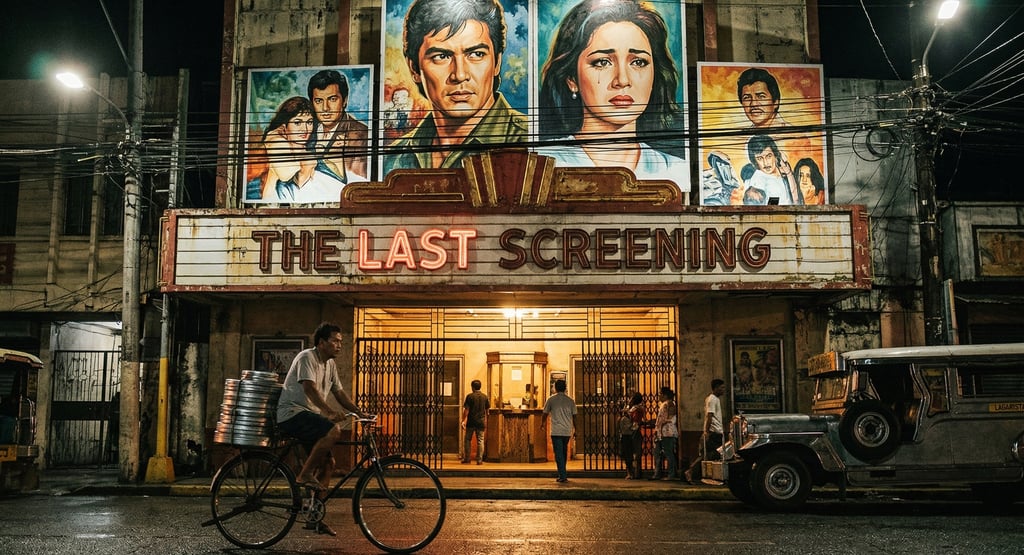
Magnolia appears to be closing its cinema.
I read it the other day. Took me a second to process why it bothered me so much. It bothered me because it feels less like an isolated event and more like a pattern. The kind of pattern I've been watching unfold for decades.
I lived through the 80s, the 90s, the 2000s. I watched things rise, peak, and vanish. And every single time, it happened so gradually that by the time you noticed, it was already over.
WHEN CINEMAS WERE ALIVE
There was a time when cinemas had their own economy. Their own people.
I remember the lagaristas. Most people have probably forgotten the word, but if you grew up in the 80s, you knew what they were. They were the men on bicycles who carried film reels from one cinema to the next. Theaters didn't own the reels. They shared them. So a lagarista would race across Manila on a bike, hauling heavy canisters of film on a tight schedule so that one cinema could start its 3pm screening after the 1pm show ended at another theater down the road. The timing had to be exact. If the lagarista was late, the audience got angry, and would shout at the projectionist. That was the system. Analog. Human. Held together by a guy on a bike pedaling through traffic.
The practice was so much a part of the culture that Mel Chionglo made an entire movie about it in 2000. "Lagarista," starring a young Piolo Pascual as a film biker.
Then there were the hand-painted movie billboards. Not printed. Painted. Full-color, larger-than-life faces of Fernando Poe Jr. and Nora Aunor, Vilma Santos, and many more towering over Banawe, Recto, Legarda, or the corner of EDSA and Aurora Boulevard.
Sagmit Advertising Inc. was the company behind most of them, founded in 1960 by Eduardo Sagmit, a former accountant at the 20th Century Fox Manila office. Vic Delotavo became the most well-known painter, doing posters for Regal, Viva, and Seiko Films starting in the early 80s. The billboards were constantly painted over and reused, so almost no archive of them exists. Eventually, the work dried up. An entire art form, gone. Parang wala lang.
And there were double features. Two movies for the price of one ticket. You'd walk in at noon and come out at five. You didn't even have to like the second movie. You watched it because it was there and you already had a seat.
Lagaristas on bikes. Hand-painted billboards. Double features on a Sunday afternoon. That was what the cinema world looked like when I was growing up. Every part of it is gone now.
THE FIRST THX CINEMA IN MANILA
This reflection brought me back to my favorite ciname - Loui's THX Cinema.
It was on Amorsolo Street in Makati, inside the Mile Long Compound. The Rufino family built it in 1994. They had a history with cinemas going way back, to the old Manila movie houses on Escolta and Rizal Avenue, places like Capitol Theater, the State, the Avenue, the Ever.
Louie’s THX was different from anything else we had. It was the most high-tech cinema in Makati at the time, THX-certified, with sound and seats that felt years ahead of the malls. It felt like the future.
The last movie I watched there was Brendan Fraser's The Mummy. 1999. I remember walking out of that theater thinking the experience couldn't get much better than that.
Then one day, it was gone. The cinema couldn't compete with mall-based multiplexes. It eventually shut down and sat empty. In 2014, a Japanese filmmaker named Toshihiko Uriu converted the space into TIU Theater, a performing arts venue for urban poor children. And then in 2017, the government took over the entire Mile Long complex after a long legal battle with Sunvar Realty. Everyone was told to vacate.
I'VE SEEN THIS BEFORE
I grew up watching technologies peak and disappear.
Pagers. Little black boxes clipped to your belt that made you feel important. Cellphones showed up and pagers were done. One-hour photo labs, there were over 7,600 of them in the US at their peak in 1993. All gone. Floppy disks, Walkmans, VHS tapes, PDAs. PDAs felt like the future until the iPhone buried them in 2007.
Every time, the cycle was the same. Something useful reaches its peak. Something more convenient comes along. The old thing doesn't die right away. It lingers. Becomes nostalgic. Then one day, you look up and realize nobody's used it in years.
Kodak invented the digital camera but couldn't save itself from digital photography. Blockbuster had the chance to buy Netflix and laughed it off. Nokia owned the mobile phone market and couldn't pivot fast enough when smartphones arrived.
The thing that replaces you doesn't even have to be better. It just has to be more convenient.
But I digress...
PHILIPPINE CINEMAS ARE BLEEDING
The numbers here at home are rough.
A study by the Film Development Council of the Philippines in collaboration with De La Salle University found that streaming services have become the primary platform for 67% of Filipinos. Only 21% still regularly go to cinemas.
That gap is massive. And it keeps growing.
FDCP Chair Jose Javier Reyes has been raising the alarm for a while now. He pointed out that the audience has shrunk dramatically. Only those in the A, B, and a small portion of the C socioeconomic classes still show up. The D and E classes have almost entirely stopped going. A single ticket costs around P500. A family of four needs at least P1,500 just for one movie, not counting transpo or a snack. The cinema has become a luxury.
Reyes also flagged something else. The concept of "return viewers," the people who used to watch a favorite movie two, three times in theaters, has nearly disappeared. People watch once, then wait for it to land on streaming.
Wala na yung dating excitement. Yung pipila ka pa sa ticket booth, yung mag-aaway kayo ng tropa mo kung saan uupo.
The pandemic made all of this worse. Three years of lockdowns changed habits for good. People got used to watching from home. K-dramas, foreign films, Netflix originals. The couch won.
In Alabang, Festival Mall's original cinemas opened in 1998 with six screens and eventually grew to ten. Now only two or three screens still operate on any given day. Commercenter's four-screen cinema in Filinvest City closed in 2025. That's fourteen screens gone from one city alone.
Even here in Cabanatuan, you can feel it. SM Cinema isn't immune. The slump is visible. Fewer people lining up, more empty seats on a Friday night. If a city like this is feeling it, the smaller towns don't stand a chance.
And now, Magnolia.
IT'S HAPPENING EVERYWHERE
This isn't just us.
AMC, the largest cinema chain in the world with over 850 locations, has closed 213 theaters in the past five years. In February, the company said it plans to keep closing more than it opens. Their Q4 2025 foot traffic dropped nearly 10%. From 62 million moviegoers down to 56.3 million. They posted a net loss of $632.4 million for 2025.
Globally, cinema ticket sales fell 8.8% in 2024. That's 500 million fewer tickets sold compared to 2023. Total attendance is now sitting at just 68% of 2019 levels. We haven't bounced back. We've plateaued. And the plateau is way below where we used to be.
In the US, the percentage of people who go to the movies at least once a month has dropped from 39% in 2019 to just 17% in 2025. Among those going less, 66% said cost was the main reason. Almost half said they'd rather wait and watch at home on a streaming service they already pay for.
Singapore had it rough in 2025. One journalist called it a "cinema-pocalypse." The Projector, an 11-year-old indie cinema beloved by film fans, suddenly shut down in August. Two weeks later, Cathay Cineplexes, with 87 years of history, ceased operations entirely. Filmgarde and WE Cinemas also closed. Four cinema operators gone in one country in roughly a year.
In the US, LOOK Dine-In Cinemas, which tried to reinvent the theater experience with food and premium seating, still had to close three LA locations in early 2026.
If even the reinvention model can't survive, what does that tell you?
WHAT STREAMING ACTUALLY REPLACED
Streaming didn't just replace cinemas. It replaced the reason to leave your house for entertainment.
When I was growing up, going to the movies was an event. You planned it. You got dressed. You argued with your friends about what to watch. The screen was massive, the sound was deafening, and for two hours, you were inside someone else's world.
Now you can get 80% of that experience on a 55-inch TV with a home theater and a Netflix subscription. And you don't have to wear pants.
The remaining 20%, the massive screen, the collective gasps, the feeling of strangers laughing together in the dark, that part can't be replicated. But the market has decided that 20% isn't worth the price of a ticket anymore.
Reyes admitted as much. The change was already happening as early as 2017 in the Philippines. The pandemic just sped up something that was already in motion.
And the younger generation, the ones who should be the future audience, grew up with content on their phones. They don't have the same attachment to the theater experience. Watching a movie on a laptop with earbuds is normal to them. They never experienced Louie's THX. They never sat through a double feature. They never saw a lagarista pull up on a bike with the next reel.
FOR CINEMA ONLY
I still watch movies in theaters. Every now and then. It's my small way of helping the industry, especially when something comes out that isn't another kabit-themed movie.
My daughter and I have this thing where we tag certain films as "for cinema only." The ones where the screen has to be big. The ones where the sound has to shake the seat. The ones that would lose something if you watched them on a laptop. We treat those like events, because they are.
The last movie I actually watched in a cinema wasn't even in the Philippines. I was in Canada, and my brother-in-law invited me to watch Avatar: Fire and Ash. On Boxing Day. The theater was packed. Every seat taken. I'll be honest, it had been a long time since I'd seen a cinema that full. I haven't seen that in the Philippines in a while, though I'll admit that might be because I'm confined to the province. Cabanatuan isn't exactly Metro Manila.
We watched it in 4DX. I'd never tried it before. It's this multi-sensory cinema technology developed by CJ 4DPlex. The seats move in sync with the action on screen. There's wind, water mist, scents, snow, lightning effects, vibrations. Over 20 different environmental effects built into the experience. They mostly use it for blockbusters and horror films, and Avatar was the perfect movie for it. When Pandora's oceans hit the screen, you felt the spray. When something flew overhead, the seat tilted with it.
That's a cinema movie. You don't watch that on a phone. You don't stream that on a laptop. You sit in that chair and you let the room take over.
But that's the thing. I had to be in another country to have that experience. And the fact that I remember it so clearly tells you how rare my cinema-going experience has become.
THE GRAVEYARD OF THINGS THAT PEAKED
I think about this more than I probably should.
The pager peaked in the 90s. The one-hour photo lab peaked in 93. VHS peaked just before DVD showed up. DVD peaked just before Blu-ray arrived. Blu-ray barely had time to breathe before streaming buried it. Each one, at its peak, felt permanent.
Cinemas felt permanent too. They've been around for over a century. They survived radio, television, home video, cable, and piracy. Every time, people said this would be the thing that killed cinemas. Every time, cinemas adapted.
But streaming might be different. Not because the content is better. Because the convenience gap is too wide. And because an entire generation built its viewing habits during a pandemic when theaters were closed for three years.
The AMC CEO talks about a strong 2026 lineup, with films like Spider-Man and the next Moana and Dune installments that should bring people back. And maybe they will. Blockbusters still draw crowds. But blockbusters are seasonal. The everyday moviegoer, the one who went on a random Tuesday night just because, that person is gone.
WHAT WE ACTUALLY LOSE
When a cinema closes, we lose more than a screen.
We lose a place where strangers shared something together. Where teenagers went on first dates. Where kids watched their first superhero movie and walked out feeling like they could do anything.
Sa Pilipinas, cinemas were one of the few places where class didn't matter as much. You bought a ticket, you sat in the dark, you watched the same movie as everyone else. The MMFF used to be described as "the people's festival," the one time ordinary workers would take their kids to the mall to see their idols on the big screen. That's fading.
Director Jun Robles Lana said it well. Cinema has gone from a shared national experience to a luxury for the middle class.
And once something becomes a luxury, it stops being part of the culture. It becomes niche. And niche things are the ones that end up next to pagers, floppy disks, and one-hour photo labs.
I don't know if cinemas will disappear completely. They probably won't. There will always be IMAX screens and 4DX rooms and premium experiences for those who can afford them. But the neighborhood cinema, the one inside the mall where you'd catch a movie on impulse, the one at Magnolia or Festival Mall or Commercenter, the SM Cinema here in Cabanatuan where the seats are half-empty on a weekend, those are the ones that are dying.
I watched Brendan Fraser fight a mummy in the first THX cinema in Manila. The building belongs to the government now. The screen is gone. The seats are gone. The lagaristas are gone. The hand-painted billboards are gone. The double features are gone.
And nobody noticed when it happened.
As someone who grew up watching movies in dark, crowded theaters, I feel a specific kind of grief watching this part of our lives fade. Call it a habit, a ritual, a small piece of culture we shared without thinking too hard about it.
So while I still can, my quiet promise is simple: I’ll keep choosing the cinema when it matters, I’ll avoid piracy, and I’ll pay for the stories that deserve that giant screen.
Tara, nood tayo ng sine. Bring your friends, your family, your workmates. Kung kaya pa, tulungan natin na mabuhay itong industriya.
Contact us
subscribe to morning coffee thoughts today!
inquiry@morningcoffeethoughts.org
© 2024. All rights reserved.
If Morning Coffee Thoughts adds value to your day, you can support it with a monthly subscription.
You can also send your donation via Gcash: 0969 314 4839.