
Who Gave You the Right to Call Yourself Media?
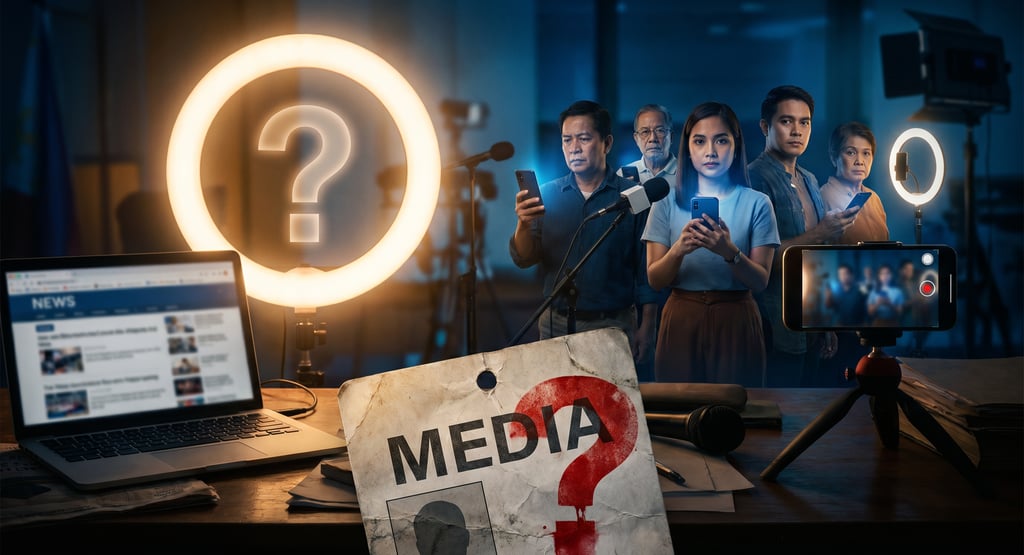
Who gave you the right to call yourself media — and should the government have the power to answer that question? This piece examines whether licensing bloggers and vloggers actually solves the fake news problem, or whether it hands the government a tool it has already proven it will misuse. From Twinmark to Rappler to PGMN, the evidence points in one direction: the real threat to Philippine information isn't the person who calls themselves media — it's the system that wants to decide who gets to.
14 min read
Krizette Chu sat in front of the House tri-committee on March 21, 2025, and apologized for calling government officials "tanga." She'd claimed there would be mass resignations in the police and military over Duterte's arrest. It was false. She said she got "carried away by her emotions."
MJ Quiambao Reyes apologized too — for a post accusing lawmakers of having children living beyond their SALN declarations. No proof. Just vibes.
This is what the regulation conversation keeps pointing to: bloggers and vloggers spreading baseless claims, and then only apologizing when hauled into a congressional hearing. The instinct is obvious — regulate them. License them. Make them register before they can claim the word "media."
MCT has been writing without a press ID, without accreditation, without anyone's permission. That's exactly why this question matters here - to me, especially. Because the answer affects everyone who does what this column does — and everyone who reads it.
But that instinct, understandable as it is, misses the bigger question: who benefits when the government decides who gets to speak?
What's Actually Happening
The Philippines ranked 114th out of 180 countries in the 2026 World Press Freedom Index — a marginal improvement in rank from 116th the year before, but with an overall score that actually dropped, from 49.57 to 46.79.
RSF (Reporters Sans Frontières / Reporters Without Borders) specifically flagged independent media outlets as targets of fabricated accusations linking them to "terrorist" activities. A documented tactic.
At the same time, the government's counter to fake news is Oplan Kontra Fake News — a program formalized in April 2026 through a memorandum of agreement between the PCO, DICT, and DOJ to combat disinformation, including AI-generated deepfakes. The inter-agency body can flag "viral content deemed a threat to public safety or national security" and pursue prosecution.
Who decides what's a threat?
The Troll Farm Problem Nobody Wants to Name
Here's the data point the regulation debate keeps avoiding.
The Philippines has been labeled "patient zero" of the global disinformation epidemic since 2016. And the fake news industry here was not built by independent bloggers. It was built by political operators, advertising firms, and state-backed networks.
Twinmark Media Enterprises is the clearest example. It ran 220 Facebook pages, 73 accounts, and 29 Instagram accounts — with Trending News Portal being the most notorious of its sites. Twinmark's network generated content that slandered opposition senators with fabricated sex scandal headlines and fake drug charges, all designed to go viral.
The operation was gamified. Celebrities were paid millions to post Twinmark content. Programmatic ads brought in revenue. The whole thing was coordinated inauthentic behavior at industrial scale.
Facebook finally banned Twinmark in January 2019. The company folded, then resurfaced weeks later under a new name with a new network of websites and accounts.
During both the Duterte and Marcos Jr. administrations, disinformation was documented as state-adjacent — coming from professional "keyboard armies," political consultants, and campaign operations that used TikTok and Facebook to flood the information space with revisionist narratives about martial law and extrajudicial killings.
When the government talks about regulating independent media to combat fake news, it is conflating two very different problems. One is coordinated, well-funded, politically driven disinformation. The other is a blogger getting their facts wrong.
These are not the same problem. And they don't have the same solution.
Regulating bloggers won't touch Twinmark 2.0.
Titles Don't Equal Integrity
Here's what the credentialing argument never survives: some of the most consequential disinformation in Philippine history came from people with titles, podiums, and institutional authority.
The drug war death toll is a case study in state-managed deception. Opposition senators put the toll at over 20,000. The CHR estimated as high as 27,000. Human rights organizations and academics put the figure between 12,000 and 30,000. The government's official PNP count stood at just over 6,200. A sitting president, at a podium, with a press corps in the room, let those numbers contradict each other for years.
Harry Roque — former UP law professor, former human rights lawyer, former presidential spokesperson — was charged alongside vlogger Claire "Maharlika" Contreras with inciting to sedition for spreading a deepfake video falsely accusing President Marcos of drug use. A law degree didn't prevent the behavior. If anything, it made the disinformation more authoritative.
Lawyer Raul Lambino falsely claimed on Facebook Live that the Supreme Court had issued a TRO against Duterte's arrest — a claim that caused immediate public confusion about the limits of presidential immunity.
A PhD does not make someone truthful. A press ID does not guarantee accuracy. A law degree does not prevent deliberate deception.
The regulation argument assumes that credentialing separates reliable voices from unreliable ones. The record says otherwise.
Yes, There Are Grifters
To be clear — there are bad actors among independents too. And they deserve to be named.
In March 2025, during a House tri-committee hearing on fake news, vlogger Mark Anthony Lopez admitted on record: "Fake news po ako."
He had posted that Philippine forces used water cannons in the West Philippine Sea — the exact tactic China uses against us. When grilled by lawmakers, he first tried to walk it back, saying he meant the Philippines could use water cannons. But eventually, under threat of contempt, he admitted it was false.
The claim wasn't a harmless mistake. It seeded confusion on a critical national security issue. And beyond the public shaming at the hearing, he faced no real consequence.
Then there's the Philippine Guardian Media Network. On May 5, 2026, PGMN founder Franco Mabanta was arrested by the NBI in an entrapment operation at Valle Verde Country Club in Pasig. Before the 2022 elections, Mabanta had been Marcos Jr.'s social media strategist.
The allegation: attempting to extort P350 million from former House Speaker Martin Romualdez in exchange for not releasing an "exposé video" allegedly linking him to corruption. Romualdez's legal team named both Mabanta and PGMN host CJ Hirro in the complaint affidavit — Mabanta allegedly made the demand, while Hirro was cited for her role in the planned exposé video. The NBI subsequently subpoenaed Hirro as a person of interest."
PGMN insists they're journalists being silenced for exposing the powerful. Romualdez's camp says it's extortion disguised as journalism. The NBI is now searching for other potential victims.
The question this case forces: where is the line between investigative work and shakedown?
That line exists. And independent media that want to be taken seriously need to defend it — not blur it.The Question Is Always Intent
Not all fake news is created equal. Some is error. Some is agenda. Some is for sale.
The difference is real — and regulation can't tell them apart.
When a vlogger admits "fake news po ako" after claiming the Philippines used water cannons in the West Philippine Sea, the question isn't just whether it was false. The question is why it was posted in the first place. Was it carelessness? Confirmation bias? Or was it designed to muddy a national security issue because that kind of content performs well with a certain audience? (But Lopez is a DDS, so we already know the answer to these questions.)
Intent is nearly impossible to prove. But patterns aren't.
Here's the harder truth: when a blogger or vlogger builds an audience, that audience becomes marketable. The bigger the platform, the louder the offers. Sponsored posts. Campaign work. "Consultation fees" that come with expectations. And depending on how rooted a creator's principles are, they are eventually confronted with a reality this industry doesn't talk about enough — there is no money in principles.
You can build a following by asking hard questions. But the people willing to pay you are rarely the ones you're questioning.
There are bloggers and vloggers whose positions move with whoever holds power. Their critiques follow access, not principle. When one administration ends and another begins, the targets change but the tone stays the same — fierce loyalty to whoever holds office, fierce opposition to whoever threatens it.
Call it adjacency. It has nothing to do with journalism.
Compare that to independent writers who have a perspective, disclose it, and own it. They might get things wrong. They might let bias shape their analysis. But the work isn't performed for access or favor. It's driven by conviction — sometimes misguided, sometimes too certain, but not for rent.
MCT has never taken money from a politician, a campaign, or a government agency for content. That's not a defense of every word published here. It's a disclosure.
The Constitution protects your right to speak. But that protection was never meant to be a shield for dishonesty. It was written for people who take the power of their platform seriously — who understand that a larger audience means a heavier obligation to get it right.
Power and responsibility are the same conversation.
The creators who self-regulate, disclose, correct their mistakes, and own their positions — they're exactly who the Constitution was written to protect. The ones who abuse the platform don't just face legal exposure. They hand the government the justification it's been looking for.
Your integrity is your constitutional armor. Lose it, and you lose the argument. Entirely. Which is why, even if you are a Guazon, a Toreon, a Roque, a Belgica, or a Tiglao — the title, the law degree, the byline, the platform — none of it protects you from yourself. The credential doesn't hold the line. You do.
The Constitution Already Answered This
Article III, Section 4 of the 1987 Philippine Constitution is unambiguous: "No law shall be passed abridging the freedom of speech, of expression, or of the press, or the right of the people peaceably to assemble and petition the government for redress of grievances."
A guideline can be rewritten. The Constitution cannot.
Any licensing requirement that conditions the right to publish on government approval doesn't just raise constitutional questions — it answers them. The moment the state decides who qualifies as media and who doesn't, it has effectively passed a law abridging press freedom. It just called it something else.
The Constitution doesn't check your follower count before it protects you. It doesn't require a license. It protects the right to speak — and that's the end of the sentence.
The Rappler Lesson
Before anyone gets comfortable with the idea of registration as accountability, they need to sit with what happened to Rappler.
In January 2018, the Securities and Exchange Commission revoked Rappler's certificate of incorporation, alleging that its Philippine Depositary Receipts to US-based Omidyar Network violated constitutional restrictions on foreign media ownership. This was the same SEC that had previously approved PDR instruments for other media companies.
The ICJ (International Commission of Jurists) called the move a "weaponization of law to curb opposing views." The Court of Appeals eventually overturned the order in July 2024, ruling Rappler remained fully Filipino-owned and that the SEC had violated due process and acted with bias. In January 2026 — nearly a decade after it started — the Supreme Court definitively closed the case.
One word: registration. That's all it took to open a nearly decade-long attempt to shut down a Nobel Prize winner's newsroom.
The lesson is not subtle. When a registration requirement exists, it becomes a lever. And in this country, levers get pulled.
The Libel Problem Already Exists
The Philippines already has one of the most aggressive accountability mechanisms for online speech in the region — cyber libel under RA 10175.
Ordinary libel under the Revised Penal Code carries imprisonment of six months to four years. Cyber libel increases this to six years minimum — and potentially up to 10 years in severe cases.
The accountability mechanism already exists — and it is being used against the people it was supposedly designed to protect. CMFR and NUJP documented 184 total attacks on media workers between July 2022 and April 2025, with 13 journalists facing cyber libel charges in that period alone — filed not by anonymous accusers but by politicians, local officials, and people in power who found a reporter inconvenient. Amnesty International, RSF, and UN Special Rapporteur Irene Khan have all called for the decriminalization of libel in the Philippines precisely because the law's most consistent use has been silencing the press, not protecting the public.
In March 2026, a Manila court issued an arrest warrant against Baskog Radio anchor India Lavapiez — served by 10 police officers at her station in Roxas City, Capiz. She was brought outside Sigma Municipal Hall and publicly humiliated in front of media, vloggers, and municipal employees. The cases were filed by Sigma Mayor Dante Eslabon, his councilor son, and a political ally — in retaliation, according to the Lavapiezes, for reports they aired on local corruption and irregularities.
A previous cyber libel complaint had already been dismissed in 2024 for failing to prove the elements of the crime. New cases were refiled anyway — in Manila, Muntinlupa, and Capiz — forcing the couple to mount a legal defense across multiple jurisdictions. The NUJP condemned the cases in April 2026 as a textbook example of libel used as a tool for harassment.
The accountability tool already exists. The question is whether it protects the public — or protects the powerful.
Identity and MCT — The Personal Part
So what about someone like MCT? Should this blog be registered? Identity known? Accountability demanded?
The BIR has already answered part of this. Under Revenue Memorandum Circular No. 038-2026, digital content creators — bloggers included — are required to display a government-issued Registration Seal Badge on their platforms. You earn from this work, you pay taxes. That's fair, and it's separate.
MCT is monetized. The income it earns right now is good for a few cups of coffee — nowhere near the threshold that triggers mandatory BIR reporting. But the moment it crosses that line, there are no qualms about reporting it. That's how it should work. Financial transparency and editorial independence are not in conflict.
But there's a difference between the BIR knowing your TIN and the government knowing what you can and cannot write.
MCT has a name attached to it. It has a position. When this column gets something wrong, readers push back — and they should. Messy, imperfect, community-driven accountability is still accountability.
Mandatory editorial registration — as a prerequisite to being taken seriously — would create a two-tiered information space. Registered equals credible. Unregistered equals suspect. And the government gets to decide who qualifies.
Gatekeeping with extra steps.
The Best Case for Regulation
To be fair — there is a legitimate argument on the other side.
A Pulse Asia survey found that 58% of Filipino adults view social media influencers, bloggers, and vloggers as peddlers of fake news about government and politics. That's a majority. And that perception has weight.
There are also real harms from unaccountable content creators — harassment, health misinformation, and reputation destruction — that fall outside the current legal framework. The 2025 Reuters Institute Digital News Report found that disinformation in the Philippines surged over the past year, fueled by the political rift between the Marcos and Duterte camps.
The argument from Rep. Geraldine Roman for a Digital Council of the Philippines — a peer-led body of content creators, academics, and platform representatives that draws up its own code of ethics — is not inherently unreasonable. Peer-led is the part that matters. The moment it gets government appointees and prosecution authority, it stops being a council and becomes a licensing board.
What the Evidence Says About Regulation
The Southeast Asian experience with fake news laws is consistent, and it is not encouraging.
Singapore's POFMA (Protection from Online Falsehoods and Manipulation Act) gives government ministers the power to issue corrections and takedowns for content they deem false. What followed was not a cleaner information environment — it was a shrunken space for political criticism. Malaysia's Anti-Fake News Act was used almost immediately against opposition voices. Thailand's anti-fake news center focused heavily on content critical of the government and military.
When governments hold the power to declare something false, that power gets used politically. Every time.
With 184 documented attacks on journalists between July 2022 and April 2025 — a 44 percent increase from the Duterte era — this is not an environment that earns the government the benefit of the doubt on media regulation.
What Actually Works
The Philippine Press Institute has been quietly doing the harder work since 2022: building Media-Citizen Councils in Batangas, Iloilo, Davao, Central Luzon, Aklan, and Leyte-Samar. Voluntary, community-driven bodies that include vloggers, civil society, local government, and media practitioners — not to prosecute, but to hold standards and address complaints.
That model is worth more than any inter-agency task force with criminal prosecution authority.
Digital literacy — not for audiences alone but for content creators — is the longer, harder play. Teaching people to verify before sharing, teaching writers to source before publishing. Tsek.ph, the collaborative fact-checking network of Philippine media, academe, and civil society, is a working example of what peer accountability looks like without government control.
Transparency norms should be community-built. Bloggers who want to be taken seriously should have names attached to their work and clear disclosure when they have a commercial or political interest in a story. Not because the government says so. Because credibility is the only real currency in this space.
The problem with fake news in the Philippines is not anonymous bloggers with small audiences. The problem is coordinated, funded, professionally managed disinformation that knows exactly what it is doing — and faces almost no consequences for doing it.
Regulating independent media will not fix that.
MCT will keep writing. With a name attached. With sources listed. With the understanding that the moment this column stops holding itself to a standard, it hands someone else the right to hold it to theirs.
SOURCES
Inquirer.net, Vloggers apologize under grilling in House fake news probe, https://newsinfo.inquirer.net/2045820/vloggers-apologize-under-intense-grilling-in-house-fake-news-probe
Manila Bulletin, Social media personalities apologize for sharing unconfirmed information, https://mb.com.ph/2025/3/21/social-media-personalities-apologize-for-sharing-unconfirmed-information-online
Global Nation Inquirer, PH improves to 114th in 2026 World Press Freedom Index, https://globalnation.inquirer.net/320652/ph-improves-to-114th-in-2026-world-press-freedom-index
Philstar, Press freedom index Philippine scores down amid higher ranking, https://www.philstar.com/headlines/2026/05/04/2525540/press-freedom-index-philippine-scores-down-amid-higher-ranking
RSF, Philippines country page, https://rsf.org/en/country/philippines
Newsbytes.ph, DICT PCO DOJ formalize Oplan Kontra Fake News, https://newsbytes.ph/2026/04/14/dict-pco-doj-formalize-oplan-kontra-fake-news-amid-rising-deepfake-threats
Cambridge University Press, Disinformation by design Philippines, https://www.cambridge.org/core/journals/data-and-policy/article/disinformation-by-design-leveraging-solutions-to-combat-misinformation-in-the-2025-philippine-elections
NATO StratCom COE, Politics and Profit in the Fake News Factory, https://stratcomcoe.org/cuploads/pfiles/5december_report_philippines.pdf
New Internationalist, The Philippines disinformation machine, https://newint.org/science-and-technology/2024/philippines-disinformation-machine
Oxford Academic, Digital Autocratization and Disinformation in Philippine Elections, https://academic.oup.com/edited-volume/60551/chapter/523644627
Facebook Newsroom, Banning Twinmark Media Enterprises in the Philippines, https://about.fb.com/news/2019/01/banning-twinmark-media-enterprises
Reuters, Facebook bans Philippines Twinmark Media Enterprises, https://www.reuters.com/article/technology/facebook-bans-philippines-twinmark-media-enterprises-idUSKCN1P50DY
GMA Network, Facebook takes down 220 pages 73 accounts 29 Instagram accounts related to Twinmark, https://www.gmanetwork.com/news/money/companies/681063/facebook-takes-down-220-pages-73-accounts-29-instagram-accounts-related-to-twinmark/story
Al Jazeera, Philippine authorities contradict own death toll in drugs war, https://www.aljazeera.com/news/2019/7/18/philippine-authorities-contradict-own-death-toll-in-drugs-war
BBC, Philippines drug war do we know how many have died, https://www.bbc.com/news/world-asia-50236481
Human Rights Watch, Killing and Lies Philippine President Duterte war on drugs, https://www.hrw.org/news/2017/03/09/killing-and-lies-philippine-president-dutertes-war-drugs-exposed
DW, Duterte's drug war facts and fiction, https://www.dw.com/en/investigating-dutertes-drug-war-in-philippines-facts-and-fiction/a-43695383
Inquirer.net, NBI files inciting to sedition charges vs Roque vlogger Maharlika, https://newsinfo.inquirer.net/2053355/nbi-files-inciting-to-sedition-charges-vs-roque-vlogger-maharlika
GMA Network, NBI files inciting to sedition raps vs Harry Roque vlogger, https://www.gmanetwork.com/news/topstories/nation/942895/nbi-maharlika-harry-roque-polvoron-video/story
BNC, NBI files case vs Harry Roque vlogger Maharlika over deepfake polvoron video, https://bnc.ph/nbi-files-case-vs-harry-roque-vlogger-maharlika-over-deepfake-polvoron-video/news
Inquirer.net, Blogger apologizes for claiming PH uses water cannons in WPS, https://newsinfo.inquirer.net/2045733/blogger-apologizes-for-claiming-ph-uses-water-cannons-in-wps
BNC, Vlogger Mark Lopez admits water cannon claim untrue, https://bnc.ph/fake-news-po-ako-vlogger-mark-lopez-admits-water-cannon-claim-untrue/news
VERA Files, Blogger falsely claims PH uses water cannons in WPS, https://verafiles.org/articles/fact-check-blogger-falsely-claims-ph-uses-water-cannons-in-wps
Rolling Stone Philippines, Franco Mabanta PGMN extortion allegations quick facts, https://rollingstonephilippines.com/state-of-affairs/philippine-politics/franco-mabanta-pgmn-extortion-allegations
Inquirer.net, Matibag NBI checking for other victims of Mabanta, https://newsinfo.inquirer.net/2225126/matibag-nbi-checking-for-other-victims-of-mabanta
Gulf News, Philippines social media founder Franco Mabanta arrested, https://gulfnews.com/world/asia/philippines/philippines-social-media-founder-franco-mabanta-arrested-following-alleged-350-million-peso-extortion-bid-1.1715016885804
Tribune, NBI files cybercrime extortion case vs PGMN founder Mabanta, https://tribune.net.ph/2026/05/06/nbi-files-cybercrime-related-extortion-case-vs-pgmn-founder-mabanta
Inquirer.net, Romualdez camp PGMN not journalists just extortionists, https://newsinfo.inquirer.net/2224904/romualdez-camp-pgmn-not-journalists-just-extortionists
ICJ, Philippines SEC order to shut down Rappler violates freedom of expression, https://www.icj.org/philippines-sec-order-to-shut-down-rappler-violates-freedom-of-expression
BBC, Philippine news website Rappler has licence revoked by SEC, https://www.bbc.com/news/world-asia-42692723
MDIF, Philippine Supreme Court ends case against Rappler, https://www.mdif.org/news/philippine-supreme-court-ends-case-against-rappler
Inquirer.net, SC ends decade-long case to shut down Rappler, https://newsinfo.inquirer.net/2205960/its-final-rappler-wins-shutdown-fight
Doughty Street Chambers, Philippine Supreme Court closes case seeking to shut down Rappler, https://www.doughtystreet.co.uk/news/philippine-supreme-court-closes-case-seeking-shut-down-maria-ressas-news-organisation-rappler
PCIJ Blog, Online libel provision gives chilling effect, https://old.pcij.org/blog/2014/03/03/online-libel-provision-gives-chilling-effect
Respicio Law, Cyber Libel Laws and Defenses in the Philippines, https://www.respicio.ph/commentaries/cyber-libel-laws-and-defenses-in-the-philippines
CMFR, State of Media Freedom in the Philippines 2025, https://cmfr-phil.org/press-freedom-protection/press-freedom/the-state-of-media-freedom-in-the-philippines
NUJP, Statement a challenge for government to do better, https://nujp.org/statement-a-challenge-for-government-to-do-better
NUJP, Statement on the full report of UNSR Irene Khan, https://nujp.org/statement-on-the-full-report-of-unsr-irene-khan
Amnesty International, Philippines Cybercrime law threatens freedom of expression, https://www.amnesty.org/en/latest/news/2012/10/philippines-cybercrime-law-threatens-freedom-expression-and-must-be-reviewed
RSF, Cybercrime law threat to freedom of information, https://rsf.org/en/cybercrime-laws-threat-freedom-information
NUJP, Cases vs Capiz journos a clear example of how libel is used for harassment, https://nujp.org/cases-vs-capiz-journos-a-clear-example-of-how-libel-is-used-for-harassment
Manila Bulletin, Influencers online sellers face new BIR registration rules, https://mb.com.ph/2026/05/06/influencers-online-sellers-face-new-bir-registration-rules
Pulse Asia via RSISIS International, Capacity to detect fake news Philippines, https://rsisinternational.org/journals/ijriss/articles/capacity-to-detect-fake-news-its-relationship-to-the-utilization-of-online-news-sources
Reuters Institute, Philippines Digital News Report 2025, https://reutersinstitute.politics.ox.ac.uk/digital-news-report/2025/philippines
Inquirer.net, Self-regulatory body urged for vloggers after House grilling, https://newsinfo.inquirer.net/2046030/self-regulatory-body-urged-for-vloggers-after-house-grilling
East Asia Forum, Fake news the law and self-censorship in Southeast Asia, https://eastasiaforum.org/2019/08/02/fake-news-the-law-and-self-censorship-in-southeast-asia
Public Media Alliance, The rise of fake news laws across South East Asia, https://www.publicmediaalliance.org/the-rise-of-fake-news-laws-across-south-east-asia
Tandfonline, Illiberal responses to fake news in Southeast Asia, https://www.tandfonline.com/doi/full/10.1080/13510347.2024.2442395
PCIJ, State of Media Freedom in the Philippines 2025, https://pcij.org/2025/05/03/cmfr-state-of-media-freedom-in-the-philippines-2025
Philippine Press Institute, Media-Citizen Councils self-regulation, https://philpressinstitute.net/ppi-promotes-self-regulation-accountability-via-media-citizen-councils
Wikipedia, Fake news in the Philippines, https://en.wikipedia.org/wiki/Fake_news_in_the_Philippines
Contact us
subscribe to morning coffee thoughts today!
inquiry@morningcoffeethoughts.org
© 2024. All rights reserved.