
Why Duterte Is Not Machiavellian: The Psychology of a Populist Strongman
Rodrigo Duterte is not Machiavellian. He is a populist strongman who ruled by fear, ego, and impulse — not strategy. Machiavelli would have seen through him in a paragraph.
10 min read
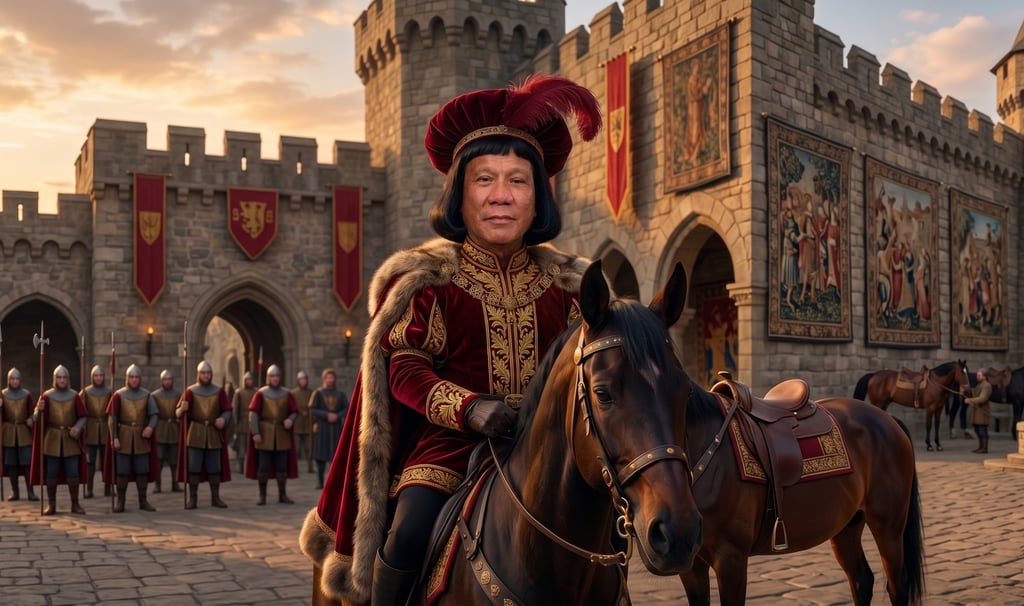
One of our community members recently reposted my piece and, in his caption, tagged Rodrigo Duterte as "Machiavellian." I thank him for sharing it — I always appreciate when the work travels — but the label caught my eye.
This isn't even the first time I've seen Duterte compared to Machiavelli. My reaction is usually one of mild amusement, because Duterte is far from being a Machiavellian. If anything, it feels a bit offensive to Machiavelli. The man has been dead for centuries; he doesn't deserve that kind of slander. If he could see the comparison, I imagine him turning in his grave.
I've been reading The Prince since I was 17, and I've gone back to it repeatedly over the years. Not as a bible, not as the only lens, but as one of several reference points when I'm studying political personalities. It's one of the tools on the desk, not the whole toolbox.
Beside it, there's Robert Greene's The 48 Laws of Power, which dissects how people accumulate, protect, and project power. There's Dale Carnegie's How to Win Friends and Influence People — the more polite ancestor of every "persuasion" book — useful for seeing where charm ends and manipulation begins. I also reach for The Dictator's Handbook by Bruce Bueno de Mesquita and Alastair Smith, which looks at how leaders survive by rewarding a small winning coalition, and On Tyranny by Timothy Snyder, a slim guide to spotting and resisting authoritarian habits.
I don't read these books to worship them. I read them to build benchmarks. When I look at a leader, I ask: How do they use fear? How do they use loyalty? Do they build institutions or just brands?
By those standards, and especially by Machiavelli's, Duterte fails badly.
WHAT MACHIAVELLI ACTUALLY DEMANDS
The easiest reading of The Prince is the lazy one: ruthless man, ruthless politics, any means necessary. That reading is popular. It is also shallow.
In Chapter XVII, Machiavelli writes: "It is much safer to be feared than loved, if one of the two has to be wanting." People love that line. They throw it around on Facebook and in bar arguments. What they usually leave out is the next part, where he says a ruler must manage fear "in such a way that, if he does not win love, he avoids hatred." The point isn't "be cruel." The point is "do not make people hate you, or you will fall."
Machiavelli's ideal ruler has what he calls virtu. Not virtue like being kind or honest, but a kind of political skill: courage, quick thinking, the ability to read a situation and act at the right time. Virtu is the leader who sees the storm coming and starts reinforcing the house before the rain hits.
Opposite virtu is fortuna — fortune, luck, the things you cannot control. Machiavelli compares fortuna to a raging river that sometimes floods and destroys everything in its path. You can't stop the river. But you can build dikes and walls before it overflows. A smart leader respects luck, but does not blame everything on it. He prepares.
Then there is the famous fox and lion image. Machiavelli says a ruler needs to be both: a fox to see traps, a lion to scare away wolves. If you are only a lion — all force, no cunning — others will trick you. If you are only a fox — all tricks, no courage — you will be eaten.
Underneath all of this is one simple rule: the people matter. Machiavelli says a wise ruler would rather rely on the people than on the elites or the army, because ordinary people only really want not to be oppressed. So you keep them from hating you. You think ahead. You mix lion and fox. You build walls before the flood.
That's the Machiavellian bar.
Duterte doesn't clear it.
THE MAN WITH A HAMMER
Rodrigo Duterte had one tool: the threat of violence. And he used it on everything.
He did not pretend to be gentle while being harsh in private. He bragged onstage about killing. He joked about rape. He compared himself to Hitler and said he would be happy to slaughter drug addicts. A leader who thinks like Machiavelli knows that looking cruel all the time is dangerous because it turns fear into hatred. Duterte's whole political brand was cruelty in the open.
Look at his anti-corruption record. For all the tough talk, there was no real strategy. Officials were fired in a big show, then quietly reassigned or recycled. Corruption scores got worse under him, not better. In 2019, the Philippines fell to 113th place out of 180 countries in Transparency International's Corruption Perceptions Index, dropping 18 spots compared to earlier years. That is not careful use of power. That is a man swinging a hammer at whatever is in front of him and calling the noise "reform."
A Machiavellian leader plans ahead. He builds alliances before he needs them. He shapes institutions that can survive him. Duterte did the opposite. He hollowed out institutions, attacked checks and balances, and made everything depend on his personal mood. His foreign policy lurched from cozying up to China to suddenly talking tough again, from insulting Western allies to later trying to reassure them. He did not manage events; events pushed him around.
He was a lion who liked to roar into the microphone.
He was almost never the fox.
THE PSYCHOLOGICAL FILE
In 1998, during his marriage annulment case, Duterte underwent a psychological evaluation. The report, by clinical psychologist Dr. Natividad Dayan, described him as having "antisocial narcissistic personality disorder." That's a mouthful, but the key ideas are simple: he was found to be self-centered, lacking empathy, impulsive, and showing little concern for rules or consequences if they got in the way of what he wanted.
The report said he had a "gross indifference to the suffering of others," showed "insensitivity" and a "lack of remorse," and struggled to control his anger and behavior. It also noted that he had poor judgment and was "unable to reflect on the consequences of his actions."
That last line cuts straight across the Machiavelli comparison. The entire point of The Prince is consequence. Machiavelli cares about what happens three steps down the line. He is constantly asking: "If a ruler does this today, what will it do to his grip on power tomorrow?" Duterte, by that psychological account, could barely see past today.
Modern research on narcissistic leaders says something similar. People with this kind of outsized self-importance often overestimate their abilities, take reckless risks, and ignore feedback. They need constant praise and react with rage or denial when criticized. That might produce strong speeches. It rarely produces strong governance.
You also see the cowardice in how he handled accountability. When the International Criminal Court began looking into the killings in his drug war, he did not calmly say, "Yes, I will face the court and explain my decisions." He shifted, delayed, attacked the court, pulled the country out of the treaty, then later gave mixed signals about being "ready" to go to jail. That's not courage. That's a man trying to avoid a day of reckoning while still acting tough onstage.
Machiavelli might accept cruelty in the name of stability.
He would not respect mindless cruelty from a man who panics when the bill arrives.
THE BETTER COMPARISON
If Duterte is not Machiavellian, then what is he?
The label that fits better is "populist strongman." A strongman is a leader who gathers power into his own hands, weakens checks and balances, and relies heavily on force or the threat of force. A populist is someone who claims to speak for "the people" against "the corrupt elite," often using simple, emotional language to divide society into "us" and "them." Put them together and you get a familiar figure: a leader who says, "Only I can protect you," while slowly breaking the very systems that are supposed to protect everyone.
Duterte is often compared to Thaksin Shinawatra of Thailand. Thaksin launched a "war on drugs" in 2003. In about three months, police-linked operations killed roughly 2,800 people. A later investigation found that more than half of those killed had no proven drug links at all. It was a bloodbath presented as policy. Duterte's drug war followed a similar pattern: thousands killed, many without trial, with police and vigilantes acting under a climate of permission. Same pose. Same script of "tough love." Same lack of careful targeting.
Duterte once said he didn't mind being compared to Idi Amin of Uganda. Amin's regime, from 1971 to 1979, is estimated to have killed 300,000 to 500,000 people through political purges, ethnic targeting, and sheer terror. He ruled through fear, torture, and arbitrary violence. Survivors have described torture chambers where opponents were brutalized, and stories of Amin keeping body parts of his enemies have become part of his dark legend. The comparison is not exact — contexts differ — but the emotional logic is similar: rule by making everyone afraid of what you might do next.
Hugo Chavez in Venezuela is a different kind of mirror. He didn't boast about killing people the way Duterte did. His cruelty was more institutional. Under Chavez, human rights groups documented how courts were packed with loyalists, media outlets were harassed or shut down, and critics were threatened or prosecuted. Power was slowly concentrated in the executive, while the government still spoke the language of "the people" and "revolution." Duterte admired that kind of posture. The difference is that he preferred the shortcut of open violence and shock statements instead of slow, boring control of institutions.
So yes, strongmen and would-be strongmen are better comparisons than Machiavelli's ideal ruler. They are not deep thinkers about power. They are performers with real guns behind them.
Duterte fits that family photo much better.
ACTUALLY, ONE MORE COMPARISON
If there is one figure — fictional or real — that Duterte reminds me of most, it's Lord Farquaad from Shrek.
Hear me out.
Farquaad is a small man in every sense who overcompensates through spectacle. He builds a giant castle. He issues loud commands. He parades his authority in front of terrified subjects. But when it's time to face danger, he doesn't go himself. He sends others. He watches from a safe distance and calls that leadership.
That is Duterte's political story in cartoon form.
He ordered a drug war where thousands died, but he was not the one in the dark alleys pulling the trigger. Police, local officials, and masked gunmen did the dirty work. When the international community and human rights bodies asked questions, he postured at the microphone — joked, cursed, threatened — while letting others handle the risk on the ground and, later, in court.
Farquaad, famously, was a small man. Shrek said it best when he first saw the giant castle: "Do you think he's compensating for something?" The movie plays it for laughs. But underneath the joke is a simple read of power: a fragile ego hiding behind oversized walls and oversized cruelty. Duterte's violence was never cool and detached. It felt like anger. It looked like someone needing the whole country to be scared of him so he wouldn't have to face the fear of being ordinary.
Machiavelli's ideal ruler uses fear like a tool in a toolbox — picked up, put down, measured, controlled.
Farquaad — and Duterte — are ruled by fear: their own and everyone else's.
One more detail seals the comparison. Farquaad doesn't actually want to do the hard work of ruling a kingdom. He wants the title, the grand wedding, the image of being king. When the dragon shows up, when the real danger hits, he shrinks. Duterte's six years look like that. No clear economic vision. No lasting reform of institutions. A drug war that didn't solve the drug problem. A foreign policy that made us more vulnerable, not more secure. In the end, what he left behind was not a stronger state. It was just a brand.
He was Lord Farquaad all along. We just didn't have the subtitles on.
ON THE SURVIVALIST GULLIBLES
Now to the people who loved him.
His followers — especially the most devoted ones — were not simply "dumb." They were scared. Many lived in communities where crime felt close, where drugs felt visible, where the state showed up rarely, if at all. When someone like Duterte walks in shouting, "I will kill for you, I will clean this up, I don't care what others say," that can sound like safety.
Political psychology has a consistent finding: when people feel threatened, afraid, or humiliated, they become more willing to follow a harsh leader who promises order. Fear pushes many into a kind of default obedience toward "strong" leaders, especially those who talk in simple, moral terms like "good people" versus "criminals."
So yes, I call some of them survivalist gullibles. Survivalist, because their instinct was to protect themselves and their families in a brutal environment. Gullible, because they mistook loudness for wisdom and blood for results. The instinct to survive is deeply human. The choice of savior was deeply tragic.
Duterte was a man with a hammer. Nothing more. The people who cheered him on were not born foolish. They were taught, over years of neglect and fear, to run toward the first man who shouted that he wasn't afraid of the dark.
If Machiavelli were alive today, watching from some corner of Florence, he would recognize Duterte for what he is: not his student, not his proof of concept, but a warning about what happens when raw impulse wears the mask of strategy.
He would have seen through him in a paragraph.
Sources:
The Prince, Wikipedia, https://en.wikipedia.org/wiki/The_Prince
Effectiviology — Lessons and Quotes from The Prince, https://effectiviology.com/strategy-lessons-from-machiavelli-the-prince/
Marxists.org — The Prince Chapter XVII and XIX, https://www.marxists.org/reference/archive/machiavelli/works/prince/ch19.htm
The Collector — Virtu and Fortuna in Machiavelli, https://www.thecollector.com/virtu-and-fortuna-according-to-niccolo-machiavelli/
LitCharts — The Fox and the Lion, https://www.litcharts.com/lit/the-prince/symbols/the-fox-and-the-lion
Rodrigo Duterte — Wikipedia, https://en.wikipedia.org/wiki/Rodrigo_Duterte
Institut Montaigne — Portrait of Rodrigo Duterte, https://www.institutmontaigne.org/en/expressions/portrait-rodrigo-duterte-president-philippines
Philstar Life — Anti-corruption under Duterte, https://philstarlife.com/news-and-views/525469-anti-corruption-under-duterte-reactive-and-ineffective
ABS-CBN — Understanding Duterte: What a psych report says, https://www.abs-cbn.com/halalan2016/focus/04/19/16/understanding-duterte-what-a-psych-report-says
The Independent — Duterte mental health assessment, https://www.independent.co.uk/news/world/asia/philippines-president-rodrigo-duterte-mental-health-psychological-condition-a73558
PMC — Leader narcissism and outcomes, https://pmc.ncbi.nlm.nih.gov/articles/PMC5437163/
PMC — Grandiose narcissism and decision-making, https://pmc.ncbi.nlm.nih.gov/articles/PMC7427600/
New Mandala — Duterte Harry: Fire and Fury in the Philippines, https://www.newmandala.org/duterte-harry-fire-fury-philippines/
East Asia Forum — Duterte's illiberal democracy, https://eastasiaforum.org/2018/04/16/dutertes-illiberal-democracy-and-perilous-presidential-system/
Human Rights Watch — Thailand's War on Drugs, https://www.hrw.org/news/2008/03/12/thailands-war-drugs
PubMed — War on drugs in Southeast Asia as state vigilantism, https://pubmed.ncbi.nlm.nih.gov/33549467/
Inquirer — Duterte likened to Idi Amin, https://newsinfo.inquirer.net/796976/digong-says-he-doesnt-mind-being-likened-to-idi-amin
World Vision — Uganda genocide, https://www.worldvision.org/disaster-relief-news-stories/uganda-genocide-nightmare-finally-end
IWMF — Idi Amin's torture chambers, https://www.iwmf.org/reporting/ghost-stories-idi-amins-torture-chambers/
Human Rights Watch — Venezuela under Chavez, https://www.hrw.org/news/2012/07/17/venezuela-concentration-and-abuse-power-under-chavez
BBC — Human rights in Venezuela, https://www.bbc.com/news/world-latin-america-18867310
Political strongman — Wikipedia, https://en.wikipedia.org/wiki/Political_strongman
APA — Fear: A powerful motivator in elections, https://www.apa.org/news/apa/2020/fear-motivator-elections
Scientific American — Why some people follow authoritarian leaders, https://www.scientificamerican.com/article/why-some-people-follow-authoritarian-leaders-and-the-key-to-stopping-it/
Contact us
subscribe to morning coffee thoughts today!
inquiry@morningcoffeethoughts.org
© 2024. All rights reserved.
If Morning Coffee Thoughts adds value to your day, you can support it with a monthly subscription.
You can also send your donation via Gcash: 0969 314 4839.