
WHY IS CAMILLE VILLAR SILENT ON THE DUPAX DEL NORTE MINING CASE?
Camille Villar’s silence on the Dupax del Norte mining case raises serious questions about her role as chair of the Senate environment committee. This blog traces how Woggle Corporation got its permit, what DENR did and didn’t do, and why villagers ended up arrested before a prosecutor threw the charges out. It asks what Camille Villar’s inaction reveals about political dynasties, conflicts of interest, and environmental justice in the Philippines.
11 min read
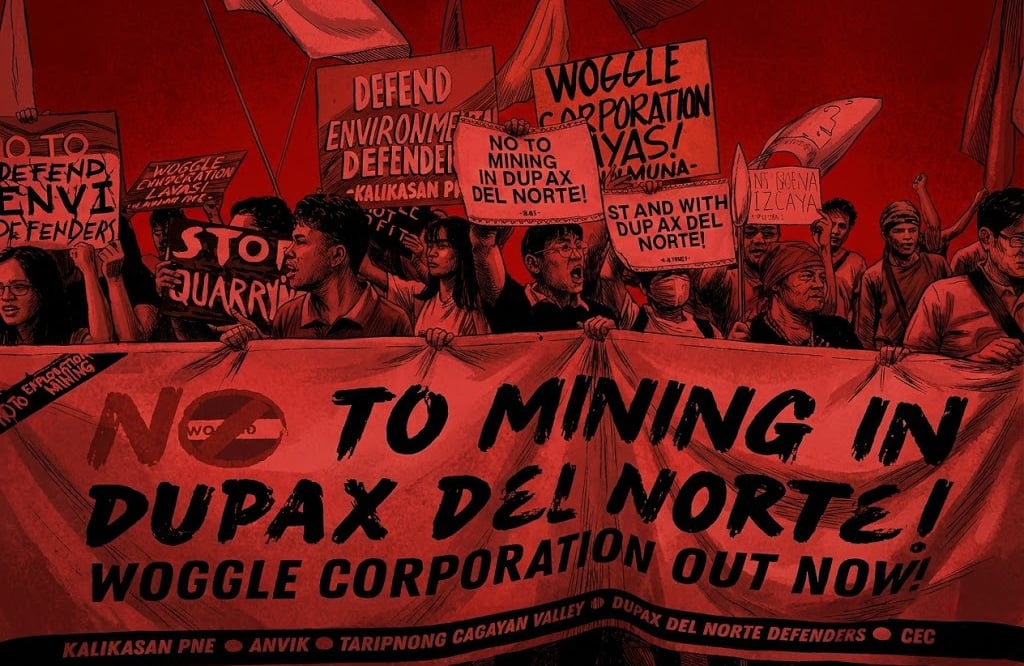
I've been following the Dupax del Norte situation for weeks now. And I keep asking myself the same question: where is Senator Camille Villar?
She chairs the Senate Committee on Environment, Natural Resources and Climate Change. There's a mining controversy unfolding in Nueva Vizcaya—arrests, church condemnation, human rights violations, environmental destruction. And from her? Nothing.
Or at least, nothing I can find.
So I started digging. Because the question isn't whether she's directly involved with Woggle Corporation or profiting from their operations. The question is simpler and maybe more damning: as chair of the committee that's supposed to oversee this exact kind of situation, shouldn't she have said something by now?
Let me walk you through what I found.
WHAT'S HAPPENING IN DUPAX DEL NORTE
Since September 2025, residents of Dupax del Norte, Nueva Vizcaya, have been holding a barricade. They're blocking British-linked mining company Woggle Corporation from exploring their land. Woggle has a DENR exploration permit covering 3,102 hectares. The company is 40 percent owned by London-based Metals Exploration PLC and 60 percent by the FCF Minerals pension plan—FCF is also a subsidiary of Metals Exploration. So basically, it's British money all the way down.
The residents aren't protesting for nothing. According to reports, Woggle had already started cutting down trees and muddying rivers before the barricade went up. People were scared about water contamination, landslides, losing their farmland—everything that keeps them alive. They know what happened in Didipio when OceanaGold moved in. The Dinaoyan River got copper contamination. So they said: not here, not again.
On January 19, 2026, a regional trial court in Bambang ordered the barricade removed. Four days later, over 300 police officers and SWAT personnel showed up and forcibly cleared the barricade. Seven residents were arrested, including six indigenous women and community leader Florentino Daynos. Human rights groups called it "violent" and "excessive use of force."
The Catholic Bishops' Conference of the Philippines and the Catholic Educational Association of the Philippines released a joint statement on January 27, 2026. They called on the government to protect the residents, reassess the mining permit, and stop harmful operations. Bishop Roberto Mallari said, "It is painful to see the suffering of our brothers and sisters at the barricade—simple citizens and farmers who only want to defend their life and livelihood, their land."
Environmental groups protested at the DENR office. They accused the government of "state-backed corporate plunder."
Nueva Vizcaya Representative Timothy Joseph Cayton filed House Resolution 413 for a congressional investigation. But on January 28, 2026, he admitted the investigation was "unlikely" to happen.
Then on January 26, 2026, something important happened. The Provincial Prosecutor's Office in Nueva Vizcaya dismissed the charges of direct assault, resistance and disobedience, and obstruction of justice against the seven arrested residents. The prosecutor found the evidence "lacked sufficient basis" and emphasized that the gathering was a peaceful exercise of constitutional rights to free expression and assembly. The charges could not stand.
That matters. It tells the public this was never a simple story of "lawbreakers blocking a legal project." It was contested. It involved state power, a foreign-linked mining company, and a community that had to fight just to prove they were not criminals for defending their own land.
So that's where we are. A crisis. Arrests that got thrown out by the prosecutor. Church condemnation. Human rights violations. Environmental destruction.
In late January, community leader Florentino “Bro Tino” Daynos brought their story to national radio in an interview with Ted Failon and DJ Chacha. He described how residents were never properly consulted, how some were called to hearings but not allowed to speak, and how many only learned about Woggle’s exploration permit after activities had already begun.
And from Senator Camille Villar? Silence.
THE DENR SIGNED THE PERMIT—AND HASN'T SAID A WORD SINCE
On August 4, 2025, DENR Assistant Secretary for Mining Concerns and concurrent MGB Officer-in-Charge Director Michael V. Cabalda signed the exploration permit covering 3,102 hectares in Dupax del Norte. This happened under the watch of DENR Secretary Maria Antonia Yulo-Loyzaga, who was the head of DENR at the time.
Fast-forward to today. Yulo-Loyzaga is no longer DENR Secretary. In May 2025, she was one of several cabinet members ordered by President Marcos to tender courtesy resignations following the midterm elections.
Her resignation was accepted. Executive Secretary Lucas Bersamin said the evaluation concluded she must "rest for a while" and noted that there was "a perception that she was frequently abroad." She was replaced by Raphael Lotilla, who was moved from the Department of Energy to DENR.
Lotilla's appointment was welcomed by mining groups. The Chamber of Mines of the Philippines expressed excitement to see under his leadership "the fruition of President Ferdinand R. Marcos, Jr.'s vision for maximizing the full potential of the Philippine minerals development industry." Lotilla himself has been clear about his priorities.
In October 2025, he said the Philippines is entering a "renewed period of energy and momentum" for mining, citing the lifting of the moratorium on new projects, the removal of the open-pit mining ban, and the passage of a new fiscal regime for large-scale metallic mining.
At a mining conference in December 2025, Lotilla emphasized that responsible mining drives the economy and benefits communities. He said the DENR is finalizing an executive order to establish a national policy framework for developing a critical minerals industry.
Since taking over in May 2025, Lotilla and the DENR have not revoked the Woggle exploration permit. They have not issued a statement on the January 23, 2026 arrests of seven Dupax del Norte residents. They have not responded to the Catholic Bishops' Conference and the Catholic Educational Association's joint statement on January 27, 2026, calling for the government to protect residents, reassess exploration permits, and halt harmful mining operations. They have not clarified whether proper Free, Prior and Informed Consent was obtained from affected communities, or addressed allegations that attendance sheets from ayuda distributions were used as fake FPIC proof. They have not explained why the exploration permit was fast-tracked and approved in August 2025. They have not responded to allegations that Woggle had already started cutting trees and muddying rivers before proper environmental safeguards were in place. They have not made environmental impact reports publicly available, despite repeated calls from environmental groups.
Environmental groups have been protesting at the DENR central office in Quezon City since January 23, 2026, demanding the agency revoke Woggle's permit and halt all mining activities. Kabataan Partylist Rep. Raoul Manuel and other lawmakers have called on DENR to immediately revoke the exploration permit. The DENR has not responded.
The current DENR does not view the Woggle permit as a mistake. If Secretary Lotilla believed the permit was improperly issued, lacked proper consultation, or violated environmental safeguards, he could have suspended it pending review. He could have ordered an investigation. He could have made a statement. He hasn't. And that tells you that the agency tasked with protecting the environment has chosen to protect the mining company instead.
WHAT HER COMMITTEE IS ACTUALLY SUPPOSED TO DO
Camille Villar chairs the Senate Committee on Environment, Natural Resources and Climate Change. She's held that position since August 2025.
According to Senate rules, her committee has jurisdiction over everything related to "conservation and protection of the environment," "exploration, regulation and licensing" of mineral resources, and "Philippine compliance with relevant international agreements" on environmental issues.
At her first committee hearing in September 2025, Villar laid out her priorities: climate resilience, biodiversity, plastic pollution, solid waste management. She said flooding is "not just a natural hazard, but a governance challenge that tests our capacity for urban planning, disaster preparedness, and environmental law enforcement." She said, "We do not inherit the Earth from our ancestors, we borrow it from our children."
That all sounds good.
At that same hearing, Senator Raffy Tulfo raised concerns about mining abuses, illegal logging, and land grabbing. The committee was functioning. Environmental controversies were being surfaced.
So why hasn't Villar convened a hearing on Dupax?
Why hasn't she issued a statement?
Why hasn't she filed a Senate resolution calling for an investigation?
I searched. I looked through major news outlets—Inquirer, Manila Bulletin, Rappler, Philippine News Agency. I checked Senate plenary sessions from January 27-28, 2026. Senators Raffy Tulfo, Loren Legarda, and Risa Hontiveros made manifestations on illegal black sand mining and dredging. But no one mentioned Dupax, not yet at least.
A Mindanao radio program ran a short feature asking why Senator Camille Villar remains "tak-om" on the Dupax del Norte mining project. The anchor walks listeners through how Woggle's UK-linked permit was quickly approved, how residents say they weren't properly consulted, and how ayuda attendance sheets were allegedly used as fake FPIC proof before seven protesters were arrested. The segment is another reminder that people outside Nueva Vizcaya are now asking why the Senate's environment chair is quiet while all this is happening.
People noticed she hasn't spoken.
THE VILLAR FAMILY'S MINING AND LAND INTERESTS
Let me make you uncomfortable for a moment (but if you have conscience, it will last longer).
The Villar family has a history of investing in mining. In 2012, Manuel Paolo Villar—Camille's brother—bought ₱1.8 billion worth of shares in Nationwide Development Corporation, which holds mining rights over gold and copper in Compostela Valley. In 2014, the Villar group acquired 13.33 percent of Mindoro Resources Ltd., a Canadian company developing a nickel project in Agusan del Norte.
There's no evidence that the Villar family has a direct stake in Woggle Corporation or Metals Exploration PLC. But the perception problem is real. When your family has profited from mining, how do people trust you to regulate mining?
Then there's the real estate empire. Vista Land & Lifescapes is the Villar family's main business. They own Camella Homes, Lumina Homes, and massive subdivisions across the Philippines. Vista Land has been accused repeatedly of converting farmland into housing developments. In 2017, KAISAHAN raised concerns about Cynthia Villar chairing Senate committees on agrarian reform and environment while owning a company that turned irrigated farmlands in Bulacan and other provinces into subdivisions. They warned that "Senator Villar's business interests can diminish her objectivity when legislation related to land use, agrarian reform, and even agriculture are tackled."
That same logic applies to Camille Villar.
Real estate depends on infrastructure. Infrastructure depends on government permits. Environmental permits come from DENR—the agency her committee oversees.
The Las Piñas-Zapote River flood control project is another example. The project cost ₱2.42 billion from 2011 to 2022, passed through Villar-owned properties, and has been criticized for potential conflicts of interest. Despite completion, the river is still polluted and flooding continues. But the project improved access to Villar family real estate.
Camille's brother Mark Villar was DPWH Secretary during the Duterte administration's Build Build Build program. In 2025, the DOJ launched an investigation into possible family ties to government contractors. I&E Construction, linked to his cousin Carlo Aguilar, received ₱18.5 billion in contracts. Motiontrade Development Corporation, owned by his uncle Christian Aguilar, secured ₱2.8 billion in public projects from 2023 to 2025.
The pattern is clear. The Villar family has financial interests in mining, real estate, and infrastructure—all industries that depend on government permits, regulatory approvals, and environmental clearances.
When a family member chairs the Senate committee responsible for environmental oversight, the potential for conflict becomes structural.
IS THIS A CONFLICT OF INTEREST?
Legally? Maybe not. There's no evidence Camille Villar personally profits from Woggle Corporation.
But structurally? Yeah. I think so.
Her family has mining investments. Her family profits from land development. Her family has been investigated for contractor ties. And now, when a major environmental and human rights crisis is unfolding—arrests that got dismissed by the prosecutor, church condemnation, allegations of state-backed corporate plunder—she says nothing.
That silence protects a system that benefits her family.
She's sitting on the statement she needs to make. That's the conflict. She has the authority to act. She has the mandate to investigate. But she has every personal, financial, and political reason not to.
WHAT WE SHOULD EXPECT FROM A RESPONSIBLE SENATE ENVIRONMENT CHAIR
Senator Camille Villar should convene a Senate committee hearing on Dupax del Norte. She should invite testimony from affected residents, the CBCP, environmental groups, Woggle Corporation, and the DENR. She should issue a public statement clarifying her position on the arrests, the dismissal of charges by the prosecutor, the exploration permit, and the allegations of inadequate consultation. She should file or co-sponsor a Senate resolution calling for a full investigation.
If her family's mining and real estate interests create a conflict, she should recuse herself. Or at minimum, disclose all family business ties to mining and land development publicly.
But more broadly, the Senate should pass the anti-political dynasty law that has been sitting in Congress since 1987. Political families control nearly all 82 provinces in the Philippines. The Constitution says dynasties should be prohibited, but no law has ever been enacted. Senate Bill 1765 was approved by 13 senators in committee in 2018, but it never reached the floor.
The Villar family has been the subject of petitions calling for an end to their political dynasty in Las Piñas. Critics argue the family's grip on power undermines democracy and creates conflicts of interest, prioritizing personal gain over public welfare.
Senator Cynthia Villar said there's "nothing wrong" with political dynasties "as long as they work hard." But working hard doesn't erase the conflict. The question is whether the work serves the public or serves the family.
WHAT’S REALLY ON THE LINE IN DUPAX
The Philippines is the deadliest country in Asia for environmental defenders. In 2023, at least 17 land and environmental defenders were killed or forcibly disappeared. In 2024, that number was seven killings and one disappearance. From 2012 to 2024, at least 2,253 environmental defenders were killed globally, and the Philippines consistently ranks among the top countries for such violence.
The seven residents arrested in Dupax del Norte on January 23, 2026, join a long list of Filipinos criminalized for defending their land, water, and livelihoods. Legal advocates say the cases filed by Woggle Corporation are Strategic Lawsuits Against Public Participation—SLAPP suits designed to "silence, intimidate, and deter public participation."
Atty. Ryan Roset of the Legal Rights and Natural Resources Center noted that the Mining Act of 1995 requires permit holders to consult affected communities and resolve disputes through negotiation or arbitration. "Instead of addressing disagreements through negotiation and arbitration, Woggle violated established procedure and went straight to taking the affected communities to court and effecting their arrest and detention," Roset said.
The fact that the prosecutor dismissed all charges on January 26, 2026, finding the evidence lacked sufficient basis and that the gathering was a peaceful exercise of constitutional rights, should have been a wake-up call. It was a judicial acknowledgment that the arrests were wrong. That the residents were exercising their rights. That the charges were baseless.
The DENR, which issued Woggle's exploration permit, has been silent. Environmental groups have called on the agency to revoke the permit, make environmental impact reports publicly available, and prioritize ecological restoration over extraction. But as of late January 2026, the DENR has taken no such action.
When the government agency tasked with protecting the environment sides with mining companies over communities, and when the Senate committee tasked with oversight remains silent, the system has failed.
WHAT CAMILLE VILLAR’S SILENCE TELLS US
For the chair of the Senate Committee on Environment, Natural Resources and Climate Change to remain silent on Dupax del Norte while all of this unfolds is not just a political choice. It is immoral. It is unethical. It is irresponsible.
If she believes Woggle's exploration is justified and safe, she should say so on the record and defend that position in a public hearing. If she believes there are problems with the permit, the process, or the way force was used against residents, then she should use the authority of her committee to confront those problems.
But if she finds herself unable or unwilling to act, to speak, or even to stand visibly on one side of this issue, then maybe the honest thing to do is step aside. Say she cannot do this job. Let someone else hold that gavel.
Because the chair of the Senate Committee on Environment, Natural Resources and Climate Change cannot simply vanish every time a politically risky environmental conflict appears. If the weight of that responsibility is incompatible with her family's business interests, her alliances, or her comfort, then someone else should be doing this work.
WHY DUPAX DEL NORTE MATTERS FOR ALL OF US
Is there a conflict of interest in Camille Villar's silence on Dupax? Maybe not in the narrow legal sense. But in every other sense that matters? Yeah.
Her family profits from mining. Her family profits from land development. Her family has been investigated for government contract favoritism. And now, when she has the authority and the mandate to investigate a major environmental crisis, she says nothing.
She's sitting on the statement she needs to make.
Dupax del Norte has already shown more courage than many of our institutions. A small community stood in front of a mining road, faced down more than 300 police, got arrested, then had all charges dismissed by the prosecutor because the evidence didn't hold up. They did their part.
Senator Villar, it's time for you to decide whether you'll do yours.3
SOURCES:
https://docs.google.com/document/d/1ROUXE1J_FtRq6-u8OYyuZ5PEstJhTbaZHWgmMwkB8po/edit?usp=sharing
Contact us
subscribe to morning coffee thoughts today!
inquiry@morningcoffeethoughts.org
© 2024. All rights reserved.
If Morning Coffee Thoughts adds value to your day, you can support it with a monthly subscription.
You can also send your donation via Gcash: 0969 314 4839.