
WHY THE PHILIPPINES SHOULD NEVER SAY YES TO CHINA ON OIL EXPLORATION IN THE WEST PHILIPPINE SEA
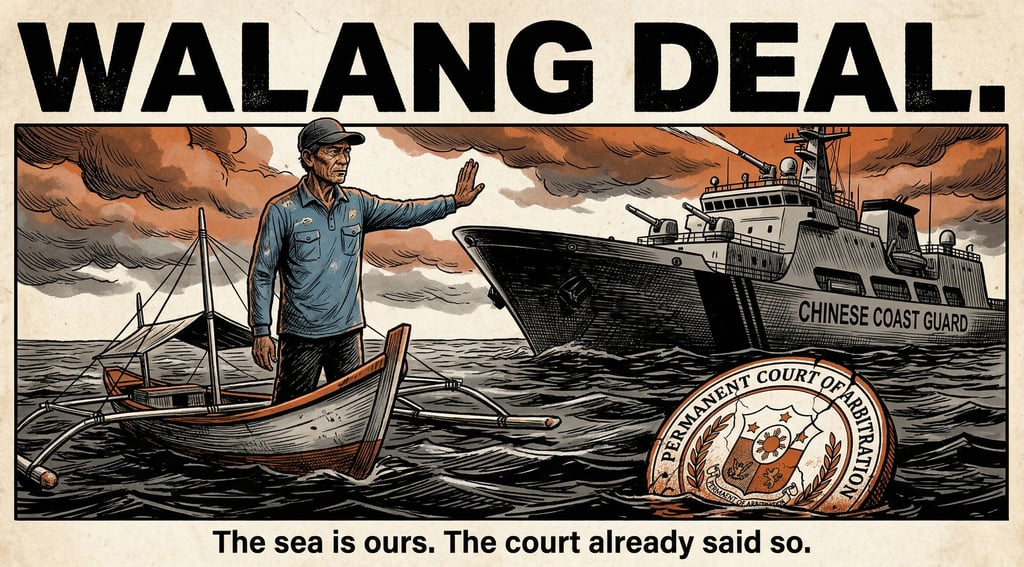
The Philippines has already won in international law — the 2016 PCA arbitral award confirmed that China has no legitimate claim over the West Philippine Sea. But Beijing keeps pushing for joint oil exploration anyway, using maritime coercion to manufacture a crisis it then offers to solve. This piece breaks down why saying yes would cost the Philippines far more than any barrel of oil is worth.
10 min read
I read about this a few days ago and kept putting off writing about it. The more I sat with the information, the more I felt like I had to put it all down somewhere.
The short version: there are people in government who keep entertaining the idea of letting China co-develop our oil and gas in the West Philippine Sea. Joint exploration. A partnership with Beijing in waters we have already won in international arbitration.
The Supreme Court already said no. International law already said no. And yet the conversation keeps coming back.
So, let me go through this properly.
THE MALAMPAYA CONTEXT PEOPLE GET WRONG
Before anything else, let's fix something that keeps getting repeated inaccurately.
You've probably seen articles saying Malampaya powers "40% of Luzon" and is about to run dry by 2027. That framing is outdated. As of 2024 and 2025, Malampaya supplies roughly 20% of Luzon's electricity, based on official figures from Prime Infra and confirmed by President Marcos himself in mid-2025. The 40% figure comes from the project's peak years in the early 2000s, and when it appears in current writing, it usually refers to natural gas as a share of Luzon's power mix, not total electricity.
The 2027 depletion story has also changed significantly. Service Contract 38, Malampaya's operating license, was renewed in May 2023, extending operations to 2039. Phase 4 drilling is underway. And in January 2026, President Marcos announced the Malampaya East-1 (MAE-1) discovery — 98 billion cubic feet of new gas, the first domestic discovery in over a decade.
Here is what we shouldn't ignore about this timing: China has been pushing hardest for joint exploration in the WPS exactly when the Philippines is finding gas on its own. That's the thing worth sitting with. The pressure increases as our need for Beijing decreases.
Malampaya has generated over USD 13.9 billion in government revenues since it started operating. All of that, under a service contract where the Philippines remained fully in control.
That model works. The question is why anyone would want to abandon it.
THE SUPREME COURT ALREADY ANSWERED THIS
On January 10, 2023, the Philippine Supreme Court voted 12-2-1 to declare the Joint Marine Seismic Undertaking (JMSU) unconstitutional and void.
The JMSU was a 2005 tripartite agreement between the Philippine National Oil Company, China National Offshore Oil Corporation, and Vietnam's Petrovietnam. It covered 142,886 square kilometers of the South China Sea, roughly 80% of which fell within the Philippine EEZ. The Court ruled it violated Section 2, Article XII of the 1987 Constitution, which requires that exploration, development, and utilization of natural resources stay under full state control, with any foreign participation capped at 40% at most.
The part I find most important: the SC specifically rejected the argument that seismic surveying is just "pre-exploration" and therefore exempt from constitutional restrictions. The Court ruled that exploration covers the search for petroleum in both its ordinary and technical senses. There is no legal workaround. You cannot relabel a survey as research to get around the constitution.
The motion for reconsideration was denied with finality on July 4-5, 2023.
So when government officials float the idea of joint exploration with China, they're talking about something the Supreme Court has already struck down. That's not a negotiating position. Legally, it's a dead end.
The constitutional model that works is the service contract. The state owns the resource. The foreign company comes in as a contractor, contributes capital and technology, and takes a minority share of net proceeds. That's how Malampaya ran for decades. The current SC 38 consortium includes Prime Energy Resources Development (under Manuel Razon Jr.'s Prime Infra), UC38 LLC, and PNOC-EC. Shell and Chevron left years ago. The project survived the transition and is still running.
THE OFFER CHINA IS MAKING AND WHY IT'S A TRAP
China consistently refuses the service contract model. Accepting a sub-contractor role under Philippine law would mean submitting to Philippine jurisdiction, which is a de facto acknowledgment that Manila has sovereign rights over the territory. Beijing will not do that.
What China proposes instead is state-to-state co-development. A joint development zone. Co-ownership of the resource.
This matters because of the 2016 PCA Arbitral Award. On July 12, 2016, the Permanent Court of Arbitration ruled that China's nine-dash line has no basis in international law. Reed Bank, Mischief Reef, and Second Thomas Shoal were confirmed as falling within the Philippine exclusive economic zone and continental shelf. China has no legitimate overlapping claim in those waters.
A joint development zone is a legal tool for when two states have unresolved, overlapping entitlements. Use it here and you're suggesting the dispute is still open. You're handing back the ground you won in The Hague.
Beijing knows this. The demand for co-ownership is not about energy development. It's about getting Manila to sign a document that functionally resurrected a legal claim that was already buried.
The coercion pattern is deliberate. Throughout 2024, 2025, and into 2026, Chinese Coast Guard vessels and the People's Armed Forces Maritime Militia have used water cannons, military-grade lasers, acoustic weapons, and blocking maneuvers against Philippine vessels near the Second Thomas Shoal, Scarborough Shoal, and Reed Bank. In early 2026, the Chinese Embassy publicly demanded that the Philippines seek Chinese "approval" before conducting any oil and gas activities within its own 200-nautical-mile EEZ.
Seeking that approval means acknowledging Chinese sovereignty. The harassment makes independent exploration physically dangerous and commercially uninsurable, driving away the international energy majors that would otherwise partner with us under a standard service contract. Once Manila is isolated and undercapitalized, Beijing steps in as the only option.
Accepting the offer at that point doesn't end the pressure. It proves the pressure works.
WHAT CNOOC DOES IN THE PLACES IT OPERATES
If there's any remaining argument that we should trust a Chinese state company to be a responsible partner in the Coral Triangle, the operational record ends it.
In 2011, CNOOC was part of a joint venture operating the Penglai 19-3 oilfield in Bohai Bay, northeastern China. The platform catastrophically failed. An estimated 6,200 square kilometers of water were contaminated. The 1.683 billion yuan compensation fund that was eventually established excluded entire provinces of affected fishermen and tourism operators in Shandong and Tianjin. Hundreds of victim claims were rejected or stalled in Chinese courts because plaintiffs couldn't prove a direct link between the spill and their specific losses.
In Uganda, CNOOC's Kingfisher oil project and the associated East African Crude Oil Pipeline have been linked to forced evictions, air and noise pollution, water contamination risks, and the arrest and detention of environmental defenders and students who protested the project. Human rights organizations and UN special rapporteurs have documented the abuses.
The 2016 PCA ruling itself explicitly condemned China for "severe harm on the marine environment" through the use of cutter-suction dredgers for artificial island building and for failing to stop the illegal harvesting of endangered species.
The West Philippine Sea is part of the Coral Triangle. The global epicenter of marine biodiversity, hosting nearly 80% of the world's coral species. Fish stocks in the South China Sea have already declined 70 to 95 percent since the 1950s.
I'll give a local point of comparison. In February 2023, the MT Princess Empress sank off Naujan, Oriental Mindoro. The tanker was carrying 900,000 liters of industrial fuel oil — roughly 238,000 US gallons. Seven marine protected areas were confirmed damaged. Coral reefs, seagrass beds, mangroves. More than 27,850 fishers directly affected. That was one tanker, in transit.
A deep-water blowout from an offshore rig would be an order of magnitude worse.
THE ECONOMIC LOGIC DOESN'T HOLD EITHER
The case for a joint development agreement usually comes packaged as economic pragmatism. We need energy investment. China has capital.
The problem is that Chinese state-owned enterprises don't operate on market logic. They operate as extensions of the Communist Party's strategic interests. Their investment terms are rarely subject to open competitive bidding or transparent auditing. That opacity opens the door to inflated capital expenditure reporting, depreciated royalties, and revenue-sharing arrangements that look reasonable on paper until the operational costs are released.
The Malampaya service contract benchmark is 60% for the government, 40% for the contractor. That's the constitutional floor. A bilateral state-to-state arrangement negotiated under the implicit threat of resource denial will not hold that standard.
Look at what happened to Laos. Massive Chinese-financed infrastructure under the Belt and Road Initiative left the country in a debt position so severe that by 2023, debt servicing obligations were consuming more than half of domestic government revenues. Education and health spending collapsed. The Kiel Institute found that by 2022, 60% of China's overseas lending portfolio was going to borrowers already in financial distress.
The WPS version of this doesn't require sovereign debt. The collateral is the resource itself. Lock the Philippines into a long-term opaque extraction pact and Beijing gains a permanent veto over foreign policy. Get too close to Washington or Tokyo and the revenue tap slows.
Nakakaistress. Kasi alam naman natin ito. We've seen this pattern before, in different forms, under different administrations.
WHAT A REAL ALTERNATIVE LOOKS LIKE
The Luzon Economic Corridor gives us a blueprint. Launched in April 2024 by the leaders of the United States, Japan, and the Philippines, the LEC is designed to channel up to USD 100 billion in investments over the next decade through multilateral development banks and private sector partners. It links Subic Bay, Clark, Manila, and Batangas. Clean energy deployments are explicitly part of the framework.
The United States committed USD 500 million in foreign military financing for Philippine defense modernization in 2024. The Enhanced Defense Cooperation Agreement now covers nine sites. Japan and Australia have signed reciprocal access agreements with Manila, and joint maritime patrols in the WPS are at an unprecedented tempo.
That security umbrella is the thing that makes independent exploration viable. Private energy majors will not deploy capital into a conflict zone where their survey vessels get water-cannoned. But if commercial exploration activities are synchronized with allied naval and coast guard patrols, the calculus changes. Beijing would need to escalate against a coalition, which it has historically avoided.
The MAE-1 discovery in January 2026 is critical here. The Philippines found new gas, on its own, under a fully Filipino-controlled service contract framework. That's the proof of concept. We don't need Beijing to drill in our own waters.
THE POLITICAL REALITY
Fisherfolk groups like PAMALAKAYA have been the loudest consistent voice against any accommodation with China in the WPS. Groups like PINAS, with representatives like Antonio Tinio, have been clear that joint exploration is not an energy strategy for Filipino communities. It's an act that legitimizes the entity that has systematically blocked Filipino fishermen from their own traditional grounds.
Senators like Risa Hontiveros and Francis Pangilinan have drawn hard lines on transparency and UNCLOS compliance. The Supreme Court has already ruled. The street-level anger around Chinese Coast Guard aggression is real and documented.
Former President Arroyo's administration never fully recovered from the public fallout over Chinese-funded projects and the JMSU. Duterte's pivot to Beijing produced almost no tangible economic gains while alienating the defense establishment. The political cost of capitulation has been demonstrated twice in recent memory.
The administration that signs a joint development agreement with China will be tested in court, opposed in the Senate, and condemned in communities where fishermen know exactly what Beijing has been doing to their livelihoods.
Politically, this goes beyond bad policy and turns into a slow-moving disaster. For us, not them.
WHERE THIS LEAVES US
The Philippines found new gas this year. We have a Supreme Court ruling that has already drawn the constitutional line. We have allied security architecture in place. We have a multilateral investment framework that provides an alternative to Chinese capital.
The argument for joint exploration with Beijing was always weak. In 2026, it's hard to see what's left of it.
What keeps the conversation alive is short-term pressure, the immediate pull of capital when you're looking at an energy deficit, and political actors who believe accommodation buys stability.
It doesn't. The Bohai Bay fishermen can tell you what CNOOC's idea of accountability looks like. The Laotian government can tell you what Chinese debt feels like from inside it. And the fisherfolk in Mindoro, three years after the Princess Empress spill, are still living with what happens when the sea gets poisoned.
The question I keep coming back to: how many times does the evidence have to accumulate before the answer is just no?
This blog is written from the perspective of a curious blogger and researcher, not a journalist. The purpose is to explore the topic by connecting publicly available information. No new facts are presented beyond what is cited. This should not be treated as verified reporting or definitive fact.
Sources
Inquirer News — JMSU unconstitutional ruling https://newsinfo.inquirer.net/1714929/phs-2005-joint-exploration-deal-with-china-vietnam-unconstitutional-says-sc
Philippine News Agency — SC voids 2005 joint exploration deal https://www.pna.gov.ph/articles/1192422
GMA Network — SC affirms PH deal unconstitutional https://www.gmanetwork.com/news/topstories/nation/874884/sc-affirms-ph-deal-with-china-vietnam-in-scs-unconstitutional/story/
Philstar — SC JMSU case transcendental value https://www.philstar.com/opinion/2023/07/08/2279433/sc-jmsu-case-has-transcendental-value
Manila Bulletin — SC final ruling July 2023 https://mb.com.ph/2023/7/5/sc-declares-final-ruling-on-unconstitutionality-of-2005-joint-deal-among-ph-china-vietnam-on-oil-exploration
Malampaya East-1 Discovery — Prime Energy https://malampaya.com/malampaya-east-gas-discovery-a-breakthrough-for-ph-energy-independence-prime-energy/
Inquirer Business — New gas find to power 5.7M households https://newsinfo.inquirer.net/2170424/new-gas-find-to-power-5-7m-households-a-year
Philstar — Marcos bares major Malampaya gas find https://www.philstar.com/headlines/2026/01/20/2502189/marcos-bares-major-malampaya-gas-find
PCO — Philippines makes major gas discovery Malampaya East https://pco.gov.ph/news_releases/pbbm-philippines-makes-major-gas-discovery-at-malampaya-east-first-in-over-a-decade/
Malampaya.com — Overview https://malampaya.com/about/
Philippine News Agency — Marcos Malampaya Phase 4 https://www.pna.gov.ph/articles/1254282
Business Inquirer — Malampaya gas deliveries rise 2024 https://business.inquirer.net/455210/malampaya-gas-deliveries-rise-as-luzon-grid-placed-on-alert-status
Inquirer Business — Malampaya contribution to government revenue $13B https://business.inquirer.net/385640/malampaya-contribution-to-govt-revenue-13b
Malampaya deal extends SC 38 to 2039 https://newsinfo.inquirer.net/1769559/malampaya-deal-eases-power-shortage-fears
Lawfaremedia — South China Sea arbitration landmark ruling https://www.lawfaremedia.org/article/tribunal-issues-landmark-ruling-south-china-sea-arbitration
The Diplomat — PCA unanimous award July 12, 2016 https://thediplomat.com/2016/07/international-court-issues-unanimous-award-in-philippines-v-china-case-on-south-china-sea/
USCC — South China Sea arbitration ruling https://www.uscc.gov/research/south-china-sea-arbitration-ruling-what-happened-and-whats-next
Licas News — Groups hit China's aggression WPS 2024 https://philippines.licas.news/2024/02/06/groups-hit-chinas-aggression-in-west-philippine-sea/
Eco-Business — ConocoPhillips and CNOOC sued over Bohai spill https://www.eco-business.com/news/conocophillips-and-cnooc-sued-over-bohai-spill/
Business and Human Rights — Litigation against ConocoPhillips Bohai Bay https://www.business-humanrights.org/en/latest-news/commentary-litigation-against-conocophillips-over-bohai-bay-oil-spill
Dialogue Earth — Bohai oil leak China marine law https://dialogue.earth/en/ocean/3787-bohai-oil-leak-china-marine-law/
China Daily — Oil giants face $24m Bohai Bay claim https://www.chinadaily.com.cn/china/2016-12/29/content_27807538.htm
Witness Radio — CNOOC human rights abuses Uganda https://witnessradio.org/report-reveals-ongoing-human-rights-abuses-and-environmental-destruction-by-the-chinese-oil-company-cnooc
African Arguments — CNOOC TotalEnergies Uganda 2024 https://africanarguments.org/2024/11/uganda-its-time-for-total-and-cnooc-to-clean-up-and-go-home-kingfisher-eacop/
FIDH — Oil in Uganda human rights abuses EACOP https://www.fidh.org/en/issues/business-human-rights-environment/business-and-human-rights/oil-uganda-human-rights-eacop-kingfisher
Wikipedia — MT Princess Empress oil spill https://en.wikipedia.org/wiki/MT_Princess_Empress_oil_spill
UP Resilience Institute — Princess Empress disaster https://resilience.up.edu.ph/the-oil-spill-disaster-of-mt-princess-empress/
Mongabay — Philippines oil spill long after cleanup https://news.mongabay.com/2023/12/philippines-oil-spill-may-reverberate-long-after-cleanup-declared-complete/
EcoHubMap — Oil spill Oriental Mindoro https://www.ecohubmap.com/hot-spot/oil-spill-at-oriental-mindoro-philippine/i63klfgsokd5
China Global South — South China Sea fish stocks https://chinaglobalsouth.com/analysis/south-china-seas-fish-stocks-are-running-low-chinas-fishing-ban-isnt-helping/
South China Sea fish stocks scientific report https://hdcentre.org/news/south-china-sea-fish-stocks-at-risk-without-regional-cooperation-five-country-scientific-report-warns/
Kiel Institute — Belt and Road bailout lending record levels https://www.kielinstitut.de/publications/news/belt-and-road-bailout-lending-reaches-record-levels/
Lowy Institute — Trapped in debt: China's role in Laos https://www.lowyinstitute.org/sites/default/files/2025-04/BARNEY-RAJAH-COORAY-Trapped-in-debt.pdf
Lao PDR Debt Bulletin 2023 https://www.mof.gov.la/storage/document/8%202023%20Public%20and%20Publicly%20Guaranteed%20Debt%20Bulletin%20of%20Lao%20PDR
World Bank — Lao PDR Economic Monitor November 2023 https://thedocs.worldbank.org/en/doc/7b88e584318b60940d7edb94d7ed0b4f-0070012023/original/LaoEconomicMonitorNov2023WB.pdf
Luzon Economic Corridor launch 2024 https://pamirllc.com/blog/us-japan-and-the-philippines-launch-luzon-economic-corridor-attract-g7-countries
Philstar — LEC partnership forged April 2024 https://www.philstar.com/headlines/2024/04/13/2347317/partnership-forged-for-development-luzon-economic-corridor
East Asia Forum — LEC as US Southeast Asian litmus test https://eastasiaforum.org/2024/07/10/the-luzon-economic-corridor-as-the-united-states-southeast-asian-litmus-test/
Inquirer — US to allocate $500M military financing for PH https://globalnation.inquirer.net/244141/us-to-allocate-500-million-in-foreign-military-financing-for-ph
Manila Bulletin — Philippines to get $500M military aid from US https://mb.com.ph/2024/7/30/philippines-to-get-500-m-us-dollars-in-military-funding-from-us
Contact us
subscribe to morning coffee thoughts today!
inquiry@morningcoffeethoughts.org
© 2024. All rights reserved.
If Morning Coffee Thoughts adds value to your day, you can support it with a monthly subscription.
You can also send your donation via Gcash: 0969 314 4839.