
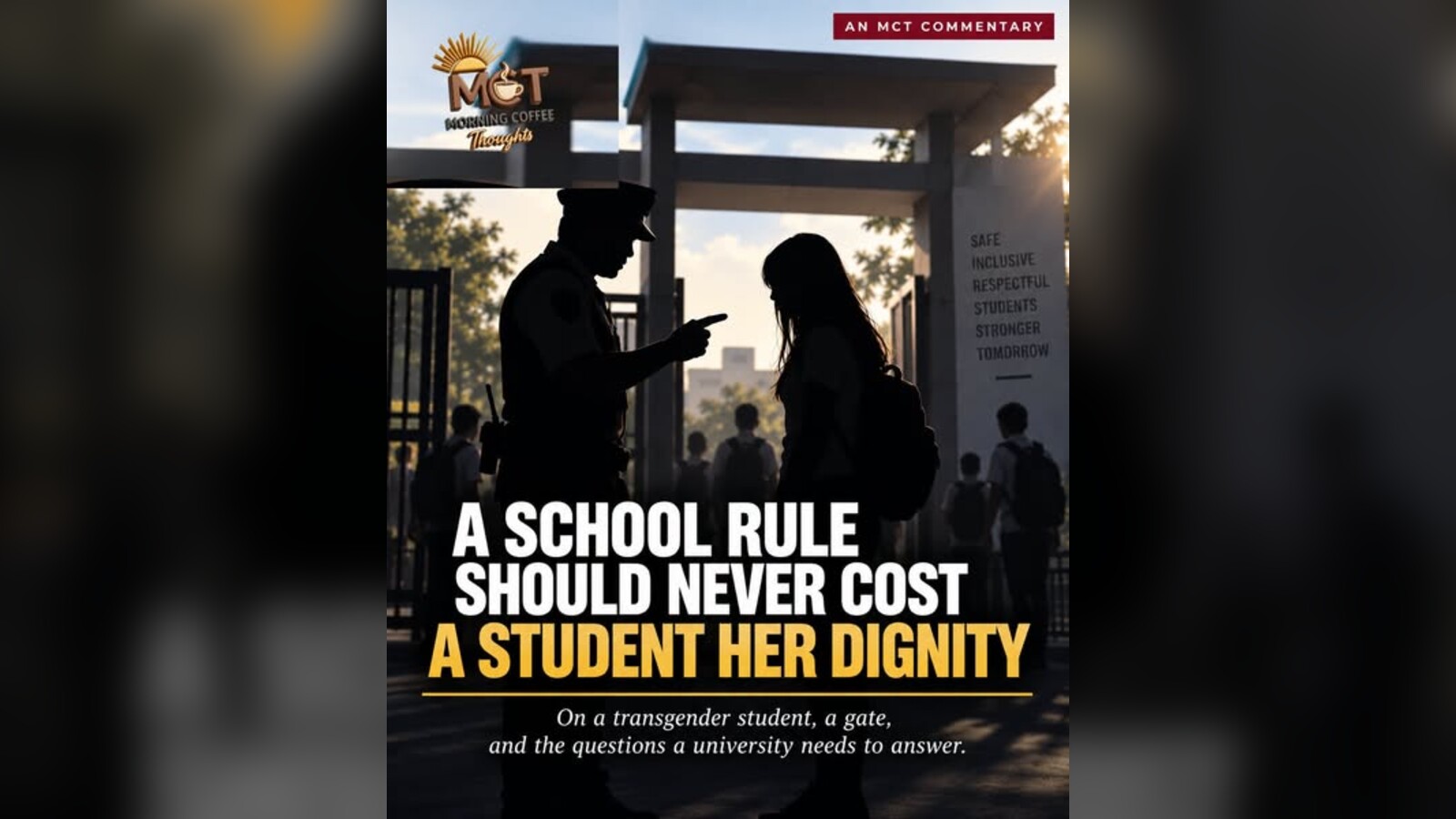
This story reached Morning Coffee Thoughts through an email from a student connected to Batangas State University and the LGBTQIA+ community. I am withholding his name and identifying details for his safety and security.
He was asking MCT to look into what happened to Jamie Alday, a transgender student at Batangas State University, The National Engineering University Lipa Campus.
According to Jamie’s account, she was entering the campus on September 8 when security personnel stopped her over the university’s dress rules. She says she was first told to remove her earrings.
Then she says she was told to remove her bra.
This was allegedly happening right at the school gate, with other students present or within hearing distance. Jamie refused to remove it.
That was the part that made me look deeper.
WHAT HAPPENED AT THE GATE
Jamie’s account was reported by The APEX, a student publication, and later by Radar. The reporting says she was entering the Lipa Campus in her PE uniform when she was questioned over compliance with the university’s dress code.
Jamie says she removed her earrings when instructed. The conversation then turned to the bra she was wearing underneath her uniform.
She says she was told to remove it there at the gate.
The APEX also reported that a classmate was standing behind Jamie during the encounter and was shocked by the instruction. Jamie says she refused to remove her bra.
That last detail is important because some retellings of the story can leave the impression that Jamie actually removed her undergarment in public. According to her account, she did not.
Batangas State University’s own Office of Student Discipline has also entered the story.
Radar, citing The APEX, reported that Asst. Prof. Rey Anthony N. Abing, head of the Office of Student Discipline, said the student manual contains no protocol requiring a student to immediately remove an undergarment because of a dress-code violation.
There are other ways to enforce the rules. A student can be denied entry or dealt with through the university’s disciplinary process.
That makes the alleged instruction difficult to dismiss as simply “following school policy.”
If the rule did not require Jamie to remove her bra, why did her bra become the subject of an instruction at a public school gate?
That question belongs to BatStateU.
THE POLICY BEHIND THE INCIDENT
This controversy did not begin with Jamie.
Batangas State University has already spent years dealing with questions involving appearance, gender expression and inclusivity. An older university handbook contained explicitly sex-specific rules, including restrictions involving makeup and earrings for male students and a prohibition on cross-dressing.
The university revised portions of its dress policy in 2024 after discussions involving school officials and student representatives. BatStateU’s own Chronicle reported that the discussions included concerns about student development and inclusivity.
Representatives of PAPAGAYO, the university’s Pride Council, participated in those discussions.
Some restrictions were relaxed. Rules involving hair and certain clothing requirements changed.
But the prohibition on cross-dressing remained.
That becomes complicated the moment the rule is applied to a transgender student.
How does BatStateU define cross-dressing for a transgender woman? Is clothing classified according to sex assigned at birth, legal sex, gender identity or another standard created by the university?
Those are not small technical questions.
They determine how a transgender student is expected to dress every time she enters the campus.
A policy can look simple on paper when it assumes that every student fits neatly into two categories. The real world is more complicated than that, and universities already have transgender students studying inside their classrooms.
If a transgender woman dresses according to her gender identity, does the university consider that cross-dressing?
If the answer is yes, the rule itself creates a conflict for transgender students before any security guard begins enforcing it.
That is why the conversation should not stop with whether Jamie violated a dress code.
The university also has to examine the dress code.
SCHOOL RULES AND HUMAN DIGNITY
I understand the argument that students are expected to follow school policies.
Schools have the authority to set reasonable standards for uniforms, appearance, discipline and conduct. Students cannot simply decide that every rule they dislike no longer applies to them.
But enforcement still has limits.
If Jamie violated a legitimate rule, tell her what she violated. Deny entry if the policy authorizes it. Refer her to the proper university office and apply the appropriate sanction.
There is a disciplinary process for a reason.
A student’s underwear should not casually become part of a conversation at a public gate.
That principle does not require anyone to agree with every position taken by LGBTQ organizations. It does not require abolishing dress codes or surrendering a university’s authority over student conduct.
It simply requires discipline to be carried out without unnecessary humiliation.
And that standard should protect every student, regardless of gender identity.
The law provides additional context.
Republic Act No. 11313, the Safe Spaces Act, expressly recognizes gender identity and expression. Its definition includes transgender people whose gender identity differs from the sex assigned to them at birth.
The law also imposes responsibilities on educational and training institutions. Schools are expected to have mechanisms for complaints covered by the law, provide gender-sensitive processes, protect complainants from retaliation and observe due process.
Whether Jamie’s experience legally falls under the Safe Spaces Act will depend on facts and the application of the law. But the broader expectation is already clear: educational institutions are not operating in a legal environment where gender identity and gender expression can simply be ignored.
BatStateU’s own public materials also describe institutional commitments involving gender equality, non-discrimination and implementation of the Safe Spaces Act.
Its charter under Republic Act No. 11694 also says that no student shall be denied admission solely because of age, gender, nationality, religious belief, economic status, ethnicity, physical disability or political opinion or affiliation.
Admission and dress-code enforcement are different questions. But together, these policies and laws show that gender is already part of the university’s institutional responsibility.
MCT AND THE LGBTQ COMMUNITY
The student who emailed MCT was asking for help because student organizations had already been speaking about the incident and wanted people outside the university to listen.
So I listened.
Morning Coffee Thoughts is a friend of the LGBTQ community.
For me, that does not mean accepting every allegation without checking it. It means taking people seriously enough to do the homework when they say something happened to them.
It means recognizing that LGBTQ students should not have to prove that they deserve the same basic dignity we expect for everyone else.
Jamie’s account deserves to be heard.
The security personnel involved should also be heard. BatStateU should establish exactly what happened and tell its students what it found.
As of this writing, I have not found a public apology from Batangas State University concerning what Jamie says happened to her.
The Office of Student Discipline has reportedly engaged with the case, and its clarification about the absence of any protocol requiring immediate removal of an undergarment is significant. But I have not found a publicly available final university finding explaining exactly what happened at the gate.
BatStateU can answer that.
Was Jamie instructed to remove her bra?
Why was that instruction allegedly given?
Was it consistent with university policy or with the instructions given to security personnel?
If it was not, what action followed?
And beyond the individual encounter, how exactly does the university’s continuing prohibition on cross-dressing apply to transgender students?
Those answers would help far more than silence.
THE RULE DESERVES ANOTHER LOOK
BatStateU has already shown that its dress code can change.
It revised parts of the policy in 2024 after discussions that included questions of inclusivity. That means the university has already acknowledged that rules written years ago sometimes need to be reconsidered as society and the student population change.
The prohibition on cross-dressing deserves the same examination.
A transgender woman should not have to arrive at a university gate wondering whether the clothes she considers normal for herself will suddenly be treated as a violation because somebody else classifies her differently.
That uncertainty is bad policy.
It also places security personnel in a difficult position if the university has not given them clear, thoughtful and humane guidance.
The answer cannot simply be “rules are rules” when the rule itself leaves a basic question unanswered.
Which rule applies to a transgender woman?
BatStateU should answer that clearly, and transgender students should be part of the conversation.
Jamie has described the bra involved in this incident as connected to her comfort, dignity and identity as a transgender woman. You do not have to understand every part of that experience to understand why being told to remove it at a school gate could be humiliating.
Privacy is not an LGBTQ privilege.
Dignity is not an LGBTQ privilege.
They belong to students.
Batangas State University should establish what happened on September 8, hear everyone involved and review whatever security records, reports or available footage exist.
If the investigation establishes that Jamie was instructed to remove her bra even though university protocol did not require it, BatStateU should explain how that happened and what accountability follows. An apology may also be appropriate depending on what the investigation establishes.
But even after this particular case is resolved, the bigger question will remain.
How does a modern state university apply gendered dress rules to transgender students without creating confusion, humiliation or arbitrary enforcement?
Batangas State University calls itself The National Engineering University.
Engineering starts by understanding the problem well enough to build a solution that actually works.
This is a human problem worth solving.
A school rule should never cost a student her dignity.
SOURCES
- Radar PHhttps://radar.ph/batangas-trans-student-humiliated-after-guard-orders-removal-of-bra-in-public/
- Batangas State University Office of Student Discipline Manualhttps://batstateu.edu.ph/sites/files/osas/manuals/OSD%20manual%20FINAL.pdf
- Batangas State University Student Handbook AY 2017-2018https://batstate-u.edu.ph/sites/files/osas/New-Student-Handbook-AY-2017-2018.pdf
- Batangas State University Chronicle, Third Quarter 2024https://batstateu.edu.ph/wp-content/uploads/2024/10/2024_3rd-QUARTER-CHRONICLE.pdf
- The AXIS Group of Publications, The NEU Wears Revised Dress Code; Stretches 'Inclusivity'https://fliphtml5.com/zwhlq/jduq/The_AXIS_Newseltter_2024-2025/
- Republic Act No. 11313, Philippine Commission on Womenhttps://pcw.gov.ph/republic-act-11313-safe-spaces-act/
- Republic Act No. 11313, Senate of the Philippines Legislative Reference Bureauhttps://issuances-library.senate.gov.ph/legislative%2Bissuances/Republic%20Act%20No.%2011313
- Philippine Commission on Women, Safe Spaces Act Frequently Asked Questionshttps://pcw.gov.ph/faq-republic-act-no-11313/
- Republic Act No. 11694, Lawphilhttps://lawphil.net/statutes/repacts/ra2022/ra_11694_2022.html
- Philippine Commission on Women and Commission on Higher Education, GADtimpala Guidelines for State Universities and Collegeshttps://pcw.gov.ph/joint-memorandum-circular-no-2025-02-guidelines-on-the-gadtimpala-gender-and-development-transformation-and-institutionalization-through-mainstreaming-of-programs-agenda-linkages-advocacies/