
A district should not have to elect the president’s son or cousin to get the roads, bridges and flood protection it needs. People pay taxes regardless of whom their congressman knows.
Yet some of the largest infrastructure allocations have gone to districts represented by presidential relatives. Congress owes the public an explanation of how those amounts were decided and why other districts received less.
Do those differences reflect public needs, the influence of powerful politicians, or both?
WHO GOT THE MOST?
DPWH documents published by the Philippine Center for Investigative Journalism allow a comparison of 253 district entries covering 2023–2025. They cover infrastructure allocations excluding foreign-assisted projects, rather than all government spending in each district.
For districts served by more than one DPWH engineering office, the amounts were added together to produce the rankings in the accompanying MCT research report.
| District | Representative | Relationship to the president | 2023–2025 allocation | Rank |
|---|---|---|---|---|
| Leyte 1st | Martin Romualdez | Cousin | ₱57.517 billion | 1st |
| Ilocos Norte 1st | Sandro Marcos | Son | ₱39.204 billion | 5th |
| Ilocos Norte 2nd | Angelo Marcos Barba | Cousin | ₱16.125 billion | 44th |
Amounts and rankings were calculated from the published DPWH records. The full tables are in the accompanying report.
Romualdez’s district received the largest combined amount. Sandro’s district ranked fifth, while Barba, another presidential cousin, ranked 44th. Their family relationships are documented.
In 2025 alone, Occidental Mindoro’s lone district and Oriental Mindoro’s 1st district received more than Leyte 1st.
Reports naming Sandro as the biggest recipient refer to a narrower category called “allocables,” which is associated with district project choices. PCIJ reported ₱15.8 billion for Sandro and ₱14.4 billion for Romualdez over 2023–2025, placing them first and second in that category.
Sandro led in reported allocables. Romualdez’s district led in the broader infrastructure category used for the three-year comparison. Those amounts should not be added together because doing so could count the same funding twice.
DAVAO’S FUNDING FELL SHARPLY
Davao City’s 1st district received very large infrastructure allocations during 2020–2022, when Paolo Duterte represented the district. His father, Rodrigo Duterte, was president until June 30, 2022.
The Philippine Information Agency reported that a DPWH official confirmed approximately ₱51 billion for that three-year period during a congressional hearing. The same PIA account described a DPWH project book listing 710 projects worth ₱49.8 billion.
The difference between those amounts remains unresolved. The projects included major roads, flyovers and other infrastructure, not just flood control.
The older figures and the later district table have not been matched for coverage. Within the comparable 2023–2025 figures, Davao City 1st received ₱5.228 billion in 2023, ₱1.024 billion in 2024 and ₱640.173 million in 2025. Its ranking fell from 40th to 252nd.
Which projects had been completed? Which requests were rejected? Did funding move to other parts of the budget? What needs remained unmet?
DPWH should answer those questions with project records. Residents still need roads and flood protection after their political allies lose power. Their needs do not disappear with a change of president.
THE ARROYO YEARS
PCIJ reported ₱342.65 million in public-works contracts for Dato Arroyo’s district over fifteen months from July 2007. Mikey Arroyo’s district had ₱808.79 million over four years beginning in 2004. These were contract values covering different periods.
The same investigation reported ₱2.68 billion in contracts for opposition congressman Lorenzo Tañada III’s district between July 2004 and September 2008. Tañada told PCIJ that he had not known the total value of those contracts and did not get involved in the projects.
For 2012, economist Gerardo Sicat’s analysis of DBM records listed Ruben Ecleo Jr., Thelma Almario and Dakila Carlo Cua as the highest district recipients of PDAF releases. His account recorded zero PDAF releases under the names of Dato Arroyo and Mikey Arroyo, who was then an Ang Galing Pinoy party-list representative.
These were releases of funding, including unused allocations from earlier years. They were not a measure of all government spending in the areas or among the people those lawmakers represented.
THE POWER OF HOUSE LEADERSHIP
Romualdez was the president’s cousin and served as Speaker through September 17, 2025. His family relationship and House position overlapped during much of the period covered by these budgets.
PCIJ reported that House leaders can secure additional funding, citing accounts from former and current lawmakers. It also reported that project requests could enter the budget during its preparation by the executive branch, before congressional deliberations.
Who requested the projects in the highest-funded districts? Which requests came from the Speaker, committee chairs or presidential relatives? Who approved them, and what reasons were recorded?
Those questions belong in budget hearings. Officials should answer them with the project lists, requests and changes that produced the final amounts.
DIFFERENT BUDGETS NEED A FAIR EXPLANATION
Every district does not need the same amount.
A bridge across a wide river can cost far more than repairs to an existing road. Population, poverty, flood risks, terrain and unfinished projects can all affect the funding needed. A national highway may also serve people far beyond the district where construction takes place.
For a district near the top, the government should identify the projects behind the large allocation and explain why they took priority. For a district near the bottom, it should show what remains unfunded and why.
A rejected project should come with a reason that can be checked. Missing documents, excessive costs and poor design are different from being pushed aside for a project backed by someone more powerful.
The public needs access to project proposals, cost estimates, reasons for approval or rejection, and changes made while the budget passes through Congress.
The executive branch prepares the proposed budget, Congress debates and changes it, and the president signs it or exercises veto powers. Congress should publish the changes it made, while DPWH and DBM should explain how the original project list and amounts were chosen.
The accompanying MCT research report contains the district rankings, calculations and links to the records. It also identifies older documents that have not yet been obtained and questions that need further work.
CONGRESS NEEDS TO ANSWER
Congress, DPWH and DBM owe the public an explanation for these budget differences. They should identify who proposed the projects, who changed the amounts and why those projects took priority over needs elsewhere.
A family connection is never an acceptable reason to give one district more public money.
People should keep asking their representatives what projects their districts requested, what was approved, what was rejected and who made those decisions. Demand the same explanation from the districts at the top of the list. The answers should come with records that anyone can check.
Giving a district more money because its representative is related to the president is a practice that must end wherever it occurs. Public money belongs to the people, including those whose congressman has no relative in Malacañang.
This should not become another budget controversy that fades as soon as the next scandal arrives. Questions left unanswered should follow lawmakers into district meetings, public hearings and the next budget debate. An incomplete answer deserves a follow-up, not a pass.
No district should have to borrow the president’s surname to get what its people need.
SOURCES
- Philippine Center for Investigative Journalism, August 26, 2026. Documents: DPWH budget data from 2023 to 2026. Contains the DPWH records used to calculate the district totals and rankings.https://pcij.org/2026/08/26/dpwh-budget-2023-to-2026/
- PCIJ, November 29, 2025. “Allocables” are the new pork and Sandro Marcos and Martin Romualdez are the pork barrel kings. Source for the reported ₱15.8-billion and ₱14.4-billion allocables.https://pcij.org/2025/11/29/allocables-are-the-new-pork/
- Philippine Information Agency, September 12, 2025. DPWH provides Davao media with past infra projects report. Reports the ₱51-billion hearing figure and the project book listing 710 projects worth ₱49.8 billion.https://pia.gov.ph/news/dpwh-provides-davao-media-with-past-infra-projects-report/
- PCIJ, April 30, 2009. Arroyo sons, friends, foes get big public works deals. Source for the Dato Arroyo, Mikey Arroyo and Lorenzo Tañada III contract figures.https://old.pcij.org/stories/arroyo-sons-friends-foes-get-big-public-works-deals/
- Gerardo P. Sicat, The Philippine Star, September 4, 2013. The “pork barrel” and who got their releases in 2012. Contemporary analysis of DBM’s PDAF release records.https://www.philstar.com/business/2013/09/04/1168741/pork-barrel-and-who-got-their-releases-2012
- PCIJ, July 27, 2022. Marcos’ first SONA: Experts weigh in on what he said and didn’t say. Identifies the president’s relatives in Congress and records Romualdez’s election as Speaker.https://pcij.org/2022/07/27/live-blog-marcos-sona-state-of-the-nation-address/
- GMA News, September 17, 2025. House elects Bojie Dy as Speaker. Confirms Romualdez’s resignation and Dy’s election.https://www.gmanetwork.com/news/topstories/nation/959454/house-elects-bojie-dy-speaker/story/
- PCIJ, August 25, 2026. Romualdez replaces Pulong as the top recipient of DPWH funds. Reporting on district allocations, project requests and House leadership’s influence over funding.https://pcij.org/2026/08/25/romualdez-top-recipient-of-dpwh-funds/
- Department of Budget and Management, October 23, 2026. National Budget Undergoes Rigorous Scrutiny, Checks and Balances Before Becoming Law. Explains the roles of the executive branch, Congress and the president in preparing and approving the budget.https://www.dbm.gov.ph/index.php/management-2/4333-sec-kim-national-budget-undergoes-rigorous-scrutiny-checks-and-balances-before-becoming-law
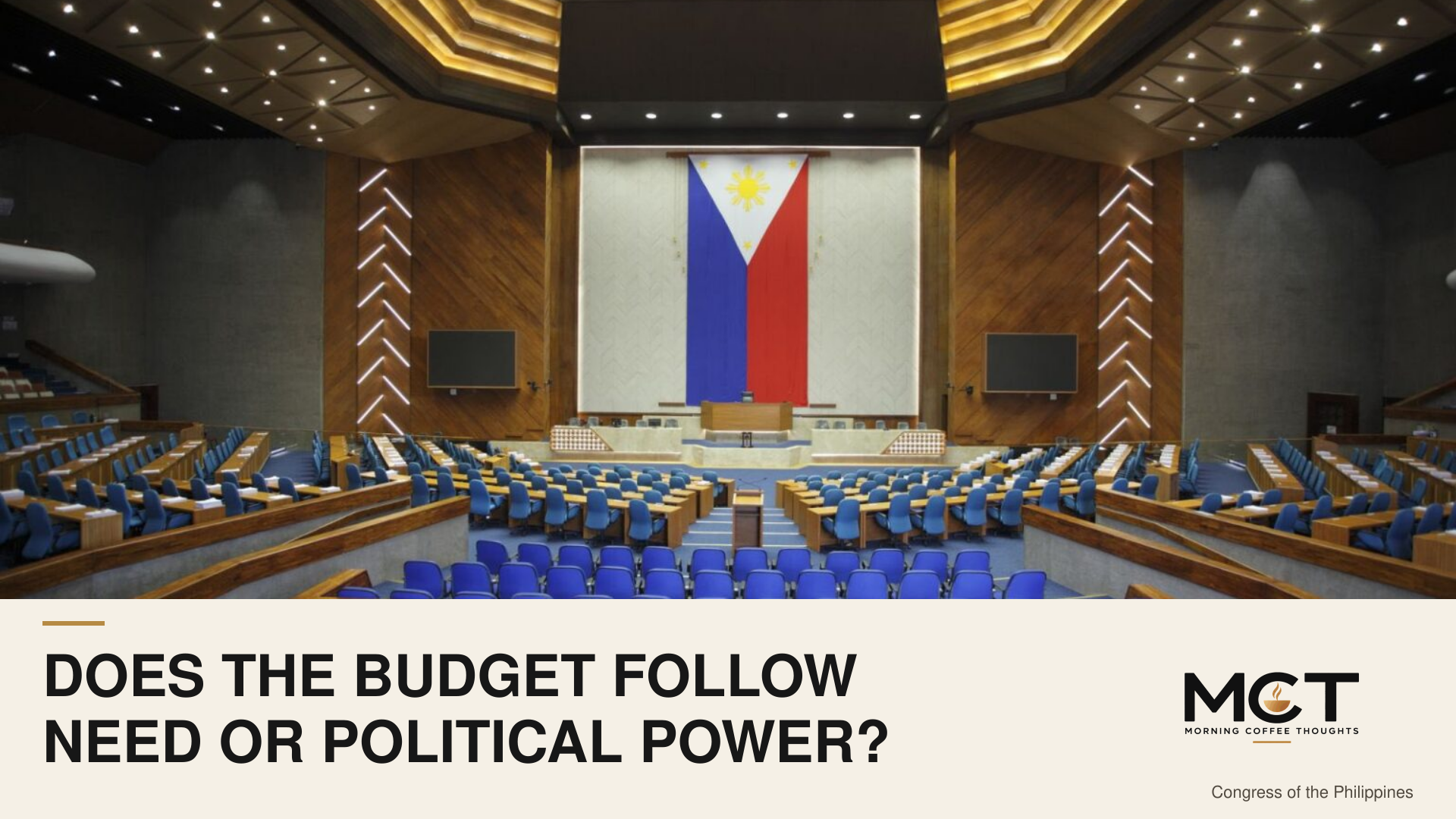
Photo: Congress of the Philippines, 2023, via Wikimedia Commons. Public domain (PD-PhilippinesGov). Archival House plenary photograph, not current budget deliberations. Source: https://commons.wikimedia.org/wiki/File:Batasang_Pambansa_Plenary_Hall.jpg . Cover adds the approved editorial title and official MCT logo; the homepage uses the photo-only crop.