
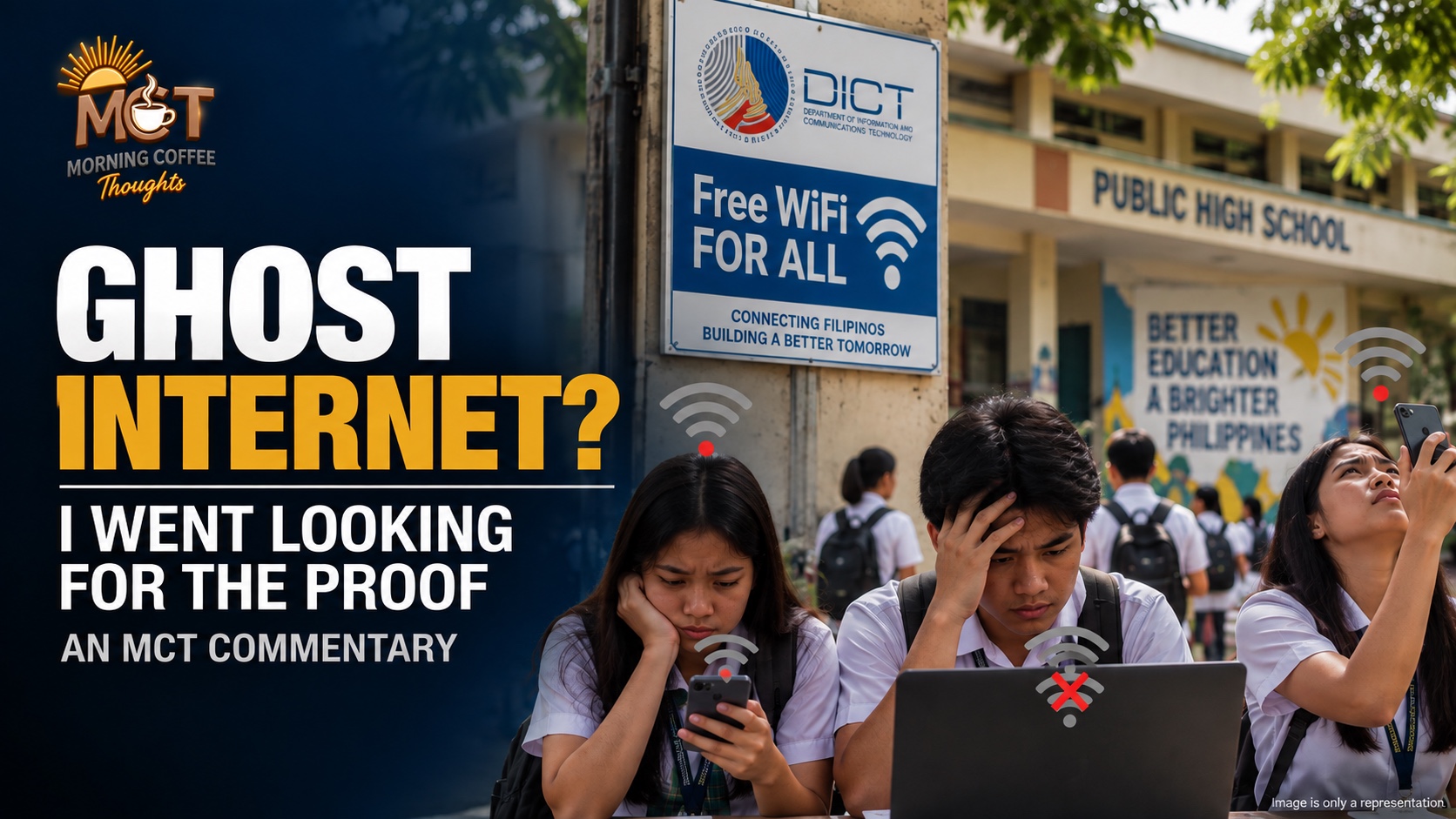
I only found out about this because I came across a Facebook post about the Office of the Ombudsman investigating what it called “ghost internet” involving the Department of Information and Communications Technology. The term caught my attention, so I started looking for traces of evidence online from sources I trust, particularly government records, Commission on Audit findings, procurement documents and DICT’s own data.
I expected to find either something concrete or very little at all. Instead, I found years of documented problems involving Free Wi-Fi projects, incomplete delivery by suppliers, hundreds of locations that had not been activated and installed, thousands of sites going offline, recurring implementation problems and questions about how DICT monitors whether the internet services it contracts are actually delivered.
THE 942 LOCATIONS
The Commission on Audit's 2023 report on DICT refers to 18 awarded contracts covering 3,456 locations with a combined contract value of ₱1,679,458,636.03.
As of November 15, 2023, 942 of those locations had not been activated and installed with Free Wi-Fi service. That is roughly 27 percent of all the locations covered by those contracts. The report also calls them unaccepted locations. Some equipment may have been physically installed but still lacked completed testing, documents or formal acceptance.
The same audit finding identified three reasons: 13 suppliers were unable to completely deliver the internet services provided in their contracts, procurement activities had started late, and the Free Wi-Fi project management team lacked sufficient manpower.
Eighteen contracts worth almost ₱1.68 billion. Thirteen suppliers that had not fully delivered. Nine hundred forty-two locations not accepted at the audit cutoff. The ₱1.68 billion is the combined contract value, not a finding that this amount was paid or lost.
THE PROBLEMS DID NOT START IN 2023
When I went further back, the 942 locations started looking less like an isolated implementation problem and more like part of a longer history of difficulty with the government's Free Wi-Fi program.
In its audit of the 2019 program, COA reported that DICT had activated only 3,251 of a targeted 22,034 public Wi-Fi hotspots by the end of that year.
By the end of 2021, DICT reported 11,618 established sites against an accumulated target of 34,442. Of those, 9,248 were subsequently identified as existing and monitored.
By April 23, 2022, the number of monitored sites had fallen to 6,658. COA's figures showed that only 2,890 remained active while another 3,768 were either not operational or under maintenance.
COA also noted that some sites were deactivated when service contracts with private suppliers were terminated. That becomes important when comparing active-site counts across different years.
SO WHAT IS THE OMBUDSMAN NOW LOOKING FOR?
On September 18, Assistant Ombudsman Mico Clavano announced that the Ombudsman had begun fact-finding involving DICT.
The questions he raised went much further than delayed installation. Were the contracted sites actually installed and working? Was government billed for connectivity and services that were never delivered? Were the prices of hardware, software and services reasonable, or were they inflated? Who approved, certified or released payment for projects that were not delivered?
Clavano also described another possible scheme where the proper hardware is delivered and passes inspection, but cheaper, outdated or even fake software is installed while government is charged for the real thing.
The issue is whether any of the documented delivery failures crossed into billing, acceptance or payment for something government did not actually receive.
I have not found a document showing that the Ombudsman has included these same 18 contracts in its inquiry.
On September 20, DICT said it welcomed the Ombudsman's inquiry and stood ready to provide records and system data. It said it had strengthened contract monitoring, audits and performance checks, and that reported inactive sites face technical audits and contractual penalties. DICT did not provide a site-by-site account of the 942 locations or their payment histories in that statement.
AND THAT IS WHERE THE MONEY TRAIL BECOMES IMPORTANT
The ₱1.679 billion connected to the 2023 finding is the combined value of the 18 contracts. I have not found evidence showing that ₱1.679 billion was fully paid, and I have not found evidence showing that DICT paid for all 942 locations despite their non-delivery.
What happened to those 942 locations after November 15, 2023?
Some may have eventually been completed. Others may have remained unfinished. There may have been extensions, penalties, withheld payments, terminated contracts or substituted locations.
COA calculated initial liquidated damages of ₱45,851,863.17 for delays across the 18 contracts as of November 15, 2023. That is an audit calculation, not proof that the amount was ultimately collected. DICT told auditors in January 2024 that final billings for the 2023 procurements had not yet been processed. We still need to know what happened later: were damages collected, payments withheld, contracts terminated, performance bonds called, suppliers blacklisted or extensions granted?
If DICT identified non-delivery and refused to pay for it, then we are dealing with failed contract implementation. If an undelivered site acquired an acceptance report, appeared on an invoice and was paid anyway, the situation becomes much more serious.
THE CONTRACTS WERE SUPPOSED TO LEAVE A PAPER TRAIL
Some of the DICT internet procurement documents I examined contain procedures specifically designed to establish whether a service was actually delivered. They include on-site testing, internet-speed measurements, inspection records, service-level reports and formal acceptance procedures.
The Universal Internet Subscription for Geographically Isolated and Disadvantaged Areas procurement, for example, called for testing and formal acceptance as part of the process for paying activated sites. The contract also allowed an advance payment of up to 15 percent after the Notice to Proceed, subject to a special bank guarantee. These are the terms of that procurement, not proof of the payment terms or payment history of all 18 contracts in the 2023 finding.
A contracted internet location should still generate records showing what happened to it. There should be installation records, technical testing, acceptance documents, billing records and payment records where applicable. COA said DICT had reported 2,514 locations accepted by November 15, 2023, but the auditors had not received the service and final acceptance reports needed to validate those claims.
COA also recorded two pieces of equipment under UIS-GIDA Lot A that DICT's central project team had tagged as tested and accepted even though they had not been delivered to the regional office. Auditors recommended an investigation. The report does not establish whether those two pieces of equipment were paid for.
There may also be technical evidence. Routers and network equipment have serial numbers and other identifiers. Service providers may hold circuit or account records, and network monitoring may show uptime, outages and when equipment first appeared online. Investigators would need to establish which records were kept and whether they are still available.
For ordinary site delivery and progress payments, investigators should be able to reconstruct the chain:
Contract.
Installation.
Testing.
Acceptance.
Invoice.
Payment.
Then compare all of that against the actual network.
THERE IS ALSO A REASON TO LOOK AT DICT’S CHANGING SITE NUMBERS
DICT has released a Freedom of Information summary with aggregate counts and site lists for 2022 through 2025. Those lists give names and locations, but they do not identify which entries, if any, correspond to the 942 locations in the 2023 audit finding.
According to a DICT Freedom of Information response covering 2022 to 2025, the agency reported 15,717 operational sites at 8,258 locations in 2024. For 2025, that fell to 9,567 operational sites at 5,057 locations.
At the same time, the number of reported connected users rose from around 4.43 million in 2024 to around 9.71 million in 2025.
Documents reported by The Philippine Star also showed 18,849 activated Free Wi-Fi sites in 9,769 locations as of May 2025.
These figures need to be read carefully because “access point,” “site,” “activated site,” “hotspot,” “operational site” and “location” may not mean the same thing. One location may contain several access points, and contracts can expire during the year.
DICT should be able to explain exactly what each term means and reconcile the numbers.
WE ALREADY KNOW SITES CAN DISAPPEAR FOR REAL REASONS
In 2024, then-DICT Secretary Ivan Uy said around 2,600 Free Wi-Fi sites had gone offline because the government did not have sufficient funding to renew the contracts operating them. Once those contracts expired, DICT would have to go through procurement again.
The Department of Budget and Management later released an additional ₱3.681 billion for the Free Public Internet Access Program. DBM said the money was expected to benefit 13,462 access-point sites nationwide, on top of ₱2.5 billion already allocated that year.
A site can genuinely exist, operate, lose its service contract and then disappear from the operational inventory. That is why aggregate numbers alone cannot establish what happened to a specific site.
THE SOFTWARE ALLEGATION MAY BE ANOTHER PROBLEM ENTIRELY
Clavano also said hardware can be delivered and pass inspection while cheaper, outdated or fake software is installed instead of the software government paid for.
I have not found the specific procurement behind that allegation. I do not know which supplier is involved, which software is being examined, what version was contracted, what version was allegedly delivered, or what government paid for it.
I also have not found anything tying that allegation to the 942 Free Wi-Fi locations from the 2023 audit finding. Until evidence connects them, they should be treated as separate lines of investigation.
WHAT ABOUT THE 13 SUPPLIERS?
The 2023 audit finding tells us there were 13 suppliers that were unable to completely deliver internet services under the 18 contracts. COA's full report identifies at least one joint venture and lists the 18 contract lots in an annex. None of that establishes that any supplier is part of the Ombudsman's current inquiry.
The original COA report and its annex are now available. What we still need are the affected site records, later acceptance documents, invoices, payment histories and any collection of liquidated damages.
Then the 942 locations can be examined contract by contract instead of as one giant number.
THERE ARE THREE SEPARATE QUESTIONS
The first is already documented: DICT had implementation problems, including 942 locations still unaccepted under the 18 contracts as of November 15, 2023.
The second is what the Ombudsman is now investigating: whether government was billed or paid for internet connectivity or services that were never actually delivered.
The third is possible software substitution and possible overpricing of hardware, software and services.
The first is documented. The second and third still need their own evidence.
WHAT I WANT TO SEE NOW
For the 942 locations, I want to know where each one eventually ended up.
Completed?
Still unfinished?
Cancelled?
Substituted?
Terminated?
Penalized?
Paid?
Not paid?
Then I want the corresponding records: what the contract called for, when the contractor claimed installation, who inspected it, what testing was performed, who accepted it, whether it was invoiced and whether government money was released.
There is also a separate Freedom of Information request seeking details beyond the published site lists, including activation and deactivation dates, operational status and technical performance. The public FOI record lists September 21 as DICT's response deadline.
If that dataset is released with enough detail, it could make site-by-site comparison much easier.
SO, DID I FIND GHOST INTERNET?
I did not find a document saying, “Here are 942 ghost sites and here is the money paid for them.”
What I found is a documented trail of problems serious enough to explain why the Ombudsman is investigating: years of missed implementation targets, 18 contracts worth nearly ₱1.68 billion, 942 locations still unaccepted at the November 2023 audit cutoff, and 13 suppliers unable to completely deliver the internet services in their contracts.
Now the acceptance records, invoices and payment documents become crucial.
If those records show that government money was released for services that never existed, then the term “ghost internet” will have documentary weight behind it.
Until then, the records already justify scrutiny. The next step is to follow the money.
SOURCES
- GMA Newshttps://www.gmanetwork.com/news/topstories/nation/1002860/ombudsman-probes-ghost-internet-scheme-in-government/story/
- ABS-CBN Newshttps://www.abs-cbn.com/news/nation/2026/9/18/ombudsman-starts-fact-finding-on-alleged-ghost-internet-scheme-2132
- Commission on Audit, DICT Annual Audit Report 2023https://www.coa.gov.ph/download/7215/department-of-information-and-communications-technology/87201/department-of-information-and-communications-technology-annual-audit-report-2023.zip
- House of Representatives Congressional Policy and Budget Research Departmenthttps://econgress.gov.ph/wp-content/uploads/publications/ABN2022-17%20DICT%20FY2023.pdf
- Philippine Institute for Development Studieshttps://pidswebs.pids.gov.ph/CDN/PUBLICATIONS/pidsdps2210.pdf
- Philippine Daily Inquirerhttps://newsinfo.inquirer.net/1968173/2600-free-wi-fi-sites-down-as-govt-unable-to-pay-contractors
- Department of Budget and Managementhttps://www.dbm.gov.ph/index.php/management-2/2938-pangandaman-approves-p3-681-billion-to-continue-nationwide-free-wi-fi-program
- Department of Information and Communications Technology, UIS-GIDA Bidding Documentshttps://cms-cdn.e.gov.ph/DICT/pdf/Bidding-Documents_UIS-GIDA_Final.pdf
- Department of Information and Communications Technology Freedom of Information Portalhttps://www.foi.gov.ph/agencies/dict/dict-free-wifi-for-all-project-detail-request/
- Department of Information and Communications Technology Freedom of Information Portalhttps://www.foi.gov.ph/agencies/dict/request-for-free-wi-fi-for-all-program-data-for-academic-research/
- The Philippine Starhttps://www.philstar.com/business/2025/06/13/2450101/dict-eyes-21k-free-wifi-sites-year
- GMA News, DICT responsehttps://www.gmanetwork.com/news/topstories/nation/1003055/dict-welcomes-ombudsman-probe-into-alleged-ghost-internet-scheme/story/