
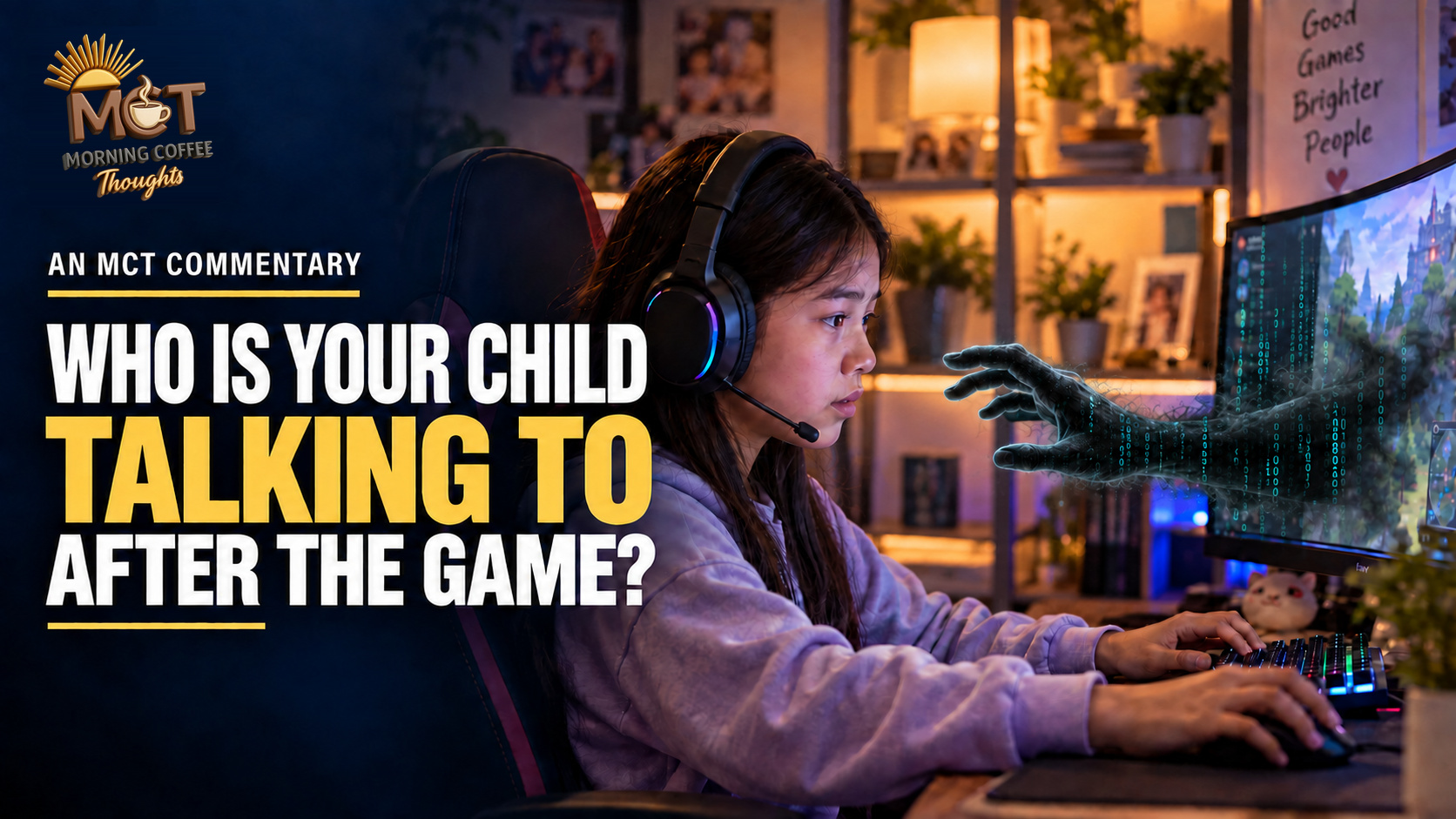
If your child plays online games, you might want to read this.
I have been a gamer for most of my life. My first console was a hand-me-down Atari 2600. I moved on to the Family Computer, and gaming became a much bigger part of my life when the first PlayStation came along. Since then, I have owned every PlayStation generation, mostly second-hand because I could never afford a brand-new unit.
Through all those years of playing, I never once wanted to hurt someone because of a game. That is my experience, and it is one reason I am careful about blaming gaming whenever something terrible happens involving a young person who plays.
I understand why children enjoy games. I still enjoy them myself. Gaming can be a safe, enjoyable hobby. But the people a child meets while playing deserve our attention, especially when those people begin asking for secrecy, making demands, or carrying the conversation into private chats.
When I think back to my Atari, I knew who was playing beside me. Today, a child can be sitting alone in a room while talking to people we have never met. The conversation can continue during the game, after it ends, or on another app entirely. As a gamer and a father, that is the change that worries me.
SEVEN CHILDREN IN LAGUNA
Earlier this year, police stepped in after learning that seven 15-year-olds in Calamba, Laguna, were allegedly planning to attack their school. According to a Philippine Star report, also published by the Philippine Center for Investigative Journalism, the children had met someone through Roblox. That person later sent a link to their group chat. The report, based on police records, said the attack was planned for February 16. Police reached the children on February 2 after receiving information from law enforcers abroad.
The Philippine National Police Anti-Cybercrime Group said someone the children met online had encouraged them toward violence and told them to go to another platform to get guns. Police stepped in before they could buy the weapons.
These children were fifteen. Somewhere between playing a game and talking to someone they met there, police say they reached the point of planning an attack on their school. For a parent, that is a frightening distance to imagine a child traveling without us knowing.
Roblox is named here because it appears in the reporting on this case. But whether your child plays Roblox, Valorant, or another online game, it helps to know who they regularly play and talk with. We may recognize the game on the screen without knowing much about the people our children meet through it.
THE CONVERSATION CAN CONTINUE SOMEWHERE ELSE
A child meets another player, enjoys playing with them, and starts looking forward to seeing them online. Later, someone suggests continuing the conversation on Discord, Telegram, or another app. To a child, that may feel like giving a new friend another way to stay in touch.
For parents, this is easy to miss. We may have checked the game and changed its safety settings. We may have decided it was suitable for our child. But those settings do not follow the child into every other app. The game can close while the conversation continues.
The FBI has warned that violent online groups, including those known as 764, reach young people through games, social media, and messaging apps. Some first build a friendship or what appears to be a romantic relationship. They then use trust, threats, shame, and blackmail to push children into harmful acts. The agency has described cases involving sexual abuse, self-harm, harm to animals, and suicide.
The frightening part is that the child may already trust the person before the threats begin. We might see an unfamiliar name on a screen. Our child might see someone who listens, gives them attention, or makes them feel welcome.
WHEN A FRIEND STARTS MAKING DEMANDS
One case in the United States shows what authorities say can happen after that first contact.
In December 2025, the US Department of Justice announced charges against five alleged leaders of a group called Greggy’s Cult. Prosecutors said the group found victims on Discord and games including Roblox and Counter-Strike. Children were allegedly told to perform sexual or humiliating acts during video calls. People watching recorded those acts and shared them. Prosecutors also said victims were pressured into hurting themselves and doing things to prove their loyalty. Those charges were allegations, not findings of guilt.
The FBI describes how pictures and recordings can then be used against a child. Someone threatens to send them to the child’s family or friends unless the child follows another demand. What has already happened becomes a way to force something else to happen.
This helps explain why telling a frightened child to “just block them” may not feel like an answer. The child may believe the person can still expose them, embarrass them, or hurt someone they love. Blocking an account does not automatically make that fear disappear.
As parents, we also need to think about what our children expect from us. If they believe we will shout, shame them, or punish them before listening, telling us may feel like another danger. We have to be able to hear something upsetting without making our child wish they had kept quiet.
WHEN THE DEMANDS GET WORSE
Are children being given increasingly harmful things to do? The FBI describes that kind of growing pressure. Its warning explains how a relationship can turn into demands that become more harmful, with recordings used to keep the victim under control. But that does not establish a fixed list of tasks that every child follows, or prove that self-harm always leads to hurting someone else.
For a parent, the point is to pay attention before a demand becomes extreme. I would want my daughter to know she can refuse anything that frightens or humiliates her. Having agreed to something once does not mean she owes that person another favor, another picture, or another chance to hurt her.
WHAT WE KNOW ABOUT THE PHILIPPINE CASES
The Laguna case is serious enough on its own. We do not need to assume that every school shooting that followed was planned by the same people.
After the June 22 shooting at San Jose National High School in Tacloban, authorities looked into possible online grooming and links to 764. In July, the PNP said it would work with law enforcers abroad to find out who was involved and how far the group’s activities reached. Police were investigating a possible connection; that announcement did not prove every part of it.
Researchers Saddiq Basha and Benjamin Mok later studied the Tacloban case for the Global Network on Extremism and Technology. Their September report found signs that the attackers had been influenced by online groups that admire mass shooters. But the researchers said the direct involvement of groups such as 764 had not been confirmed. They also described young people encouraging and drawing other young people into harmful online spaces.
That leaves questions we should not answer by guessing. Seeing violent posts, joining a group that praises killers, and receiving direct orders from someone are different situations. Knowing that a child was part of a group does not, by itself, tell us who told that child what to do.
The researchers also found a troubling conversation in a Discord group that formed after an earlier group was taken down. A user claiming to be fifteen described recruiting vulnerable children. That age was self-reported, but the exchange shows why parents should pay attention to pressure from other young people too. We cannot judge whether a relationship is safe simply by whether the other person appears to be our child’s age.
They also found edited videos and posts turning the Tacloban attackers into figures to admire or copy. This activity after the shooting does not prove who caused it. It does show that harmful material can keep spreading after an attack. As a parent, I would want to know if a group my child follows starts praising people for hurting others.
The Banga case needs the same care. After the September 18 shooting at Banga National High School, South Cotabato Governor Reynaldo Tamayo Jr. said the suspect’s best friend had told officials about the boy’s membership in an online true-crime community. Authorities were still looking into the group and whether it was connected to the shooting. That account does not prove that the same people were behind Laguna, Tacloban, and Banga.
There are also questions about people outside the Philippines being involved. Philippine authorities have already spoken about groups operating across countries and have sought help from law enforcers abroad. Finding out who took part, who gave instructions, and whether any government had a role will require clearer evidence. I will return to that when more reliable information is available. For now, the warning for parents is serious enough without naming anyone we cannot yet connect to these cases.
WHAT I COULD DO AS A FATHER
Being a stay-at-home, work-from-home dad gave me a privilege I know many parents do not have: I could be around while my unica hija played. We gave her a game room because we wanted gaming to be something she could enjoy openly, without feeling she had to hide it from us.
I knew how dark parts of the internet could be, so I made a point of staying aware of her online activities. I wanted to know more than the name of the game. I wanted to understand what she was doing online and who she was spending time with.
That did not mean I could see everything or protect her from every possible danger. A game room and a parent nearby cannot promise that. But being home gave me more chances to pay attention and more chances for us to talk.
I also know that many parents leave early for work and come home exhausted. They love their children just as much. I would not turn the time I had with my daughter into a standard every family must somehow meet.
What I would encourage is taking an interest whenever we can. Let your child explain the game. Ask about the people they enjoy playing with. Make their online life something they can talk about at home, including the parts that become uncomfortable or frightening.
We teach our children how to behave at home, but online they meet people with different habits, beliefs, and ways of treating others. Some will be good friends. Others may make cruelty seem funny, pressure them to keep secrets, or ask them to do things they would never ask in front of a parent.
With a younger child, sitting nearby, watching occasionally, and asking about the people they play with should be part of knowing their day. With older children, we need clear rules and regular conversations that respect their growing privacy while still keeping them safe. We do not have to understand every game to take an interest in the people reaching our children through it.
PAY ATTENTION WHEN SOMETHING CHANGES
The FBI’s advice to parents includes watching for growing secrecy about online activity, pulling away from others, unexplained gifts or gaming money, and signs that a child is hurting themselves. It also urges parents to talk about online relationships and help children feel comfortable reporting threats or unwanted contact.
A child wanting privacy does not automatically mean someone is grooming them. A new online friend is not automatically dangerous. But a clear change in behavior deserves attention, especially when the child seems frightened, upset, or under pressure.
I would want to understand why a child who used to talk freely about a game suddenly refuses to discuss the people in it. I would be concerned if someone demanded secrecy, asked for private pictures, threatened them, or made them prove their friendship by doing something harmful.
The first conversation should give the child room to answer. “Who do you usually play with?” is easier to respond to than an accusation. So are questions about whether they talk outside the game, whether anyone has made them uncomfortable, and whether someone gets angry when they refuse a request.
We should also make something clear before there is trouble: they can come to us even if they broke a rule. Even if they already sent something. Even if they are embarrassed. They do not have to solve a frightening situation alone before asking for help.
MAKE IT POSSIBLE FOR YOUR CHILD TO TELL YOU
The larger story still has unanswered questions. Police and researchers need to find out more about the people behind these groups, how children are drawn in, and what happened in each case. Those questions deserve careful work.
At home, though, we can begin with something much closer to us. Do we know who our children keep talking to? Would they tell us if that person started frightening them? What do they think we would do if they admitted something had gone wrong?
I worry about a child sitting a few feet from a parent, carrying a threat the parent knows nothing about. I worry about the child who wants help but keeps putting off the conversation because they cannot bear the thought of our anger or disappointment.
There may need to be new rules. There may need to be help from a counselor, the school, or the police. But the child needs to know that telling us is a way toward help.
I have loved games since that hand-me-down Atari. I wanted my daughter to be able to enjoy them too. What I want alongside that enjoyment is for her to know that she can always tell me when someone makes her uncomfortable, asks too much of her, or frightens her.
If something has already gone wrong, I want her to come to me while there is still time to help. And I want the first thing she hears to make it easier to tell me the rest.
SOURCES
- Philippine Center for Investigative Journalism / The Philippine Star — “On Roblox, Pinoy kids preyed on by violent extremists,” Elijah Felice Rosales, July 4, 2026.https://pcij.org/2026/07/04/on-roblox-pinoy-kids-preyed-on-by-violent-extremists/
- Philippine News Agency — “Senator: Ban minors on socmed amid teens’ alleged planned attack,” March 18, 2026.https://www.pna.gov.ph/articles/1271327
- Federal Bureau of Investigation — “Violent Online Networks Target Vulnerable and Underage Populations Across the United States and Around the Globe,” March 6, 2025.https://www.fbi.gov/investigate/cyber/alerts/2025/violent-online-networks-target-vulnerable-and-underage-populations-across-the-united-states-and-around-the-globe
- US Department of Justice — “Five Leaders of ‘Greggy’s Cult’ Charged with Sexually Exploiting Children on the Internet,” December 2, 2025.https://www.justice.gov/opa/pr/five-leaders-greggys-cult-charged-sexually-exploiting-children-internet
- Philippine News Agency — “PNP focuses on transnational online groups promoting violence to kids,” July 2, 2026.https://www.pna.gov.ph/articles/1278514
- Global Network on Extremism and Technology — “The Afterlife of the Tacloban Shooting: Nihilistic Violent Extremism in the Philippines,” Saddiq Basha and Benjamin Mok, September 18, 2026.https://gnet-research.org/2026/09/18/the-afterlife-of-the-tacloban-shooting-nihilistic-violent-extremism-in-the-philippines/
- DZRH — “Suspect in school shooting allegedly part of ‘true crime community’—South Cotabato Governor,” September 18, 2026.https://www.dzrh.com.ph/post/suspect-in-school-shooting-allegedly-part-of-true-crime-communitysouth-cotabato-governor
- Federal Bureau of Investigation, Dallas Field Office — “FBI Dallas Open Letter to Parents, Guardians, and Teachers.”https://www.fbi.gov/contact-us/field-offices/dallas/news/fbi-dallas-open-letter-to-parents-guardians-and-teachers