
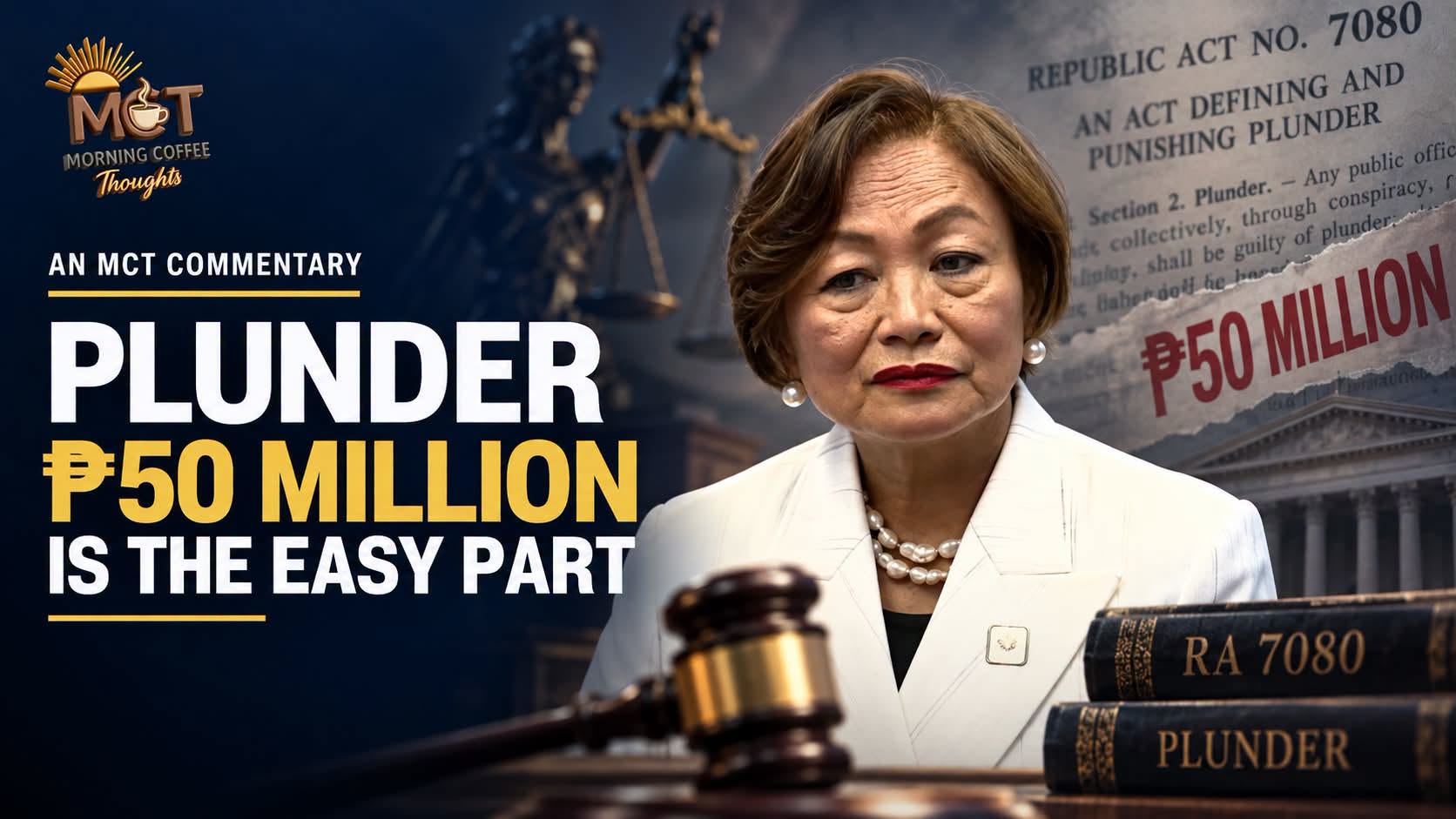
I went back to the testimony of former Sandiganbayan Presiding Justice Amparo Cabotaje-Tang because of something she said about the Plunder Law.
She said prosecuting plunder has become more difficult. She pointed to the Supreme Court doctrine that tells prosecutors to identify a mastermind or what the courts call the “main plunderer.”
That made me curious because, as a non-lawyer, my understanding of plunder was very shallow. I basically knew two things: the amount must reach ₱50 million, and plunder is what we commonly call a non-bailable offense.
As it turns out, even the second one needs correction.
Plunder is punishable by reclusion perpetua. A person charged with plunder can still apply for bail, but the court first has to determine whether the evidence of guilt is strong.
So I started reading Republic Act No. 7080, the Supreme Court decisions around it, and several actual plunder cases. Since I am not a lawyer, there is always a chance that I am reading a legal point incorrectly, so if you are one and you see an error, please let me know.
I am trying to understand this as an ordinary citizen.
WHAT PLUNDER ACTUALLY MEANS
The Plunder Law was passed in 1991. The original threshold was ₱75 million, but Congress lowered it to ₱50 million in 1993.
In simple terms, plunder happens when a public officer, alone or working with other people, amasses or acquires ill-gotten wealth worth at least ₱50 million through a combination or series of acts listed in the law.
Those acts can include taking public money, receiving kickbacks or commissions, taking advantage of government contracts, illegally acquiring government assets, or using public office to obtain wealth.
The money does not have to be sitting in the public official’s own bank account. RA 7080 covers wealth acquired directly or indirectly through other people, including nominees, agents, subordinates and business associates.
So putting money or property under another person’s name does not automatically place it outside the law. The difficult part is proving that the money or property really belongs to, is controlled by, or benefited the accused.
The ₱50-million threshold is also an aggregate amount. Several smaller amounts can be added together if prosecutors can prove that they belong to the same combination or series covered by the law.
Then I encountered something I did not expect.
If a public official illegally gets ₱100 million through only one criminal act, that single act may still not qualify as plunder.
The Supreme Court has explained that plunder needs a “combination or series” of criminal acts. A combination involves at least two acts from different categories listed in the law, while a series involves at least two acts from the same category.
The ₱100-million act may still be another serious crime. The amount alone does not automatically make it plunder.
Congress designed the law for large corruption schemes made up of connected acts. Section 4 even says prosecutors do not have to prove each and every criminal act done in furtherance of the scheme.
They can instead prove a pattern showing the overall unlawful scheme or conspiracy. That deals with what ultimately has to be proved in court.
A different question later reached the Supreme Court: how much detail must prosecutors put in the charge itself so an accused person knows what he or she is supposed to defend against?
HOW THE COURTS CHANGED THE FIGHT
When the Plunder Law reached the Supreme Court in Joseph Estrada’s case in 2001, Justices Santiago M. Kapunan, Consuelo Ynares-Santiago and Angelina Sandoval-Gutierrez dissented from the majority that upheld the law. They worried, in different ways, that parts of RA 7080 were too vague or broad and could leave too much discretion to prosecutors and courts.
Ynares-Santiago warned that the law could lead to arbitrary and unequal enforcement. Sandoval-Gutierrez described it as “vague and fuzzy, inexact and sweeping,” while Kapunan also questioned whether its wording gave an accused enough certainty about what conduct could lead to a plunder conviction.
The Supreme Court majority disagreed. It upheld the Plunder Law as constitutional and said its meaning was clear enough when the statute was read as a whole and with the help of its legislative history.
Twenty-five years later, Cabotaje-Tang, Justice Marvic Leonen and Ombudsman Jesus Crispin Remulla are raising a different concern: whether later court rulings have made plunder unusually difficult to prosecute.
The 2015 Enrile ruling was important here.
The Supreme Court said prosecutors had to give greater detail about the alleged acts making up the combination or series. The accused had to be told enough about the projects, transactions, amounts and alleged acts to prepare a proper defense.
That ruling dealt with the constitutional right of an accused person to know the accusation. It did not say prosecutors must prove every single act in the scheme.
Then came the Gloria Macapagal-Arroyo plunder case.
The Supreme Court majority said that when several people are accused, prosecutors must identify the public officer who is the “main plunderer.”
Those words do not appear in RA 7080.
The Arroyo majority reasoned that someone must be identified as the principal public officer who amassed the ill-gotten wealth. It also connected this to due process because a person facing possible life imprisonment must be clearly told what role he or she supposedly played.
Former Chief Justice Lucas Bersamin, who wrote the ruling, later defended that interpretation. Several justices disagreed.
Justice Leonen argued that RA 7080 does not call for one mastermind because the law already allows several people acting under a common plan to accumulate ill-gotten wealth. Then Chief Justice Maria Lourdes Sereno also questioned rules she believed were not written in the law.
There was another disputed point in Arroyo.
For the specific form of plunder involving a “raid on the public treasury,” the majority said prosecutors must show personal benefit. Justice Estela Perlas-Bernabe and other dissenting justices questioned that interpretation.
This point needs to stay narrow. It does not mean every possible plunder case always needs a separate showing of personal benefit.
Still, if prosecutors build a case around that specific kind of plunder, they may have to show who actually benefited. That becomes harder when money moves through contractors, corporations, intermediaries, nominees or several accounts.
At that point, I began to understand Cabotaje-Tang’s concern.
WHAT THE ACTUAL CASES SHOW
The “main plunderer” doctrine changed how prosecutors handled actual cases.
In the ₱50-million Bureau of Immigration case involving Al Argosino, Michael Robles and Wenceslao Sombero, Ombudsman prosecutors initially argued that RA 7080 did not make them identify a main plunderer. They later amended the charge and named Argosino as the main plunderer.
The Sandiganbayan convicted Argosino, Robles and Sombero of plunder in 2021. The case involved an identifiable amount, identifiable people and separate instances involving the money.
Now compare that with a large procurement or infrastructure scheme involving many projects, different contractors, several public officials and transactions spread over years. The job of proving who acquired what can become much harder.
The Pharmally controversy shows one part of that problem.
Pharmally received about ₱4.165 billion in government pandemic supply contracts. Former Ombudsman Samuel Martires later explained why his office pursued graft instead of plunder.
Martires said the evidence did not establish which public officer had amassed at least ₱50 million in ill-gotten wealth or received commissions from the transactions.
That distinction is easy to miss. A huge government contract does not automatically become an equally huge plunder case, and the value of a contract is not the same thing as the amount of ill-gotten wealth proved against a public officer.
The Enrile case shows another problem.
The plunder charge against Enrile, Jessica “Gigi” Reyes and Janet Lim Napoles alleged around ₱172.8 million in kickbacks. They were acquitted of plunder in 2024 after the Sandiganbayan majority found that guilt had not been proved beyond reasonable doubt.
Five entries in the records totaled about ₱46.39 million, below the ₱50-million threshold. The majority also questioned whether receipt of those payments had been proved with the certainty needed for conviction.
Cabotaje-Tang agreed with the plunder acquittal but disagreed on the lesser offenses. In her separate opinion, she believed the ₱46.39 million in payments to Reyes had been proved and would have convicted Reyes of five counts of direct bribery, with corresponding convictions against Napoles for corruption of public officials.
So the ₱46.39 million was Cabotaje-Tang’s finding, not the finding of the court majority.
The Carlos Garcia case shows another weak point.
The retired major general was accused of plunder involving around ₱300 million. The case eventually resulted in a plea bargain involving lesser offenses, with Garcia offering to surrender about ₱135.4 million in cash and property to the government.
The Supreme Court record shows why the prosecution had a problem. Prosecutors said they could not find contractors or suppliers who could support the allegation that Garcia received gifts, commissions or kickbacks from them, and they could not prove the criminal acts that supposedly produced the wealth beyond reasonable doubt.
This also explains why a plea bargain or a lesser charge does not automatically mean someone escaped accountability. Prosecutors sometimes have to decide what offense their evidence can actually prove.
Then there is the demurrer to evidence.
After prosecutors finish presenting their case, the accused can ask the court to dismiss because the prosecution’s own evidence is insufficient. If the court grants the demurrer and acquits the accused, double jeopardy normally prevents the government from simply repairing the weaknesses and trying the same person again for the same offense.
The first trial is not a rehearsal.
THE LAW IS ONLY PART OF THE PROBLEM
Sandiganbayan’s own historical statistics also caught my attention.
Its published tables show that plunder cases make up a very small part of the court’s historical docket compared with the thousands of cases involving graft and malversation.
There are limits to that comparison. Plunder did not become a crime until 1991, and one criminal case can involve several accused.
Still, the difference is striking.
The record itself is also mixed. Joseph Estrada was convicted of plunder in 2007 and later received executive clemency.
Ramon “Bong” Revilla Jr. was acquitted of plunder while Richard Cambe and Janet Napoles were convicted in the same case. Enrile, Reyes and Napoles were acquitted in the separate Enrile case.
So I would not say that nobody gets convicted of plunder. The record does not support that.
Cabotaje-Tang has also said that one of the Sandiganbayan’s biggest problems is the quality of the evidence brought before it. A judge cannot convict because a government project looks suspicious or because the public believes corruption happened.
Every element of the offense still has to be proved with admissible evidence beyond reasonable doubt.
Current Sandiganbayan Presiding Justice Geraldine Econg has made a related point about delay. Long cases can weaken evidence because witnesses may die, disappear, become unavailable or simply forget details after many years.
Delay can also violate the rights of the accused. Faster and better-prepared cases therefore serve both accountability and due process.
PLUNDER IS NOT THE ONLY PATH TO ACCOUNTABILITY
If prosecutors fail to prove plunder, it does not automatically mean every underlying act was legal.
The same conduct may support graft, malversation, bribery, corruption of public officials, money laundering, administrative cases or civil recovery.
There is also Republic Act No. 1379, which allows the government to seek forfeiture of property that is manifestly out of proportion to a public official’s lawful income. These are civil proceedings, so the standard is preponderance of evidence rather than proof beyond reasonable doubt.
The Supreme Court’s 2025 Ligot ruling also confirmed that putting property in another person’s name does not automatically shield it. If the evidence traces true ownership to the public official, the property can still be covered by forfeiture proceedings.
Plunder is a serious tool, but other legal paths remain available.
THE ARGUMENT IS STILL HAPPENING
Ombudsman Jesus Crispin Remulla has also criticized the difficulty of prosecuting plunder under current Supreme Court decisions.
In 2025, he called the law “full of holes” and said other offenses could sometimes be easier to prove. In 2026, after studying the law and the cases further, he said the Ombudsman could still build successful plunder cases but continued to argue that some court-made rules were not written in RA 7080 and should be revisited.
New plunder cases have also been filed in 2026 against Senator Jinggoy Estrada, Senator Rodante Marcoleta and former House Speaker Martin Romualdez in separate proceedings.
Estrada declined to enter a plea during his September 3 arraignment, so the Sandiganbayan entered a not guilty plea for him. Marcoleta pleaded not guilty earlier and his bail proceedings were still ongoing this week, while Romualdez pleaded not guilty on September 16.
All of those cases are pending.
The charges are allegations, and the courts will decide whether the evidence proves them. Their relevance here is narrower: prosecutors are again working under the same body of law that Cabotaje-Tang, Leonen and Remulla have questioned.
SO WHAT DID CABOTAJE-TANG MAKE ME REALIZE?
I started this reading thinking plunder was basically about a corrupt public official, ₱50 million and a very serious criminal charge.
I now understand why that barely scratches the surface.
The harder questions are about proof. Who actually acquired the wealth, and can prosecutors trace it?
If the money moved through another person or company, can they prove who truly controlled or benefited from it? Were there enough criminal acts to form a combination or series, and can those acts be connected into one overall scheme?
If several people were involved, who was the main plunderer under current Supreme Court doctrine?
If prosecutors rely on a raid on the public treasury, can they show the personal benefit called for by the Arroyo ruling? How much detail should prosecutors have to give while still preserving the original purpose of a law designed for large and complicated corruption schemes?
I do not have a simple answer.
I also do not think it would be fair to blame everything on the Supreme Court. The due process concerns are real, and several failed cases also show problems involving investigation, witnesses, documents and the quality of prosecution.
But I now understand why Cabotaje-Tang raised the issue.
RA 7080 was created to deal with corruption involving many acts and many people. Yet the larger and more complicated an alleged scheme becomes, the harder it may become to trace the money, identify who actually received or benefited from it, connect the participants and prove the whole case beyond reasonable doubt.
That leaves Congress with a difficult question.
After more than three decades of court decisions and actual prosecutions, does the Plunder Law still work the way Congress intended it to work?
I started reading because of one statement from Cabotaje-Tang. Now I understand the question behind it.
SOURCES
- Republic Act No. 7080, Office of the Ombudsmanhttps://www.ombudsman.gov.ph/docs/republicacts/Republic_Act_No_7080.pdf
- Republic Act No. 7080, Senate Legislative Reference Bureauhttps://issuances-library.senate.gov.ph/legislative%2Bissuances/Republic%20Act%20No.%207080
- Republic Act No. 7659, Supreme Court E-Libraryhttps://elibrary.judiciary.gov.ph/thebookshelf/showdocs/2/1787
- Enrile v. Sandiganbayan, G.R. No. 213847, Supreme Court E-Libraryhttps://elibrary.judiciary.gov.ph/thebookshelf/showdocs/1/60865
- Enrile v. People, G.R. No. 213455, Supreme Court E-Libraryhttps://elibrary.judiciary.gov.ph/thebookshelf/showdocs/1/60980
- Estrada v. Sandiganbayan, G.R. No. 148560, Supreme Court E-Libraryhttps://elibrary.judiciary.gov.ph/thebookshelf/showdocs/1/52942
- Macapagal-Arroyo v. People, 2016 Decision, Lawphilhttps://lawphil.net/judjuris/juri2016/jul2016/gr_220598_2016.html
- Macapagal-Arroyo v. People, separate opinions, Lawphilhttps://lawphil.net/judjuris/juri2016/jul2016/gr_220598_so_2016.html
- Macapagal-Arroyo v. People, 2017 Resolution, Lawphilhttps://lawphil.net/judjuris/juri2017/apr2017/gr_220598_2017.html
- Philippine News Agency, Bersamin on the main-plunderer doctrinehttps://www.pna.gov.ph/articles/1079541
- Sombero v. Office of the Ombudsman, Supreme Court E-Libraryhttps://elibrary.judiciary.gov.ph/thebookshelf/showdocs/1/66442
- Philippine Daily Inquirer, Argosino named main plunderer in amended chargehttps://newsinfo.inquirer.net/1000699/argosino-becomes-main-plunderer-in-amended-charge
- GMA News, Argosino, Robles and Sombero convicted of plunderhttps://www.gmanetwork.com/news/topstories/nation/792948/argosino-robles-sombero-get-reclusion-perpetua-over-p50-million-immigration-bribery/story/
- GMA News, Ombudsman on Pharmally and plunderhttps://www.gmanetwork.com/news/topstories/nation/880300/ombudsman-no-evidence-of-plunder-vs-ex-ps-dbm-pharmally-execs/story/
- Philippine Daily Inquirer, Enrile, Reyes and Napoles plunder acquittalhttps://newsinfo.inquirer.net/1990029/enrile-cleared-of-plunder-in-p173-m-pork-scam-case
- GMA News, Cabotaje-Tang opinion on direct bribery in the Reyes casehttps://www.gmanetwork.com/news/topstories/nation/922605/sandiganbayan-gigi-reyes/story/
- Philippine Star, Enrile, Reyes and Napoles acquittalhttps://www.philstar.com/headlines/2024/10/05/2390254/enrile-reyes-napoles-cleared-plunder-pork-scam
- Republic v. Sandiganbayan and Carlos Garcia, Supreme Court E-Libraryhttps://elibrary.judiciary.gov.ph/thebookshelf/showdocs/1/66995
- GMA News, Carlos Garcia forfeited assetshttps://www.gmanetwork.com/news/topstories/nation/844724/ombudsman-turns-over-to-treasury-11-properties-p53-6-million-proceeds-of-ex-afp-comptroller-s-forfeited-assets/story/
- Philippine Star, Garcia plea bargain and lesser offenseshttps://www.philstar.com/headlines/2010/12/17/639633/garcia-pleads-guilty-lesser-offenses
- Sandiganbayan, Statistics on Cases Filed, Pending and Disposed as of April 30, 2024https://sb.judiciary.gov.ph/wp-content/uploads/2024/09/Statistics-on-Cases-Filed-Pending-and-Disposed-as-of-April-30-2024.pdf
- Risos-Vidal v. COMELEC, Supreme Court E-Libraryhttps://elibrary.judiciary.gov.ph/thebookshelf/showdocs/1/58837
- People v. Napoles, Revilla plunder case, Supreme Court E-Libraryhttps://elibrary.judiciary.gov.ph/thebookshelf/showdocs/1/67088
- GMA News, Cabotaje-Tang on evidence and anti-corruption institutionshttps://www.gmanetwork.com/news/topstories/nation/966877/pork-barrel-flood-control-scandal-justice/story/
- Philippine News Agency, Sandiganbayan Presiding Justice Geraldine Econg on faster trials and evidencehttps://www.pna.gov.ph/articles/1283735
- Republic Act No. 1379, Supreme Court E-Libraryhttps://elibrary.judiciary.gov.ph/thebookshelf/showdocs/2/10888
- Heirs of Ligot v. Republic, Supreme Court E-Libraryhttps://elibrary.judiciary.gov.ph/thebookshelf/showdocs/1/69940
- September 14, 2026 impeachment trial working transcript, Cabotaje-Tang testimonyhttps://tordecilla.github.io/duterte-impeachment-working-draft/sessions/24/
- GMA News, Cabotaje-Tang testimony during Day 24 of the impeachment trialhttps://www.gmanetwork.com/news/topstories/nation/1002380/sara-duterte-impeachment-trial-day-24-ex-sandiganbayan-chief-testifies-on-unexplained-wealth/story/
- GMA News, Ombudsman Remulla on difficulty of plunder prosecutionshttps://www.gmanetwork.com/news/topstories/nation/966465/ombudsman-flood-control-projects-investigation/story/
- Philippine Daily Inquirer, Remulla on revisiting plunder jurisprudencehttps://newsinfo.inquirer.net/2236169/plunder-raps-filed-vs-estrada-bonoan-3-othersover-insertions
- Philippine News Agency, Estrada arraignmenthttps://www.pna.gov.ph/articles/1283272
- GMA News, Estrada bail rulinghttps://www.gmanetwork.com/news/topstories/nation/1001015/sandiganbayan-affirms-denial-of-jinggoy-estrada-s-plea-to-fix-bail-in-plunder-case/story/
- GMA News, Marcoleta plunder proceedingshttps://www.gmanetwork.com/news/topstories/nation/1002696/marcoleta-solicited-campaign-donation-from-co-accused-in-plunder-raps-witness/story/
- GMA News, Romualdez arraignmenthttps://www.gmanetwork.com/news/topstories/nation/1002545/romualdez-pleads-not-guilty-in-p7-4-billion-plunder-case/story/
- Associated Press, Romualdez plunder arraignmenthttps://apnews.com/article/b265b2c57ce2c2cba621896301f9676a