FIVE THINGS TO KNOW…

Short explainers published throughout the day.

3:15 PM8-minute read

ABOUT THE PLUNDER CASE AGAINST MARTIN ROMUALDEZ

The Office of the Ombudsman filed a plunder case against former House Speaker Martin Romualdez at the Sandiganbayan on September 7 over his alleged involvement in flood-control kickbacks. The accusations have now reached the court that will handle the criminal case. Romualdez denies wrongdoing and remains presumed innocent.

Read the explainer →
1:18 PM7-minute read

ABOUT THE NEW SWS POVERTY NUMBERS

Self-rated poverty and food poverty declined in June, but the figures also show how many Filipino families remain under pressure and why lower household budgets do not necessarily mean life became cheaper.

Read the explainer →
2:02 PM11-minute read

ABOUT THE CHILDREN'S SOCIAL MEDIA SAFETY ACT

House Bill No. 9965 would bar children below 13 from having social media accounts, require parental consent for users aged 13 to 17, regulate platform algorithms, and impose fines reaching P50 million. It is still being deliberated in the House.

Read the explainer →
12:02 PM7-minute read

ABOUT THE SEALED BIR BOX

Marcos authorized the BIR to comply with the Senate subpoena. That did not open the records to the public or prove the unexplained-wealth allegation.

Read the explainer →

MCT READER PULSE · MCT-PULSE-2026-007

MCT READER SURVEY

House prosecutors are considering whether to stop presenting evidence on the bribery article against Vice President Sara Duterte and move directly to the unexplained-wealth charge. Do you agree with that strategy?Pinag-iisipan ng mga prosekutor ng Kamara kung ititigil ang paghaharap ng ebidensiya sa artikulo tungkol sa panunuhol at tututok sa kasong hindi maipaliwanag na yaman laban kay Bise Presidente Sara Duterte. Sang-ayon ka ba sa estratehiyang ito?

Some prosecutors want to move directly to the unexplained-wealth charge; others want to proceed with all four articles. No final decision had been announced when this survey opened. The question is about prosecution strategy, not guilt.

Background: The Philippine Star and Daily Tribune.

This is an informal survey of verified MCT readers who choose to participate. It is not nationally representative.

Open the shareable survey page →
View previous survey results →
Checking your reader session…

September 7, 2026 · 3:15 PM8-minute read

FIVE THINGS TO KNOW ABOUT THE PLUNDER CASE AGAINST MARTIN ROMUALDEZ

The Office of the Ombudsman filed a plunder case against former House Speaker Martin Romualdez at the Sandiganbayan on September 7 over his alleged involvement in flood-control kickbacks. The accusations have now reached the court that will handle the criminal case. Romualdez denies wrongdoing and remains presumed innocent.

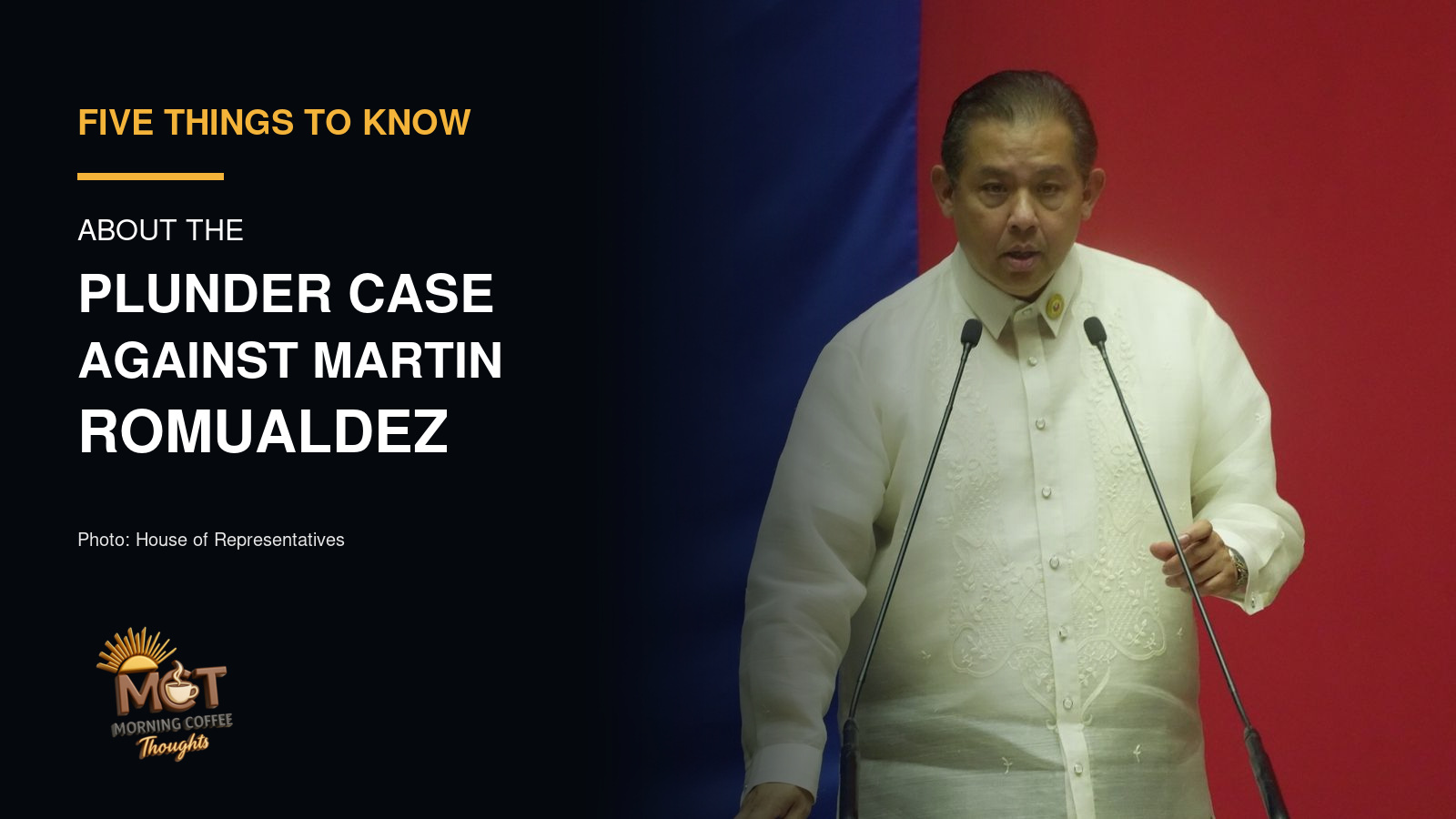
Martin Romualdez speaking at the House of Representatives on February 5, 2025.
Photo: House of Representatives

For people who paid for these projects through their taxes, the questions are concrete: which transactions were unlawful, where did the money go, and what evidence connects it to the people accused? Filing the case puts those questions before a court. It does not, by itself, recover public money or establish anyone’s guilt.

Here are five things to understand about this development and the decisions ahead.

1

THIS HAS MOVED BEYOND AN OMBUDSMAN INVESTIGATION

Assistant Ombudsman Mico Clavano went to the Sandiganbayan to file the case on Monday. The case has been assigned to the court’s Third Division, according to GMA News and DZRH. That moves the matter beyond the investigation readers have been following for weeks and identifies the judges who will make the next court decisions.

During a preliminary investigation, prosecutors examine whether there is enough basis to bring a criminal accusation to court. The respondent can submit a counter-affidavit, a sworn answer to the allegations. That earlier process is different from a trial, where the prosecution must prove its case and the defense can challenge it.

The formal charging document is called an “information.” That sounded stupid to me, so I stopped and checked. It really is the term used in the Rules of Court. It names the accused and sets out the offense and the acts prosecutors allege constitute it.

Its contents are more useful than a headline that simply says someone has been “charged,” because a complaint submitted to investigators and a case filed in court are different steps. Today supplies a concrete change in status. It does not tell us that the court has accepted every accusation or reached a verdict.

WHAT TO WATCH

The Third Division’s first orders and the complete filed information. Read those documents for the specific allegations against each accused and the next steps the court requires.

2

THE MONEY HAS TO BE CONNECTED TO SPECIFIC TRANSACTIONS

The case concerns alleged flood-control kickbacks: payments secretly returned to people involved in arranging or influencing transactions. GMA News, quoting the criminal information, reported alleged receipts totaling at least ₱7.4 billion on at least 15 occasions. That is distinct from the roughly ₱56 billion investigators alleged in their July complaint against Romualdez, former lawmaker Zaldy Co and others covering 2022 to 2025. The earlier complaint and Monday’s court charge must not be treated as identical accounts of the amount involved.

Several different amounts can appear in reporting on the same controversy. There is the money budgeted for a project, the value of the contract, the amount actually paid by government and the share allegedly diverted. Those figures describe different things. They cannot simply be added together or treated as the amount one person received.

A project’s price alone cannot establish that Romualdez obtained its funds. Prosecutors need evidence connecting the alleged scheme to him. That could involve financial records, testimony from people with direct knowledge and other documents, depending on what they actually submit. Readers should be able to follow who allegedly paid whom, when and for what purpose.

For taxpayers, tracing those transactions helps answer who should account for missing funds. A criminal filing also does not mean damaged infrastructure has been repaired or money returned to the treasury.

WHAT TO WATCH

The amounts and transactions specified in the information, followed by the records offered to support them. Keep alleged proceeds separate from total project costs and any money actually recovered.

3

PLUNDER REQUIRES MORE THAN A LARGE ALLEGED LOSS

Under the plunder law, a public officer must have acquired ill-gotten wealth worth at least ₱50 million through a combination or series of specified unlawful acts. The law covers acts such as misuse of public funds and receiving kickbacks connected with government contracts. Other participants can also face liability under its provisions.

The amount is one requirement. Prosecutors must also establish the unlawful acts and the accused person’s participation in the scheme. Calling several transactions suspicious, or placing a politician’s name beside a large total, does not supply those missing links.

If the case reaches judgment, the standard for conviction is proof beyond reasonable doubt. The prosecution carries that burden. Romualdez does not have to prove his innocence to deserve the presumption of innocence, although his lawyers can contest the evidence and present a defense.

That protection applies even when the allegations concern public money and provoke anger. It is also what makes a conviction meaningful: a court must explain how the evidence establishes the crime and responsibility for it. Political influence and public reputation cannot substitute for that examination.

WHAT TO WATCH

How prosecutors connect the alleged unlawful acts, the amount involved and Romualdez’s participation. Those links will show what supports the accusation beyond the size of the headline figure.

4

ROMUALDEZ’S DEFENSE MUST BE READ ALONGSIDE THE ACCUSATIONS

Romualdez has denied receiving flood-control kickbacks. Before Monday’s filing, his lawyer Ade Fajardo asked the Ombudsman to give the defense an opportunity to answer any new allegations from former Public Works Secretary Manuel Bonoan or other witnesses. Fajardo made that request on Sunday, September 6, while seeking a chance to respond during the preliminary investigation.

The investigation also has a disputed witness history. Orlando “Orly” Guteza previously accused Romualdez in connection with alleged cash deliveries, then withdrew his account. That reversal gives the defense a concrete reason to challenge the reliability of his earlier story. His conflicting accounts leave questions about what he actually witnessed and which claims can be supported independently.

A recantation does not automatically decide what every other witness or document can establish. Its effect depends on the evidence actually relied on and how the court evaluates it. Equally, announcing that there are additional witnesses does not tell the public whether they have direct knowledge or can support their accounts.

WHAT TO WATCH

Romualdez’s response to the actual court filing, the specific evidence his lawyers dispute and how prosecutors answer those challenges. A witness count alone cannot settle a credibility problem.

5

A COURT FILING DOES NOT CONFIRM AN ARREST WARRANT

The reports confirming Monday’s filing do not, by themselves, establish that the Sandiganbayan has issued a warrant against Romualdez. A warrant is a separate court order. Claims that an arrest is already authorized should be checked against that order or a reliable confirmation of its issuance.

The court makes its own assessment of probable cause for an arrest warrant. That means determining whether there is sufficient basis to believe an offense was committed and the accused probably committed it. This decision concerns bringing an accused before the court; it does not apply the standard required for conviction.

Bail also needs careful explanation. Plunder is among the serious offenses for which bail is denied when the evidence of guilt is strong. If bail is sought, the strength of the prosecution’s evidence is examined in a hearing, with the prosecution bearing the burden on that question. A bail decision concerns release while the case is pending and does not decide guilt.

So a description such as “non-bailable” should not be taken to mean that the court can never consider a bail application. Nor should anyone assume that Romualdez can simply pay a predetermined amount and leave.

WHAT TO WATCH

The court’s actual order on probable cause, any warrant it issues and any subsequent bail hearing or ruling. These documents will establish what happens to his custody while the case proceeds.

BOTTOM LINE

The Ombudsman has taken the plunder accusation against Romualdez to court. The next questions are specific: what acts are charged, what evidence connects him to alleged proceeds, how his defense answers that evidence and what the Sandiganbayan orders.

People who fund public works deserve an account of how their money was used. That requires following the transactions and the court record, while giving the accused a fair hearing. Today’s filing is a step in that process. A finding of guilt, recovery of funds and repairs to flood-control works each require more than the filing itself.

GOOGLE PREFERRED SOURCES

FOLLOW MCT ON GOOGLE

Google’s Preferred Sources feature lets you choose publications you want Google to prioritize for you. Select “Add to Preferred Sources” to make MCT easier to find in Top Stories and other eligible Google results. This does not subscribe you to email.

← Back to MCT home

LATEST COMMENTARY

View all commentary →

SUPPORT MCT

HELP KEEP INDEPENDENT POLITICAL WRITING GOING.

Morning Coffee Thoughts is reader-supported. Contributions help pay for research tools, hosting, and the work required to verify and explain each development.

Choose the monthly support amount you are comfortable with.Continue through PayPal
Send support through GCash or Maya0969 314 4839