
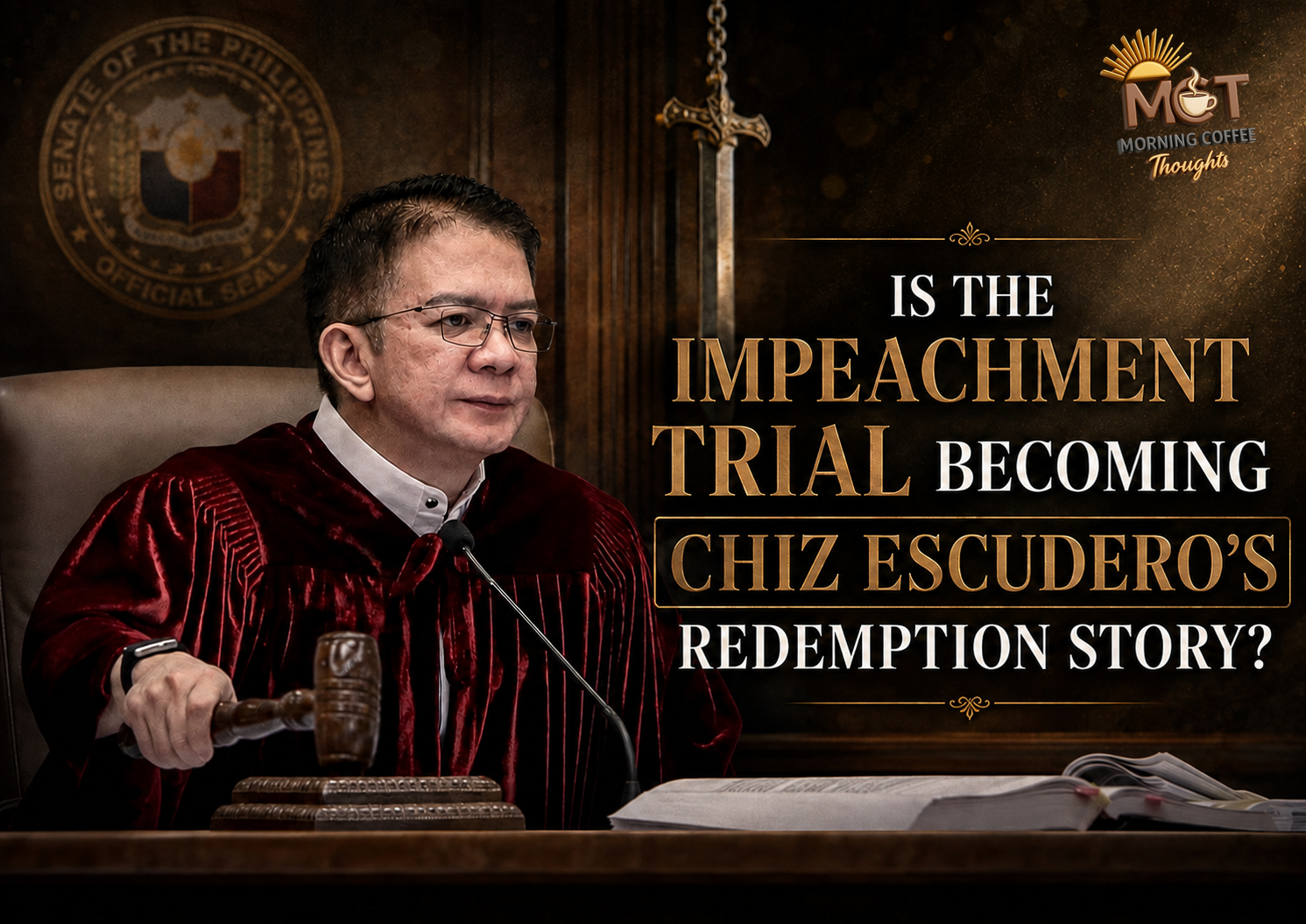
I have been watching Chiz Escudero closely during the impeachment trial, and I have to give him this: he is doing a good job as presiding officer. He comes prepared. He follows the testimony. He remembers previous rulings and discussions. He seems to know where the lawyers are going with their questions, and when an objection comes up, he can usually identify the issue without requiring another fifteen minutes of argument from everybody. He also manages the traffic inside that courtroom reasonably well, which is not easy when you have prosecutors, defense lawyers, witnesses, and 24 politicians who are also supposed to behave like judges.
Considering my previous criticism of Escudero, I find myself asking an uncomfortable question: is being presiding officer becoming his saving grace?
Maybe.
Or perhaps the better question is: is this impeachment trial becoming his redemption story? Because hanging over Escudero is still what happened in 2025. I have not forgotten the first Sara Duterte impeachment, the arguments over when the Senate should act, and that one word in the Constitution that became almost impossible to separate from Escudero:
“Forthwith.”
The House transmitted the Articles of Impeachment on February 5, 2025. Escudero maintained that the Senate could not convene as an impeachment court while Congress was in recess. When Congress resumed, the presentation of the Articles was again moved while the Senate attended to legislative business. Then, when the Senate finally convened as an impeachment court, it voted to return the Articles to the House for certifications and clarifications instead of proceeding directly to trial. I remember the frustration then. Every time it looked as though the impeachment might finally move forward, another procedural question seemed to appear.
Now, fairness requires acknowledging what happened afterward. In April 2026, the Supreme Court said “forthwith” did not require the Senate to begin the trial instantaneously. It treated the timing and preparation of an impeachment trial as matters within the Senate's discretion and found no grave abuse in the Senate's failure to convene immediately. The Court also dismissed the petition as moot because the 2025 Articles of Impeachment had already been nullified. So no, I am not going to pretend that Escudero ultimately lost that legal argument. He did not. But the political memory of 2025 did not disappear with the Supreme Court decision.
For me, that remains the sword of Damocles hanging above him as he presides over this trial. Which is why his performance now has caught my attention. The Chiz Escudero I am watching today looks different from the Chiz Escudero I remember from that impeachment. But there is one area where he still needs work. He is very good at policing the people standing before the impeachment court. I am not yet convinced that he is equally willing to police the people sitting on it.
And now that he is preparing a ruling on Rule 18 and the out-of-court statements being made by lawyers from both camps, that question becomes harder to avoid. Escudero said on Wednesday, August 12, that he was preparing a ruling, warning, and order after defense counsel Sheila Sison complained about a Facebook post by private prosecutor Amando Ligutan. He also said the impeachment court had already been monitoring public statements and that some participants had crossed the line more than once. Okay. Fair enough.
Lawyers appearing before an impeachment court should observe decorum. If Escudero believes lawyers from either side have been publicly discussing the merits of the case in violation of the rules, then rule on it. Warn them. Reprimand them. If warranted and legally supported, cite them for contempt. But I went back and read Rule 18.
WHO EXACTLY IS RULE 18 FOR?
Rule XVIII does not begin with the prosecution. It does not begin with the defense. It does not even begin with the witnesses. It begins with the presiding officer and the members of the Senate. They are the first people instructed to refrain from publicly commenting on the merits of a pending impeachment trial. The prosecutors, respondent, lawyers, and witnesses come afterward. Senator-judges are expressly covered by the rule. The same impeachment rules require senators to observe political neutrality during the trial, and every senator-judge took an oath to render impartial justice.
So if Escudero is going to issue a ruling on Monday, August 17, defining what lawyers may or may not say outside the courtroom, there is another question he needs to answer: What about the senator-judges? Because we already have examples. Remember Robin Padilla publicly discussing the authenticity of the video evidence after questioning a witness about essentially the same issue? The impeachment court's own spokesperson later reminded everyone that senator-judges themselves are bound by Rule 18. Then there is Pia Cayetano.
She reposted an edited video of Chel Diokno that made it appear that Diokno had admitted the prosecution was simply fishing for evidence. When the entire exchange was examined, the missing context showed otherwise. Diokno had been explaining what would constitute a fishing expedition and why, in his view, the prosecution's request did not fall into that category. That was not some anonymous Facebook account posting it. Pia Cayetano was sitting as a senator-judge in the same impeachment trial. An ethics complaint was subsequently filed against her.
So, ano na?
I am not saying Escudero personally has the authority to decide Pia Cayetano's ethics complaint. He does not. That belongs to the proper Senate process. But Rule 18 is an impeachment rule. If the impeachment court is now examining whether lawyers have violated it, then the conduct of senator-judges covered by the exact same rule should not suddenly become invisible. And this is part of the test for Escudero now.
If this really is becoming his redemption story, then competence alone will not be enough. He will also have to show that the rules remain rules even when the people testing them happen to be his fellow senators.
THEN THERE WAS IMEE MARCOS AND WAMIL
I have already written about this particular exchange, so some of you may remember it. During Imee Marcos's questioning of former COA auditor Roderick Wamil, Marcos clearly had an angle she wanted Wamil to go to. She was trying to establish that responsibility for the confidential funds rested principally with the special disbursing officer rather than with Vice President Sara Duterte as head of the agency. Wamil would not go there.
He disagreed with Marcos's interpretation and explained why. His position was that the governing rules also imposed responsibilities upon the head of the agency. Marcos kept trying to reduce the issue to the answer she wanted, while Wamil kept explaining why it was not as simple as the yes-or-no answer she was demanding. Gladly, Wamil stood his ground. A witness can disagree with the senator asking the question without becoming argumentative. If the senator puts forward a proposition that the witness believes is wrong, particularly when that witness is there because of his professional expertise, he has to be allowed to say so.
Marcos eventually complained that Wamil was always “fighting” with her. Then Escudero intervened and told Wamil to avoid arguing with the senator-judges. If Wamil was becoming argumentative, then by all means tell Wamil to stop arguing. But Marcos was not simply asking a question and waiting for an answer. She was driving toward a conclusion she appeared to want the witness to accept, and when he would not accept it, she kept pressing him. So why was only Wamil corrected? Why not tell Marcos, “Senator, please allow the witness to explain his answer”? Because otherwise the rule becomes absurd.
A senator-judge may argue with a witness, but the witness may not argue back. Worse, “do not argue with the senator-judge” can very quickly become “do not contradict the senator-judge.” And I will hazard a guess here. This is an inference from watching the questioning, not something I can prove. I would not have been surprised if Marcos was hoping Wamil would eventually make a mistake and give her one clean answer that could be isolated from everything else he had said. One careless yes. One badly worded sentence. Something that could later be repeated without the qualifications that came before and after it.
We have already seen how this works. Chel Diokno gave a longer explanation about what constitutes a fishing expedition. One fragment was pulled out, the context disappeared, and the circulating clip made it look as though he had admitted something he had actually denied. This is a tactic we have repeatedly seen from Duterte-aligned social-media pages: isolate the useful sentence, remove the surrounding explanation, then circulate the shortened version until that becomes the version people remember. That is why I was glad Wamil refused to be pushed into an answer he did not believe was accurate.
A loaded question can become content by itself. A reluctant “yes” can become a headline. The witness's explanation immediately afterward may never make it into the Facebook reel. I cannot say that this was Marcos's purpose. I do not know what was in her head. But I can say that she appeared to have a prepared proposition she wanted Wamil to validate, and Wamil refused to give her the uncomplicated answer she was looking for.
Good for him.
POLITE WARNINGS ARE NOT ALWAYS ENOUGH
This also goes to Escudero's courtroom style. He is almost unfailingly polite, and usually that is a good quality. But sometimes I find myself wishing he would use the damn gavel. There have been repeated instances of lawyers interrupting each other, continuing to argue after a ruling, speaking over witnesses, or turning what should have been a simple objection into another round of oral arguments. Escudero often responds by nicely asking them to stop. Then they do it again. At some point, a presiding officer has to establish that an instruction is not a suggestion.
You do not have to scream. You do not have to embarrass anybody for sport. But there are occasions when counsel should be called to the bench and reprimanded, on the record, so everybody understands that the next warning will not sound exactly like the previous five warnings. Personally, I would probably prescribe something more memorable for repeat offenders, but apparently public bitch-slapping and 40 lashes are not recognized sanctions under the Senate impeachment rules.
Sayang.
There are, however, real sanctions available. Rule 18 itself does not provide an automatic punishment. It tells the covered persons what they must not do but does not attach a specific fine, jail term, or other penalty to a violation. The impeachment court does have contempt powers. Rule V authorizes the Senate to preserve order and punish contempt of, or disobedience to, its authority and orders. That does not make contempt automatic for every Rule 18 dispute. It means the court has stronger tools available if warnings and reprimands fail and the legal requirements for contempt are met.
So whatever standard Escudero announces on August 17 should answer more than what a prosecutor or defense lawyer is allowed to post on Facebook. It should tell us whether Rule 18 is actually a rule of the impeachment court or merely a rule for people who do not have Senate seats.
ROBIN PADILLA AND THE QUESTION BEHIND THE QUESTION
Robin Padilla raises another version of the same problem. I cannot prove that Padilla asks certain questions specifically so trolls can cut them into clips and circulate them online, so I will not state that as fact. But I can watch what his questions do. When a senator-judge asks a question containing an accusation or political proposition, the question itself can become the clip. The witness's explanation afterward may never make it onto Facebook or TikTok. We have already seen Padilla publicly discuss an evidentiary issue after questioning a witness about that same issue.
We have also heard him tell the prosecution that he hoped it would not be “one-sided.” But of course the prosecution is one-sided. It is the prosecution. The defense is also one-sided. That is why we have senator-judges. They are supposed to be the ones who are not. If a senator-judge starts using his questioning to establish his own preferred conclusion rather than to clarify testimony, the presiding officer cannot treat that as something completely beyond his concern.
The same goes for questions that seem designed to force a witness into a particular formulation. The senator may call it questioning. The witness may experience it as being pushed toward an answer. And once again, one badly worded answer can leave the courtroom and take on a completely different life online.
WHO POLICES THE SENATOR-JUDGES?
Escudero's responsibility goes beyond keeping the prosecution and defense in their lanes. He also has to protect the integrity of the tribunal itself. I am not suggesting that Chiz can simply suspend Imee Marcos, Robin Padilla, or Pia Cayetano whenever he believes one of them has misbehaved. The powers of a presiding officer are not unlimited. Formal disciplinary proceedings against senators have their own constitutional and Senate processes. But he can call them out. He can enforce courtroom rules evenly. He can remind a senator-judge that a witness is entitled to complete an answer.
He can make it clear that argumentative questioning is still argumentative questioning even when the person doing it is sitting behind the bench. And if Rule 18 applies to senator-judges, and the language of Rule 18 says that it does, then any interpretation he announces should not magically stop at the edge of the senators' table. That is what I mean when I say Escudero has to police his own ranks. His authority over fellow senators has limits, but he cannot demand discipline from everybody below the dais while treating everything happening on the dais as somebody else's problem.
If Escudero reprimands prosecutors when they cross the line, good. If he reprimands defense counsel when they cross the line, good. If he corrects a witness who becomes argumentative, good. But when a senator-judge crosses the line, there cannot suddenly be silence. And this is where I come back to 2025. Because if I am going to call this a redemption story, then I have to be fair about what redemption actually means.
Escudero does not need redemption because he was legally proven wrong about every procedural position he took in 2025. He wasn't. The Supreme Court later gave substantial support to the Senate's discretion over the timing and preparation of an impeachment trial, while dismissing the petition against it as moot. What he has to overcome is the political and institutional impression left by that episode: that when confronted with an impeachment of Sara Duterte, procedure seemed to become a series of brakes. This time, he is presiding over the actual trial. He is prepared. He is following the evidence. He is making rulings.
He is keeping the proceeding moving. And, yes, I am noticing. That is why I think being presiding officer may indeed be becoming Chiz Escudero's redemption story. But redemption is not completed by competence alone. The harder test is what happens when enforcing the rules becomes uncomfortable. It is easy enough to correct a lawyer. It is easy enough to admonish a witness. It is considerably harder to look at somebody sitting beside you, another senator and another senator-judge, and say: you crossed the line too. That is where Escudero is now. The August 17 Rule 18 ruling could become part of that answer.
If he establishes a standard and applies it consistently to everyone expressly covered by the rule, including the senator-judges, then perhaps we really are watching Chiz Escudero put some distance between himself and the impeachment controversy of 2025. If the rules are strict for lawyers and witnesses but somehow become softer when they reach the senators' table, then the sword is still hanging there. So, is the impeachment trial becoming Chiz Escudero's redemption story?
Maybe.
So far, he is giving me reason to think it could be. But the story is not finished yet.
SOURCES
- Supreme Court of the Philippines, Generillo v. Senate, G.R. No. 278311https://elibrary.judiciary.gov.ph/thebookshelf/showdocs/1/70395
- Supreme Court Press Briefer, April 29, 2026https://sc.judiciary.gov.ph/press-briefer-april-29-2026/
- Senate Rules of Procedure on Impeachment Trialshttps://www.senate.gov.ph/15th_congress/resolutions/resno39.pdf
- Philstar.com, Fact check on Robin Padilla’s Zoom raw-file claimhttps://www.philstar.com/headlines/2026/07/09/2540995/fact-check-robin-padilla-misleads-zoom-raw-files-duterte-trial/amp/
- Radyo Pilipinas, impeachment court spokesperson on Rule 18 and senator-judgeshttps://radyopilipinas.ph/2026/07/10/impeachment-court-spokesperson-pinaalalang-saklaw-ng-sub-judice-rule-ang-mga-senator-judges/
- Philstar.com, ethics complaint against Pia Cayetano over edited videohttps://www.philstar.com/headlines/2026/07/30/2545781/ethics-complaint-filed-vs-pia-over-spliced-video/amp/
- Balita, Sheila Sison’s Rule 18 complaint about Amando Ligutan’s posthttps://balita.mb.com.ph/2026/08/12/atty-sison-binanatan-pagpo-post-ni-atty-ligutan-sa-gitna-ng-impeachment-trial/