The Agriculture Department has answered questions about proposed roads whose map coordinates point to the sea. The peso ended Friday at another record low, while two new irrigation facilities opened in Leyte. There is also a new online route for authenticating NBI clearances and another Coast Guard operation near Lawak Island.
DA blames encoding errors for farm roads mapped at sea
Peso ends the week at ₱63.615 to the dollar
Two solar-powered irrigation projects open in Leyte
NBI clearances get an online authentication route for use abroad
Coast Guard escorts a foreign fishing vessel away from Lawak Island
LATEST FIVE THINGS TO KNOWOctober 24, 20265-minute read
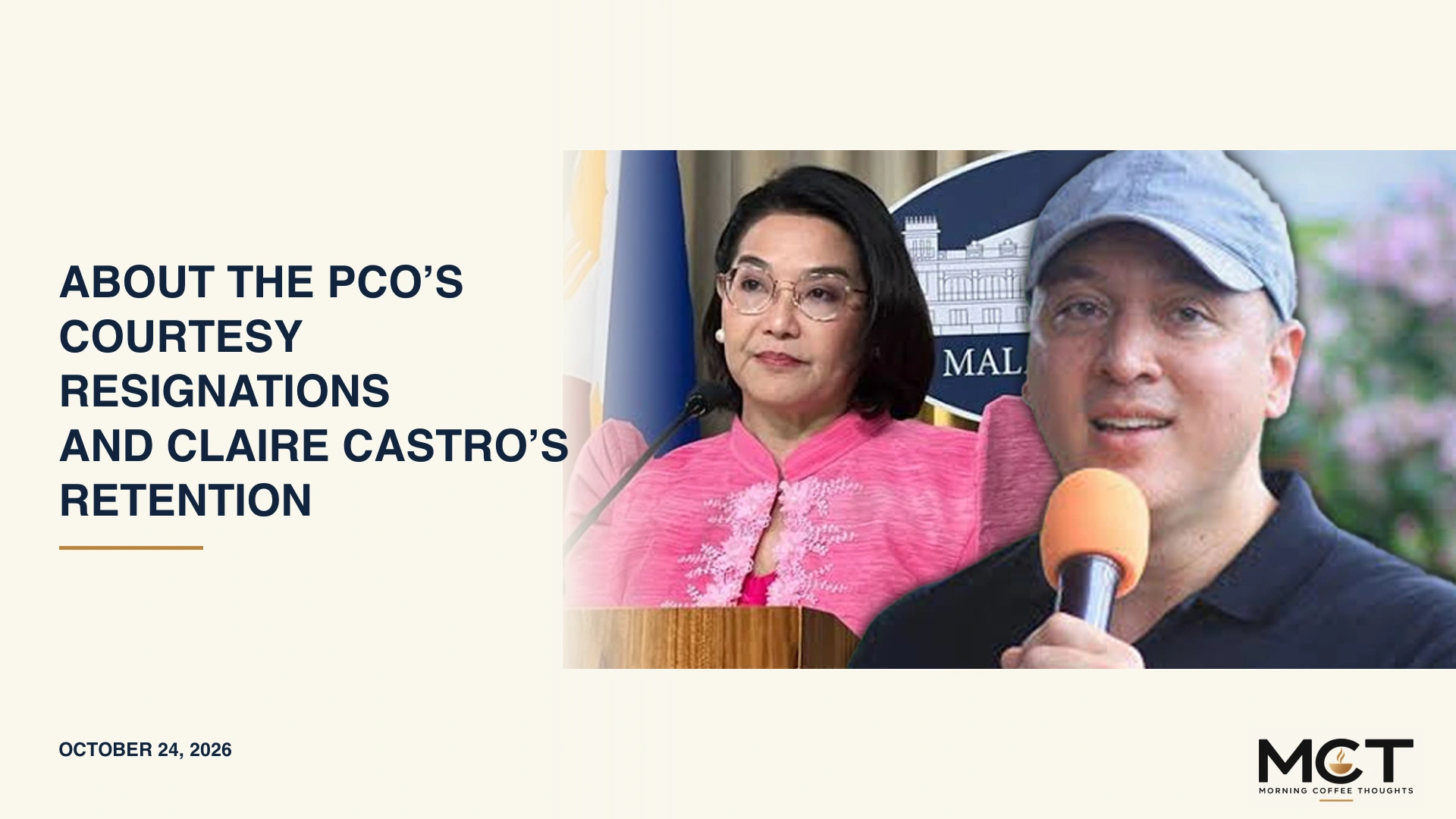
ABOUT THE PCO'S COURTESY RESIGNATIONS AND CLAIRE CASTRO'S RETENTION
Officials have submitted courtesy resignations at the Presidential Communications Office, but Palace Press Officer Claire Castro is staying. Acting Secretary Lino Cayetano confirmed that on October 23, giving the public one clear personnel decision while other changes remain under review.
The DILG announced a ₱50-million bounty for Senator Bato dela Rosa’s capture on October 23. The announcement came after months of talk about a possible reward—and days after Interior Secretary Jonvic Remulla said authorities knew dela Rosa was in Mindanao and were negotiating for his turnover.
When a government website asks for a copy of your ID, your address or your medical information, you have little choice about trusting the agency with it. You may need those records to claim a benefit or complete an application.
COMELEC has canceled the registrations of 50 party-list groups, including Bayan Muna, Magdalo and Buhay. The action is listed in Resolution No. 11281, promulgated on October 15, 2026. Here are five things to know about what was canceled and what voters should look for next.
For a family trying to pay a hospital bill or bury a loved one, emergency aid can be the only help available. Every questionable payment deserves a clear answer, both for taxpayers and for people still waiting for assistance.
Eligible documents can now be notarized online, but the new route still involves a real notary, identity checks and a live video session on an approved platform.
The Office of the Vice President’s proposed budget moved through a Senate panel today in 16 minutes. Vice President Sara Duterte was absent; her chief of staff answered for the office. Yesterday’s MCT explainer looked at parliamentary courtesy. Today’s question is what that short hearing actually did to the spending plan, and what it left for the Senate to examine.
The Department of Transportation is again asking Congress to fund the EDSA Busway. Its original ₱1.756 billion request received zero in the administration’s proposed 2027 National Expenditure Program. A House budget panel later inserted ₱75 million. Those two statements describe different stages of the same budget process. Neither tells us yet what Congress will finally approve.
You see SSS contributions come out of a payslip, or set aside money to pay them yourself. Then you read that the fund has almost ₱40 billion in paper losses.
Several lawmakers want Chinese Ambassador Jing Quan sent home. The Chinese Embassy has challenged them to follow through. That exchange leaves an ordinary reader with a reasonable question: if our own officials say an ambassador should leave, why is he still here?
Agriculture Secretary Francisco Tiu Laurel Jr. says his department stopped a disputed rice shipment. A farmers' group is asking him to step aside while the importation is investigated. Customs has described enforcement action against the cargo.
You hear that Meralco has been ordered to return billions of pesos. Then another announcement says the electricity rate is going up. If you are trying to stretch the household budget until payday, the obvious question is: may refund nga, bakit mas mahal pa rin?
A poverty report can quickly turn into a political argument. One side points to progress. Another points to hardship. Before joining that argument, it helps to know what the numbers actually mean.
What the House committee decision establishes, how system loss is charged, and why households still need a final rule and a sample bill before calculating savings.
President Ferdinand Marcos Jr. announced on October 11 that Lino Cayetano would replace Dave Gomez at the Presidential Communications Office. He said Gomez had been bypassed by the Commission on Appointments and that the change would be formalized when they returned from Singapore.
A restaurant charge above ₱200,000. Two purchases at a Nike store in Davao on the same day. More shopping in Japan and Malaysia. These credit card entries appear in financial forensic analyst Alexander Cabrera’s October 9 testimony at Sara Duterte’s impeachment trial.
When can the BIR examine an old tax return? That question became part of Friday’s impeachment hearing when defense counsel Kristine Ferrer asked whether alleged fraud discovered in 2026 would put the earliest assessable tax year at 2016. The prosecution objected, and presiding officer Chiz Escudero sustained the objection.
The House has approved the proposed ₱7.2-trillion national budget for 2027 on second reading, with about ₱116 billion in reported amendments. Its next scheduled vote is on October 12.
The argument at Thursday’s impeachment hearing was about which witness the prosecution could present next. It began with an absent lawyer and became a dispute over preparation and notice. Understanding the exchange helps explain why a courtroom can pause even when the parties, documents and another potential witness are already in the building.
Senator Mark Villar has formally left the Senate minority and joined the majority. The October 8 move strengthens the bloc supporting the chamber’s leadership and gives Villar two significant positions. Its implications for Sara Duterte’s impeachment trial, however, require more than counting political allies.
A bank balance can fall even when the value represented by the money has not disappeared. That distinction sits behind the prosecution’s questions about manager’s checks in Sara Duterte’s impeachment trial. To understand the October 7 testimony, we need to follow the instrument, the person entitled to its value and the declaration of assets for the relevant year.
COA has rejected the request to reconsider the ₱73.287-million disallowance involving the Office of the Vice President’s December 2022 confidential expenses. The October 5 resolution became public on October 7. Its significance is easier to understand when the amount, the audit finding and the available legal remedies are kept separate.
A Makati court has ordered the arrest of Batangas First District Representative Leandro Leviste over an alleged violation of the Public Service Act. The reports checked for this article do not confirm that he has been taken into custody.
The arguments over bank records in Sara Duterte’s impeachment trial involve several protections. The privacy of a peso deposit, the protection of a foreign-currency deposit, and the confidentiality of a report sent to the AMLC come from different rules. Understanding those differences helps explain what the court has allowed and what remains in dispute.
Reports that House prosecutors may stop presenting the bribery article against Sara Duterte can easily sound like the charge has already disappeared. The verified statements describe a proposed prosecution move and the court process needed to address it.
₱4.4 billion is a figure that can dominate a conversation before anyone asks what it counts. AMLC Executive Director Ronel Buenaventura presented that approximate total in the Senate impeachment court on October 5, covering reported transactions involving Vice President Sara Duterte and her husband, Manases Carpio. He also explained that a bank correction had reduced the earlier figure of ₱6.7 billion.
A screenshot saying “walang pasok” can change a family’s plans before anyone checks where it came from. This Teachers’ Day, parents are dealing with a false nationwide announcement alongside local notices that may apply only to particular schools or have already been revised.
Free tuition can make college possible for a family that could never afford the fees. Keeping a child in school still means finding money for transport, meals, supplies and other requirements.
If you use Coins.ph to receive money or pay bills, a failed cash-in can disrupt plans for the day. Coins.ph has announced that some incoming peso services are temporarily unavailable following a BSP directive to improve its internal controls. Its advisory also identifies services that existing customers can still use.
No Contact Apprehension Policy enforcement is returning to six Metro Manila cities on Monday, October 5. A camera can record a possible violation even when no enforcer stops the vehicle, so drivers and registered owners need to know where notices come from, how to check the evidence, and how to question a mistake.
A secondhand phone can put a useful device within reach of someone who cannot afford a new one. The problem comes when the buyer has no clear information about where it came from, what condition it is in, or who will fix it if it fails.
The Supreme Court dismissed three petitions on September 30 challenging how the Senate impeachment court would count the votes needed to convict Vice President Sara Duterte. The dismissal leaves the Senate’s September 23 ruling in place, but it needs to be read carefully. A case can be dismissed because it does not meet the requirements for the Court to hear it, without settling whether the challenged action is constitutional.
Davao City Mayor Sebastian “Baste” Duterte told the Senate impeachment court on September 29 that he had been unfamiliar with GenCorp Industries Inc. before it came up in the proceedings. He also said he did not know about Vice President Sara Duterte’s declared business interest in the company.
If you are planning a flight home or a family trip, check the full ticket price before paying. The Civil Aeronautics Board has approved a higher fuel-surcharge ceiling for October 1 to 15. The increase can add to your travel costs even when the advertised base fare looks affordable.
A Philippine fisheries vessel was damaged in a collision off Palawan. Manila and Beijing disagree about how it happened, while fishermen still need fuel.
Both chambers have backed longer terms, but the November 2026 election remains the law until Congress completes one final bill and the President acts on it.
Metro Manila households served by Maynilad and Manila Water will see slightly higher water charges beginning October 1. The announced increases are small for many residential customers, but the figures vary by concessionaire and consumption level. That makes it easy to misunderstand a notice expressed only in centavos per cubic meter.
Retired Sandiganbayan Presiding Justice Amparo Cabotaje-Tang explained the legal framework for Article II. Her testimony laid out the test; it did not prove the allegations against Vice President Sara Duterte.
Why the Constitution points to 16 votes, why the current absences created a real dispute, and why the Senate must settle the counting rule before judgment.
Defense Secretary Gilberto “Gibo” Teodoro Jr. was answering questions at the Seoul Defense Dialogue on September 8 when a man handed him a note. He read it aloud, challenged its rejection of the 2016 South China Sea ruling and objected to being interrupted that way.
An amicus curiae is someone who helps a court understand a legal question. The phrase means “friend of the court.” When more than one person takes that role, they are called amici curiae. They give advice. The court still makes the decision.
It can be raining outside while PAGASA warns about El Niño. That can sound confusing when the immediate problem is a wet road or a flooded field. The two warnings describe different periods: the weather happening now and the rainfall conditions that may develop over the coming months.
The Sandiganbayan has ordered the arrest of Zaldy Co, Martin Romualdez and two other accused in the plunder case filed on September 7. By Monday evening, authorities had served Romualdez's warrant and carried out booking procedures at Cardinal Santos Medical Center in San Juan. His arrest is a confirmed development; it does not establish that his three co-accused are also in custody.
The Office of the Ombudsman filed a plunder case against former House Speaker Martin Romualdez at the Sandiganbayan on September 7 over his alleged involvement in flood-control kickbacks. The accusations have now reached the court that will handle the criminal case. Romualdez denies wrongdoing and remains presumed innocent.
The increase was divided between March and September, so workers and payroll staff who remember only the first adjustment may apply the wrong rate after September 1.
Flood control is not only about pumps, canals and drainage. It also depends on where communities build, which lands remain open, and whether development decisions follow the same hazard information.
Orly Guteza has withdrawn his earlier accusation. Here is what a recantation changes, what it does not prove, and what the Ombudsman still needs to examine.
The Senate has approved stronger protections for patients who cannot immediately pay, but hospital debt does not disappear and the proposal is not yet law.
The fund can pay for useful local projects, but it is separate from the automatic tax share of local governments and still depends on national budget decisions.
Self-rated poverty and food poverty declined in June, but the figures also show how many Filipino families remain under pressure and why lower household budgets do not necessarily mean life became cheaper.
The Philippines has joined a technology partnership, but the proposed New Clark City hub still needs detailed agreements, investors, utilities, and safeguards.
CADENA could connect budgets, contracts, payments, and reported results in one public trail. The technology still cannot determine whether the information entered is true.
The French financing belongs to a nearly US$970-million package and supports the national budget after policy reforms, rather than a list of local marine projects.
What prosecutors filed, what they must prove, how Duterte’s conditional wording may affect the charge, and the unresolved question of whether the case can proceed while she remains vice president.
The election is still scheduled for November 2, 2026. A newly filed Senate bill would move it by two years, keep current officials in office longer, and change who can run for the Sangguniang Kabataan.
House Bill No. 9965 would bar children below 13 from having social media accounts, require parental consent for users aged 13 to 17, regulate platform algorithms, and impose fines reaching P50 million. It is still being deliberated in the House.
The proposal would add rights over automated decisions, six months’ notice for major workplace AI changes, deepfake rules, and environmental disclosure for AI infrastructure. It is not law yet.
The proposed benefit is not available yet. Congress still has to settle who qualifies, how claims will be verified, and how the program will be funded.
What the 6.2 percent national rate measures, why lower-income households recorded 8.2 percent inflation, and what the figures mean for an ordinary family budget.
What the auditor found in the OVP’s confidential-fund submissions, what those findings mean, and what prosecutors still have to connect to Sara Duterte personally.
Lithuania is offering technology, training, and experience in tracking organized propaganda campaigns, but no detailed Philippine program has been announced.
FIVE THINGS TO KNOWSeptember 8, 2026 · 9:05 PM6-minute read
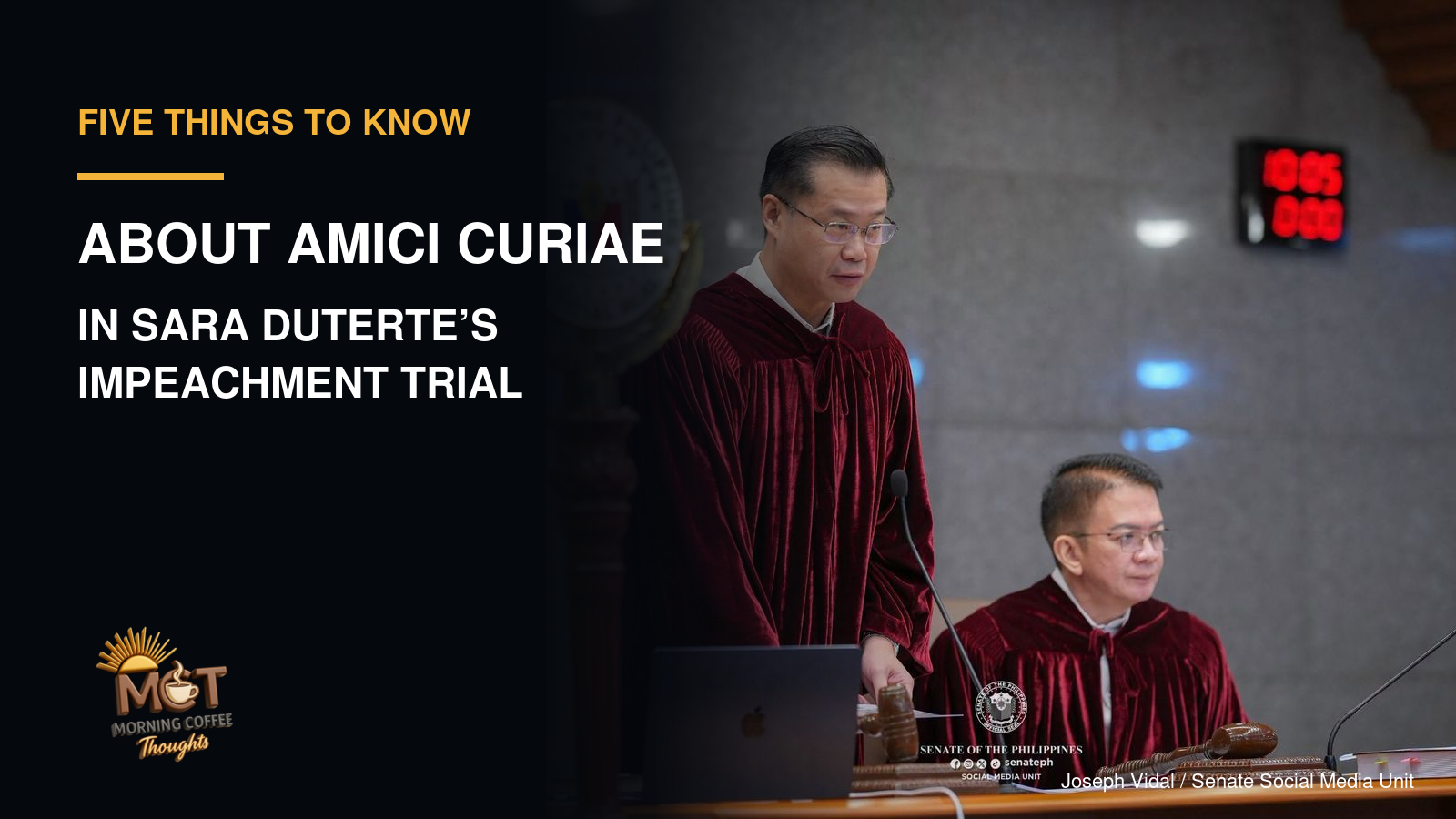
ABOUT AMICI CURIAE IN SARA DUTERTE’S IMPEACHMENT TRIAL
An amicus curiae is someone who helps a court understand a legal question. The phrase means “friend of the court.” When more than one person takes that role, they are called amici curiae. They give advice. The court still makes the decision.
The term came up at Sara Duterte’s impeachment hearing on September 8 because the Senate plans to invite legal experts to discuss how many votes are needed to convict her. Retired Supreme Court justices are being considered. The disagreement concerns the Constitution’s two-thirds requirement and questions about senators who are not attending the proceedings. Inviting experts does not change the voting rule or decide Duterte’s case.
1
A FRIEND OF THE COURT HELPS EXPLAIN THE LAW
An amicus can explain the meaning of a constitutional provision, discuss earlier court decisions and show how different interpretations would work. In this trial, that advice would help the senator-judges examine the rule for counting votes.
The word “friend” refers to helping the court. It does not give the adviser a vote or make the person part of the prosecution or defense. The adviser may agree with an argument from either side while still serving in that separate role.
Philippine legal practice recognizes this kind of assistance. The professional rules for lawyers address requests to serve as an amicus on questions related to their expertise. Experience with constitutional law can be useful here because the dispute concerns a requirement written into the Constitution.
WHAT TO WATCH
The invitations should identify the questions the experts will address. That will establish the scope of the consultation and whether it includes related questions about the court’s earlier ruling.
2
THE QUESTION IS HOW MANY VOTES ARE NEEDED TO CONVICT
The Constitution requires two-thirds of all Senate members to agree before an impeachment conviction. Presiding officer Francis Escudero has used the full 24-member Senate as the basis. Two-thirds of 24 is 16.
At the September 8 hearing, senator-judge Erwin Tulfo asked about voting and members who were not attending. Senator-judge Pia Cayetano also questioned whether the impeachment court could revisit Escudero’s earlier ruling. The disagreement therefore includes both the counting rule and the court’s power to reconsider it.
The number has a direct effect on the outcome. Under a 16-vote requirement, 15 votes for conviction would fall short. A senator’s absence does not automatically establish a lower requirement. The planned consultation gives the court a chance to hear the legal arguments before resolving the dispute.
WHAT TO WATCH
The court’s ruling should state the number of votes required and explain its basis. The plan to seek advice did not itself replace the 16-vote interpretation.
3
THE EXPERTS HAD NOT YET BEEN PUBLICLY CONFIRMED
Escudero said names of retired Supreme Court justices had been discussed with the prosecution and defense. He did not announce them because they had not yet been contacted. The September 8 announcement therefore did not provide a confirmed list of participants.
Senator-judge Francis Pangilinan proposed allowing the presiding officer to choose the amici after consulting both sides. That would give the prosecution and defense a part in the discussion about whom to invite. It would not commit either side to accepting the advice later given.
An expert’s experience can help explain the law, but the arguments remain open to disagreement. An adviser who agrees with the prosecution or defense on one question does not become that side’s lawyer. The Senate still has to weigh the reasons offered.
WHAT TO WATCH
Accepted invitations will establish who is taking part and whether the proposed schedule can proceed. The names, availability and questions assigned to the experts had not all been confirmed in the September 8 announcement.
4
THEIR ADVICE CANNOT DECIDE WHETHER THE CHARGES ARE PROVED
The advisers are being asked about the voting requirement. Their views cannot establish what happened to confidential funds or whether an allegation against Duterte has been proved. Those questions depend on the evidence presented during the trial and the Senate’s assessment of it.
The Constitution gives the Senate the power to try and decide impeachment cases. A retired Supreme Court justice invited as an amicus would not be issuing a Supreme Court judgment. The person would be giving advice to the impeachment court.
The Senate does not have to adopt that advice. It may accept the argument, accept part of it or reach a different conclusion. An opinion supporting one side’s position also does not amount to a ruling in that side’s favor.
WHAT TO WATCH
After the experts speak, the Senate’s own ruling will establish the interpretation it adopts. A ruling on the voting requirement would settle that question without deciding the allegations against Duterte.
5
SEPTEMBER 16 AND SEPTEMBER 23 HAVE DIFFERENT PURPOSES
Escudero tentatively set September 16 for the amici curiae to appear, depending on their availability. September 23 was intended for oral arguments by the prosecution and defense on the voting question. Oral arguments give the lawyers a chance to explain their positions and answer questions from the court.
The plan would give the senator-judges expert advice first, followed by the arguments of the two sides. It also called for action on the voting issue after those arguments. The schedule could still change through later court announcements.
Neither date was announced as a guaranteed date for Duterte’s conviction or acquittal. The planned discussions concern how the votes should be counted. Whether the evidence proves an impeachment charge remains a separate decision in the trial.
WHAT TO WATCH
The confirmed notices will establish whether the September 16 consultation and September 23 arguments will proceed as proposed. Any ruling afterward should state the voting requirement the Senate adopts.
BOTTOM LINE
The Senate plans to ask legal experts for advice about the votes needed to convict Sara Duterte. They can explain the constitutional arguments, but they cannot change the rule on their own or decide the case. Those decisions remain with the senator-judges.
As announced on September 8, the experts had not yet been publicly confirmed. Their consultation and the arguments from the prosecution and defense concern the voting rule. The allegations against Duterte still have to be decided through the impeachment trial.
Google’s Preferred Sources feature lets you choose publications you want Google to prioritize for you. Select “Add to Preferred Sources” to make MCT easier to find in Top Stories and other eligible Google results. This does not subscribe you to email.
Morning Coffee Thoughts is reader-supported. Contributions help pay for research tools, hosting, and the work required to verify and explain each development.
Monthly PayPal subscription — choose your support amount.