
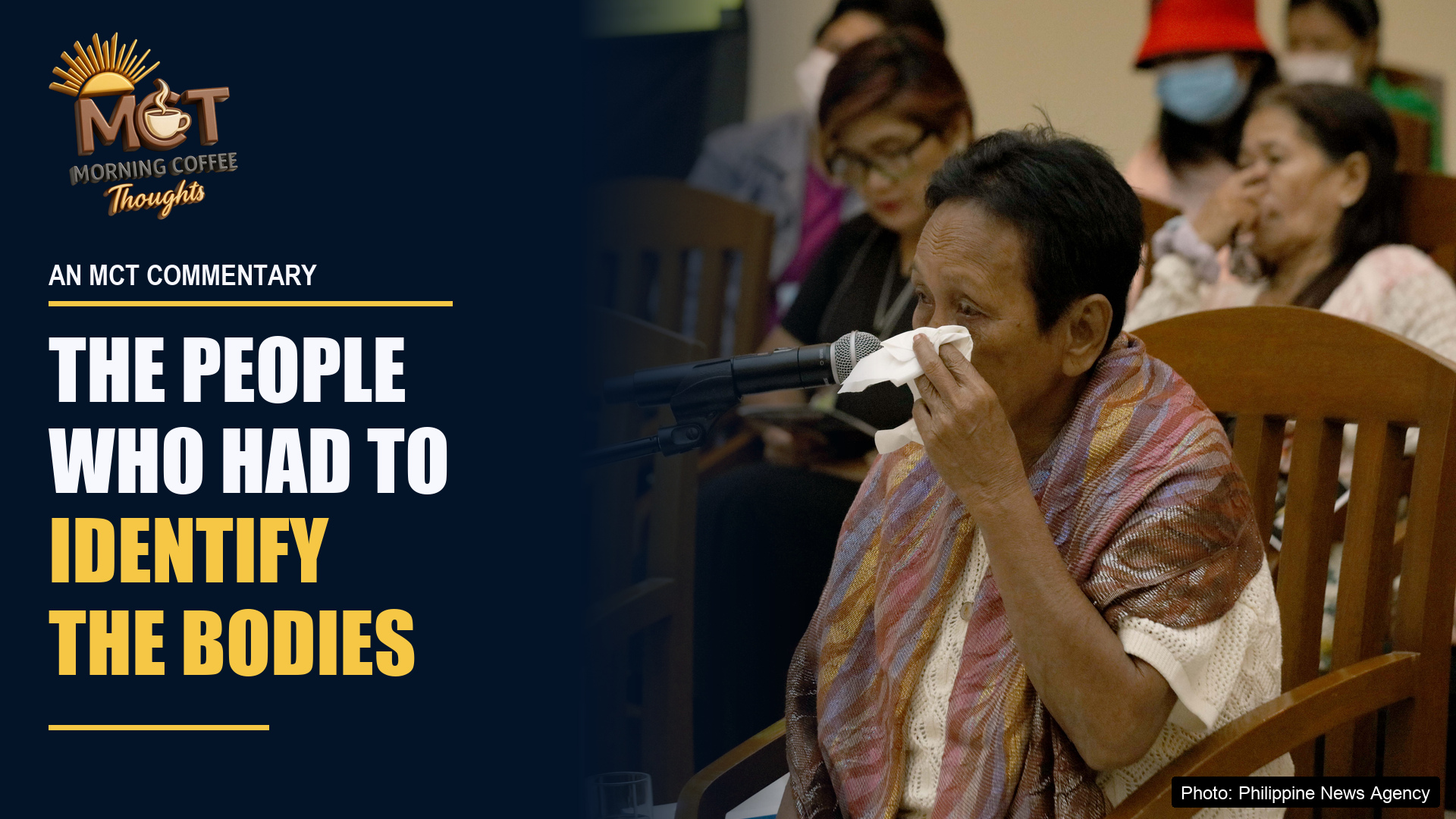
For years, much of the argument over the drug war happened through numbers. We argued about how many people were killed, how many died during police operations, how many allegedly fought back and how many deaths could fairly be attributed to the government’s campaign. Those numbers are necessary because they help us understand the scale of what happened. But they leave out much of what surviving families have been trying to tell us.
A body count cannot explain what it was like to search for your child and discover days later that his body was already in a funeral home. It cannot explain what a mother goes through after hearing that her son, who had difficulty running because of a disability, was allegedly ordered to run before he was shot. And it cannot tell us how another mother continued living after burying four sons over nearly six years.
The independent, civil-society-led Philippine Truth Commission has begun holding public truth-telling sessions where surviving families can recount these experiences. It is not a government body. It documents their accounts and examines them alongside records and other evidence. Its work includes killings connected with the national anti-drug campaign and apparent death-squad killings in Davao City that happened years earlier.
I have been reading the testimony and the older records behind these cases. What stays with me is how much we lose when a person’s life is reduced to a statistic, a police entry or the word “nanlaban.” We hear the accusation and the official explanation, argue about them for a while, and move on. The family still has to find the body, arrange the burial and live with questions that may remain unanswered for years.
WHAT THE FAMILIES CAN TELL US
Listening to a surviving relative does not mean accepting every claim without checking it. We can compare the account with police documents, other witnesses and findings from an examination of the remains. Some claims will be supported, while others may weaken when records conflict or witnesses change their accounts. If I am going to write about these families, I also have to be honest about those problems.
Their testimony preserves things that a police report rarely captures: what happened before the death, what relatives were told afterward, where they searched, whom they approached for help and what happened when they filed complaints. It lets us follow what happened to the family in the months and years after public attention had gone elsewhere.
RAYMART SIAPO
Luzviminda Siapo was working in Kuwait when her son Raymart was killed in Navotas on March 29, 2017. He had congenital clubfoot, a condition present from birth that affected his ability to walk and run. The Truth Commission describes him as 18, although some reports published at the time gave his age as 19.
According to the Commission, a neighbor accused Raymart of selling marijuana, and he was taken hours later. Reports from 2017 record witness accounts of armed men bringing him near a bridge and ordering him to run before shooting him. Ronald dela Rosa, then chief of the Philippine National Police, publicly described the killing as murder and ordered the Northern Police District to investigate.
Raymart’s remains were exhumed years later, and forensic pathologist Dr. Raquel Fortun presented preliminary findings to the Truth Commission. According to GMA’s report on the hearing, some bones were missing, which limited the examination. The original death certificate and police medical report recorded gunshot wounds to the head. Fortun questioned parts of the earlier documentation, identified gunshot wounds as the cause of death and said the exact number of shots could not be determined from the available remains.
Fortun classified the manner of death as homicide. That medical finding does not, by itself, establish murder or tell us who should be held criminally responsible. Her examination gives investigators more evidence to compare with the earlier records and witness accounts, although the available remains could not answer every question.
Luzviminda’s question is simple enough for anyone to understand. If her son had committed an offense, why was he not arrested and brought through the justice system? She does not have to prove that Raymart was perfect for that question to deserve an answer. An accusation, however serious, still has to be dealt with through a lawful process.
DARWIN HAMOY
The second public truth-telling session centered on Mariza Hamoy and her son Darwin, who was 17 when he was killed during a police anti-drug operation in Payatas, Quezon City, on August 15, 2016. The Truth Commission describes him as a student who helped his family by carrying people’s purchases at the market for small amounts of money.
Police said officers conducting a drug operation encountered armed resistance. Darwin and four other men were killed. His family disputed the police account, and Mariza and relatives of other victims pursued complaints against the officers involved.
But the families’ complaint ran into problems. According to the Philippine Daily Inquirer, another complainant, Polo, initially supported their version but later signed an affidavit withdrawing her complaint and said she had not witnessed the incident. The Ombudsman dismissed the complaint in 2018, treating Mariza’s and another complainant’s accounts as hearsay because they had not witnessed the shooting. The newspaper noted that the resolution did not mention Polo’s retraction.
The same report raised a question about the police account. The Ombudsman relied partly on direct-assault charges against survivor Harold Arevalo to support the claim of a gunfight. But the Inquirer reported that his case had already been dismissed in January 2018 because prosecutors failed to prove that he had exchanged gunfire with police. The newspaper said it was unclear whether the Ombudsman knew about that dismissal. Neither development, on its own, settles how the five men died.
Darwin’s remains were later exhumed, and Fortun examined them alongside the earlier medical records. According to the Truth Commission, the examination documented injuries consistent with gunshot wounds and classified the manner of death as homicide. As with Raymart, that finding does not establish who fired the shots or determine criminal responsibility. It provides physical evidence to compare with the different accounts.
While reading about the complaints and medical findings, I kept thinking about what Mariza had already gone through just to bring her son home. According to VERA Files, she searched for days before learning that his body had been taken to a funeral parlor. She worked as a street sweeper and then had to find the money for his funeral and burial.
Mariza managed to buy Darwin a new barong before he was placed in the casket. She explained that she did not want him buried in old clothes because this would be the last time she could buy her son something to wear. I keep coming back to that detail. While the public was being told about another police operation, she was finding money to bury her child and choosing the last clothes she would ever buy for him.
CLARITA ALIA
Clarita Alia’s account takes us further back, before the national anti-drug campaign began in 2016. A vegetable vendor from Davao City, she lost four teenage sons—Richard, Christopher, Bobby and Fernando—between 2001 and 2007. She testified before the Truth Commission on September 25, 2026.
Their cases appear in Human Rights Watch’s 2009 investigation of apparent death-squad killings in Mindanao. Some ages and dates conflict, even between sections of that report. I cannot confidently give those disputed details as settled facts.
Clarita told HRW that police tried to take Richard without a warrant. When she resisted, she said, an officer threatened that her sons would be killed “one by one.” HRW recorded her account; that alone does not prove the threat was made. It described the brothers’ deaths as apparent death-squad killings by unidentified perpetrators and reported no arrests in the four cases by publication.
The report also recorded Richard’s earlier arrests for petty crimes, a cellphone-theft accusation against Bobby, and Fernando’s arrest for sniffing rugby, an industrial solvent. Arrests and accusations do not establish guilt.
According to the Commission, Clarita sent Fernando away because she feared for him after losing three sons. He returned and was killed in 2007. She has continued seeking accountability. Her position is that any offenses should have been dealt with through arrest and a court hearing.
I do not think a parent should have to present a flawless child before the public is willing to ask whether his death was lawful. Whatever accusations existed, they still needed to be investigated. They could not replace a case, a hearing and a judgment.
THESE ACCOUNTS WERE ALREADY ON RECORD
HRW interviewed Clarita in 2008 and published her account in 2009, seventeen years before these hearings. Its wider investigation reported evidence of police or local-government involvement in some killings and fear among witnesses. Those findings were not court judgments.
The older record gives investigators something to compare with what people are saying now. They can look for changes, missing details and questions that were never answered.
The Commission says it will examine the earlier Davao killings alongside cases from the national campaign, including what carried over and what changed. Any claim connecting the people, organizations or methods involved still needs evidence.
WHAT HAPPENED AFTERWARD
Public attention often follows a killing only as far as the police report, the funeral and the argument over what happened. For the families, that is the beginning of years of searching, explaining and asking for help.
Luzviminda had to return from Kuwait and begin asking what happened to Raymart. Mariza had to find Darwin, raise money for his funeral and pursue complaints through a process in which parts of the evidence later weakened. Clarita lived through the deaths of four sons over nearly six years and continued asking for accountability.
Their experiences also show why finding out what happened becomes harder as the years pass. Witnesses become afraid or change their accounts. Documents may be incomplete, and memories have to be compared with records made closer to the event. An examination of the remains can reveal problems in earlier medical reports without identifying who committed the killing. Even basic details, including a victim’s age, sometimes differ across sources.
LISTENING TO THE PEOPLE LEFT BEHIND
For years, public arguments about these killings often began by asking whether the victim used drugs, sold them, committed other crimes or resisted police. Those questions belong in an investigation, but their answers do not, by themselves, establish that a killing was lawful. An accusation is not a conviction, an intelligence record is not a court judgment, and previous wrongdoing does not cancel a person’s right to due process.
Reading these accounts makes it harder to leave the discussion at labels such as “drug suspect,” “criminal” or “nanlaban.” I think about the families trying to understand what happened, dealing with conflicting accounts and deciding whether to keep pursuing a complaint. I think about the ordinary things that still had to be done while they were grieving, including finding money and choosing clothes for a burial.
Someone had to identify the body, pay for the coffin, approach the police and file complaints. Someone had to remember dates, repeat names and keep asking questions after most people had stopped paying attention. These are things a body count cannot tell us, and I do not want to lose them in another argument about which political side is right.
We have spent years debating the drug war. Reading these accounts made me ask how much time I had actually given the people left behind. I think we owe them that attention, along with the care to check what they tell us and be honest about what remains unanswered.
SOURCES
- Philippine Truth Commission — About the Commissionhttps://truthcommission.ph/about
- Philippine Truth Commission — First Public Truth-Telling Session on Drug War Killingshttps://truthcommission.ph/resources/philippine-truth-commission-to-hold-first-public-truth-telling-session-on-drug-war-killings
- GMA News — Man with club feet shot dead after being taunted to runhttps://www.gmanetwork.com/news/topstories/metro/606479/man-with-club-feet-shot-dead-after-being-taunted-to-run/story/
- GMA News — PNP’s Dela Rosa orders NPD to solve ‘murder’ of club-footed youthhttps://www.gmanetwork.com/news/topstories/metro/606616/pnp-s-dela-rosa-orders-npd-to-solve-murder-of-club-footed-youth-nbsp/story/
- GMA News — Truth Commission starts public hearing on EJKs with Raymart Siapo casehttps://www.gmanetwork.com/news/topstories/nation/998547/truth-commission-starts-public-hearing-on-ejks-with-raymart-siapo-case/story/
- Philippine Truth Commission — Second Public Truth-Telling Session: Mother of 17-Year-Old Killed in Payatas to Testifyhttps://truthcommission.ph/resources/media-advisory-truth-commission-convenes-2nd-public-truth-telling-mother-of-17-year-old-killed-in-payatas-to-testify
- Philippine Daily Inquirer — Ombudsman junks murder charges vs 16 Batasan cops in drug killingshttps://newsinfo.inquirer.net/1037345/ombudsman-junks-murder-charges-vs-16-batasan-cops-in-drug-killings
- VERA Files — Mariza Hamoy on her son’s murder: The pain remains raw and deep as it was ten years agohttps://verafiles.org/articles/mariza-hamoy-on-her-sons-murder-the-pain-remains-raw-and-deep-as-it-was-ten-years-ago
- Human Rights Watch — You Can Die Any Time: Death Squad Killings in Mindanaohttps://www.hrw.org/report/2009/04/07/you-can-die-any-time/death-squad-killings-mindanao
- Philippine Truth Commission — Mother Who Lost Four Teenage Sons to Davao Death Squad Will Tell Her Storyhttps://truthcommission.ph/resources/mother-who-lost-four-teenage-sons-to-davao-death-squad-will-tell-her-story-to-the-truth-commission
- Philippine News Agency — Public Truth-Telling Sessionhttps://www.pna.gov.ph/photos/85081
- Supreme Court E-Library — 1987 Constitution, Article IIIhttps://elibrary.judiciary.gov.ph/thebookshelf/showdocs/3/353