FIVE THINGS TO KNOW…

Short explainers published throughout the day.

1:18 PM7-minute read

ABOUT THE NEW SWS POVERTY NUMBERS

Self-rated poverty and food poverty declined in June, but the figures also show how many Filipino families remain under pressure and why lower household budgets do not necessarily mean life became cheaper.

Read the explainer →
2:02 PM11-minute read

ABOUT THE CHILDREN'S SOCIAL MEDIA SAFETY ACT

House Bill No. 9965 would bar children below 13 from having social media accounts, require parental consent for users aged 13 to 17, regulate platform algorithms, and impose fines reaching P50 million. It is still being deliberated in the House.

Read the explainer →
12:02 PM7-minute read

ABOUT THE SEALED BIR BOX

Marcos authorized the BIR to comply with the Senate subpoena. That did not open the records to the public or prove the unexplained-wealth allegation.

Read the explainer →

MCT READER PULSE · MCT-PULSE-2026-006

MCT READER SURVEY

After Gilas Pilipinas’ wins over Jordan and Iran, how confident are you that the team will qualify for the 2027 FIBA Basketball World Cup?Matapos ang mga panalo ng Gilas Pilipinas laban sa Jordan at Iran, gaano ka kumpiyansa na makakapasok ang koponan sa 2027 FIBA Basketball World Cup?

Gilas improved to 4–4 after beating Jordan and Iran, but the Philippines remains fifth in Group E with four games left. This survey asks about readers’ confidence; qualification has not yet been secured.

Read where Gilas stands before answering.

This is an informal survey of verified MCT readers who choose to participate. It is not nationally representative.

Open the shareable survey page →
View previous survey results →
Checking your reader session…

September 2, 2026 · 10:00 AM6-minute read

FIVE THINGS TO KNOW ABOUT THE PROPOSED FREE FREIGHT SERVICE FOR RELIEF GOODS

What the proposed service would cover, who could qualify, which costs may be waived, and why the program is not available yet.

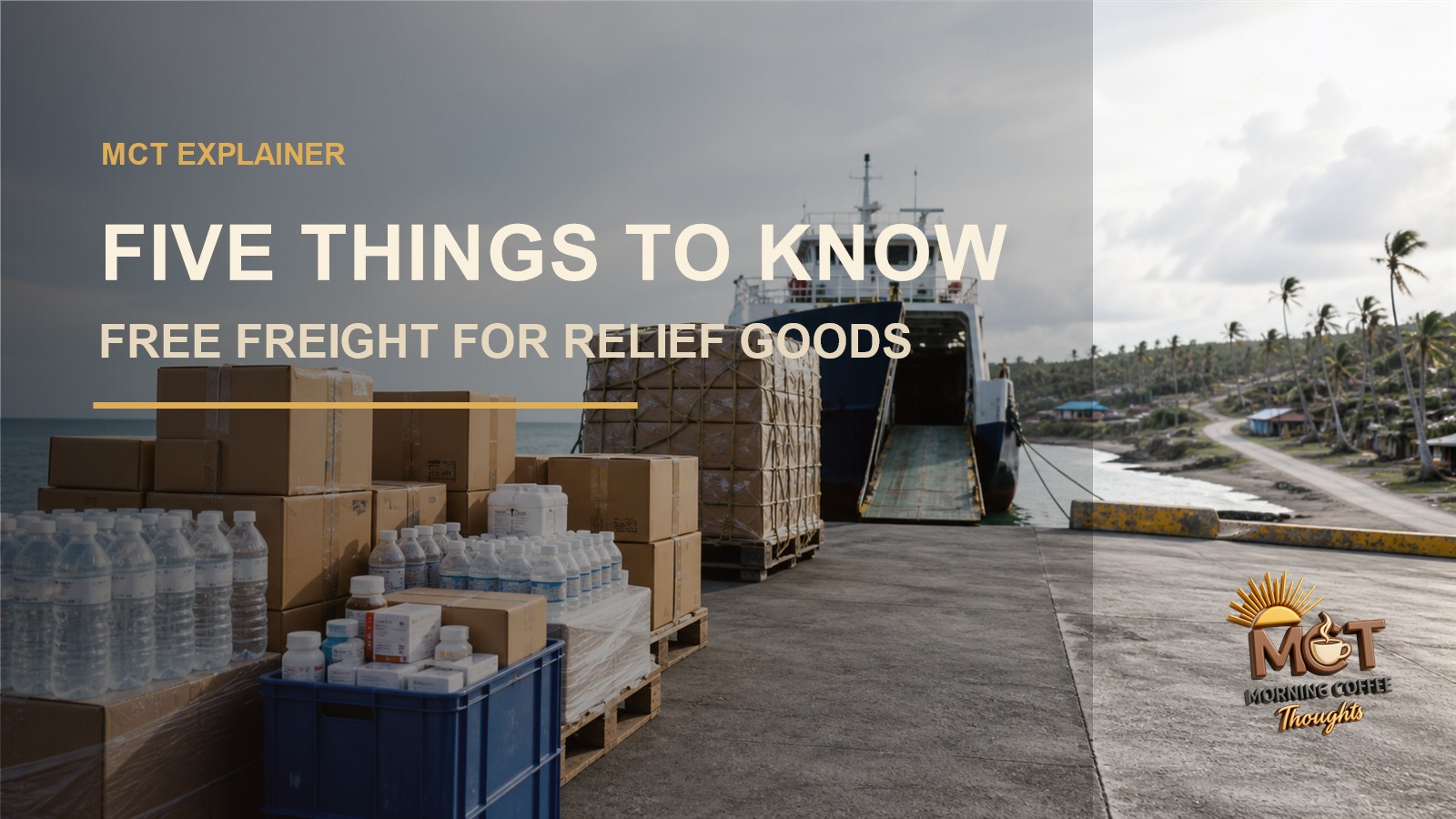
A conceptual editorial image of relief boxes moving through a freight and logistics network after a disaster. Not a documentary image.

When a typhoon, earthquake, fire, or other disaster cuts off a community, donated food and medicine are useful only if they can reach the people who need them. Transport costs, port fees, damaged roads, and paperwork can slow that work.

The House disaster-resilience committee had already approved a substitute bill combining several proposals for free freight services for relief goods sent to calamity areas, then referred its funding provisions to the Appropriations and Ways and Means committees. On September 2, Ways and Means was scheduled to consider that substitute bill. The proposal is still in Congress, and neither committee action nor an agenda entry makes it a law or a service the public can already claim.

1

THE PROPOSAL TARGETS THE COST OF MOVING DONATED AID

The bills seek to require or organize free freight services for emergency relief goods and donated articles sent to areas declared under a state of calamity. Filed versions assign a central role to the national and regional logistics clusters led by the Office of Civil Defense, working with the Department of Transportation, the Philippine Postal Corporation, and public and private logistics providers.

For families in an affected area, the practical question is whether donated food, drinking water, hygiene kits, medicine, blankets, and other essentials arrive faster. Removing freight charges can stretch a donor's budget, but transport is only one part of delivery. Roads, ports, warehouses, security, sorting, and local distribution still have to work.

WHAT TO WATCH

Watch for the committee's published substitute text. It should identify which agency accepts requests, which carriers participate, what routes are covered, and how quickly approved shipments must move.

2

FREE FREIGHT WOULD NOT MEAN ANY PACKAGE CAN BE SENT FOR FREE

One filed House version limits the service to duly registered relief organizations and to emergency goods bound for areas declared under a state of calamity by the President or an LGU through its Sanggunian. If the destination cannot be reached, that version allows delivery to the local chief executive of the nearest accessible LGU.

Those limits are meant to keep a disaster program focused on verified aid. They also create a possible bottleneck for small volunteer groups that are legitimate but not formally registered. The final rules will need a quick and understandable verification process so donated goods do not sit in a warehouse while papers move from office to office.

WHAT TO WATCH

Watch how the final bill defines a registered relief organization, what documents are required, and whether a fast accreditation route is available during an emergency.

3

PORT AND AIRPORT CHARGES COULD BE PART OF THE RELIEF

Filed versions go beyond the basic freight bill. They propose waiving some port and airport charges that are normally passed on to customers, including cargo-handling and related operating fees. They also direct agencies to consider container use, turnaround time, cargo volume, and the burden placed on private carriers.

This detail affects whether the program is workable. A shipment can be called free while other handling charges remain, leaving donors with costs they did not expect. At the same time, a permanent duty placed on private companies needs clear limits and a funding or tax arrangement that does not weaken regular transport service.

WHAT TO WATCH

Watch the exact list of waived charges, whether carriers receive a tax deduction or reimbursement, and which public agency pays costs that cannot reasonably be absorbed.

4

RELIEF GOODS WOULD STILL PASS THROUGH SAFETY AND RELEASE RULES

One filed bill says donated goods would remain subject to the release procedures of agencies such as the Department of Social Welfare and Development, Bureau of Customs, Department of Health, Department of Education, and LGUs. It also assigns disaster-response bodies a role in moving people, goods, and equipment while coordinating with law enforcement and port authorities.

These checks can prevent unsafe, expired, unsuitable, or misdirected donations from entering the relief chain. Poorly designed checks can also cause delay. People who donate need a short public list of accepted goods, prohibited items, labeling rules, drop-off points, and the office responsible for each shipment.

WHAT TO WATCH

Watch for one published operating guide shared by OCD, DSWD, Customs, transport agencies, ports, airports, and LGUs. Conflicting instructions during a disaster would defeat the purpose of faster freight.

5

THE SEPTEMBER 2 AGENDA IS ANOTHER STEP, NOT A NEW BENEFIT YET

The disaster-resilience committee's approval moved the substitute bill forward, and the September 2 Ways and Means agenda placed its tax and funding provisions under another committee's review. Earlier versions of a similar measure moved through Congress, but a bill from a previous Congress does not automatically become law in the current one. Any September 2 action must still be documented, and an approved House bill would still need the rest of the legislative process.

Donors and communities should not assume that free freight is already available nationwide under this proposal. Existing company or agency programs may operate under separate rules, but the proposed national system remains unfinished until Congress passes it and it takes effect.

WHAT TO WATCH

Watch for the committee report, the bill number assigned to the substitute text, House voting records, a Senate counterpart, and the final funding and implementation provisions. Those records will show whether the proposal is moving and what service people can actually claim.

BOTTOM LINE

The proposal tries to remove one practical barrier between donated aid and a disaster area: the cost of moving goods. Its value will depend on clear eligibility, fast approval, workable carrier arrangements, sensible safety checks, and public instructions that people can follow during an emergency. For now, it remains a proposal under House consideration.

SOURCES

  1. House of Representatives Committee Meetings, September 2, 2026https://www.congress.gov.ph/committees/committee-meetings/daily/2026/09/02
  2. House of Representatives, House Bill No. 4385https://docs.congress.hrep.online/legisdocs/basic_20/HB04385.pdf
  3. House of Representatives, House Bill No. 6373https://docs.congress.hrep.online/legisdocs/basic_20/HB06373.pdf
  4. House of Representatives Legislative Documents, House Bill No. 10294https://www.congress.gov.ph/legislative-documents?page=21

GOOGLE PREFERRED SOURCES

FOLLOW MCT ON GOOGLE

Google’s Preferred Sources feature lets you choose publications you want Google to prioritize for you. Select “Add to Preferred Sources” to make MCT easier to find in Top Stories and other eligible Google results. This does not subscribe you to email.

← Back to MCT home

LATEST COMMENTARY

View all commentary →

SUPPORT MCT

HELP KEEP INDEPENDENT POLITICAL WRITING GOING.

Morning Coffee Thoughts is reader-supported. Contributions help pay for research tools, hosting, and the work required to verify and explain each development.

Choose the monthly support amount you are comfortable with.Continue through PayPal
Send support through GCash0969 314 4839