
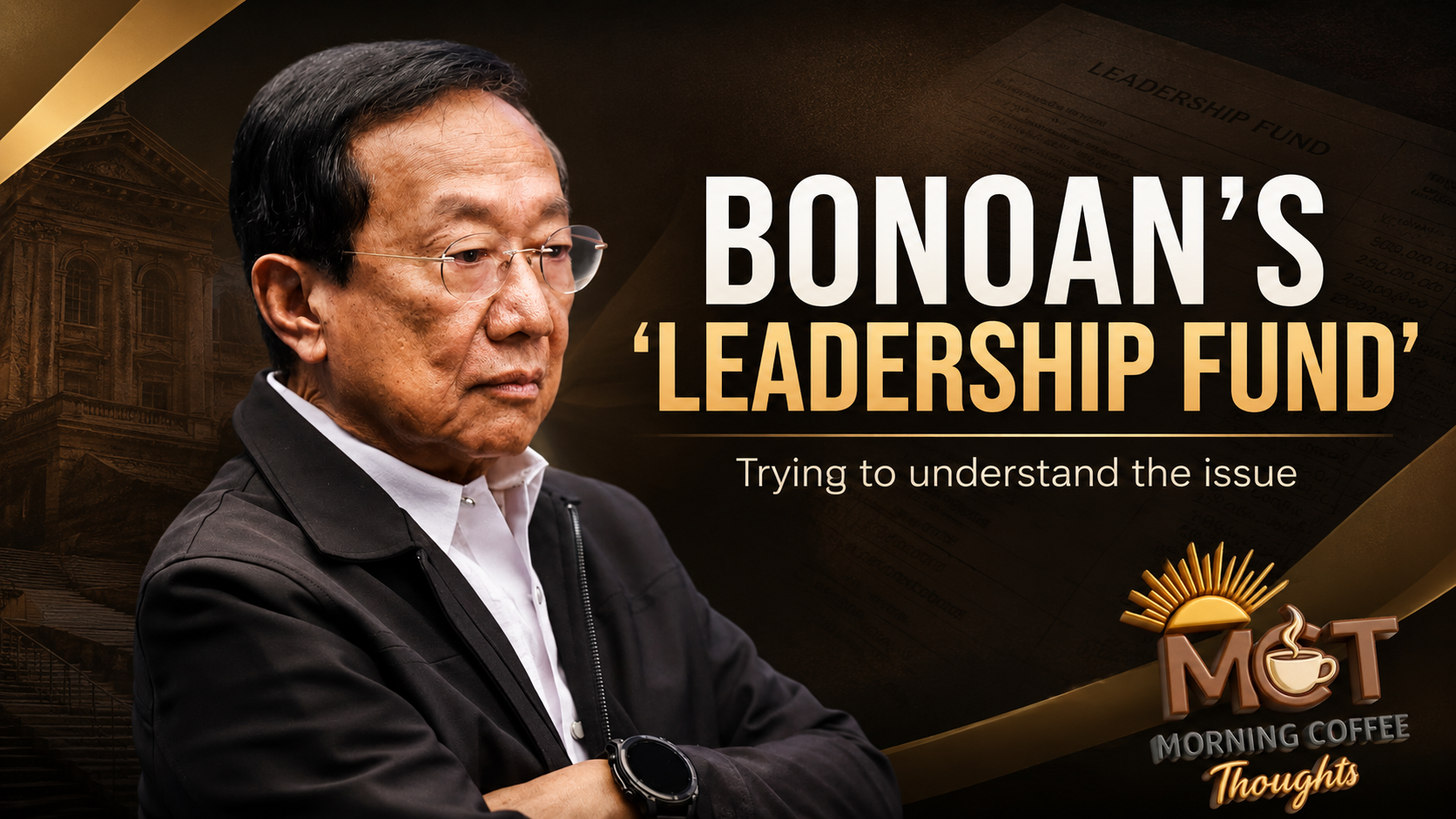
I started reading about former DPWH Secretary Manuel Bonoan’s testimony because of the number that was everywhere: ₱500 million per senator.
Naturally, that catches your attention. Twenty-four senators multiplied by hundreds of millions of pesos sounds like pork barrel all over again. But after reading more of Bonoan’s testimony, his judicial affidavit, his earlier statements before the Senate, and some of the budget records, I realized I was asking the wrong question.
The question is not simply: Did senators get ₱500 million each?
First, because Bonoan was not saying that senators were handed ₱500 million in cash. Second, because the system he described appears to be much larger and more complicated than that number.
So I went back and tried to understand exactly what Bonoan was saying.
FIRST: NOBODY IS SAYING SENATORS WERE HANDED ₱500 MILLION IN CASH
This has to be separated from everything else immediately because the shorthand can easily become misleading.
Bonoan testified that senators had allocations for priority infrastructure projects under what DPWH internally called the “Senate Leadership Fund.” According to him, each senator had at least ₱500 million available for these projects, while the Senate president and chairpersons of major committees could have allocations of at least ₱1 billion.
That is not the same as saying a senator personally received ₱500 million.
There are separate allegations in the larger flood-control scandal involving commissions, kickbacks, cash deliveries and ghost projects. Those have to be proven separately. We cannot take Bonoan’s description of a project-allocation mechanism and automatically turn that into proof that every senator received money personally.
What Bonoan is describing here is budget space: billions of pesos worth of projects associated with lawmakers.
That is already serious enough without making it something it is not.
SO WHAT EXACTLY WAS THE “LEADERSHIP FUND”?
This is where I became more interested.
Normally, when we hear about congressional insertions, we think about Congress changing the budget after the Executive sends the National Expenditure Program, or NEP, to Congress.
The NEP is the President’s proposed national budget.
But Bonoan described something happening before that stage.
Back in September 2025, during a Senate investigation into anomalous flood-control projects, Senator Ping Lacson asked Bonoan how projects associated with legislators could already be appearing in the NEP, the Executive’s own budget proposal, before Congress had even begun deliberating on it.
Bonoan answered that DPWH consolidated lawmakers’ requested projects and included them in the NEP, including through what he called the Senate “leadership fund.”
So the existence of a leadership fund is actually not a brand-new revelation. Bonoan had already admitted it publicly in September 2025.
What is new is how much more detail he has now provided under oath.
According to his judicial affidavit, DPWH deliberately created the system so senators’ priority infrastructure projects could already be accommodated in the department’s proposed budget.
Think about what that means.
Before Congress formally receives the President’s budget proposal, the priority projects of individual legislators may already be inside it.
That was the part I wanted to understand.
WHY WOULD DPWH DO THAT?
Bonoan actually gave an explanation.
According to him, the problem began with what Congress did to DPWH’s proposed budget for 2023.
He specifically cited foreign-assisted projects. DPWH had proposed approximately ₱70.71 billion for these projects. After congressional action, according to Bonoan, only about ₱7.938 billion remained.
That is an approximately 88.8 percent reduction.
I checked this particular number because an almost 89-percent reduction sounded extraordinary. The figures reported from Bonoan’s affidavit correspond to the government budget records cited in subsequent reporting.
Bonoan said he brought the reductions to President Ferdinand Marcos Jr., who was alarmed that infrastructure programs connected with the administration’s socioeconomic agenda could be derailed. According to Bonoan, Marcos instructed that government resources should be allocated more equitably, including support for poorer and underserved provinces.
But there is an important line here that we should not cross.
Bonoan did not say, based on the affidavit made public so far, that President Marcos ordered him to create a ₱24-billion Senate Leadership Fund.
What he said was that DPWH itself later came up with what he called an “innovative way” of dealing with future congressional cuts: accommodate senators’ priority projects early, inside DPWH’s proposed budget, in the hope that legislators would then stop cutting or rearranging DPWH’s own programs.
Put simply, the idea seems to have been:
We make room for your projects now, and hopefully you leave our projects alone later.
According to Bonoan himself, it did not work.
He said congressional initiatives and insertions continued, and even increased, in succeeding budgets.
THEN WE GET TO THE ₱24 BILLION
For the proposed FY2024 DPWH budget, Bonoan says the system had an internal allocated limit of ₱24 billion.
This is where another confusing detail needs sorting out.
The ₱24 billion was apparently not an amount that automatically had to be spent. Bonoan described it as the internal ceiling for the system.
According to his affidavit, the minimum allocation was ₱500 million per senator, while the Senate president and chairpersons of major committees had at least ₱1 billion.
For FY2024, Bonoan says actual Senate “availment” reached ₱13.29 billion.
For FY2025, he says it reached approximately ₱21 billion.
Those are Bonoan’s figures.
I have not seen the complete DPWH allocation matrix that would allow me to independently add every project and reproduce the ₱13.29-billion and ₱21-billion totals myself.
That is where attribution becomes necessary.
Bonoan says DPWH records show those amounts.
Show us the records.
THEN HE SAID ALL THE SENATORS AVAILED OF IT
This is probably the statement that generated the biggest headlines.
Asked how many senators availed themselves of the leadership fund for the FY2025 budget, Bonoan said all senators did. Reports on his judicial affidavit likewise say ₱24 billion had been set aside for senators under the mechanism.
Again, I would be careful about translating that into:
“All senators received ₱500 million.”
What Bonoan is asserting is that DPWH records show all senators availed themselves of the mechanism for priority projects.
Those are different statements.
And if those DPWH records exist, this should actually be fairly straightforward to examine.
- Which senator?
- Which project?
- How much?
- Where?
- When was it inserted into the NEP?
- Was it eventually included in the General Appropriations Act?
- Was it constructed?
- How much did it cost?
- Who was the contractor?
That is the trail I want to see.
ZUBIRI, ESCUDERO AND THE SENATE PRESIDENT’S ROLE
Bonoan also placed Senate leadership directly into his description of the process.
For FY2024, he said he met then Senate President Juan Miguel Zubiri and informed him about the leadership fund and its guidelines. According to Bonoan, amounts were not fixed because allocations could be subject to the Senate president’s discretion.
Zubiri disputes Bonoan’s portrayal of his role.
He has said that he refused to handle such lists and that proposed budget amendments did not pass through his office.
Those statements need to be placed beside each other rather than choosing one simply because it fits a preferred conclusion.
Bonoan says he met Zubiri and explained the mechanism.
Zubiri says he did not handle senators’ project lists.
Those are not even necessarily exact opposites. There may have been a meeting without Zubiri personally processing individual requests.
This is why documents matter more than political statements.
For FY2025, Bonoan said he similarly met then Senate President Francis “Chiz” Escudero. According to DPWH records cited by Bonoan, Senate availment for that fiscal year reached roughly ₱21 billion.
Again: where are the records?
WHO IN THE EXECUTIVE KNEW ABOUT THIS?
Then Bonoan said something that, for me, deserves at least as much attention as the ₱500-million figure.
According to his affidavit, the initiative was “in principle acknowledged by members of the Cabinet Economic Team” when DPWH began preparing its proposed FY2024 budget.
I am being very careful with those words because they are Bonoan’s words.
He did not say, at least in the publicly reported portion of the affidavit, which members acknowledged it.
He did not explain exactly what “acknowledged in principle” meant.
He did not identify a Cabinet resolution or memorandum formally approving the ₱24-billion ceiling.
Malacañang, meanwhile, said President Marcos did not know about the leadership fund.
That does not automatically contradict Bonoan’s account.
Bonoan says Marcos knew about the enormous cuts to DPWH’s 2023 proposed budget because Bonoan personally raised the issue with him. Bonoan does not appear to say that Marcos personally approved or was even told about the subsequent leadership-fund mechanism.
Those are two separate things.
But Bonoan’s statement about members of the Cabinet Economic Team raises obvious questions.
Who were they?
What were they told?
Who approved the ₱24-billion internal limit?
Was DBM aware that portions of the DPWH NEP represented individual senators’ priority projects?
Was there a spreadsheet? A memorandum? An email? A project list?
An arrangement involving tens of billions of pesos should leave paperwork somewhere.
AND APPARENTLY THERE WAS A HOUSE VERSION TOO
This is where the issue becomes even wider.
Bonoan’s affidavit did not describe only the Senate.
He said DPWH also consulted then House Speaker Martin Romualdez, then House Appropriations chair Zaldy Co and other House leaders regarding infrastructure allocations for legislative districts.
According to Bonoan, regular congressional districts had a ₱500-million baseline allocation, calculated using a formula that considered population, land area, contribution to GDP, vulnerability to disasters, existing infrastructure, the poorest provinces and implementation performance.
Party-list representatives, according to Bonoan, had ₱120 million for priority projects in FY2023 and FY2024, increasing to ₱150 million in FY2025.
Now the question changes again.
We are no longer looking only at a mysterious “fund” supposedly associated with senators.
Bonoan is describing an entire budgeting practice in which the infrastructure priorities of legislators were considered while DPWH itself was preparing the Executive’s proposed budget.
Whether every part of that arrangement was improper is a separate legal question.
But the arrangement itself deserves examination.
IS THIS PDAF ALL OVER AGAIN?
My first reaction was probably the same as many people’s:
Wasn’t pork barrel already declared unconstitutional?
Yes, but this is where I had to slow down again.
In the 2013 Belgica v. Ochoa decision, the Supreme Court struck down the PDAF system and similar arrangements that allowed legislators to exercise post-enactment authority over project identification, releases, realignments and implementation after Congress had already passed the budget. The Court found that kind of legislative intervention in budget execution incompatible with the separation of powers.
Bonoan is describing something somewhat different.
The priority projects he is talking about were supposedly being placed into the budget before enactment, even before the Executive transmitted the NEP to Congress.
Does that automatically make the system constitutional? I cannot say that.
Does Belgica automatically make it unconstitutional? I cannot honestly say that either.
Lacson himself has described the leadership fund as improper, but not necessarily illegal.
That legal question should probably be answered by constitutional lawyers and, eventually, perhaps by the courts.
But there is a separate institutional question that ordinary citizens are perfectly capable of asking:
If legislators are already being allotted hundreds of millions or billions of pesos worth of priority projects while the Executive is preparing its own proposed budget, then where exactly does Executive budget preparation end and congressional influence begin?
I would like an answer to that.
THEN THERE IS BONOAN’S ₱292.715 BILLION CLAIM
Bonoan also made an even bigger allegation.
According to his affidavit, reductions from DPWH’s original FY2023 proposal, together with additional budget allocations, totaled ₱292.715 billion and were converted into 8,075 newly inserted projects shared between the House and Senate.
That number is staggering.
But this is one of the claims I am not yet prepared to repeat as independently established fact.
Bonoan said it under oath.
That gives the claim weight.
It does not relieve us of the responsibility to check it.
I have been able to confirm the massive reduction Bonoan cited involving foreign-assisted projects, from roughly ₱70.71 billion to ₱7.938 billion.
I have not yet independently reconstructed all 8,075 projects and reproduced Bonoan’s ₱292.715-billion total from the budget documents.
Until that is done, I would describe it exactly as what it currently is:
Bonoan’s sworn claim.
AND WE ALSO HAVE TO REMEMBER WHO BONOAN IS
Bonoan is not standing outside this scandal giving us an academic explanation of how DPWH worked.
He is himself facing plunder and graft charges arising from the infrastructure investigations, and prosecutors have expressed interest in using him as a state witness. His latest testimony was given as a prosecution witness in former Senator Bong Revilla’s ₱92.8-million malversation case involving an allegedly anomalous flood-control project.
That does not make his testimony false.
Neither does being under oath automatically make everything he says true.
An insider who participated in a system may be one of the best people to explain how it operated. An implicated insider may also have reasons to minimize his own role, emphasize the responsibility of others or cooperate with prosecutors.
So I am interested in Bonoan’s testimony, but I am more interested in the records that can corroborate it.
SO WHAT DID BONOAN ACTUALLY REVEAL?
After going through all of this, I no longer think the most interesting question is whether Senator X had ₱500 million or Senator Y had ₱1 billion.
The larger issue is the system Bonoan says DPWH created.
According to the former DPWH secretary himself, the department deliberately accommodated legislators’ priority infrastructure projects inside its proposed budget before that budget reached Congress. It did this because congressional alterations had previously gutted portions of DPWH’s program, and officials hoped that giving lawmakers room for their priorities early would prevent more cuts later. Bonoan says members of the Cabinet Economic Team acknowledged the initiative in principle, Senate presidents were briefed, billions were actually availed of, and similar arrangements existed on the House side.
If his account is accurate, that is bigger than a catchy ₱500-million headline.
It describes a way of building the national infrastructure budget.
It does not prove that every senator was corrupt.
It does not prove that every priority project was anomalous.
It does not prove that every legislator received a kickback.
And it certainly does not mean ₱500 million was handed personally to every senator.
Those require separate evidence.
But Bonoan says the records exist.
Then let us see them.
- Show the FY2024 and FY2025 leadership-fund matrices.
- Show which legislators recommended which projects.
- Show how much each project received.
- Show where those projects were located.
- Show which projects were eventually included in the GAA.
- Show which ones were completed.
- Show the contractors.
And if DPWH really recorded approximately ₱13.29 billion in Senate availments for FY2024 and about ₱21 billion for FY2025, show us how those totals were reached.
Because right now, much of the public argument is happening around one number: ₱500 million.
After reading Bonoan’s testimony, I am beginning to think that number may actually be the least complicated part of the story.
The harder question is how this system was allowed to operate in the first place, and exactly who knew how it worked.
SOURCES
- Bonoan: Senate leadership fund formed after Marcos alarmed over 'insertions' | GMA News Onlinehttps://www.gmanetwork.com/news/topstories/nation/998463/bonoan-senate-leadership-fund-formed-after-marcos-alarmed-over-insertions/story/
- Press Release - Lacson Grills DPWH on 'Leadership Fund': Why Let Lawmakers Tinker with NEP?https://legacy.senate.gov.ph/press_release/2025/0923_lacson1.asp
- Bonoan: 'All senators' got share of 'leadership fund' - Newshttps://newsinfo.inquirer.net/2283475/bonoan-all-senators-got-share-of-leadership-fund
- Bonoan: All senators got 'leadership funds'https://tribune.net.ph/2026/08/12/bonoan-all-senators-got-leadership-funds
- Press Briefinghttps://pco.gov.ph/press-briefing/malacanang-press-briefing-of-palace-press-officer-and-pco-undersecretary-claire-castro-with-dswd-secretary-rexlon-rex-gatchalian-dswd-undersecretary-for-innovations-and-program-development-eduard/
- Supreme Court E-Library, Belgica v. Ochoa, G.R. No. 208566https://elibrary.judiciary.gov.ph/thebookshelf/showdocs/1/56517
- Lacson: No 'leadership fund' in 2026 budgethttps://news.abs-cbn.com/news/nation/2026/8/13/lacson-no-leadership-fund-in-2026-budget-1356