
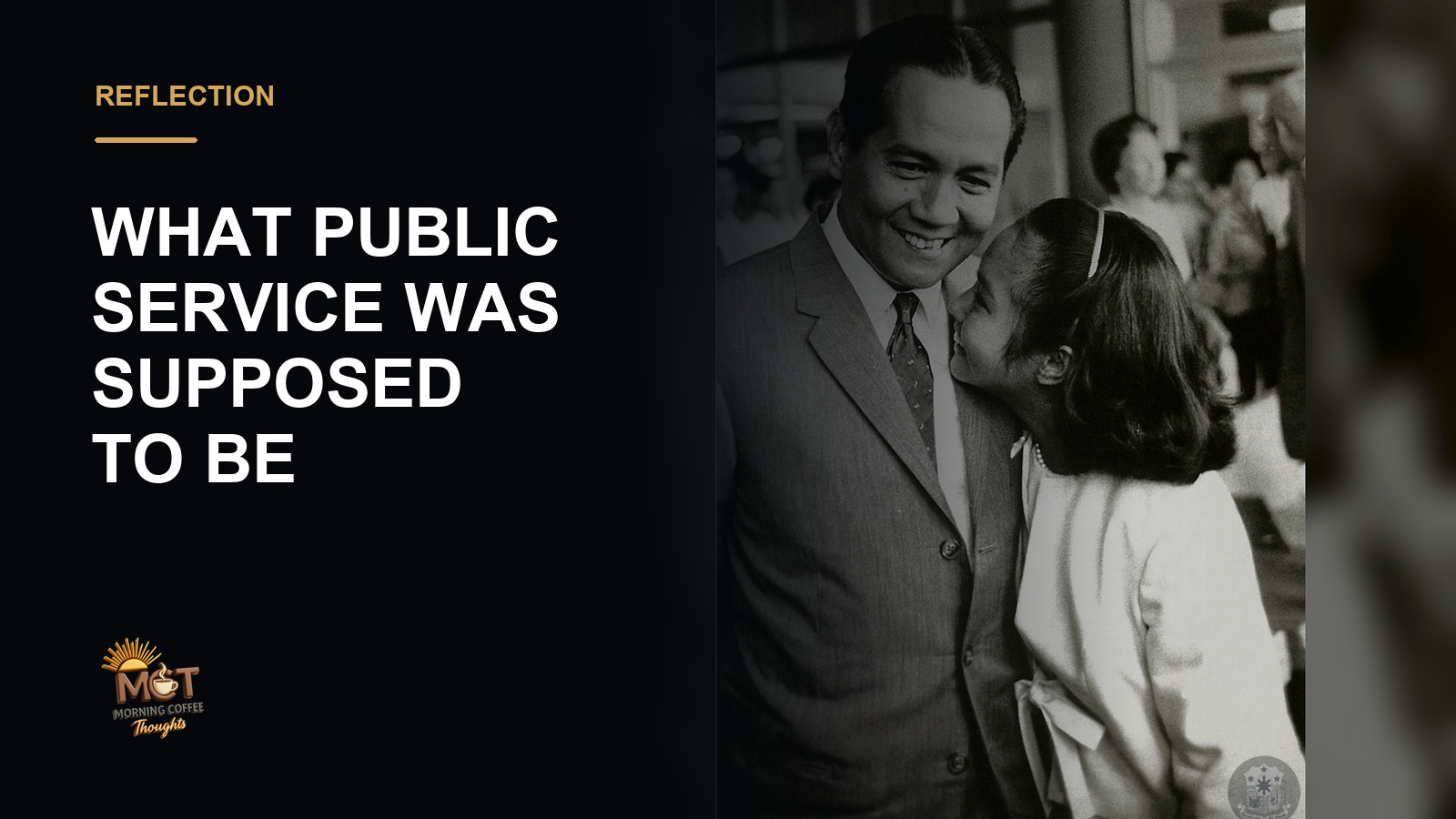
There is one piece of advice I heard years ago that made me reflect. Galing ito kay Diosdado Macapagal, para sa anak niyang si Gloria: respect the bureaucracy, respect the civil service. Nakalimutan ko na ito, actually. I only remembered it recently, and hearing it again made me think about what respecting the bureaucracy really means.
THE LINE I REMEMBERED
I finally found the interview I had been trying to remember. Tina Monzon-Palma interviewed Gloria Macapagal-Arroyo for the ANC Independence Series in 2019. When Arroyo was asked about her leadership style, she said, “I respect the bureaucracy. My father always told me to respect the civil service.” The advice also appears in an official record. Career Executive Service Board Resolution No. 619 quotes Arroyo recalling her father’s words: “respect the bureaucracy, respect the civil service.”
My memory had compressed the two ideas into one. I remembered Diosdado telling Gloria to respect the bureaucracy. I also remembered the advice as something he gave her when she was about to enter government service. The record supports the words, although it does not establish the precise moment when Diosdado gave the advice. I want to be honest about that because the reflection is mine, while the wording and sequence belong to history.
Gloria moved from academe into government in the late 1980s. She became an assistant secretary at the Department of Trade and Industry during the Aquino administration. That was why the advice initially troubled me. The bureaucracy she entered carried the damage of political control, patronage, and corruption, while honest career employees kept government running through changes in leadership.
When I first heard “respect the bureaucracy,” I understood it as an instruction to adjust to the machine: learn how things are done and avoid disturbing the people who have become comfortable with the institution’s failures. Perhaps that reading was unfair to Diosdado. We have Gloria’s account of his words, without his full explanation.
THE DISTINCTION I MISSED
Looking for the interview forced me to hear the complete thought. Arroyo spoke about respecting the bureaucracy, then recalled her father telling her to respect the civil service. The bureaucracy is the machinery of government: offices, procedures, records, rules, chains of command, institutional habits, and the people working within them. The civil service is also a constitutional system designed to protect merit, fitness, professionalism, continuity, and political neutrality.
The Constitution says civil-service appointments should be based on merit and fitness. It protects employees from removal or suspension without a cause provided by law and prohibits civil servants from engaging in partisan election activity. Republic Act No. 6713 requires public officials and employees to place public interest above personal interest and loyalty to country above loyalty to any person or political party. A government employee’s duty is owed to the public and the law.
A career civil servant may serve under several presidents, secretaries, mayors, or agency heads. Political officials come and go, while career employees preserve records, technical knowledge, and the memory of what happened the last time somebody arrived promising to reinvent everything. There is wisdom in respecting those people because government did not begin on the day a new boss took an oath. An honest career employee may know which program works, which shortcut violates the law, which supplier keeps appearing after elections, and which impressive announcement will collapse before it reaches the barangay. Ignoring that knowledge can destroy a reform before it begins.
Contempt can also be lazy. It is easy to curse “the bureaucracy” as though it were one corrupt person. That lets us avoid distinguishing among the clerk enforcing a law she did not write, the official who designed a senseless process, the fixer selling access, and the civil servant quietly refusing an illegal order. The distinction helps us locate the failure without excusing it.
Respect can mean listening before acting, protecting honest career workers from political retaliation, and learning why a rule exists before tearing it down for being inconvenient. Respect also has a limit. Institutional memory can preserve competence, concealment, cowardice, and excuses polished by years of repetition.
“Ganyan talaga dito” is also institutional memory.
IF I WORKED IN GOVERNMENT
I have always wondered what would happen if I worked in government. I imagine seeing corruption, small and big. I imagine knowing who asks for favors, who manipulates documents, and who closes their eyes because they need the salary or because ilang taon na lang, retirement na. I understand why some people stay quiet. It is easy to demand courage when our pension, health benefits, children, and monthly bills are not on the line.
I also know myself. I probably would not survive government employment because I would make it my mission to expose every single one of those corrupt motherfuckers. Maybe they would get rid of me before I even learned where the forms were kept. This is why I admire people who would rather quit and keep their integrity than participate in the corruption game everyone expects them to play once they become part of the team. The harder question is what happens to the clean person who decides to stay.
A person can enter government determined never to steal, lie, or sign anything illegal. Once corruption surrounds that employee from above, beside, and below, honesty can make the person the odd one out. The pressure may begin quietly: invitations stop, information is withheld, and performance evaluations change. Co-workers tell the boss that the honest employee is difficult, disloyal, arrogant, or impossible to work with. After enough repetition, integrity begins to appear in the office record as a personality problem.
The employee may be transferred, denied promotion, left without meaningful work, or surrounded until resignation feels like the only escape. Some stay and resist. Some learn to look away. Some accept one small compromise to survive, then discover that the first compromise can be used to demand the second. This is one way corruption recruits people: the group changes what is considered normal until the person objecting to wrongdoing appears to be the problem.
We know that whistleblowers can pay a high price. In a 2021 decision, the Supreme Court recognized that whistleblowers may suffer retaliation and ostracism. The Court also explained why their testimony can be essential: they may be the people who understand the inner workings of a corrupt operation.
The law offers protection to qualifying witnesses, yet legal protection does not erase every practical risk. The people exposed may still control assignments, records, money, promotions, and access to decision-makers. They may have allies willing to attack the whistleblower before anyone answers the evidence.
I feel sad when someone with the ability to reform an office quits because honest work has become impossible. Government loses whatever that person might have changed, and everyone left behind receives another warning about the price of refusing to cooperate. When an honest government employee resigns, I do not immediately ask why that person failed to stay and fight. I want to know what the institution did to the person who tried.
THE PROMISE WAS TESTED
The most uncomfortable part of the story came after Arroyo became president. On March 20, 2006, the Career Executive Service Board issued Resolution No. 619. The resolution recalled Arroyo’s promise to respect the bureaucracy and the civil service, then expressed grave concern over personnel actions that the board said violated civil-service laws, rules, and regulations. The board cited the transfer or reassignment of career executive officials without the required consent or consultation, qualified officers left floating, appointees occupying executive posts without the required eligibility, and political appointees placed in career positions.
These were the board’s formal findings and accusations in the resolution. They should be described accurately as such because the resolution was not a court judgment deciding the legality of every personnel action it discussed. Still, the document presents a test that every administration should face. A promise to respect professional civil servants has meaning only when they invoke rules that inconvenience people in power.
A leader may praise merit in a speech and later make decisions that career officials believe weaken it. An institution may celebrate professionalism while rewarding proximity to political authority. The board responsible for the Career Executive Service used Arroyo’s own remembered words when it accused her administration of disrespecting the system she had promised to honor. I cannot read the promise without reading that complaint.
WHAT I HEAR NOW
I understand the advice differently today, although I remain wary of it. Respect for the civil service can require defending professional standards against political officials who control appointments, budgets, assignments, and promotions. It can mean respecting the clerk enough to avoid asking for a shortcut, respecting the career officer enough to avoid demanding personal loyalty, and respecting the citizen enough to avoid hiding incompetence behind procedure. The public is owed respect first. Every seal, title, plantilla item, and presidential appointment comes after that.
Someone entering government should learn the institution, listen to the people who keep it running, and protect those who have survived without selling their judgment. That person should also examine every habit defended only by seniority, fear, or the sentence, “That is how we have always done it.” Respect should never require silence. It should never turn hierarchy into morality or longevity into innocence.
Perhaps Diosdado understood that distinction. I will not invent an explanation he did not leave us. The advice I would carry is narrower and clearer: respect the honest civil servants, their experience, and the rules that protect merit, neutrality, records, and lawful process. When bureaucracy protects corruption, humiliates citizens, rewards patrons, or punishes the employee who speaks, it is no longer owed polite silence. Sometimes fighting the bureaucracy is the only way left to respect what public service was supposed to be.
SOURCES
- ANC, ANC Independence Series: Speaker Gloria Macapagal-Arroyo, June 17, 2019https://www.youtube.com/watch?v=_MeBYYqGcQk&t=1205s
- Career Executive Service Board, Resolution No. 619, March 20, 2006https://www.cesboard.gov.ph/2018/Public%20Documents/Resolutions/2006/619.pdf
- Senate of the Philippines, profile of Gloria Macapagal-Arroyohttps://legacy.senate.gov.ph/senators/former_senators/gloria_arroyo.htm
- 1987 Constitution of the Republic of the Philippines, Article IX-Bhttps://lawphil.net/consti/cons1987.html
- Republic Act No. 6713, Code of Conduct and Ethical Standards for Public Officials and Employeeshttps://lawphil.net/statutes/repacts/ra1989/ra_6713_1989.html
- Supreme Court of the Philippines, Department of Justice v. Nuqui, G.R. No. 237521, November 10, 2021https://lawphil.net/judjuris/juri2021/nov2021/gr_237521_2021.html
- Republic Act No. 6981, Witness Protection, Security and Benefit Acthttps://lawphil.net/statutes/repacts/ra1991/ra_6981_1991.html
- Prijono Tjiptoherijanto, Civil Service Reform in the Philippines: Building Strong Governancehttps://www.lpem.org/repec/lpe/papers/201202.pdf